Friday, August 24, 2012

Why Books Can Be Windows, Not Walls

Recently I stumbled across this article that spotlights the continued dearth of multicultural titles in the world of children's literature. As I said when I posted a link on Facebook, I wish this was a surprise to me, but it sadly is not. I'm sure that others who spend their time immersed in books for children probably aren't shocked either. Groups like the Cooperative Children's Book Center at UW-Madison, mentioned in the article, scour the record of titles published each year, tracking the number of books by and about people of color that are released. (If you want some fascinating reading, check out the CCBC's archives, where director KT Horning and her incredible staff post their yearly essays on the state of publishing.) What's really startling about the CCBC research is that the rate of kid's books by people of color published has never exceeded 5%.

Let that sink in a moment.

Of all the books published in any given year, 95% are by white authors.


True, there are books about multicultural characters being written by white authors - after all, I'm a white mama writing about race. But still, the rate of multicultural titles is very, very low. What's so sad about that is that it flies in the face of what's really happening in our country. Our society is becoming increasingly diverse; if you don't believe me on that fact, take a look at this detailed analysis of census data and the implications it carries for diversity in the population of US children. In researching a paper I wrote last fall on children's literature for multiracial families, I found multiple sources indicating that the lack of representation of their own reality can have a major impact on the identity formation of young children.

And really, is it any wonder? If you never saw yourself reflected in the world around you, wouldn't you grow to be a little self-doubting?


So if the world is becoming more diverse, then why aren't books reflecting that diversity? The short answer is white privilege; the long answer, as with so many things related to race, is more complicated. Publishers often argue that multicultural books don't sell. Booksellers and librarians may use the same argument. "We buy them and they don't circulate," as a school librarian in one of my classes put it. And in the days of ever-shrinking budgets, who can afford to buy what people don't want to read?

But if fewer titles are published, then fewer titles are reviewed by critics and even fewer are purchased by bookstores and libraries. The smaller the pool to draw from the more "other" these books seem. And in a world where everyone gravitates toward what they believe is HOT HOT HOT, quiet titles are going to be overlooked. I mean, I think The Hunger Games is just fantastically written, but is that really why everyone and their brother has read it? Or was it more about the drive to not be left out of the loop?


And then there's the fact that so many of the multicultural titles that make it into print are "issues" books. You know what I mean here, the ones that are about accepting others no matter how different, or are about standing up in the face of discrimination. Don't get me wrong, I think those titles are hugely important, and all our kids need to hear these messages, regardless of their skin tone. But honestly, kids get sick of being lectured to, and if they feel that a title is going to hit them over the head with a big ol' lesson, well, they're going to tune out. Trust me. What is immensely more effective are what I call "inclusion" titles, where the diversity of the characters is secondary to the plot or theme of the story. You know, the book that is such a great read that you're not constantly sidelined by the heavy-handed message the author is trying to get through.

So what's a parent or industry professional to do here? First off I think we all need to quit hiding behind excuses or being timid about this issue. Booksellers and librarians, take some time to examine your motives. I know we all think of ourselves as impartial, but the truth is we carry plenty of biases. Maybe you don't buy a certain author's new release because his/her older titles never circulated. Fair enough - but what's the buzz behind the new book? Check out the kidlitosphere, read some review journals, talk to other professionals. More importantly, read it yourself - and if you love it, sell the hell out of it. I'm just going to say it: multicultural books may require a bigger boost than other titles. I mean, you know the new Mo Willems is going to fly out the door, but something like Big Red Lollipop might require more of a boost from you. Integrate these titles into booktalks, feature them in displays, handsell them to customers or patrons, include them on booklists. The more you talk the more your message will get out there, and I promise you that the checkouts or purchases will follow. Make it your mission to get that title into the hands of a child who needs it, and don't give up!



Parents, if you feel as strongly as I do about having your kids represented in the literature they read, make your voice heard. You don't have to be obnoxious about it, but take some time to talk to your bookstore buyer or youth services librarian about what's on the shelves. Maybe they never realized that there are interested parties out there, and they'll make more of an effort to look for quality titles if they know you want them. If you are frequent library users like us, or are lucky enough to shop at an indie bookstore, I guarantee that your needs are hugely important to the powers that be. If you're buying at a chain, take some time to email their corporate office about your concerns. Above all, vote with your dollars and your checkouts. Libraries and bookstores are strapped for cash, and they can't stock books that don't show turnaround. It does very little good to entreat a store to stock more diverse selections if you're not going to follow through by buying them. So when you see more color popping up on the shelves, support the efforts of that store or library. Tell your friends, other parents, teachers or babysitters. And please try to track down the person who made that diversity possible, and thank them for their efforts. We all want to feel appreciated, and this will go a long, long way to continuing the process.

Look, this is something I'm passionate about because I feel we owe it to our children to give them books that are mirrors AND windows, that show them not only the reality they already know but one they may not otherwise see. In a world where image is everything, we really can make a difference in the lives of our young people. Start a movement that doesn't end until every child recognizes themselves in a book they read - can you imagine how different that might make our world??

Wednesday, August 22, 2012

Wayback Wednesday - Peter's Chair (1967)

Some authors become so identified with a particular work that it sometimes is difficult to remember that they've done other titles as well. Take Maurice Sendak for example - author of a slew of amazing books, illustrator of tons more, and yet to many people he's remembered for just one book. An incredible book, to be sure, but not the be-all end-all of his literary life, no way.

Ezra Jack Keats is another artist that seems to have a similar association. To most people he's probably best known as the author and illustrator of The Snowy Day. And don't get me wrong, it's gorgeous and absolutely belongs at the tippy-top of every single recommended books list. It's one of our all-time favorite reads, so much so that a good friend gave Sprout this little cutie for his third birthday. But it's by no means the outer limit of Keats's talents, and it isn't even the only adventure to feature Peter, Snowy Day's precocious wanderer.

This week's Wayback Wednesday pick is Peter's Chair, the third Peter title (after The Snowy Day and Whistle for Willie - which we also love). We first read Peter's Chair together about a year after Sprout joined our family, and for many months one or the other of these three Peter books was featured in just about every night's reading rotation. Not only are these books visually appealing - Keats did, after all, win a Caldecott for The Snowy Day - but they are full of the stuff children love: dragging sticks in the snow, building towers, exploring the neighborhood. Keats's kids are real children, not wooden creations, and you can feel their boundless energy sparking off every page.


In Peter's Chair, Keats gives our hero a dilemma to face that many kids will relate to: feeling displaced after the arrival of a younger sibling. Peter's more than a little put out to discover that all his old furniture is being painted pink for his baby sister. First the cradle, then the high chair and crib, and next up is Peter's chair. But Peter's not going to let the chair fall victim to this lunacy, so he decides to run away, taking only the important things (his dog, some cookies and his toy crocodile - and the chair, of course). Is that not just the epitome of childhood decision-making? I love Peter's prioritizing! And naturally the running-away lasts until just about lunchtime. . . .

The story of the artist behind the stories is every bit as interesting as his work. Keats grew up very poor, during the Great Depression. Though his family was proud of him, they also worried that he'd never make a living as an artist. Fortunately Keats was a beneficiary of Roosevelt's New Deal policies, working as an artist through the WPA. This gave him his start as a painter, and he turned to children's books later in his career - some of his early work was illustrating the Danny Dunn books. Keats was not himself African American (he was Jewish, and changed his name to escape anti-Semitism), and some were surprised at his choice to introduce Black characters at a time when people of color were mostly relegated to the backgrounds of children's books, if they were even present at all. He was inspired to create Peter by a series of photos he saw in a magazine; those photos, Keats has said, caused him to wonder why he had never seen a Black boy as the main character in a children's book.

Peter's Chair, like the other marvelous books by Ezra Jack Keats, epitomize multiculturalism for me in that they are thoughtful, engaging stories in which race is not a central (or even secondary) theme. Instead the focus is on the nitty-gritty of childhood life: learning to whistle, running away, finding out that a snowball won't stay forever in your jacket pocket. Sometimes these are hard lessons, but in Keats's hands the learning is joyful, not jarring.

Tonight my son fell asleep with Peter in his arms, after we yet again read Peter's Chair. That, my friends, is the mark of good literature.

Wayback Wednesday verdict? Belongs on every child's shelf

Peter's Chair by Ezra Jack Keats, published by Penguin
All ages
Source: personal collection
Sample: "He saw his crib and muttered, 'My crib. It's painted pink too.' Not far away stood his old chair. 'They didn't paint that yet!' Peter shouted. / He picked it up and ran to his room."

Tuesday, August 21, 2012

Puffling Patrol!

Quick, tell me everything you know about baby puffins.

Yeah, that's what I thought. Your knowledge is probably as thin on the ground as mine. To be honest I had never given puffins much thought, aside from the fact that they are darn cute and I've enjoyed seeing them at the zoo.


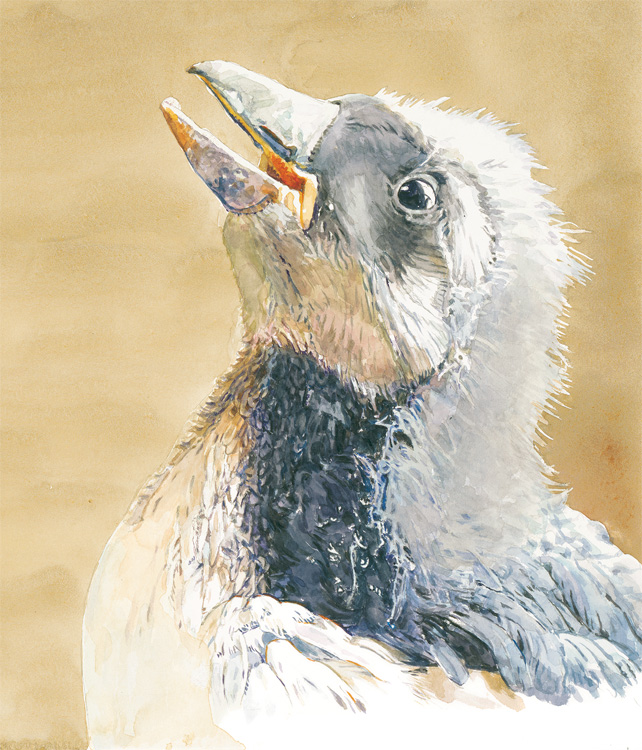
Then we were sent a review copy of the new book Puffling Patrol, out this month from authors Ted and Betsy Lewin. And suddenly I was learning a whole lot about these incredible birds, especially their youngsters, and the remote islands off the coast of Iceland where they make their homes.

Pufflings are baby puffins. They are cared for by their parents, and about this time every year they begin leaving their cliff-face homes to venture out into the sea. But a small percentage of pufflings raised on the island of Heimaey get disoriented and instead of heading for open water, end up landing on the streets of the villages nearby. Not yet strong enough to take off again, the birds might end up in serious trouble. But that's where the Puffling Patrol takes over, a group of children who are trained to seek out and rescue the fledgling birds, helping them make their way to the sea.


The Lewins are both Caldecott Honor winners, and at this point in their illustrious careers they could afford to phone it in a bit. Lucky for readers, they don't. The Lewins visited Heimaey in August of 2008, and the book shares their experiences learning about the pufflings and their habitat, and following two Puffling Patrol members. The result is a book as affecting as it is informative, one that brings readers up close and personal with the birds and with the children who rescue them. Ted's paintings and Betsy's field sketches bring the story to life, capturing the tension as the children search for any foundlings in the dark of night. Watching Erna and Dani release the pufflings they've found on the beach is an emotionally stirring moment in the narrative; children will be inspired to learn more about animal rescues, and perhaps to do what they can for the wildlife where they live.

The end of the book features fascinating facts about puffins, their homeland, and their current situation amid an ecosystem shift. Puffling Patrol is a natural choice for school and classroom libraries, but don't overlook titles like this for your home collection as well. Kids love learning about the world around them - Earth is a pretty amazing place, after all! - and titles that pair dramatic narratives with vivid paintings and sketches can satisfy their thirst for adventure every bit as well as a novel could.


Think you have what it takes to be part of the Puffling Patrol? Then you need to take part in a Puffling Hunt! This is a fun scavenger hunt sponsored by the publisher of Puffling Patrol, where you can visit kidlit blogs, including Sprout's Bookshelf, to locate pictures of pufflings they've posted during the month of August. Full details coming soon to the Lee & Low blog, so check there for the scoop!

Puffling Patrol by Ted and Betsy Lewin, published by Lee & Low
Ages 6-9
Source: review copy received from the publisher (this review represents my true and unbiased opinion of the book)
Sample: "The children gently hold their precious charges. It is time to release the pufflings and send them out to sea. / 'Good luck,' whispers Erna. 'Be careful, little one.'"
Recommended

Friday, August 17, 2012

Chapter Book Review - Summer of the Gypsy Moths by Sara Pennypacker

The name Sara Pennypacker is probably most familiar for her early chapter book series Clementine. In these books, our high-spirited heroine seems always to land herself in the most outrageous kinds of trouble (cutting her best friend's hair off, for instance, and then coloring it back in with permanent marker). Clementine defines the word irrepressible, and it's all her poor parents can do to keep up with her. She's a lot of outrageous fun, a Ramona Quimby for the post-millenial set.


But if you're looking for a Clementine-esque character in Pennypacker's new novel, Summer of the Gypsy Moths, you may be a bit disappointed. While the author gives us two very strong girls in the form of Stella and Angel, and while there are some funny moments, Clementine these ladies definitely are not.

In fact Stella, the narrator, is really more like a little adult than she is a girl of twelve. Most of that is due to Stella's familiarity with loss. She's had more than her fair share of it already, from the father she never knew to the grandmother who's now passed on. And Stella's mother - let's just say she's flighty at best, but far closer to neglectful. In fact, that's how Stella came to be living with her Great-aunt Louise, at the Linger Longer Summer Cottages on Cape Cod. Louise is the caretaker of the cottages, and of Stella too, now that her mother's run off yet again. And Louise has taken in another child besides, the mysterious Angel, who wants Stella to keep her distance at all times. Angel seems always poised to run, which Stella can't quite understand, since she thinks living at the Cape is the closest thing to perfect she's ever known.

And then a giant rock crashes through the clear glass that surrounds Stella's fragile world, and suddenly everything is a huge mess. Stella's used to relying on herself - she does, after all, take care of everything possible since her mother is so "restless" - but this is all very different. She needs someone else, and surprisingly enough she finds that someone in Angel. Oh, Angel's resistent to the idea at first also, but the two girls are forced to pull together in order to survive, literally. And soon they are faced with the hard truth: like it or not, there's more that unites them than sharing a roof at Linger Longer.

I won't say more (though I'm itching to) because I don't want to give away everything. Suffice it to say that these two girls are some of the fiercest seen in kidlit since Gilly Hopkins. Just when you think that they're presented with truly insurmountable odds, they manage to pull through, by working together. And in that is the real lesson, that life is difficult and the deck is often stacked against us, so we need to find strength wherever we can. Even if that's in someone we always thought we couldn't stand. When Stella comes to realize that her mother isn't just scatter-brained, but really has some emotional issues, it's a hard moment for her and for us. And as we get to know Angel, find out more about her Portuguese heritage and see the pain that drives her deep inside her shell, we come to recognize her beauty also.

Stella and Angel are high-risk kids, no question. And Pennypacker doesn't shy away from revealing that to readers, letting us see the difficult bits a little at a time. Don't be fooled by the gauzy, wistful cover art - there are some really hard moments in this book, especially at the beginning. But that to me is the real test of great writing, that an author can blindside you with events you never anticipated and you still hang on for the whole wild ride. There are a ton of quietly moving scenes in this novel, scenes that make you think about the whole notion of family and trust, and ultimately to consider what bonds really hold us most deeply.

Pair this with books like Katherine Paterson's The Same Stuff as Stars or Patricia Reilly Giff's Pictures of Hollis Woods for more about foster kids in difficult situations. And I won't be at all surprised come Newbery time if this isn't at least on the short list - it's that fine of a novel.

Summer of the Gypsy Moths by Sara Pennypacker, published by Balzer + Bray
Ages 9-12
Source: Library
Sample: "I looked over the cottages. Here were five homes to prove myself on. Below, in our backyard, were Louise's blueberry bushes. My mother's blueberry bushes. Mine, too, now. I felt a good iron-bone, lead-blood heaviness settle me into the floorboards. I couldn't tell Angel any of this, either. / I turned. 'Because, this place?' I said instead. 'I'm not leaving it.'"
Highly recommended

Wednesday, August 15, 2012

Nonfiction Picture Book - Minette's Feast by Susanna Reich

So normally this would be Wayback Wednesday, but since today is Julia Child's 100th birthday, this seemed like a more appropriate post.

An especially fantastic trend in picture books of late are the fictionalized biographies of real-life individuals. Technically, since the stories are usually told from an alternate perspective and some details are invented, they aren't strictly nonfiction. And yet, because they have a basis in reality, these accounts can make an excellent bridge for young children from the fiction section to the nonfiction section, or vice versa. Kids who only want "true stories" could be induced by a whiff of whimsy to try something else, or those whose fare leans toward the imaginary might be convinced that real life can be just as engaging.


One of my favorite recent examples of this trend is Robbin Gourley's Bring Me Some Apples and I'll Make You A Pie. In a similar vein comes Susanna Reich's Minette's Feast, a peek into the life of Julia Child via her cat, Minette Mimosa McWilliams Child. Told through the perspective of this very blessed feline, Julia Child's early life in Paris and the beginnings of her culinary career are lovingly rendered and beautifully illustrated. Minette does in fact lead a charmed life, and she knows it - she came into the household thanks to Julia's belief that "(a) house without a cat is like life without sunshine!". Minette is famously finicky, and though she won't eat food out of a can, she's not entirely convinced by her mistress's delicious dishes either. Much better is a fresh bird, or maybe a mouse she's caught herself - now that's delightful. Still, Minette is Julia's constant companion as she undertakes the process of improving her cooking, first through self-study and then by enrolling at Le Cordon Bleu. (Minette polishes her own hunting skills in a similar fashion.)

This is a simply charming book, one that presents the story of Julia Child in a format that appeals to young chefs and cat lovers alike. The illustrations by Amy Bates are beyond fantastic, the kind of homey warmth you just want to linger over. For one thing, she captures the capriciousness of Minette perfectly - one minute resting quietly, then suddenly pounce! But Bates goes far beyond Minette's own actions to bring Julia's story to life as well. Her depictions of a younger Julia stirring, tasting, whisking, chopping fairly burst from the page, as the famous woman's boundless energy come through on every spread. A picture of a dinner party at the Child home is particularly spot-on: the all-but-salivating guests, including Child's husband Paul; the beaming Julia, bearing a fragrant turkey still steaming from the oven; and the ever-proud Minette, taking her place in the hostess's spot (it's only the way things should be, after all). Delectable!

Whether you're a fan of food or felines, Minette's Feast is a sure-fire hit. I'll be rooting for this one come award season - it's a gem that truly stands out on every bookshelf!

Minette's Feast by Susanna Reich, published by Abrams
Ages 7-12
Source: Library
Sample: "Sometimes the 'nice old fish lady' at the marketplace gave Julia luscious fish heads for Minette. Julia would cook them up in a pot. Perhaps she'd add a dollop of scrumptious 'chicken liver custard.' / Minette might even take a nibble. / But it seemed that mouse and bird were really much preferred."
Highly recommended

Bonus: an outstanding interview with illustrator Amy Bates from the blog Seven Impossible Things Before Breakfast