Showing posts with label adoption. Show all posts

Tuesday, February 17, 2015

Picture Book of the Day - Wolfie the Bunny by Ame Dyckman

I'm always on the lookout for picture books about adoption and transracial families. Sometimes that means digging below the obvious choices -- many of which are overly sentimental, to be totally honest -- and seeking out titles that might not be instantly recognizable as fitting the bill for us. Fortunately that search paid off with our most recent read, and Sprout's current favorite, Wolfie the Bunny.


To tell the truth, we've been looking forward to Wolfie the Bunny for quite some time, as we were huge fans of author Ame Dyckman's first book Boy + Bot, a can't-miss choice if your kiddos love robots. Also we already knew illustrator Zachariah Ohora from No Fits, Nilson, about a gorilla with a real penchant for temper tantrums (super fun). So any project with the combined talents of these two wunderkinds was automatically on our TBR list. And luckily, Wolfie the Bunny not only lived up to our expectations, it far exceeded them - I had no idea that Wolfie was going to be such a great choice for its themes about sibling relationships, adoption, and families that don't exactly match.

The real star of Wolfie the Bunny isn't the title character, but his big sister Dot. Dot and her family, a respectable rabbit clan, are stunned when a baby wolf ends up on their doorstep. Dot's parents are totally enchanted from the get-go, but Dot's not convinced. Hello, he's a WOLF! Yet try as she might, Dot can't get anyone to listen to her concerns. Then one day, there's a showdown - will Dot's worst fears be realized??!?

I won't spoil the ending for you, but let's just say that this buck-toothed wolf baby is not the big villain of the story. Though they are rabbit and wolf, the relationship between these two kiddos mirrors any sibling relationship that humans have ever had. (Of course, being that he's an only, that dynamic mostly went over Sprout's head, but Hubs and I found it all-too-familiar.) As with Boy + Bot, Dyckman was clearly in her element writing Wolfie, because the humor throughout is totally spot-on. And bless the editorial hand that matched up this author and illustrator - Ohora's style matches Dyckman's lively narrative like the two were born to create picture books. So many great touches here, particularly the character development of the lovably-bescowled Dot. (Confession: she's my super-fave.)

If you're looking for a sibling story with just a bit of bite, look no further than Wolfie the Bunny. This family may not match on the outside, but when it all comes down to it, they're perfectly paired!

Monday, November 10, 2014

30 Days of Diverse Picture Books - And Tango Makes Three by Justin Richardson and Peter Parnell

It's Day 10 of our 30 Days of Diverse Picture Books. I recently read a piece on the Diversity in YA blog about the intersection of banned books and diversity. It was very thought-provoking, and the research done by Malinda Lo, while informal, suggests that there does seem to be a tendency for diverse books to be challenged. I don't know what the answer is to overcome that, but I know one thing: stories like that make me want to read and share diverse books more than ever!


And I'm doing just that with tonight's pick, a fantastic picture book that seems always to end up on the challenge list: And Tango Makes Three by Justin Richardson and Peter Parnell. The story is based on that of Roy and Silo, two male penguins at the Central Park Zoo, who became a couple and thanks to the intervention of a zookeeper looking for a home for an egg, also became parents. The book is lovely and sweet, and a nice reassurance for kids with same-sex parents, even as it introduces other children to the idea in a nonthreatening fashion.

It's probably not hard to guess why the book is challenged, but it makes me very sad. I can't help but think of the message that gets sent to every LGBTQ child or family every time this book ends up on the challenged list. I'm proud to read Tango to Sprout -- especially proud because for him it's more about the fact that the parents are raising a baby than it is about the same-sex aspect. (Plus it's nice to have a solidly affirming adoption book, no matter who the parents are!) There's hope yet that the next generation of kiddos will be open, accepting and loving of all people, period.

Add And Tango Makes Three to your rotation simply because it's beautifully illustrated and perfectly told, and appreciate the fact that it makes everyone's world a little broader in the process.

And Tango Makes Three by Justin Richardson and Peter Parnell, published by Simon and Schuster

Sunday, December 15, 2013

Counting by 7s - Holly Goldberg Sloan

Wow! Can't believe the response to our 30 Days of Picture Books series. This is such a fun project for us to do, and it's nice to hear how it's affecting readers. For all those who've told us how much you enjoyed our picks, or mentioned that you're adding titles to your library list - thank you! And don't worry, we're already thinking about books to feature in next year's list. :)


In preparation for this year's 30 Days, Sprout and I read a ton of picture books, but that wasn't all I was reading. Today I'm featuring a title I read a while back, that touched me so much I couldn't help but share it with you. Holly Goldberg Sloan's Counting by 7s is being compared by many to R.J. Palacio's Wonder, and for good reason - both books feature narrators with compelling voices, unique challenges, and incredible people in their lives. But you can't really compare these books on any significant level, because each brings such individual strengths and impact to the reader. So let's acknowledge that one and move on, m'kay?

Counting by 7s tells the story of Willow Chance. Willow's a middle schooler who's best described as different from others she encounters. Willow's family is transracial, as Willow, who is multiracial, was adopted by "two of the whitest white people in the world (no exaggeration.)". But this isn't an adoption story. Willow's a genius, finishing the state proficiency exam so quickly that the school puts her into behavioral counseling. But this isn't a smart kid story. Willow's an oddball, not quite fitting in with anyone else at her middle school because of her talents and her interests. But this isn't an odd-girl-out story.

No, what defines this story is what happens to Willow in almost the first couple of pages: Willow's parents are killed in a car accident, and Willow, the adoptee/smart girl/oddball, is suddently and irrevocably on her own. Willow's got no support network to speak of, but from the emptiness around her, a web of family begins to appear. There's Mai Nguyen, a Vietnamese-Mexican girl who encounters Willow at the counselor's office and becomes a friend almost against her will. There's Pattie, Mai's mother, who sees Willow's plight and becomes convinced that foster care is no place for this tremendous child. There's Quang-ha, Mai's brother who disdains Willow but can't help but be impressed by her talents. And there's Dell Duke, the going-nowhere counselor who's treading water in his job until he becomes entangled with Willow and her story, and suddenly finds his whole life turned upside down.

It's tough for me to sum up in mere words just how much I loved this book. As with Wonder (here we go with the comparisons again), Counting by 7s is a watershed book, one whose story stays with you and that makes you think differently about assumptions you've previously held. Willow's a remarkable character in that her unswerving focus on her particular interests sweeps up everyone around her, a force that's changing their lives before they even realize it's happened. Though the narrative is propelled by a tragic event, this is by no means a sad book -- rather, it's a book about hope, about the goodness of human nature and how every minute can be a turning point. Willow's story speaks to the cynic in all of us, proving that even the most isolated and insular among us can be moved outside of our bubbles to be a force of change in another's life.

I highly recommend Counting by 7s for middle school readers, and for older readers as well, because I think even adults can learn a lot from this wise girl and her story, lessons about valuing yourself and about reaching out, believing that we can change the world. If you read one chapter book this year, make it Holly Goldberg Sloan's - and if you give one, make it this as well. You'll be glad on both counts.

Counting by 7s by Holly Goldberg Sloan, published by Dial Books for Young Readers
Ages 9-12 +
Source: Library
Sample: "I was taken to see an educational consultant that autumn and the woman did an evaluation. She sent my parents a letter.
I read it.
It said I was 'highly gifted.'
Are people 'lowly gifted'?
Or 'medium gifted'?
Or just 'gifted'? It's possible that all labels are curses. Unless they are on cleaning products.
Because in my opinion it's not really a great idea to see people as one thing.
Every person has lots of ingredients to make them into what is always a one-of-a-kind creation.
We are all imperfect genetic stews."
Highly recommended

Wednesday, May 8, 2013

Mom's Bookshelf - Instant Mom by Nia Vardalos

Three words for you: celebrity adoption book.

Gah!

Usually I run like crazy from this sort of thing. I mean, as adoptive parents, we've already had our share of inane comparisons to a certain megawatt celebrity couple (yes, because that's why we chose adoption to build our family - we thought it was trendy. Sheesh.)

But Nia Vardalos's book seemed promising. First, because I adore My Big Fat Greek Wedding (you know you do too). Second, because the blurb mentioned her struggles with fertility. And third, because she chose a route that is somewhat unusual for a celebrity - foster adoption.


And remarkably, Instant Mom does not disappoint. Sure, there's the requisite name-dropping, but it's done with a light touch - you get the sense that Vardalos isn't so much wanting her readers to be bowled over by her celebrity friends as she is proud of her very cool support network. And yes, she's got help in raising her daughter and keeping up her home. But really, like any one of us would pass up the chance to have someone  mop our kitchen floor? I sure wouldn't!

What works so well about this memoir is Vardalos's authenticity. She is unsparing in her honesty, about her feelings as she struggles to balance fame with her desire to be a mom, about her emotional ups and downs during fertility treatments, and then about her search for the right method to motherhood. She tells of a harrowing experience at the fertility clinic that finally convinced her and husband Ian Gomez to look into adoption. And she states forthrightly that though foster adoption worked for them, it isn't the strategy for everyone.

I also love her description of the early days with her daughter. Vardalos relates that, though she and her husband adored their little girl right away, it was clear that the feeling wasn't 100% mutual. Though their daughter wants to bond with them, she's also scared - so there's plenty of acting out and testing limits, all of which Vardalos and Gomez negotiate their way around with common sense and a healthy dose of humor (plus some help from Nia's mom). She describes the feeling of wanting it all to appear perfect, when in reality no one's getting much sleep and everyone is adjusting to this new arrangement, including the family dog. And she talks about that sensation of not being able to fully take a deep breath until their adoption is finalized -- the fear that something, anything, will interrupt the joy her family is experiencing at last.

So many adoption stories end with the placement. It's the perfect "happily ever after", isn't it? And we all want to think there's nothing but sunshine and Skittles after the social workers leave. But Vardalos dares to go further, and talk about what it's like to parent a hurt and fearful child, when you're not completely sure what you're doing -- and truly, who ever is? She's frank about the big issues, like sleep, which is a huge issue right at first. (She and Gomez switch off sleeping in their daughter's room, and inch by inch they ease her to a full night on her own. Sound familiar?) This is reality, and even though the parents are celebrities, they're living the experience we all know well, of bonding with a child whose story extends so far beyond the walls of your home, and whose presence in your life may be a dream come true, but isn't always 100% camera-ready.

This was a quick read, and a worthwhile one, not just because I became an instant mom myself when my son was handed over to me in Addis Ababa, but also because I know the feelings Vardalos describes. I've lived them, and they've been terrifying and glorious. There's fear here, and uncertainty, but delight and laughter too -- and at the end of the day, instant or not, that's what family truly is.

Instant Mom by Nia Vardalos, published by HarperCollins
Adult
Source: Library
Sample: "By the way, the only term I disagree with some on is 'adoptive mom.' Why the qualifying adjective? Why not just 'mom'? I've been introduced on talk shows as 'adoptive mom Nia Vardalos.' Um, once you've wiped a butt, you're a mom."
Recommended

Monday, April 22, 2013

Wild About You by Judy Sierra {The Children's Bookshelf}

It's been awhile since I wrote about any adoption-themed titles here. Although I used to spotlight these quite frequently, I haven't run across any lately that we just loved. That is, until we came across the newest effort by author Judy Sierra and illustrator Marc Brown, Wild About You. And this is one, my friends, that we truly are wild about!


The story is quite similar to their earlier effort, Wild About Books, in that it is set in a zoo that's populated by some quite inventive animals. This time around, it seems that everybody's having babies -- except for the tree kangaroo and a pair of pandas, who unfortunately seem to be lacking the little additions they are longing for. The pandas in fact are so upset that they are "black, white, and . . . BLUE." (A nice bit of punny humor for you there.)

Then a rescue truck pulls into the zoo, carrying a mysterious foundling egg. Of course the zookeeper asks all the birds if they can foster the little one, but everyone has some complaint. So the tree kangaroo steps right up to pouch-sit, and once the egg hatches, she's thrilled with her unexpected surprise. She's now the mommy to an adorable little penguin! Luckily the other animals pitch in to help out, supplying fresh fish and avian role models. Similarly, the pandas find themselves parenting a little kitten, and the zoo community rallies around them as well. The most terrific part is the final spread, where the entire menagerie gathers together -- those who have keen eyes will pick out other trans-species families in addition to the pandacat and the pengaroo.

We love this title for plenty of reasons: its subtle message (you don't have to "match" in order to be a family), its upbeat tone and positive take on adoption, and of course its infectious rhyme scheme. Brown has pulled out all the stops with these illustrations, utilizing geometric shapes, dots and bold primary colors to bring a warm, cheerful feel to this warm, cheerful story. Families who read this one will be strengthened in all kinds of ways, and foster or adoptive families in particular will find the positive message very reassuring.

This is a gentle treasure, perfect for introducing the topic of adoption in a classroom or home setting. And the next time your kiddos ask about a family that doesn't look alike, just reassure them that "to bring up a baby. . . it takes a whole zoo!".

Wild About You by Judy Sierra, published by Alfred A. Knopf
Ages 3-6
Source: Library
Sample: "So the puffins delivered fresh fish every day. / The flamingos invited her over to play. / And one happy day, she hopped her first hop -- A super-sensational pengaroo bop."
Highly recommended
----------------------------------------------------------------------------

This post is part of The Children’s Bookshelf, a weekly linky party with the goal of connecting parents with great books for their kids. Do you have a book review, literacy or book-related post that you think will be helpful for parents? If so, please add your link below.

NOTE: By linking up you are giving permission for any of the co-hosts to pin and/or feature a your photo on a future The Children’s Bookshelf post. Kindly link up to an individual post, not your blog’s homepage. The hosts reserve the right to delete any links to homepages, commercial links, repeat links or otherwise inappropriate links. Thank you for your understanding.

You can also follow The Children’s Bookshelf on Pinterest or visit TCB’s co-hosts: Sprout’s Bookshelf, What Do We Do All Day?, No Twiddle Twaddle, Smiling Like Sunshine, My Little Bookcase, The Picture Book ReviewMemeTales and Mouse Grows, Mouse Learns. You can find more details here.


Thursday, March 7, 2013

Of Missed Opportunities

Do you ever feel slightly let down by a book? Like maybe what you hoped it would be was just not completely realized? This is a feeling I recognize in myself more and more frequently. Maybe it's that I'm getting older (big birthday this year - keeping it in perspective). Or maybe it's just that I've reached the point where I've read so many knockout titles that when a book doesn't go deliver as much as it could, I feel a bit cheated.

I find this happening a lot now that I'm reading kidlit pretty much exclusively (with the exception of textbooks, of course). There are a ton of fantastic kid's books on the shelves in libraries and bookstores these days. Overall the quality really rivals anything I remember from my own childhood. That's especially true of multicultural kidlit, where phenomenal authors like Rita Williams Garcia and Grace Lin and Christopher Paul Curtis and Pam Munoz Ryan turn out consistently top-notch books where diversity is interwoven seamlessly into the storyline. And so when I find a book that just doesn't go quite far enough, I feel a little like it's been a wasted opportunity.


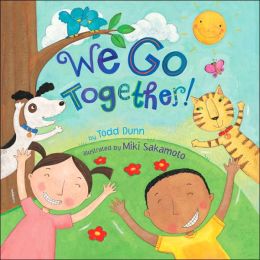
I found this to be the case with one book in particular lately. I really hesitated writing about this book, because I wanted to like it, but just couldn't 100% embrace it, and I couldn't figure out why. The book in question is We Go Together by Todd Dunn, illustrated by Miki Sakamoto. Sprout nabbed this one on a recent library visit and I suspect that's mostly because of the cover - bright sunshine, animals and birds, a white-skinned girl and brown-skinned boy with huge smiles. What's not to like?

The text and illustrations are perfectly suited, as Sakamoto's cheerful figures and palette match Dunn's bounce rhymes very well. There's no real narrative here, just a depiction of things that go very well together - like moon and night, for instance, or string and kite. Each spread has a sly joke or whimsical touch that works quite nicely. Sometimes there's a double meaning included, like "We go together like elephant and trunk", which shows a chipper purple elephant bearing a small chest on his back. Cute, in all, and upbeat, which always makes for a nice addition to any reading session.

So what was it that bothered me? It took a while to figure out, but I finally narrowed it down to the last spread. Throughout the book we have a reasonable attempt to depict diversity - most of the spreads with more than one human character has multiple ethnicities represented. But on the last page, the text reads: "We go together, that's what we do. We go together because you love me and I love you!". Sweet, but here's where the missed opportunity comes in for me: the mother and daughter depicted on the page look almost exactly identical: white skin, rosy cheeks, brown hair turned up at the ends.

For me this is a misstep - the whole book is about things that go together, so why not use this spread as a chance to emphasize that things don't have to look alike to go together? This would have been a great opportunity to depict a transracial family, or at the very least two people who looked dissimilar. Maybe mom could have red curly hair and be hugging a boy with straight black hair? Would that be too much to ask? Couldn't the creators of the book have used this as a way to drive home the point to kids that belonging isn't about looking just exactly the same, but rather belonging has to do with the feelings mentioned in the page text?

Don't get me wrong, I have nothing against this particular book, and it's not one that I would prevent Sprout from reading. It's cute enough, the illustrations are well-done, and it's something the author and illustrator should be very proud of creating. I also don't think that every single kids' book should cater to transracial families -- because come on, where's the reality in that? But I couldn't help but wonder how much stronger this little slice of kidlit could have been with just a tweak in the approach.

And here's where the missed opportunity comes in: because changing our environment and embracing more diversity is as simple as the decision to show the world families don't all have to match. The message of the title could have been that much more impactful, for my mind, with just a shift in this one editorial choice. These are the kinds of things that don't escape my notice, now that I'm parenting transracially. And you can be sure that if I'm noticing it, Sprout and all the other kids his age aren't letting these messages, however slight, pass them by. This kind of small choice strengthens the argument for kids on the playground who ask us questions like, "Are you his mom? Why don't you look like him?"

Listen, there are a host of reasons that parents and kids don't resemble one another, and adoption certainly isn't the only one. So let's be brave, kidlit creators: let's teach our kids that matching is more than just having the same hair color or wearing the same outfit. Let's throw them a curve and show them a daddy in a wheelchair or a mama and baby with different skin tones. Let's trust that kids can handle the challenge of seeing a parent and child for what they are, even when they don't look the same. Because that's an opportunity -- for thought, discussion, inclusion -- that no one should miss.

Wednesday, February 6, 2013

Chapter Book Review - Mimi by John Newman

I'm incredibly proud of our adoption. I'm glad every single day that we chose that method to grow our family. But I have to say when we look at our son, we don't immediately think "adopted", even though he doesn't look a thing like us. He's just our Sprout, our funny and messy and creative and smart and stubborn and loving little dude. Good and bad, he's our kid, and while adoption is part of our story as a family, it isn't our whole story.


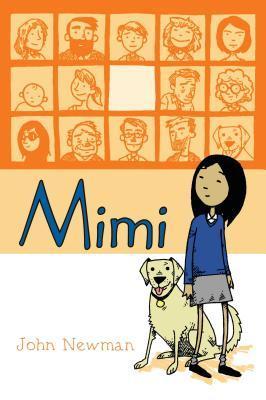
And that's why I was thrilled to run across the middle grade novel Mimi by John Newman. In this book, which takes place in the UK, the title character Mimi is adopted -- but that part of her story comes secondary to the fact that Mimi's dealing with some pretty tremendous changes in her home life. Oh, Mimi mentions her ethnicity right away, in an offhand way: her grandad's teaching her chess because she's Chinese and he thinks the Chinese invented chess. (In fact chess is thought to have originated in India, which Mimi fills us in on later.) But other than that there's not much mentioned about how Mimi's family came together, until it becomes important to the rest of her story.

When the book opens, it's been 149 days since Mimi's mum passed away, and things are pretty much falling apart at her house. Her dad's just about catatonic, her brother Conor just wants to bang away on his drums with his door closed and her sister Sally has taken up with a bunch of Goths. Mimi's doing her best to stay together but it's hard when there's no one to wash her school uniform or check her homework. Before long it's clear that the family is unraveling. Outsiders start to notice first: the dentist finds cavities, the neighbors complain about noise, the sub calls out Mimi's missing homework. And then it all gets really crazy, for Mimi and her siblings, who are just trying to fill the hole that Mum left behind.

I won't give away the ending, but suffice to say when a bully uses an aspect of Mimi's family life as a weapon, things come to an emotional breaking point. Newman's novel is honest and true, a real reflection of what grief and love look and feel like to a young girl. And while he sprinkles the plot with elements that relate in some ways to her history and their family composition, Newman never uses "adoption" or "transracial family" as the easy conflict. Instead he builds a story that works on multiple levels with a complexity that's beyond the average middle grade fare. Mimi mourns her mother, yes, but she also mourns the death of her family life, and the shift in how she relates to everyone, especially her father. What Mimi's facing is all wrapped up in relationships, which is so reflective of how we all live as families, isn't it?

Though a few of its more British references may be a challenge for some kids, I think Mimi is ultimately a story with which many young readers can connect. It's sad but funny, honest but ordinary all at once. Certainly kids who live in transracial families will respond to a story that isn't all about race, but rather about loss and loneliness, and how families can pull together to overcome the isolation that these emotions produce. And best of all is Mimi's clear voice, that shines like the brightest star throughout, making her a character you'll love from the very first bit.

Mimi by John Newman, published by Candlewick Press
Ages 9-12
Source: Library
Sample: "I used to find it hard to sleep with all the noise in our house. But you can get used to anything, and after a few words with Socky my eyes begin to close and my thumb slips into my mouth. 'Good night, Socky,' I tell my sock puppet, and he nods and says, 'Good night, you.' And then I slip him off my hand and tuck him under my pillow."
Recommended

Wednesday, January 9, 2013

Nonfiction Picture Book - Who's in My Family? by Robie H. Harris

We're in a phase right now around our house that is simultaneously the most entertaining and the most annoying one ever -- the "why" phase. I thought we'd been through this once before, and we had, but this new incarnation seems to be a deeper and more questioning one. Now instead of "why is the car wet?" it's more "why does it rain?". Everything is more philosophical. And it's great, if a bit frustrating when the question is something like "why are pancakes made out of eggs and milk and flour and salt?" (an honest-to-goodness query from last night's dinner).


So a quick flip through today's pick, Who's In My Family? by Robie H. Harris, told me this one would be just the thing for Sprout's current quizzical turn. Harris's goal with this and her other titles, including books on bodies, birth and health, is to present information in a clear and age-appropriate manner. And clarity is certainly the watchword here: Harris examines all the facets of what makes up a family, as well as the various aspects that different family members may either share or that may differ from person to person.

There's a lot here to recommend it as an addition for home libraries and classrooms alike. The prose is concise and straightforward, easy for kids to understand, which parents and teachers will appreciate. While the dialogue between the two main characters, Nellie and Gus, is a little stilted, the general upbeat tone works well with the pictures. Nadine Bernard Westcott did the illustrations, and they are charming, lively and fun, with lots of small details that make the spreads visually appealing. A whole chunk of the book centers around a trip to the zoo, so there are even family groups among animals shown here, reinforcing the overall message of Harris's text.

A big plus for us is the diversity - transracial families are featured prominently, as are same-sex parents, extended family members, older parents, and characters with disabilities. Differences are discussed in an open manner, and I appreciate Harris's no-nonsense approach to matters like varying skin colors within a family unit. This is great not only for kids whose families don't "match", like ours, but even more critical for families who do match, so all children can see that the bonds that unite family members go far beyond similarities in hair or skin color.

When you're looking to tackle the big topics with your kiddo, books like Who's In My Family? are exactly what you want on hand. And maybe a few adults should read it too -- you know, to remind us that "Most of all, and most of the time, and no matter what -- children and grown-ups and their families really do love one another!".

Who's In My Family? by Robie H. Harris, published by Candlewick Press
Ages 3-9
Source: Library
Sample: "Parents, sisters, brothers, grandparents, cousins, aunts, and uncles can all be part of a child's family. Often, good friends or a pet can be part of a child's family too."
Highly recommended

Thursday, September 6, 2012

Picture Book Review - My Family is Forever by Nancy Carlson

As a bookseller, one of the titles I remember seeing come across my counter with particular frequency was Nancy Carlson's I Like Me!. There's something about this title - its bright pink cover, and that exuberantly happy pig dressed in a tutu-esque princess dress that just jumps right out at you. Whenever someone asked for something to help bolster a child's self-esteem, this was the first title that popped into my head, and I can't be alone because this one's got real staying power. Published in the late 1980s, I Like Me! remains popular - a quick check of our library catalog as I'm typing this post reveals that our copies are all checked out.


In a similar vein, Carlson's picture book My Family is Forever aims to bolster the self-esteem and identity of children who have been adopted. Told from the point of view of a young Asian girl (who I'm guessing is Korean, based on the author's note), the book opens up the topic of transracial families right away. The narrator's friend Jeffrey "has his mom's red hair and his dad's big ears", while she herself looks "just like. . . me! (And I'm pretty cute.)". She explains that this is because her family was formed by adoption - I appreciate that this is dealt with matter-of-factly, and that adoption is discussed as one of many ways families are formed.

Our heroine goes on to discuss all the ways she's similar to her adoptive parents, in their interests and talents and ways they enjoy spending their time. But she also wonders about her birth parents. Carlson deals with this head-on, as the girl wonders if she favors certain members of her birth family in certain ways. While it's clear that she has a connection to her past, one that her parents have discussed and which she is encouraged to embrace, she's also decidedly an important member of her adoptive family. A spread depicting a holiday with the extended family shows plenty of diversity in  hair and skin colors, as well as ages. Everyone is part of this group, it's clear, and the bonds that tie the family together are truly forever.

Striking a careful balance, Carlson honors the protagonist's first family while finding lots of ways to celebrate the fact that the girl now has a forever family that clearly adores her. My Family is Forever is a cheerful, upbeat discussion-starter that adoptive families will be glad to share with even the youngest child. An excellent choice for families of all sorts!

My Family is Forever by Nancy Carlson, published by Viking
Ages 3-8
Source: Library
Sample: "Being a family means helping each other out. / We love each other in good times, and we love each other even when things don't go quite right."
Recommended

Tuesday, August 7, 2012

Library Find - Angels Watching Over Me by Julia Durango

We're getting to that stage in Sprout's life where questions are starting to emerge. Questions about people in his friend's lives who aren't in his ("why don't I have a Papa?") or about significant relationships that he doesn't remember. There are people who were crucial in Sprout's life before us that are now gone, and some in our lives, like my own father, who passed on before Sprout was born. And as these questions arise so too do opportunities to discuss these important people, how much they meant to us and how we wish, deeply and dearly wish, that Sprout could have met them.

We believe that they are angels looking down on him, on all of us. And we tell him this, but that can raise even more questions in his mind.


And so to stumble on the book Angels Watching Over Me by Julia Durango felt especially providential. The narrative is an adaptation of the African American spiritual "All Night, All Day" (Durango gives lyrics for one of the more common versions of it in her author's note). She has expanded the verses, building imagery of a young African American boy who is first playing in the sunshine, then flying through the air as he chases his kite. Joining the boy are various creatures - gorgeous birds with multi-colored wings, squirrels and insects in the leaves of a tree, deer drinking from a stream below. It's a playful yet comforting experience, and most importantly what becomes clear is that the boy is never really alone. And as the chorus is repeated, a circle of multicultural angels surrounds him, singing the refrain "All night, all day, angels watching over me."

Elisa Kleven provides the illustrations for Durango's words. Kleven's art provides the ideal backdrop to this gently soothing story. The colors are rich and yet not overpowering, and she blends a collage of texture and pattern that adds subtle depths to each spread. Best of all we like the whimsical touches -- a flying elephant, a sleeping donkey and cat curled up together, an owl peeking out from a hole in a tree trunk. With each page you are pulled into the words and at the same time drawn further out into the heavens, until at last we see the globe with angels of all colors encircling it. Peaceful and comforting.

At some point all parents end up discussing loss with their children. For those of us parenting through adoption, the topic might come up sooner and might hit a little closer to home, but it's still the same process all children eventually go through. No matter how you decide to approach the subject, I believe that well-written books can be a tool to help children deal with their feelings. For us, we have given Sprout the image of his loved ones looking down on him from above, and Durago's book helped him understand how these individuals can always be with him even though he cannot see them. It's how I like to envision the special people that I've lost, and I hope this will be the comfort Sprout needs in this moment, as he begins to understand loss. In any case, it's been another way we can retell his story, experiencing it together and drawing us closer as a family.

Angels Watching Over Me, adapted by Julia Durango, published by Simon and Schuster
All ages
Source: Library
Sample: "Grass says rest, I curl up snug. Dusk surrounds me like a hug. / Dusk says sleep, I close my eyes. Moon is full and on the rise."
Recommended

Wednesday, February 8, 2012

YA Review - How to Save a Life by Sara Zarr

Teen fiction is not what it used to be. There's a lot been said in recent months about the darkness of it, about how vampires and werewolves and paranormal romance are going to be the undoing of modern youth (which I highly doubt - if anything, it's getting them reading, right?). But what I think is most significant is that authors who write for teens are willing to explore new topics and themes. Yes, some of these lead to dark places, but others just examine the messy business that is real life, which so rarely comes wrapped up with a cutesy little bow. (Maureen Johnson says it better here than I possibly could.)

Take Sara Zarr, for instance. Zarr writes realistic contemporary fiction for teens - in other words, no time traveling detectives here. And what she writes are novels that peel back the layers, one by one, that construct the experience of teens in this reality, right now. These are kids who face difficult problems, many of which are brought on by forces outside their control, just like kids always have, but who do so in a culture that is often frantic and always changing. You know what I mean.


In How to Save a Life, Zarr brings us a whole slew of issues in the form of Jill, her mother Robin, and Mandy, a pregnant teenager whose baby Robin hopes to adopt. Jill's bitter, and angry, not about the baby so much as she is about the sudden death of her father in a car accident almost a year ago. She's dealt with her grief by building walls around herself, pushing away anyone and everyone who cares, and not letting anyone new inside her circle. And here comes Mandy, bursting with life and new possibilities, but with secrets and pain of her own. Mandy knows Jill doesn't like her, but she's so grateful to be in a safe place, a real home, not the cobbled-together life she's lived with her mother's rotating boyfriends. OK, so maybe Mandy has misrepresented herself a teeny bit, but it's for a good reason, right?

And then the carefully constructed facade that each character has made for herself begins to crumble. Mandy's never had someone care for her like Robin does, and she's not sure she's ready to give that up -- or her baby, for that matter. Jill thinks she knows the role everyone in her life has to play, and it's all structured. But then an unexpected encounter in the parking lot leads to a new friend that Jill just can't shake, and a growing realization that the emotions she's kept bottled up won't stay there forever. Both girls struggle to find their footing on this shaky new territory, and to reexamine what they thought they knew about themselves at the most elemental core of their being.

Zarr's writing is balanced and fluid, her gaze unflinching as she peers into the most secret corners of her characters' lives. No one is wholly good or entirely bad, and for that I applaud her -- if you're looking for stereotypes, you won't find any here. Most interesting of all, she turns adoption inside out, giving voice to the experience from all angles. As a birth mother, Mandy wrestles with the idea that her daughter will one day feel abandoned, or think that Mandy didn't love her. As a prospective adoptive parent, Robin wonders if what she's doing is enough, or if she owes a greater debt. And as a soon-to-be older sibling, Jill fluctuates from feeling betrayed to mourning the fact that her sister will never know the father that Jill so adored.

Those who say they don't read "kids books" are really missing out when it comes to authors like Sara Zarr. Honestly, I'd put How to Save a Life up against anything from an "adult" author and it would hold its own. Strong characters, skilled writing and a story that sticks with the reader long after the last page is turned. In my book, that's quality fiction, no matter where it's shelved.

How to Save a Life by Sara Zarr, published by Little, Brown
Ages: 12 up
Source: Library
Sample:
Mandy -- "My mother says that when another girl steps up to you, just smile and let her have the last word. My mother says it's usually jealousy or her wanting something you have. But I can't think of one thing I have that Jill, who has everything, could want. And I can't smile when we're talking about a tragedy."
Recommended

Tuesday, January 31, 2012

Picture Book Review - My Mei Mei by Ed Young

When you're preparing to add a member to your family through adoption, there's a lot of getting ready to do. Preparing a room, checking out daycares or schools, babyproofing (or big kid-proofing), picking a pediatrician -- there are a million little details. If you have other children in the home, a big part of the preparations is explaining the adoption process, and what it will feel like when their new sibling joins the household.

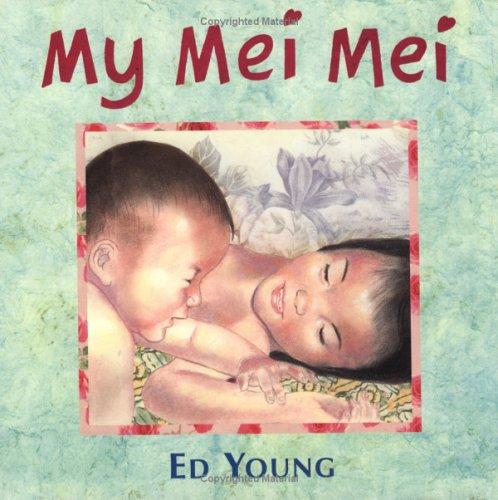
Luckily there are a lot of great picture books to facilitate these discussions, and My Mei Mei by Ed Young is one of them. Young, himself an adoptive dad, was motivated to write and illustrate this picture book through his own experience adding a second daughter from China. Young's firsthand knowledge of this situation shines through on every page.


Antonia desperately wants a mei mei (little sister) to play and share secrets with. She plays at being jieh-jieh (big sister) and she just knows she'll be a really good one. And then the day finally arrives, and the family travels to China to bring Mei Mei home. Antonia is so excited! But Mei Mei turns out to be nothing like Antonia thinks she would be, and soon jealousy is creeping in. Will the sisters ever get used to each other? Will Antonia like being a big sister after all?

Young is not only an adoptive dad, he's also a Caldecott medalist, and his talents bring this very personal story to life. The colors he uses are vibrant and vivid, emphasizing the emotional journey that all the family members move through. And as the girls' relationship changes, so does the perspective, and soon the two are totally intertwined.

Whether you're bringing home a child through international adoption, foster care, or having a birth child, there's a lot here to help ease the transition from only child to older sibling. Sharing Young's gentle tale as a family is an excellent way to open a discussion about life changes or to remember another child's adoption story. A beautiful book, beautifully told!

Friday, January 13, 2012

Picture Book Review - Journey Home by Lawrence McKay Jr.

I rarely read the dedications of picture books. Before I read a book, I'm usually in too big of a hurry to get to the good stuff, and afterwards I'm either excited to share the book or eager to be rid of it.

In this case, for some reason, I did. And I'm quite glad, because I think the dedication set the tone for the entire work. Dom and Keunhee Lee, the illustrators of Lawrence McKay Jr.'s book Journey Home, dedicated their work "to the people who have two homelands". This speaks to the desire on both the author's and the illustrators' parts to honor the experience of international adoptees as well as multiracial individuals.


And honor this experience they do, with a tale that captures the emotional and psychological process involved in searching for birth family as well as identity. Mai's mother Lin was adopted from Vietnam when she was just a baby. Lin doesn't know anything about her family -- "her past is like a puzzle", Mai explains -- but she longs to reconnect. So Mai and Lin decide to journey back, to see what parts of the puzzle they can bring together. Finding answers isn't easy. There are a lot of closed doors and dead ends, and at times Mai's mother seems to feel more lost than ever. But finally, finally, they find a connection, and the picture Lin has so often longed to see begins to fill in at last.

This is a powerful story not only of an adoptee's desire to find her first family, but also to return to a homeland whose roots are deep within her heart. McKay relates in unsparing prose the longing that Lin feels, to know more about herself and her birthplace. And he connects Lin's journey to that of her daughter Mai, who was born in America but never knew her father. In Vietnam, Mai finally has the experience of fitting in, since everyone else looks just like her. And Mai feels a connection to her mother's birthplace. As she puts it "I think home must be inside me and all around me too."

Journey Home is a gorgeously illustrated portrait of the adoption journey that would be an excellent tool for sharing with older children. There's a lot of food for thought here, and be aware that the frankness with which McKay tells Lin's story may prompt questions from adoptees about their own history. If you don't want to answer hard questions, then you'd better pass this one by. But if you feel, as we do, that it's most important to be completely honest with your children about their story, this is the kind of book that can facilitate open communication.

For another perspective on Journey Home, check out The Asian Reporter's review. For a classroom guide, check out Lee & Low's website.

Journey Home by Lawrence McKay Jr., published by Lee & Low
Ages 7 up
Source: Library
Highly recommended

Tuesday, December 27, 2011

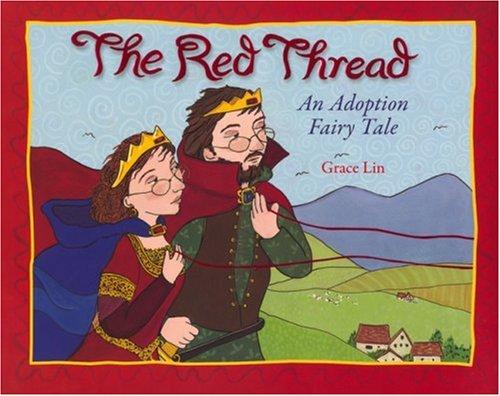
Picture Book Review - The Red Thread by Grace Lin

It's hard for me to find anything not to like about a Grace Lin book. From her realistic yet adorable illustrations, to her sensitive characters and her affinity for detail (both in words and pictures), Lin just about never takes a misstep.


And there's a lot to like about Lin's picture book, The Red Thread. For one thing, this is a great way for adoptive families to share with young children the story of their own experience. Lin sets the story as a traditional fairy tale with familiar elements. The king and queen of a prosperous land have everything, but they are very sad and in great pain. After consulting a mysterious peddler, the king and queen discover there is a red thread pulling from their hearts. The more they pull away from the thread, the more it hurts. The only solution is to follow the red thread. It is an arduous journey, but at last they come to a distant land and discover what is on the other end of the thread - a beautiful baby girl who belongs to them!

In typical Lin fashion this book is gorgeous, with lots of small details that add texture to the picture. The story, too, comes to life with details - the king and queen's journey, for example, and the fact that they gradually lose their fine appearance and become tattered and ragged. I also love that the tale is bookended by a transracial family who is reading the story to their own child, presumably who herself is adopted.

Just a couple small things nag at me, however. First, I don't love the subtitle: "an adoption fairy tale". Maybe it's because of that assumption that adoption automatically equates to "happily ever after" (which it may, but it also may not), maybe it's just that the pairing of the terms feels off to me -- either way, I could do without this part. Also, the tale itself is singular in focus, very much geared toward what the prospective adoptive parents go through and with little consideration given to the child or her first family. I'm not comfortable with how readily the king and queen scoop up their baby and return to their normal lives. Adoption isn't this seamless, in most cases, nor should it be.

Granted, adoption is a complex issue, many would argue too complex for a picture book to examine fully. Also, this is presented as a fairy tale, and therefore idealized. But it's worth noting these issues so that adoptive families who might be sharing the book with their own families can be aware of them, and discuss with their kids as necessary. When I read it with Sprout, we talked about his Ethiopia family, retelling their story to him and emphasizing the centrality of their place in his life.

Overall, however, this is a great book with lots to recommend it, and an excellent addition to home, school and public libraries. Use this to start the adoption conversation with all children, no matter how they came into their family.

The Red Thread by Grace Line, published by Albert Whitman and Company
Ages 2-7
Source: Library
Sample: "And sure enough, when the queen put on the glasses, she could see a brilliant red thread coming from her heart. It ran around the room, out the castle door, and far beyond. With every move she made, the thread pulled and twisted, causing her pain."
Recommended

Saturday, December 17, 2011

12 Days of Christmas Picture Books - Christmas Cricket

I love the holidays. Love the hustle and bustle, all the lead-up to Christmas and the crazy chaos of celebrating together. But let's face it -- it can be pretty overwhelming, particularly for the little people in our lives. It's hard for kids not to get lost in the shuffle of all there is to see and do at Christmastime.


Enter Eve Bunting and her sweet story Christmas Cricket. Bunting gives us a glimpse into the world of a little insect who "felt small and worthless in the bigness of night". Looking for warmth, Cricket slips into a house and takes refuge in a Christmas tree, where he begins to sing. But then someone hears him, and comes looking for the source of the song. Should Cricket run away? Or is he safe to sing, even in a place that doesn't seem at all familiar?

Bunting's a masterful storyteller, and one who doesn't shy away from tough subjects (her collaboration with David Diaz, Smoky Night, is one of the most powerful and poignant picture books I've ever seen). And though you might not think Christmas is a tough subject, it can be for many. Though this isn't a book about adoption, as an adoptive parent I couldn't help reading Christmas Cricket with an eye toward children in new family situations. For them, and their families, the holidays can be a time both exciting and scary, as everyone learns their place in the whole scheme of things. Like Cricket, children might feel "small and worthless in the bigness" of Christmas with a family who loves them, maybe in ways they don't even understand quite yet. And new parents, too, can be overwhelmed, as their children don't seem to be enjoying the holidays like they imagined.

As happy as this time of year can be, it's worth reminding ourselves that taking joy in the small things means every bit as much. In the end, Cricket learns that there is joy in his own song, sung in the way only he can sing it. And at Christmas, isn't that the best gift of all?

Wednesday, December 7, 2011

Chapter Book Review - Breadcrumbs by Anne Ursu

So wouldn't it be great if you could hand your child a thrilling, well-crafted, engrossing novel in which neither race nor adoption were the driving force behind the plot?

Thought so.

If you'd like to do just that, Anne Ursu's Breadcrumbs is a must-have. I was excited to read this one not only because the main character, Hazel, is part of a multiracial family formed by adoption, but also because I've read and loved Ursu's adult novels Spilling Clarence and The Disapparation of James. Both were favorite handsells back in my retail days, for the clever mixing of intriguing characters and fantastical turns of everyday reality.

And Ursu didn't disappoint me in Breadcrumbs, which I think is a strong contender for the Newbery this year (please please please). In the book, Hazel and Jack are two peas in a pod, sharing everything from a love of fantasy to a talent at superhero baseball (a game of their own invention). But one day Jack just -- goes away. Oh, he's there in body, all right, but he's no more Hazel's best friend than a stranger on the street. Jack just looks right through Hazel like he doesn't even see her. Hazel's crushed, and she can't accept what her mother tells her, that "these things happen". And when Jack disappears for real, Hazel doesn't believe for one second that he's with his elderly Aunt Bernice. No, Hazel's going to get to the bottom of this -- and for that, she must set off into the frigid Minnesota woods to rescue her very best friend.

Now, I could go on and on about all the things there are to love about Breadcrumbs, from the way Ursu interweaves fantasy into common events and how she turns fairytale conventions upside down, while never betraying their essence. Particularly well-done are the scenes once Hazel enters the woods, so evocative that I was amazed to look up from reading them and find myself at home tucked up in bed. But what many readers will take away from Breadcrumbs is the sense of holding fast to your sense of self and letting that be your compass. Hazel never wavers from the notion that Jack, the real Jack is still in there, and that he needs her now even more than he ever has. Quite a commentary on growing up but not away, this one.

Breadcrumbs is that rare thing, a novel that's not genre- (or gender) defined, neither wholly fictive nor entirely true. Honestly, I can't say enough about this smart, funny, surprising novel, which I found so compelling that I truly regretted turning the last page. For kids who feel on the outside, either because of something like adoption, or because they're finding their way across that looming chasm between childhood and growing up, Breadcrumbs will be a great gift. And if you feel that way as an adult? Guess what -- it'll speak to you too.

Breadcrumbs by Anne Ursu, published by HarperCollins
Ages 10-13
Source: Library
Sample Quote: "Hazel blinked. It occurred to her that Mikaela was being nice to her. She did not know how to react, for when your heart has been poisoned and someone picks a dandelion for you -- because it is bright and yellow and you seem like you could use something like that -- all you can do is contemplate the funny ways of weeds."
Highly recommended

Want to read more? Check out this guest post from Anne Ursu at The Book Smugglers blog, or visit her official author site.

Wednesday, November 16, 2011

Picture Book Review - I'm Adopted! by Shelley Rotner and Sheila M. Kelly

It's a fact well known that babies and toddlers love to look at pictures of other little ones. I've read a number of theories about why this is, but I suspect it might just add up to the fact that babies of all races are stinkin' cute, and they captivate kids as much as they do (most) adults. Many books and movies have taken advantage of that to great effect. The recent film Babies is a prime example -- with no dialogue and very little footage of other family members, this movie manages to catch and hold your interest throughout. As we see the babies growing and changing, we notice a lot about culture and social norms, but we also notice just how adorable these kiddos are, every last one uniquely individual.

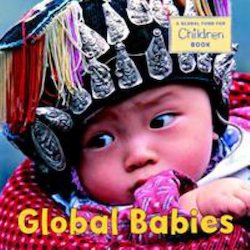
We watched Babies as a family not long after Sprout came into our family, and like us he was taken with it,. His most-requested book during that period was Global Babies, a vibrant pictorial board book that represents little ones from around the globe. I recommend this book highly to all adoptive parents, particularly those who are bringing home babies and toddlers -- it's a great way to express to a small child, especially one with whom you might not have a shared language, that people come in a rainbow of colors and that though they may look different, the kids your new son or daughter will play with are babies just like them. Sound like too much to read into a simple board book? Well maybe, but it's what I hope for, anyway.

Fast forward to now, when reading books together is a treasured part of our daily routine. Now, interspersed with books like Snow Day and What's Up, Duck are titles that share with Sprout the journey of our becoming a family through adoption. Though he's heard the word "adoption" since day one, and though we've told him his story many times already, we recognize that this isn't a concept he can yet grasp -- but still, we feel it's essential to introduce it now.

Having read and loved some of Shelley Rotner's earlier books (click here to read my review of Shades of People), I was thrilled to see her listed as one of the authors of I'm Adopted!. Rotner and frequent collaborator Sheila M. Kelly bring readers a sensitive yet factual look at adoption that's geared for the youngest readers. No easy feat, this, and yet Rotner and Kelly pull it off enormously well. First because of the format of their book -- those aforementioned pictures of babies, toddlers and kids of all races. Gorgeous shots abound, from the copper-skinned beauty on the cover to the adorable Asian, African American, Caucasian, Latino/a, and multiracial darlings inside. Serious cuteness here!

Then there's the text. You wouldn't think that adoption would be a topic you could boil down succintly and yet thoroughly, but Rotner and Kelly have nailed it. Their explanations are clear without being drawn out, and encompass all perspectives. I've seen great picture books that take the adoptive family's point of view, and equally well-done titles from the adoptee's angle. But this is the first picture book I've run across that addresses the birth mother's side of things, and discusses reasons that children may not have been able to stay with their family of origin. This is handled frankly but sensitively, and presents a great opportunity to open discussion about your particular situation.

International and domestic adoption are both mentioned as well, leading into a discussion about transracial families. "I don't look like my sister, but we like to do the same things" reads one bit of dialogue, and really, how much better could one sum up the essence of multiracial families? In a brief afterword, the authors address the fact that not all adoption situations can be adequately discussed in such a format; this sensitive recognition of the uniqueness of every adoptive family is reflected throughout the book, as the authors honor every child they depict.

I truly believe this title belongs on the shelf of every adoptive family and should be part of every school or library's collection. Bravo, Shelley Rotner and Sheila Kelly -- you've given us an adoption classic for the ages!

I'm Adopted! by Shelley Rotner and Sheila M. Kelly, published by Holiday House
All ages
Source: Library
Sample quote: "Children are happy in their families, no matter where they were born. . . when they know they are cared for and loved."
Highly recommended

Wednesday, September 28, 2011

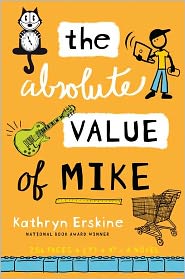
Audio Review - The Absolute Value of Mike by Kathryn Erskine

Mike Frost knows a little something about unusual people. After all, his dad is not what you'd call a normal guy -- math genius, yes, but not like other guy's dads. But having an odd dad doesn't prepare Mike for spending the summer with relatives he's never met. Poppy and Moo, Mike's great-uncle and great-aunt, are certainly strange. Moo names inanimate objects and thinks her car, Tyrone, has a mind of his own. Poppy doesn't talk to anyone and rarely even moves out of his chair. And the more Mike gets to know Poppy and Moo's friends and neighbrs, the more Mike realizes that his relatives are hardly the oddest ducks in town.

To top that off, Mike's supposed to be working on an engineering project with Poppy. In fact, that's why Mike's dad sent him out here for the summer. But instead, Mike soon finds himself deeply embroiled in a fundraising drive to help Moo's friend adopt a child from Romania. Before long Mike is coordinating town events, working out of a homeless man's "office", and trying everything to get Moo to give up driving Tyrone. Oh, and above all, keeping his dad from finding out what he's really working on. This is turning out to be way more complicated than a physics problem!

I am really torn about how I feel about The Absolute Value of Mike by Kathryn Erskine. On the one hand, there are some great lessons to be had here, about grief and loss, about coming to terms with major life shifts, and learning to find the secret strength within yourself. Mike is pretty down on himself when the book opens, mainly because he feels he'll never live up to his father's dreams thanks to his learning disabilities. It's only when Mike starts reaching out and helping others -- Moo, Past, Misha in Romania -- that he is able to see the potential for his own future. In addition, Mike learns a little something about making things happen, and how real life is not black-and-white like a math equation.  The best part is that Erskine delivers all of these big truths in a fast-paced, hilarious narrative. Really, there are some moments you have to hear to believe, especially where the always entertaining Moo is concerned (voiced surprisingly convincingly by Noah Galvin).

But, as an adoptive parent, I did have some issues with the way the whole "bring home an orphan from Romania" storyline was handled. First, there are many, many references to "saving" Misha by bringing him to the US. This is a tough one, because it implies that international adoption is the only solution for Misha. While it's true that in many countries domestic adoption is unpopular or nonexistent, most of us agree that the best thing is for children to stay in their home country. Leaving behind your home and heritage represents a compromise that many times will result in a lot of grief and loss for a child, who will not necessarily be grateful to be in another country.

Another point that bothered me is that Mike and his friends take on the fundraising and paperwork completion for the prospective adoptive parent. This is just not how things work in international adoption, as most of us know -- ethical adoptions require months and years of paperwork, background checks, verifications, and most of all legal processes on the parts of both countries. This is not something that a third party can do for you; as a prospective adoptive parent, you have to do all of this work on your own. Much of this has to be in place before a family is ever matched with a child. And the idea that the money can be cobbled together in less than a month, while it makes for great dramatic tension, is just unbelievable in all senses.

These are small points (and there are others) that won't get in the way of the story for most people. For me, though, it gave me pause, mainly because of the way the potential mother is written -- as though she is barely involved in her own adoption process, and that she perceives herself as "saving" a child. If Sprout does read this when he's older, it will give us the opportunity to talk about how people outside the adoption community view the process. We can talk about how much a child gives up when he/she is adopted, and how that might make a child like Misha feel. We can discuss parental motivations in adoption, and how it's critical to think more about parenting in the long haul rather than just completing the adoption. And we can talk about how wonderful it is that this town pulls together to make the adoption a reality -- and how that is a very simplified look at a complicated, and life-altering process for all involved.

Bottom line: I'd still recommend this, but with reservations. It is hard for me to get around the absolutely idealized version of international adoption, and the larger messages that sends about relationships and family bonds. It's definitely a novel with a great deal of heart, and one whose characters will make you laugh and cry in just about equal measures; if you can look past the adoption missteps, you'll find a great deal of value here.

The Absolute Value of Mike by Kathryn Erskine, audio published by Recorded Books
Ages 12 up
Source: Library
Recommended, with reservations

Tuesday, September 20, 2011

Picture Book Review - Goyangi Means Cat by Christine McDonnell

Soo Min isn't sure about this new home of hers. Nothing is like it was back home in Korea. The food, her new house, the sounds outside her window at night. Though her American mother and father are nice, they cannot speak her language. Soo Min teaches them some Korean words, but it isn't the same. The only thing that Soo Min finds comforting is Goyangi, the American cat. Goyangi's fur is soft and he is quiet, which makes Soo Min feel peaceful too.

But then one morning Goyangi gets out of the house, and Soo Min can't stop worrying about her friend. All day Soo Min and her mother look for Goyangi, but the cat does not reappear. What will Soo Min do without Goyangi? She is very worried -- and at last, when Goyangi comes back at the end of the night, Soo Min realizes that this is home, with her new parents, in this unfamiliar house, but with Goyangi right there by her side.

Goyangi Means Cat is a gentle story that explores the loneliness a newly adopted child feels, when he or she is settling into an entirely strange and sometimes frightening place. The artwork by Steve Johnson and Lou Fancher is fantastic -- these are the kind of pictures you could pore over, examining all the small details woven into the backgrounds via paper collage. An especially nice touch is the interweaving of Korean words into the text, a technique the artists used to demonstrate the blending together of Soo Min's experiences, both at home in Korea and now at home in America. This title would make a great addition to any child's library, but is especially wonderful for Korean children as a touchstone with their heritage and culture.

For siblings and family members who want to understand better what their children are going through, as well as for the child feeling all alone in a world they do not recognize, this is a simple and reassuring tale. It's also a good reminder for parents that although our children may act as though everything is all right, inside they may be confused and lonely. Even a small change in Soo Min's routine, like a trip to the library, seems like too much at first, and Soo Min longs for the comfort of her friend Goyangi. Although Soo Min knows her American parents care for her, she feels isolated without a common language. But the language of her four-footed friend sustains her, helping ease Soo Min into the transition of a new home and family.

Goyangi Means Cat by Christine McDonnell, published by Viking Penguin
All ages
Source: Library
Sample quote: "At night Goyangi curled up on Soo Min's bed. When she was frightened by a siren in the street, she stroked Goyangi's soft fur. When Soo Min missed her Korean friends, Goyangi licked her hand with his towelly tongue."
Highly recommended

Friday, August 26, 2011

Picture Book Review - A New Barker in the House by Tomie dePaola

Beloved author and illustrator Tomie dePaola weaves adoption into the storyline of A New Barker in the House, part of his series about the Barker family. Mama, Papa, Morgan and Moffat are excited to be adding a new member to their family: three-year-old Marcos. The twins cannot wait to show their new brother all their favorite toys, and especially want to take him to show-and-tell at their school. They begin to think about all the fun they will have together.

But when Marcos comes home with Papa, he speaks Spanish, which Morgie and Moffie can't understand. And the only English word Marcos knows is "potty", but he uses that one a lot! Marcos doesn't like the things the twins like, and he doesn't want to play ball or dolls either. Mama gently explains that Marcos may not want to eat the same food, or play the same games, and encourages the twins to ask Marcos what he wants to do. Before long Marcos and the twins are playing together on the playground, and everyone is learning how to speak one another's language.

As always, dePaola's illustrations are bright and expressive, homey depictions of the contented Barker family at home together. The layout makes use of panels to represent the various characters' points of view, especially effective when demonstrating how the twins each want to share their own favorite things with Marcos. The discussion of adoption is brief and straightforward; dePaola assumes that the audience understands what adoption's about, and doesn't get bogged down in lengthy explanations. Rather, this title focuses on the transition of a new child into a family, and the way siblings must learn to accommodate and appreciate their brother or sister's preferences. If the storyline resolves quickly, that is to be expected for the intended age group. The big benefit is that dePaola opens up plenty of opportunities for further discussion and examination.

Bottom line: Overall, a good title to introduce the topic of adoption to a family, and get siblings thinking and talking about what the new family member may want or need. Sensitive, gentle and thoughtful, A New Barker in the House is another well-rounded title from a favorite author!

A New Barker in the House by Tomie dePaola, published by G.P. Putnam's Sons
Ages 2-6
Source: Library
Sample quote: "The next morning at breakfast, Morgie gave Marcos a big spoonful of Morgie's favorite cereal - Dino Pops. Marcos didn't like it! Moffie gave Marcos a big spoonful of her favorite cereal - Alphabet Bits. Marcos didn't like it. Marcos SPIT it all out! 'Mama!' the twins yelled."
Recommended