Showing posts with label Asian American. Show all posts

Monday, November 17, 2014

30 Days of Diverse Picture Books - Tiger in My Soup by Kashmira Sheth

It's Day 17 in our 30 Days of Diverse Picture Books. This morning I read a terrific post by Angie at Fat Girl Reading, on Librarians and the #WeNeedDiverseBooks initiative. Bottom line: if you want diverse books, and your library doesn't have them, ASK! (Angie says it much better.)


And now on to tonight's pick, Tiger in My Soup by the ever-terrific Kashmira Sheth. I love this one because it illustrates just how fun diverse books can be - they need not be heavy and lesson-oriented, though those titles have their place, but can be imaginative and full of fancy. And Tiger in My Soup definitely fits that description!

The story revolves around a young boy whose sister is in charge of him. Sis is preoccupied and won't read the book our hero wants, though she will microwave him some soup. And that's where the trouble begins, for out of the steam of the boy's lunch comes one big hungry tiger! Naturally the story spins off from there, and it's a whole lot of crazy adventure that will keep your kiddos scrambling to turn the page. Jeffrey Ebbeler did the illustrations for Tiger in My Soup, and he manages to perfectly capture not only the bored vibe of the older sister, but also the frenetic energy of the boy (and, of course, the tiger!).

Tiger in My Soup is terrific to show kids how exciting reading can be - but don't be surprised if they're looking carefully at the next book you read, to see if the characters are literally leaping off the page!

Tiger in My Soup by Kashmira Sheth, published by Peachtree Publishers

Sunday, November 2, 2014

30 Days of Diverse Picture Books - One is a Drummer by Roseanne Thong

It's Day 2 of 30 Days of Diverse Picture Books. Today's choice is an older title that for some reason hasn't made the blog until today. Not sure just why, because it's one we read and enjoyed when Sprout was quite a bit younger - but I'm making up for that now!


We really love One is a Drummer: A Book of Numbers by Roseanne Thong. The winsome illustrations by Grace Lin accompany Thong's text about activities like playing mahjong and racing dragon boats, as well as counting the days of the week and dancing in the sprinkler. I love the blending of pastimes that most kids will find familiar alongside some that may be new to them. Thong includes a glossary for further discussion points, which you'll find especially helpful for any questions that arise.

One is a Drummer works on multiple levels, making it a nice well-rounded addition to any collection since it serves several purposes. Concept book, check. Cultural introduction, check. Artistic inspiration, check. All this with rhymes that flow perfectly and a light, upbeat tone make One is a Drummer a winner!

One is a Drummer by Roseanne Thong, published by Chronicle Books

Tuesday, July 29, 2014

Chapter Book Review - The Great Wall of Lucy Wu by Wendy Wan-Long Shang

Confession: I do not long for the bygone days of my youth. For the most part, they weren't all that great, and I've no secret longing to relive them in any way, shape, or form. But I do sometimes find myself hankering to have one childhood experience once again: that of picking up a book you've never read and cracking the spine to find yourself peeking back at you.

Ever had that happen? If you ever were a misfit somewhat-on-the-fringe bookworm like I was, it might just have been your biggest relief. Seriously, there was little I found more comforting than knowing that I surely couldn't be the only one for whom middle school was pretty much torture, and then reading a book that showed me someone out there felt the same (and wrote the book about it).


Even today I love finding books like that, because they can be a lifeline for kids who are having the same experience right now. I think that's especially true for kids who stand out in some way, and often that's due to cultural differences in their family life. That's certainly the case for the title character in Wendy Wan-Long Shang's The Great Wall of Lucy Wu. Lucy is relatable, accessible and someone that middle-grade readers will recognize in the mirror, even if they don't share her Chinese-American heritage.

When we meet Lucy, she's primed for a great year in sixth grade. This is going to be her moment to shine, and nothing symbolizes that more than the fact that she'll no longer be sharing a room with her older sister Regina, who's off to college soon. But everything crashes down on Lucy when she finds out that her family will be hosting a visit from Auntie Yi Po, a relative Lucy's never even heard of, much less met. And just guess where Yi Po will be staying, when she's with the family for several months. If you picked Lucy's almost-all-hers bedroom, you win (but in Lucy's view, she loses).

Shang absolutely nails Lucy's experience of feeling like an outsider even in her own family. While her sister Regina "majored in Being Chinese", Lucy can't speak much of the language and finds pretty much all the food more than she can handle. Now with Yi Po in the house, Lucy's off to Chinese school on the weekends and missing out on basketball - and she's not shy about voicing her opinion, just as her parents aren't shy about expressing theirs. Lucy feels the friction of her two worlds, and struggles to find a balancing point between them. It's a realistic struggle, and the dynamics between the family members are always believable. 

I love the resolution that comes about, mostly because it rings absolutely right and true. You can feel Wendy Wan-Long Shang's passion for her subject and her devotion to making sure that young readers have a denouement that is both positive and plausible. Lucy Wu is a character kids will root for and relate to; though Shang is a debut author, her skills speak for themselves. Hand this to kids who love Judy Blume, Grace Lin or Beverly Cleary - and then we'll all be waiting on pins and needles to read more from this talented author!

The Great Wall of Lucy Wu by Wendy Wan-Long Shang, published by Scholastic
Ages 9-12
Source: Library
Sample: "Now the desk and bookcase formed a wall between the two beds. The Great Wall of Lucy Wu. When I lay down on my bed, all I could see was my side of the desk and the front of the bookcase. And I hid my favorite picture of my grandmother, the last one we took before she got sick, in my bookcase."
Recommended

Thursday, April 3, 2014

Color Your Bookshelf: 39 Diverse Board Books to Give a Baby or Toddler


I'm of the strong opinion that books are some of the best gifts to give families adding a new member. Onesies and diaper bags are all fine, of course, but books lay the foundation of early learning that rewards a child for his or her entire life. Also, books are a great choice if the child isn't a newborn. Sprout came into our family at 12 months old, and so it was hard to judge just what he needed, but the board books we got as gifts still occupy a prominent place on his bookshelf.

Generally I just do single-title reviews here on the Bookshelf, because I think each title is a gem and should shine all on its own. But I'm breaking with tradition to come up with this list of titles that make a perfect gift for anyone adding a baby or toddler to their family. Please note: these are NOT book recommendations solely for children of color. White kids need these books too. I cannot stress this enough. If we're going to raise global citizens, if we're going to foster inclusion and tolerance, we've got to start diversifying every single child's bookshelf. And we need to do that from day one.

So - on to the list!

First up is one Sprout adored as a baby himself, and which we've given to several families -- Global Babies by the Global Fund for Children. Babies love to look at other babies, so this is a sure-fire hit. We received two copies of this when Sprout came home, and it's a good thing because we've worn both out! Also look for other Global Fund for Children titles: Global Baby Girls and American Babies.


Another pair of titles Sprout read a lot as a toddler are the board books Whose Knees Are These? and Whose Toes Are Those? by Jabari Asim. Bright and cheerful, with colorful graphics, these simple titles speak directly to a young child's interest in his/her own person. And, they are super fun to boot. I can still quote chunks of this: "knees like these don't grow on trees!" Also fun are Asim's Girl of Mine and Boy of Mine -- all are illustrated by the incomparable LeUyen Pham.


We recently read Anna McQuinn's new book Leo Loves Baby Time, the companion to her series featuring African American toddler Lola and her little brother Leo. (It isn't a board book, but does have reinforced pages for small kiddos.) Though he's a little old for it now, Sprout loved revisiting these favorite characters and seeing Leo in the starring role in McQuinn's comforting and happy title. Lola at the Library is available in board book form, and we read it nearly every week, either before or after our Friday visit to stock up on books.


Cheryl Willis Hudson did a few terrific board books several years ago, and I'm glad to see they are still in print for families and libraries to add to their collections. Good Morning, Baby and Good Night, Baby deal with routines familiar to any little one, and it's nice to see African American kids in the main roles here. These are solid stories likely to earn a central place in your read-aloud routine. Also look for Let's Count, Baby and Animal Sounds for Baby, in the same series but maybe a little harder to find.


Two new books that are widely available, and which we just adore, are both written by Mary Brigid Barrett. Pat-A-Cake and All Fall Down sound like they are based on the familiar rhymes, and while there are some similarities, Barrett has put an entirely new spin on things. These are breezy, easy reads, bound to capture -- and keep -- the attention of a toddler. Oh, and if those illustrations look familiar, it's because the artist probably is: LeUyen Pham, whose work I was just raving about a little bit ago.


Another recent title that is a real visual treat is Julie Morstad's take on the poem The Swing by Robert Louis Stevenson. I have a soft spot for this poem, it being my particular childhood favorite from Stevenson's A Child's Garden of Verses. Morstad has reimagined this verse and set it in a classic format, depicting a gaggle of children experiencing the swing in various venues. I love that the diversity is woven so seamlessly into this quietly striking title, never feeling forced or premeditated, just natural, as all kinds of kids do love to swing!


Free Spirit Publishing has produced the "Happy Healthy Baby" series of board books by Elizabeth Verdick and Marjorie Lisovskis. Each one works well on its own, but giving the whole series to a family would be so much fun. Sprout and I read Reach, all about babies engaging with the world by reaching out. He liked seeing the pictures, which are striking black-and-white photos of babies of various ethnicities. The series also contains Eat, Move, and Cuddle, and every entry looks even cuter than the one before.


Little Scholastic did a line of board books a few years ago that are nicely diverse. We bought Welcome Fall for our bookshelf before Sprout joined our family, and he was pretty much obsessed with it for quite a long while. The series includes books for each season (Welcome Spring is a nice one too), books on manners like Please and Thank You and Uh-Oh! I'm Sorry and informative titles like My Body. There are interactive components in most of these titles, which really adds to the enjoyment for babies and toddlers.


A colleague recommended Karen Baicker's books to me, and they were among the first we checked out of the library, before Sprout was totally ready to handle books with paper pages. I Can Do It Too! and You Can Do It Too! stand alone just fine, but work quite nicely together. The illustrations by Ken Wilson-Max bring these titles to life, and the gentle reassurance of the message is a nice identity boost for all children.


Roberta Grobel Intrater wrote a series of board books called Baby Faces, and they are just about as cute as can be. The photos are gorgeous, clear and bold to draw the attention of little ones and keep it. Most libraries have these (or should - suggest if your library doesn't!) and I've seen them in many bookstores as well. We've read and loved several, including Splash!, Smile!, and Peek-A-Boo!, and there are quite a few more. A couple of these books, plus some small toys and a onesie, would make a terrific basket for a new baby.


Rachel Fuller is another author/illustrator who has done several board books with diversity. Each title is bright and colorful, just the thing for stimulating a young child's curiosity in books. The stories are simple enough that kiddos won't get lost, which is a nice feature of books like these that truly are written to be board books. Most of the titles are geared around the addition of a new sibling, so they can work for kids of varying ages, something not all board books do well. Among the titles: Look at Me!, Waiting for Baby (multiracial family in this one!), and You and Me.


We were fortunate to get some really terrific board books as shower gifts, some of which we still read together almost four years later. Among these was Susan Meyers' Everywhere Babies, illustrated by Marla Frazee. (This is available in a hardcover edition or board book - you can't go wrong either way, I promise you.) I adore the way Frazee incorporates diversity seamlessly into almost every one of her books, and this is no exception. Little ones will love looking at all the babies, and the sweetly sentimental text will appeal to their grownups as well.

No diverse bookshelf is complete without books by Helen Oxenbury. Her delightfully chubby babies and toddlers make the perfect complement to her simple phrases and plots. We loved so many of her board books when Sprout was younger, and even now I can quote large swatches of text from some of them. Ten Little Fingers and Ten Little Toes was a gift from a sweet friend, a total classic that we read every night during bathtime. Say Goodnight, Clap Hands, Tickle Tickle, All Fall Down-- all of these are fabulous and bound to become part of a baby's daily book time.

You can't go wrong with any of the titles we've compiled above, so add these and other diverse titles to your gift list for new families. What are your favorite multicultural books to read with a baby or toddler?

Tuesday, February 4, 2014

You Were the First by Patricia MacLachlan

A couple of nights ago, feeling nostalgic, Hubs & I cracked out a few old photos and videos of Sprout when he first joined our family. It was fun for us, and for Sprout, to marvel over how small he was, how adorably squishy and cute, with his mop of curls and big eyes. We told Sprout story after story about his first days home: when he ate ice cream (and cried inconsolably at the cold); the way he used to stand in front of the oven and watch food cooking (Hubs called it "food tv"); the obsession with trains that meant we had track spread all over the living room. It seems like yesterday to us, of course, but to Sprout it's almost unthinkable that he was ever that small, and he loves to hear about himself at that age.


Tonight's title puts me in mind of that fascination that Sprout, like most kiddos I've known, has with hearing about himself as a baby. Patricia MacLachlan's You Were the First is a wonderful look back at a young child's early days, as told from the perspective of his doting parents. "You were the first to sleep in the basket with the yellow ribbon wound round," the book begins, opposite a picture of Mom and Dad (and puppy) gazing down at their newborn. On it goes, through early experiences like laughing at the dog, to milestones like learning to crawl, to reveling in the thrill of snow with Dad. On each page, there are tender family moments, and at the end, a reassurance: "One day there may be a second -- or a third -- to sleep in the basket with the yellow ribbon wound round. / But you will always be the first."

You Were the First is a beautiful book, gentle and sweet, written by a skilled author who knows what children enjoy. If you haven't read a Patricia MacLachlan title, you're missing out -- there are so many that we love, I'm hard-pressed to name them all . And this is a very worthy addition to her canon of modern classics, which is really what she writes, after all. While goofy and trendy titles capture attention, and are great for what they are, it is quiet books like this that parents can share with their children when it matters, when they need bolstering from the world around them. (And it could easily work for adoptive families, as there's no mention of pregnancy or birth, just an opening scene of the darling boy in his bassinet.)

MacLachlan's words are elegantly set off by Stephanie Graegin's illustrations. Graegin hasn't garnered as much attention as I feel she deserves, but she's one to seek out. Her finely articulated illustrations truly match the mood conjured by MacLachlan's prose. There are also lots of small touches that kiddos will enjoy - the presence of the baby's stuffed elephant, popping up here and there, the beaming puppy who is clearly besotted with his boy, and the cozy domesticity that's present in every image of the little family. Even the endpapers are adorable, small jewels of images that trace a baby's early months and days. 

It's worth noting that this is a transracial family, Asian American and white, which for me is a huge bonus. It's always nice to find a title like this that reads so easily and soothingly -- and diversity too? Almost too good to be true. Jump at the chance to read You Were the First to your little ones, whether they are onlies like Sprout, or the first (or tenth) of several. Because it's the kind of inclusive, peerless book we need more of for our children, and for ourselves as well.

You Were the First by Patricia MacLachlan, published by Little, Brown
Ages 2-6
Source: Library
Highly recommended

Thursday, September 19, 2013

Thanking the Moon by Grace Lin

Today's a pretty awesome day - the Mid-Autumn Festival, also known as the Moon Festival. I didn't know a whole lot about this festival before I read today's selection, but it's a very cool holiday. The specific date day varies from year to year, but generally it is the 15th day of the 8th lunar month, means it can fall during either September or October. The holiday is generally observed by Chinese families, but some other Asian peoples also take part, and the observation of this day began as a way to honor the completion of the harvest and the preparation for a new season. And the moon is a very central part of the whole holiday, since it is celebrated after the moon rises in the evening.


Sprout and I learned about this holiday by reading today's selection, Thanking the Moon by Grace Lin. We first read this book a couple of years ago, stumbling on it at the library and checking it out because, well, it's Grace Lin, and I'd read the phone book if she wrote (and illustrated) it. Sprout was quite taken, then and now, with the illustrations, which isn't a surprise if you've seen any of Lin's books. Her characters have an openness and an honesty about them that draws young children in. There's plenty of depth in her deceptively simple scenes, most of which center on some aspect of family life, making them a great choice for sharing with toddlers and preschoolers.

I love that Lin always honors domesticity and tradition in her books, and Thanking the Moon is similar in that regard. Being that it follows one family's observation of the Moon Festival, we learn a lot about how they prepare for the celebration - driving to the park at night, setting up a picnic of special food (mooncakes and pears, yum!), mounting the lanterns, pouring the tea. Oh, how much Sprout wants to climb into that picnic illustration where the family is gathered around eating mooncakes in the soft light of the golden lanterns. We both love the way the family thanks the moon for all its blessings, tangible and intangible alike. Lin's author note explains that the moon's fullness during the festival symbolizes wholeness and harmony - she drives that point home with a lovely spread at the end showing all the families who have come to observe the festival in the same fashion.

The central elements of Thanking the Moon are the kind I wish to deeply imbed in my son - peacefulness and harmony, gratefulness and calm. Reading this book together again this year reemphasized for me what a great thing it can be to introduce new cultural traditions into our lives, to make them that much richer. Tonight, with the blessing of clear skies, I think we'll be letting Sprout stay up just a little longer, that we might gaze up at the clear brightness of the moon together and rejoice in all the goodness we've been given, and all that's yet to come.

Thanking the Moon by Grace Lin, published by Alfred A. Knopf
Ages 3-6
Source: Library
Sample: "The mid-autumn moon glows in the sky. We go into the night to admire it."
Recommended

Sunday, June 9, 2013

Library Find: In the Park by Huy Voun Lee

Wow oh wow, are we glad to see the warmer weather around these parts! I'm telling you, it's no mean feat keeping a four-year-old busy and engaged when the weather's too foul to play outside. And so we soak up as much outdoor time as we can once the clouds start to dissipate. This year we've been working on a big yard project, and Sprout's been right in the thick of things, helping us dig, hauling dirt and weeds in his wagon, and riding his brand-new birthday bike. Bonus: he sleeps like the dead every night! :)

Of course we had to read some summer-themed books to sustain the mood, right? And among the treasures we unearthed on a recent library trip is Huy Voun Lee's picture book In the Park. This title is part of Lee's Season Series, which includes At the Beach, In the Snow, and In the Leaves. Today's pick is an oldie, so you might have to look a bit for it - I'd try the library, or a good used bookstore if you want to own your own copy.


I'm hard put to say what we like most about this title, because there are several elements that make it not only fun to read but also a treat for the eyes. Firstly, there's the plot: as the weather turns nice, Xiao Ming and his mother head to the park to enjoy an afternoon outside. Mother suggests that they work on their Chinese characters together while they are there. As the pair explores, she finds opportunities to teach Xiao Ming new characters based on what they see. The character for earth, for instance, looks like a plant growing. The sight of a bird in flight presents a chance to learn the character for bird. Even a spring storm helps Mother introduce the character for umbrella.

What's great about the Chinese characters is that Lee helps readers learn how to write them, presenting visual examples as well as helpful hints for remembering them. Each character is tied to an event in the book, and kids will have fun guessing what character the pair will be writing based on what the illustrations show. And let me tell you, these illustrations are really stunning, as Lee uses cut-paper collage to articulate the actions of the story. Each page includes lots of small elements that deepen the visual impact, such as shadows on a hilltop or dandelion seeds wisping in the wind. There's a ton of diversity here too, a real bonus for all audiences. Lee elevates what could be a didactic premise into a gorgeous one, that not only celebrates a culture but also the relationship between a mother and son.

The first and last pages of In the Park are a glossary of the Chinese characters included. For each character, Lee has included a visual reference, the character itself, its meaning, and the written word in Chinese, with its pronunciation. This is a very nice touch and helps take the book to the next level, in my estimation. Families familiar with Mandarin will en;joy the book, but it's also a nice one to share with children as an aid to reinforce linguistic similarities and differences. And kids can't help but be intrigued by the images formed by these characters - Sprout was fascinated at the thought that each word is its own little picture!

I've said it before but I'll say it again - tying books into the events happening in our lives is one of the best ways to reinforce the relevance of literature for children. And when there's an opportunity to do so while including a multicultural theme, the benefits grow exponentially. Check this one out and see what I mean!

In the Park by Huy Voun Lee, published by Henry Holt
Ages 3-6
Source: Library
Sample: "Xiao Ming and his mother walk until they come to a stream. 'What does this look like to you?' she asks Xiao Ming as she stops to draw. 'It looks like water flowing,' Xiao Ming says. 'It must be the character for stream."
Recommended

Thursday, May 16, 2013

Candy Shop by Jan Wahl

Tolerance. It's a quality that often seems in short supply in our modern world. As we hear about events playing out on a national and international scale, it frequently feels like there's a lot more hate in the world than there is tolerance, doesn't it? One reason we elected not to have cable in our home during Sprout's early years is that we don't especially want his impression of the world to be colored by the types of events that make the news. You know what I mean here, because when was the last time a story about kindness or friendship was the most prominent story on everyone's mind?

And to be honest, I'm not sure that tolerance is an instinctive human reaction. We all know babies are selfish, and that's not a bad thing; in order to learn about the world, they must first experience it, and that's done through the lens of their own perspective. So as parents, teachers, friends and loved ones, it's up to us to help kids learn about acceptance through our own actions first, as well as the stories and examples with which we surround them.


A terrific book I recently stumbled across seems like a natural for any classroom or library needing some titles about tolerance. Jan Wahl's Candy Shop is perfect because it's never preachy or didactic. Take a look at that cover - does that scream "Heavy-duty lesson ahead?" No way. Instead it looks like exactly what it is, a fun story about a spunky little cowboy who just happens to run across an opportunity to show love to someone who desperately needs it. And there's your tolerance lesson, all wrapped up in a cute picture book. Sneaky, right?

Daniel, our narrator, is the cowboy in question, and he's excited to be heading to the Mrs Chu's candy shop with his Aunt Thelma. Early in the story we discover that Daniel lives in a somewhat depressed urban area; though his street is well-manicured, that's not the case for the whole neighborhood. Daniel and Aunt Thelma head off to get some candy, but first they have a number of stops to make. Daniel bears most of this good-naturedly, with only a bit of the expected little-boy grumbling. Soon enough they make their way to Mrs. Chu's, only to see a huge crowd gathered outside. Daniel discovers that someone has written a nasty word on the pavement, something hurtful about Mrs. Chu, who is from Taiwan. And right then and there our little cowboy decides he's going to show Mrs. Chu just what a great friend she is, and takes it on himself to clean up the graffiti and shoo away the gawkers. A brave boy indeed!

Kids will love this one for the candy and for the familiar emotions of being dragged along on errands with an adult. But scratch the surface and we'll see the real message, about standing up in the face of prejudice and not remaining silent when someone you love is hurt in a very unjust fashion. Nicole Wong illustrates Candy Shop, and she does a remarkable job of capturing Daniel's emotions, not just on his face but in his body language too. The spread of Daniel scrubbing the pavement while Aunt Thelma hustles away the onlookers is a powerful one, and it demonstrates that tolerance is more than a silent emotion - instead, tolerance is action, putting feet on your feelings for someone and standing up even when it's hard.

If you're looking for a way to start talking about prejudice and tolerance with your little ones, Candy Shop is the perfect book to do so. And as you read it, begin to think about the ways you can show your kids how critical acceptance is. Because, as the saying goes, we all can be the change in someone's reality, right now.

Candy Shop by Jan Wahl, published by Charlesbridge Press
Ages 3-6
Source: Library
Sample: "On the sidewalk a lot of people are gatherine. Do they all want candy, I wonder? No -- they stare at something written on the sidewalk. / I can't see it but it makes Miz Chu cry."
Recommended

Sunday, May 5, 2013

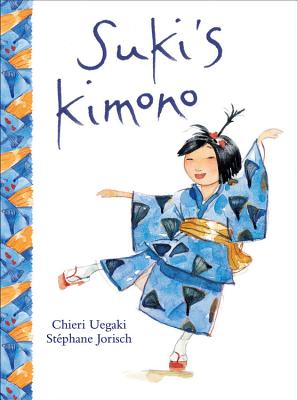
Suki's Kimono by Chieri Uegaki {The Children's Bookshelf}

As Sprout grows and makes friends, we have begun to talk about certain topics more and more. Being kind to others is a biggie, as is sharing (is this not a perpetual talk parents have with preschoolers??). But one topic I didn't expect to talk about as much as we do is identity. You see my darling son, while relatively strong-willed, is also a pleaser, and he wants very much to be just like his friends -- who among us can't relate to that? And so we've seen in the last several months a slow denying of things he likes in favor of things his friends like, or a shift in what he wants to take for "share day" based on what he thinks others will bring.

In these instances, we let him make his own choices, but we also gently remind him that he needs to be true to himself. What Sprout wants is a theme we return to again and again -- as in, is this what Best Friend of the Moment likes, or what Sprout likes? Sometimes he clings to the choice he's made, but sometimes he does rethink and select something we know is more "him". It's an ongoing discussion, and we know it's by no means going to reduce, quite the opposite. But we feel it's important to reinforce that his own identity is pretty awesome.


Naturally books that we share together are a great way to stress this idea with Sprout. One in particular that we recently checked out, Suki's Kimono by Chieri Uegaki, presents a character who's very confident and comfortable in her own skin, even after she has some brief doubts. Suki's determined to wear her favorite outfit on the first day of school. The outfit just happens to be her kimono, which her grandmother gave her on a very special outing over the summer. The outfit brings back warm memories of a wonderful day with someone she loves. Her sisters caution Suki that other kids will tease her, but Suki's unconcerned, even when her friend Penny tells her she's dressed funny ("I'm not dressed funny," Suki replies). She even shares about her kimono in front of the class, and does a little dance like the festival dancers she saw with her grandmother. But then Suki feels a little awkward -- will the other kids laugh, like her sisters warned her?

Delicate illustrations by Stéphane Jorisch are the perfect accompaniment to this tale (we've loved his previous work, especially Betty Bunny Loves Chocolate Cake). The scenes where Suki and her grandmother attend the street festival draw young readers right into the moment, as you can just about hear the beat of the drums and smell the delicious treats too. Most of all, I love Suki's confidence throughout the story. Uegaki could easily have written Suki as embarrassed or slinking off to change her clothes at some point during the day. But she didn't. Instead Uegaki gave Suki the determination to share one of her favorite memories through the clothes she wears. Even when she is faced by a silent classroom after she dances for them, Suki's never willing to hide who she is -- and fortunately, the class all applauds her performance for the wonderful experience it was.

If we want our kids to be themselves, we need to surround them with examples of confidence and self-assurance to inspire them. Suki's Kimono is a terrific instance where a character believes in herself, even when others aren't so sure. And that's exactly who I want Sprout to be, no matter what comes his way.

Suki's Kimono by Chieri Uegaki, published by Kids Can Press
Ages 3-6
Source: Library
Sample: "But Suki shook her head. She didn't care for new. She didn't care for cool. She wanted to wear her favorite thing. And her favorite thing was her kimono."
Recommended

----------------------------------------------------------------------------

This post is part of The Children’s Bookshelf, a weekly linky party with the goal of connecting parents with great books for their kids. Do you have a book review, literacy or book-related post that you think will be helpful for parents? If so, please add your link below.

NOTE: By linking up you are giving permission for any of the co-hosts to pin and/or feature a your photo on a future The Children’s Bookshelf post. Kindly link up to an individual post, not your blog’s homepage. The hosts reserve the right to delete any links to homepages, commercial links, repeat links or otherwise inappropriate links. Thank you for your understanding.

You can also follow The Children’s Bookshelf on Pinterest or visit TCB’s co-hosts: Sprout’s Bookshelf, What Do We Do All Day?, No Twiddle Twaddle, Smiling Like Sunshine, My Little Bookcase, The Picture Book Review, MemeTales and Mouse Grows, Mouse Learns. You can find more details here.


Wednesday, April 3, 2013

Spring Ahead! Four Picture Books to Plant Some New Ideas

It's spring! Lovely, glorious spring! We had a terrific time over Easter weekend, playing outside, going for bike rides, and just generally enjoying the feeling of not being bundled up in raincoats and boots. While we're not silly enough to think that the rain is gone yet -- after all, we do live in the Pacific Northwest -- it was wonderful to have a bit of spring idyll.

And of course that spring weather means that we're in the mood to read about all things growing. Spring provides a host of excellent topics for children's books, providing an introduction into the growth cycle and the rhythm of the seasons. All the aspects of spring are so much fun, aren't they? Planting, watching flowers bloom, seeing butterflies and birds, getting outside and becoming more connected to the earth. Can't wait to do more of that this year with Sprout, now that he's getting old enough to do more than just eat handfuls of dirt. :)


We brought home a ton of great spring-themed reads from the library, and sorting through to find the best was no mean feat. I took my cue from Sprout on this one, as he once again has some very definite preferences among the titles we read together. His most favorite was a title that I added as an afterthought, and I'm glad I did: City Green by DyAnne DiSalvo-Ryan. This book has an urban setting, so it's perfect for kids who maybe won't be sowing seeds in their own backyards. When an old building is knocked down in Marcy's neighborhood, all the neighbors work together to turn the patch of land into something beautiful -- all but Old Man Hammer, who is nothing but unpleasant about the whole thing. But Marcy stumbles on Old Man Hammer's secret, and soon discovers that, just like with the earth, when you scratch the surface of someone, there are hidden places underneath. This is a lovely story of community involvement and intergenerational relationships, and the diversity included is definitely an added bonus.


A friendship between young and old also forms the basis for George Shannon's Seeds. Illustrated by Steve Björkman, the pictures capture the spirit of Shannon's story perfectly, lending a slightly impressionist feel that's energetic at the same time. Warren and Bill are friends -- Warren helps Bill in his yard, and the older man draws or plays games with Warren. But then Warren's family moves away, and he misses his friend terribly. So Warren writes Bill a letter, and Bill writes back, with a surprise that makes Warren's loneliness -- and his yard -- much brighter. Not only does this book touch on the themes of loss and connection, it also provides a great example of the notion that friendship, like a beautiful garden, blooms in unexpected places. (Check your library or used bookstore for this older title.)


One of my favorite things about spring is the blossoming of the flowering cherry trees. Sprout knows this, and so every time we see one when we're out and about, he yells, "There's your pink trees again, Mama!". And so the fact that Diane Muldrow's We Planted a Tree features a spread with pink cherry blossoms just delighted him, enough that we read this one several times together. This is definitely an eye-popper, with retro-vibed illustrations by the delightfully quirky Bob Staake. Honestly, I could look at his work forever, it's that fun and full of life, as is Muldrow's poem about the growth of trees and their connection to humans. The book shows people from all corners of the globe experiencing the joy of trees - from their leaves to their shade, from fruit and flower to maple syrup and beyond. The message, that as trees grow and thrive, so do we, is timely and spot-on. Best of all, there's a reference to the Green Belt Movement of Kenya's Dr. Wangari Maathai, a connection to East Africa that seals this one as a winner in our book.


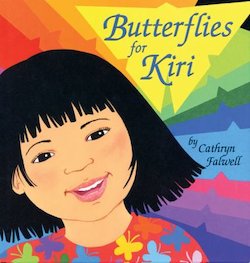
Last but not least is Butterflies for Kiri, a book about art and perseverance, that wraps its message in the beauty of a spring day. Cathryn Falwell's previous books have been favorites of ours, and this one's no exception, both intriguing to the mind and to the eye. When Kiri's Auntie Lu sends her a book of origami for her birthday, Kiri sets out at once to make a beautiful origami butterfly. But the paper folding is much harder than Kiri bargains for, and she soon gets frustrated. Still, she's determined, so every day she practices making a butterfly with scrap paper. And then one day, inspired by the gorgeous spring weather, Kiri decides to capture her feelings with an art project. At first things don't turn out how she intended them to, but this time Kiri's not giving up -- and all that practice pays off as she completes her piece with a perfectly folded butterfly. I love the message here, that difficult things take practice and patience, and I especially love the smile on Kiri's face as she shows off her completed masterpiece.

As the days get longer, there's more light for reading just one more bedtime pick. If you're squeezing in one of these springtime favorites, you may want to leave time for a reread (or two!).

Friday, February 8, 2013

3 Terrific Chapter Books for Chinese New Year!

It's almost Chinese New Year! Sprout has a sort of horrified fascination with snakes at the moment, and when I told him this coming year was the Year of the Snake he wasn't sure whether to be thrilled or freaked out (Mama is definitely in the latter camp).

Last year we shared some great picture books for Chinese New Year, so this year I thought it would be fun to feature books for slightly older readers. Because let's remember that these sorts of celebrations aren't just for the youngest set - there's all kinds of celebratory fun to be had for older kids, teens and adults too. And as I pointed out last year, it's really important to choose selections that have cultural accuracy, in order to share with our kiddos the most authentic view of the holiday and the cultures that celebrate the Lunar New Year.


First up is Laurence Yep's The Star Maker. Yep is a prolific author with many award-winning books to his credit, including historical fiction and fantasy titles as well. In The Star Maker, Yep gives us the story of Artie, whose desire to fit in with his obnoxious cousin Petey leads him to make a rather rash promise - that he'll supply firecrackers for Chinese New Year for all the cousins. Now Artie has to figure out how to come up with all the money to pay for it. And he thinks he has the solution in his Uncle Chester; now if only Uncle Chester will come through. Set in 1953 in Chinatown, The Star Maker is a slice of life that kids will thoroughly enjoy. Even better, the fast pace and realistic conflicts makes it a perfect choice for those just transitioning into more advanced chapters.


Up next is Grace Lin, one of my favorite authors, and her novel The Year of the Dog. Pacy is excited because this is supposed to be the year she finds her special talent. What will it be? She has no idea, but she does know this is going to be a lucky year when she makes friends with Melody, who is Taiwanese just like Pacy. As the two girls get into trouble, have adventures, and work hard to find Pacy's talent, they learn about friendship, family, and the process of finding yourself when you have a foot in two cultures. This is a great book for readers who love stories about bright, determined heroines - and look for more of Pacy's adventures in The Year of the Rat and Dumpling Days.


Lensey Namioka has written a series of chapter books about the Yang family; while none of them focus specifically on Chinese New Year, they all provide an excellent perspective, that of a family of Chinese immigrants navigating life in America. In the first novel in the series, Yang the Youngest and His Terrible Ear, we hear the story of Yingtao, the only untalented member in a family of brilliant musicians. Yingtao is struggling to fit in not only at home but also in this strange new American life, where even his name is hard for Americans to understand. But Yingtao soon makes a friend and finds an activity he's truly passionate about -- only it isn't the violin. This is a well-written story of identity and individuation, and kids will understand Yingtao's twin desires to be himself without disappointing his family.

What are your favorite novels for Chinese New Year? We'd love to hear how you celebrate the holiday, and what traditions are most important to you and your family. We hope books are part of the fun!

Thursday, January 24, 2013

Mad, Mad, Mad! - 4 Picture Books for Taming Tantrums

Whoever dubbed them "the terrible twos" must have never have spent time with a three-year-old. I'm here to tell you that two has nothing on three when it comes to testing, challenging and fighting for control over every.little.thing. Seriously! And because Mama can't, or won't, give in to the incessant demands for things to be done Sprout's way, we inevitably run smack into the dreaded temper tantrum.

(And to the nice elderly lady who smiles and says "Enjoy every moment" when my kid is melting down in the checkout line at Target - surely you didn't mean this particular moment, right?)

Anyway, in an effort to give Sprout words for his emotions, and to help him understand that his feelings are all part of life as we know it, I of course turned to books. There are, thankfully, a number of picture books about anger and tantrums, but here are a few that especially resonated with us, and maybe helped a little with that anger management too.


First up is Rachel Vail's Sometimes I'm Bombaloo, a great springboard for discussion about the changeable nature of moods. Katie is a pretty easygoing kid, usually. She loves her family and she has great manners, even at the table. But every so often Katie gets pushed to the edge - and that's when she becomes Bombaloo, an angry monster who acts first and thinks later. Vail does a great job of exploring Katie's emotions, even hinting at what might have driven Katie to go Bombaloo (her brother knocking over her block tower. Sprout understands this one completely.) Bombaloo has consequences, as Vail demonstrates, but just as quickly as she disappeared, Katie is back to herself again. I love that there are apologies and hugs after the Bombaloo phase, showing that being sorry for your actions is an important part of the process. And it's given us a great new term for expressing our anger, which we now call "going Bombaloo".


Finn Throws a Fit by David Elliott follows a household through the rages and stages of one little boy's tantrums. Again, we have a generally mellow kid who, when his mommy offers him his favorite peaches, is suddenly overcome by a temper fit resulting in all kinds of crazy consequences. There are storm clouds in the nursery, then lightning in the kitchen, and before you know it Finn's hapless parents are trying to survive a storm of apocalyptic proportions. But it all passes soon enough, and Finn is back to his sweet self. Though Elliott doesn't delve into as deep an examination of mood as Vail does, he does chart the escalation of the temper tantrum effectively (Sprout says, "uh-oh, he's getting really mad now!"). And the messy, sketchy artwork by Timothy Basil Ering suits the varying moods of a tantruming toddler to the T. Peaches, anyone?


In Linda Urban's Mouse Was Mad, the title character is peeved from the get-go. We never do find out what set him off, but the more Mouse tries to act out his frustrations, the more angry he gets. He's hopping mad - but he can't hop near as well as Hare. He's stomping mad - but Bear's the king of stomping. And with each successive failure to properly demonstrate anger, Mouse gets more and more explosive. Finally Mouse is so mad that he can't even move. . . and he finds that in standing still, his anger suddenly evaporates. We talked about the solution Mouse comes to at some length as we read this book, and even tried it once, with shockingly effective results. Of course, the trick is getting Sprout to stand still, but Urban's incredibly important lesson - that sometimes you need to step away and just cool off - seems to be sticking with him. And anyway, it's better than being "rolling on the ground" mad!


I usually limit these quick review posts to three titles, but I just have to mention one of my favorites, Norton Juster's Sourpuss and Sweetie Pie. Readers will recognize the multiracial family from Juster's earlier book The Hello Goodbye Window, one of our all-time favorites. This time our little girl shows off her dual personalities, the contentious Sourpuss and compliant Sweetie Pie, as she visits her grandparents. It's hard to know just what makes one show up and the other disappear, but it's very clear that these two couldn't be more dissimilar. Sprout loves to pick out which one is Sourpuss (she of screwed-up face and crossed arms) and which one is Sweetie Pie (smiles and laughter, of course). And sometimes both girls are there at once, to Nanna and Poppy's great consternation. Tracking the evolution of moods isn't easy, but Juster and illustrator Chris Raschka give us one especially genius spread that does just that, as our heroine turns from angry to happy in the space of a few sentences. Parents especially will identify with the exhausted Nanna and Poppy, who hope for nothing more than to see just Sweetie Pie at the breakfast table.

What are your favorite titles for coping with emotions? Drop me a line and we'll check them out - we can always use one more!

Thursday, November 8, 2012

30 Days of Picture Books - Cora Cooks Pancit by Dorina K. Lazo Gilmore

It's Day 8 of Picture Book Month. Today we're thinking about relationships. There's nothing like the act of sharing a book with someone to cement your relationship. Common stories unite all of us, as a people and as smaller units of family and friends. When I read an incredible book, the first thing I want to do is share it with everyone I know -- well, you know that, because that's why you're reading this! And I think it's important to use picture books to build that shared bond with our little ones.

But picture books can also illustrate important aspects about relationships, such as the connections between the generations. Family history is more than just having the same last name. It's a heritage and shared language that is passed down from one generation to another. This is how the knowledge of our families is kept alive, the traditions and ties that link us to our past and to our future.


Food is, for most families, a crucial part of the shared experience. Think back to your childhood and I'll bet you find that there's something like grandma's pies or uncle's barbecue that still makes your mouth water, even as a memory. And that's the case in Cora Cooks Pancit, a picture book by Dorina K. Lazo Gilmore that celebrates one family's culinary legacy.

In the book, Cora feels left out when the family cooks because as the youngest, she only gets the little-kid jobs. Then one day her siblings are out of the house and Cora's mama suggests they cook together. As they make a favorite family dish, Mama tells Cora about her Lolo, or grandfather, who cooked for the Filipino farmworkers and shared stories of his youth in the Philippines as he did. Cora loves hearing about Lolo and learning how to make pancit, one of her favorite dishes. Best of all, when her brothers and sisters come home, Cora gets to tell them that she did all the "grown-up" jobs this time around!

This lovingly told story of a Filipino family sparkles with pictures by illustrator Kristi Valiant. I love the way Valiant takes us right into Cora's perspective, as she looks down on a steaming pot of scrumptious-looking noodles and veggies (don't worry, the recipe's included). And Cora's expressive eyes shine with pride as her whole family settles down to a meal cooked by the youngest, but with ties to generations past.

Gather your kiddos for a reading of this delicious tale of food and family, reminiscent of another favorite, Linda Sue Park's Bee Bim Bop. Gilmore evokes a mood of togetherness and connection in a story that everyone can enjoy.

Cora Cooks Pancit by Dorina K. Lazo Gilmore, published by Shen's Books

Monday, October 22, 2012

Picture Book Review - Dragon Dancing by Carole Lexa Schaefer

Ever since Sprout started preschool, art has become a big thing for him. His teachers believe in affording the kids lots of opportunities to stretch their creative muscles, providing them with all kinds of fun art supplies and giving them (mostly) free rein. One night a few weeks ago I came in to pick him up and he was busily constructing a caterpillar for Daddy's office - cut-up egg carton, pipecleaner antennae and googly eyes, just like I remember doing when I was in elementary school. It's so much fun to see the pride in his eyes when we display one of his fantastic creations, such as the neon noodle art and sponge paintings that are hanging on the family fridge even as we speak.


That same spirit of creativity is alive and well in Carole Lexa Schaefer's Dragon Dancing. Set in a preschool much like Sprout's, populated with a diverse cross-section of kiddos, the story begins with the class reading a book about dragons. Fueled by thoughts of these fire-breathing beasts, the students begin using their art supplies to create a magical dragon of their own. Soon the children, "in a long dragon line", are transported right out of their classroom and into strange and beautiful worlds beyond. The flights of fancy this creative parade takes can only be brought back to earth when the children are called back in by their teacher (of course).

One of the things we like best about Dragon Dancing is the way illustrator Pierr Morgan makes use of every bit of the page to tell her visual story. Sprout can pretty much read this for himself, Morgan's pictures are so vivid and lively. She captures the joy of the child-dragon as it ascends a snow-topped peak or tiptoes past breakfasting panda bears, starkly black-and-white against a background of soft bamboo forest. I'd love to know just how the artwork was created, because it strikes just the right balance between realism and softly whispered imaginings. This one's definitely a feast for the eyes, if ever there was one.

And the text is great too, filled with the kinds of phrases any true devotee of read-aloud will love to share. The dragon's not just dancing through the flowers, he is "swirl-whirling around whispery meadows." Rather than just swimming, he's "slip-sliding across foamy seas." You can just about feel the atmosphere Schaefer's dreamed up, just by the choice of dialogue she employs. This is magical stuff, and a great beginning to conversations about word choices and shades of meaning.

That is, if you get that far - you may just be captivated, as Sprout and I are, by the bounty of delightful imagery each page brings. At the end, Sprout's completely tickled by the fact that the children transform back into themselves just in time to share Mei Lin's birthday snack - lollipops, which he feels sure a dragon wouldn't really enjoy that much. And who knows, maybe he's right - but then again, a dancing dragon could need a little sugar boost too.

Don't save this one for Chinese New Year - bring it out any time you and your little ones want a feast for all your senses, in the form of this vibrant storytime choice!

Dragon Dancing by Carole Lexa Schaefer, published by Viking
Ages 2-6
Source: Library
Sample: "After, in the art room, we decorate for Mei Lin's birthday with sparkly paper and ribbons. Snip, twirl, flip. 'Look at me!' Mei Lin shouts. 'I'm Birthday Dragon!'"
Recommended

Friday, September 21, 2012

Chapter Book Review - The Year of the Book by Andrea Cheng

Sometimes I just desperately wish for time travel. Usually it's because I'd like to go back and shake my 20-something-year-old self into finishing my degree (since I always wonder how much further I'd be in my career if I'd done it then instead of now). Sometimes it's because I'd like to reassure my 30-something-year-old self that this adoption thing really is going to turn out great and totally be worth the risk. But most often, it's because I come across a book that I would love, dearly love, to go back in time and present to my grade-school self.


Most recently that desire was sparked by Andrea Cheng's The Year of the Book. This is the kind of book I would have lived for as a middle-grader, one that is bursting at the seams with character and heart and all kinds of fantastic novels to boot. Oh, and just about the most adorable drawings, courtesy of the delightful illustrator Abigail Halpin (whose pictures for Penny Dreadful made me love that fantastic book even more, if that's possible!).

Anna's the kind of girl I was at her age -- bookish, slightly lonely and yet fulfilled in herself. She was best friends with Laura, but now all of a sudden Laura's hanging out with a different crowd and they don't seem to have time for Anna. This bothers her, but she's got her own life: her friendship with crossing guard Ray, her creative pursuits in the realm of sewing, and of course, her books. In fact, a book is the place Anna'd most like to be, when she's feeling out of place in Chinese school for being ABC (American-born Chinese) or when she's embarrassed by her report on winter break, when she built paper airplanes with her brother most days. As each novel she reads unfolds, Anna not only learns more about her fictional friends, but also finds more confidence in who she is, and what she has to offer to a real-life friend.

Fans of Grace Lin's Pacey novels (The Year of the Dog, The Year of the Rat, and Dumpling Days) will find a lot to love about Anna Wang as well. For starters, Anna is also a girl with a foot in two worlds, both American and Chinese, and she doesn't always feel she fits in either one. Then, too, there is the search to find a friend, which both Pacey and Anna experience. I love that Cheng gives us a very realistic scenario for Anna to face, that of friends suddenly changing allegiances for no apparent reason. That's grade school for you, isn't it? And though Laura and Anna keep the thread of friendship, it isn't quite the same while Laura's hanging out with another crowd. There's also the fact that Anna isn't always sure how she feels about her parents. While she's proud of her mother for learning to drive and attempting to master English, Anna sometimes finds herself embarrassed by her mom's Chinese-ness. Kids of all backgrounds will identify with Anna's struggle to reconcile her feelings.

Though The Year of the Book is pretty short, and the story is comparatively quiet, there's a lot to think about here. It's great to see an Asian American heroine for this age, one who is totally relatable to the audience Cheng is writing for.The story is well-told, the characters finely drawn, and overall it's a real and true pleasure to read. And Halpin's illustrations add just the right note of whimsy - her renditions of familiar book covers are particularly charming, and kids just may find some new titles for their reading lists. What could be better than that?

The Year of the Book by Andrea Cheng, published by Houghton Mifflin Harcourt
Ages 8-12
Source: Library
Sample: "Writing that makes me think about Mom. I always wished I had a mom who spoke perfect English and who got her driver's license when she turned sixteen. But if Mom wasn't the way she is, she wouldn't be my mom and I wouldn't be me. Suddenly I just want to go home, but I have to finish my work first."
Recommended

Thursday, September 6, 2012

Picture Book Review - My Family is Forever by Nancy Carlson

As a bookseller, one of the titles I remember seeing come across my counter with particular frequency was Nancy Carlson's I Like Me!. There's something about this title - its bright pink cover, and that exuberantly happy pig dressed in a tutu-esque princess dress that just jumps right out at you. Whenever someone asked for something to help bolster a child's self-esteem, this was the first title that popped into my head, and I can't be alone because this one's got real staying power. Published in the late 1980s, I Like Me! remains popular - a quick check of our library catalog as I'm typing this post reveals that our copies are all checked out.


In a similar vein, Carlson's picture book My Family is Forever aims to bolster the self-esteem and identity of children who have been adopted. Told from the point of view of a young Asian girl (who I'm guessing is Korean, based on the author's note), the book opens up the topic of transracial families right away. The narrator's friend Jeffrey "has his mom's red hair and his dad's big ears", while she herself looks "just like. . . me! (And I'm pretty cute.)". She explains that this is because her family was formed by adoption - I appreciate that this is dealt with matter-of-factly, and that adoption is discussed as one of many ways families are formed.

Our heroine goes on to discuss all the ways she's similar to her adoptive parents, in their interests and talents and ways they enjoy spending their time. But she also wonders about her birth parents. Carlson deals with this head-on, as the girl wonders if she favors certain members of her birth family in certain ways. While it's clear that she has a connection to her past, one that her parents have discussed and which she is encouraged to embrace, she's also decidedly an important member of her adoptive family. A spread depicting a holiday with the extended family shows plenty of diversity in  hair and skin colors, as well as ages. Everyone is part of this group, it's clear, and the bonds that tie the family together are truly forever.

Striking a careful balance, Carlson honors the protagonist's first family while finding lots of ways to celebrate the fact that the girl now has a forever family that clearly adores her. My Family is Forever is a cheerful, upbeat discussion-starter that adoptive families will be glad to share with even the youngest child. An excellent choice for families of all sorts!

My Family is Forever by Nancy Carlson, published by Viking
Ages 3-8
Source: Library
Sample: "Being a family means helping each other out. / We love each other in good times, and we love each other even when things don't go quite right."
Recommended

Monday, August 27, 2012

Picture Book Review - Sumi's First Day of School Ever by Soyung Pak

Fall is in the air! It's hard to believe, because our summer started so late, but pretty soon those big yellow buses will be rolling out and the kiddos will be on their way back into the classroom. And as with all transitions, the new school year can be a tough thing for many students, especially those who are learning new languages and new living situations as well. Whether the child is an adoptee or part of a family of immigrants, an unfamiliar place presents more than a few challenges and fears.


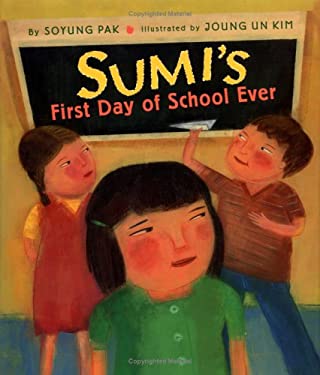
In Sumi's First Day of School Ever, Soyung Pak tells the story of a young girl just beginning her first day of classes. Sumi is Korean, and she speaks very little English, though her mother has taught her what to say if someone asks her name. She's never been to school before and she finds the whole experience frightening. From the forbidding fence around the schoolyard to the noisy, boisterous children who all seem to know just where they belong, Sumi is overwhelmed. School is a scary place, Sumi thinks, and she hangs back, watching others to know just what she should be doing. It's all pretty intense for this shy newcomer.

Fortunately Sumi's teacher is kind and gently encouraging to her new student. When she's allowed to draw a picture later in the morning, things begin to seem a little better. And then at recess, Sumi finds a stick and is drawing in the dirt when another student approaches. Mary quietly joins Sumi in drawing a scene, then introduces herself. And Sumi knows just what to say, thanks to her mother. Maybe, Sumi thinks, school is not-so-lonely after all.

Pak's sensitive portrayal of a young girl struggling to find her place in a new environment will hit home with many readers, particularly those who have felt the same way Sumi does, like she's in over her head. Joung Un Kim's soft color palette and warm backgrounds add depth to the story, and Sumi's emotions are evident in every scene. Kim keeps Sumi as the focal point of each spread, but provides appropriate context for what's happening, such as the scene where another boy makes fun of Sumi (he later apologizes after prompting from the teacher). Most importantly, the book doesn't make light of Sumi's feelings or her struggle to find her footing. Rather, it emphasizes that the most important key to fitting in might just lie in being yourself. When Sumi begins to draw, she finds common ground with another student, and in such a simple moment a friendship is born.

For those transitioning to a new environment, whether that means a new school or a new country, Sumi's First Day of School Ever can be a great tool to open discussion about how they are feeling. Equally important, this is a great way to talk with other kids about how to reach out to an unfamiliar face in their classroom, making a new friend and building a connection that benefits everyone.

NOTE: this is an older title and not readily available - check your library or a used bookstore, it's worth finding!

Sumi's First Day of School Ever by Soyung Pak, published by Viking
Ages 3-7
Source: Library
Sample: "A boy stuck out his tongue. He made a noise. He squished his eyes. / School is a mean place, Sumi thought."
Recommended