It's Day 12 of our series of 30 Days of Diverse Picture Books! One thing I really love about the #WeNeedDiverseBooks movement is that by supporting diverse titles, you are often supporting diverse authors as well. It's fantastic when I get to read a book to Sprout and then we can talk about the author's origins - especially great when we can flip to an author photo and he sees someone who looks a lot like him!
Tonight's pick is by Sarvinder Naberhaus, who's from India, and whose debut picture book, Boom Boom, is a celebration of the seasons as seen through the eyes of a multicultural group of kids. The children are all part of a preschool class, and through a series of vignettes taking place in different seasons, readers get to experience the natural world with them.
Naberhaus's text is a terrifically simple poem with spot-on rhyme and rhythm. This would be a serious joy for storytime, with plenty of action words that kids could get up and move to, yet it's elemental enough that even very young ones will have no trouble catching on. The pictures are by Margaret Chodos-Irvine, one of my favorite artists for young children. Her illustration style is bold, energetic and textural, all things that make Boom Boom a standout for any collection.
Next time you're looking for a book on seasons, consider reaching beyond the usual suspects for a more inclusive pick. Books like Boom Boom will make you glad you did!
Boom Boom by Sarvinder Naberhaus, published by Beach Lane Books
Showing posts with label seasons. Show all posts
Wednesday, November 12, 2014
Wednesday, April 16, 2014
Picture Book Review - Baby Bear Counts One
Kids and animals are a natural match, aren't they? Sprout's been fascinated by animals almost from the first day we met, quickly getting over his hesitations with our dog Maxie to the point that within a few days of coming home, he was imitating her behavior. Our early days as a family were cemented by trips to the zoo and watching squirrels out our dining room window. Once we started visiting the library, the animal books came home in droves - we went through obsessions with dogs, cats, sea creatures and now dinosaurs. Lately Sprout's become a collector of animal-related trivia; spend much time with him, and you're bound to learn all kinds of facts about peregrine falcons and even, as I recently found out, the African crested porcupine (yep, it's a real animal).
And I know Sprout's not alone in his love for critters, which is why I tend to share so many of them here on the blog. (Also, I really like them - and it's my blog, so there.) Today's pick is one that will be a huge hit with the youngest kiddos, because it marries a concept and adorable animals. Honestly, take a look at the cover for Ashley Wolff's Baby Bear Counts One -- can you even stand the cuteness??
This title's a follow-up to Wolff's Baby Bear Sees Blue, which as you might expect was all about colors. With this outing, Baby Bear is watching some strange things happen in the forest around him. The animals are preparing for winter, and Baby Bear is noticing what they're up to -- and counting as he goes. Squirrels drop acorns on him, prompting Baby Bear to count how many of the quick gray critters are cavorting around (two, as it happens). Turkeys are filling up on grapes before the cold weather moves in, and Baby Bear counts six of them. And the geese are flying way in search of warmer climes -- this flock is nine strong, by Baby Bear's reckoning. Fortunately, everyone accomplishes what they need to before the snowflakes fly. And of course, Baby Bear counts those too!
Wolff uses linoblock techniques for the striking images throughout Baby Bear Counts One. I'm not sure how the illustrations could be better - drenched in color, strong graphics, and plenty of little visual surprises that kids can pore over. This would absolutely work for babies and toddlers too. Best of all, there's such a lovely sense of fall running throughout. I'm fully aware that it's spring now, and we should be reading about bunnies and chicks and all things vernal, but Baby Bear is just too cute to resist. Reading this one, you'll be so drawn into the fall preparations that you'll probably want to do what we did and snuggle up in the blankets to share this book one more time through.
For creature-minded kiddos, for talking about seasons, or for just sharing a concept book that gives even more than just one-two-three, Baby Bear Counts One is a charming addition to any kid's bookshelf!
Baby Bear Counts One by Ashley Wolff, published by Beach Lane Books
Ages 1-3
Source: Library
Sample: "Deep down in the den, Baby Bear perks his furry ears. Thockthockthockthockthock! 'Mama, who woke me?' he asks. 'That is the woodpecker,' says Mama, 'hunting beetles before winter comes.' / Baby Bear counts 1."
Recommended
Monday, September 30, 2013
Fletcher and the Falling Leaves by Julia Rawlinson
Oh, fall. I knew you were coming, but somehow you still managed to sneak up on me, with your windy weather and your ever-so-rainy days. Last week Hubs and I scrambled in vain to get a backyard project finished, one we've been working on for most of the summer, but alas, we didn't quite make it before the blustery weather roared in. (Holding out hope for a respite in the rain later this week.)
In all honesty, though, fall is my favorite season. I'm an October baby, and that's probably why I love most of the aspects of this time of year: crisp fall days, soup simmering on the stove, visits to the pumpkin patch, baking pie with juicy fresh-picked apples. And in the interest of full disclosure, I should admit that I don't really even mind the rainy days, because those give me one more excuse to snuggle inside on the couch with a good book -- like I need one more excuse. :)
We have a lot of favorite fall titles around here, but we're always looking for another to add to our roster. This year we rounded up an older title, Julia Rawlinson's Fletcher and the Falling Leaves. This one was new to Sprout, though it's a title I'd read before. Honestly the first time I read it, I wasn't that impressed - but I can say that reading this with my own kiddo gave me a fresh perspective, and I realized I'd misjudged it somehow. (Hey, it happens, and I'm okay with admitting when I'm wrong.)
Sprout thoroughly enjoyed this story of a little fox named Fletcher and the changes that come to his favorite tree. Fletcher notices that something's up when the leaves of the tree starting turning colors and getting crinkly, but it's when the leaves begin to fall to the ground that Fletcher gets really worried. He looks for solutions to put the leaves back on the tree, but Fletcher's ingenuity is no match for the strong autumn winds. Try as he might, Fletcher can't save his friend's leaves - but he discovers that, for a tree, losing leaves is not only inevitable, it also might bring something even better.
Rawlinson's story is a gentle introduction into the topic of change and dealing with loss, something that I think is important for all kids. This is an excellent way to begin discussing these subjects, along with the notion that sometimes the changes we fear turn out for the best after all. The illustrations by Tiphanie Beeke are one of the best parts of Fletcher's story - awash with light and subtle color, Beeke's spreads set off the smudgy fox and his friends to good effect. It's clear that Beeke spent some time studying nature before she did these pictures, as those color choices reflect a knowledge of what trees really look like, for example. And of course the final spread is full of wow factor, which you know if you've read this one (if you haven't, I'm not spoiling it for you!).
I'm quite glad I gave this one a second chance. The combination of Rawlinson's sensitive story and Beeke's pictures make this a real winner for any autumn bookshelf. Grab a cup of tea, a warm blanket and Fletcher and the Falling Leaves, for a cozy fall read-aloud session that you and your kiddos will love!
Fletcher and the Falling Leaves by Julia Rawlinson, published by Greenwillow Books
Ages 3-6
Source: Library
Sample: "The world was changing. Each morning, when Fletcher bounded out of the den, everything seemed just a little bit different. The rich green of the forest was turning to a dusty gold, and the soft, swiching sound of summer was fading to a crinkly whisper. Fletcher's favorite tree looked dull, dry, and brown. Fletcher was beginning to get worried."
Recommended
In all honesty, though, fall is my favorite season. I'm an October baby, and that's probably why I love most of the aspects of this time of year: crisp fall days, soup simmering on the stove, visits to the pumpkin patch, baking pie with juicy fresh-picked apples. And in the interest of full disclosure, I should admit that I don't really even mind the rainy days, because those give me one more excuse to snuggle inside on the couch with a good book -- like I need one more excuse. :)
We have a lot of favorite fall titles around here, but we're always looking for another to add to our roster. This year we rounded up an older title, Julia Rawlinson's Fletcher and the Falling Leaves. This one was new to Sprout, though it's a title I'd read before. Honestly the first time I read it, I wasn't that impressed - but I can say that reading this with my own kiddo gave me a fresh perspective, and I realized I'd misjudged it somehow. (Hey, it happens, and I'm okay with admitting when I'm wrong.)
Sprout thoroughly enjoyed this story of a little fox named Fletcher and the changes that come to his favorite tree. Fletcher notices that something's up when the leaves of the tree starting turning colors and getting crinkly, but it's when the leaves begin to fall to the ground that Fletcher gets really worried. He looks for solutions to put the leaves back on the tree, but Fletcher's ingenuity is no match for the strong autumn winds. Try as he might, Fletcher can't save his friend's leaves - but he discovers that, for a tree, losing leaves is not only inevitable, it also might bring something even better.
Rawlinson's story is a gentle introduction into the topic of change and dealing with loss, something that I think is important for all kids. This is an excellent way to begin discussing these subjects, along with the notion that sometimes the changes we fear turn out for the best after all. The illustrations by Tiphanie Beeke are one of the best parts of Fletcher's story - awash with light and subtle color, Beeke's spreads set off the smudgy fox and his friends to good effect. It's clear that Beeke spent some time studying nature before she did these pictures, as those color choices reflect a knowledge of what trees really look like, for example. And of course the final spread is full of wow factor, which you know if you've read this one (if you haven't, I'm not spoiling it for you!).
I'm quite glad I gave this one a second chance. The combination of Rawlinson's sensitive story and Beeke's pictures make this a real winner for any autumn bookshelf. Grab a cup of tea, a warm blanket and Fletcher and the Falling Leaves, for a cozy fall read-aloud session that you and your kiddos will love!
Fletcher and the Falling Leaves by Julia Rawlinson, published by Greenwillow Books
Ages 3-6
Source: Library
Sample: "The world was changing. Each morning, when Fletcher bounded out of the den, everything seemed just a little bit different. The rich green of the forest was turning to a dusty gold, and the soft, swiching sound of summer was fading to a crinkly whisper. Fletcher's favorite tree looked dull, dry, and brown. Fletcher was beginning to get worried."
Recommended
Labels:
animals,
emotion,
friendship,
loss,
picture book,
seasons
Wednesday, July 17, 2013
Picture a Tree by Barbara Reid
Last summer our next-door neighbor cut down a couple of old apple trees in her yard. It was a sad experience for us because we loved to watch the squirrels and birds in those trees, plus we really enjoyed the shade they provided. It's been a year and while our own trees are flourishing now that the bigger ones aren't blocking the sun, we still miss those old trees. Sprout asks about them at least once a week, as in his comment this morning that, "You know, I can't tell why someone would just cut a tree down for nothing." (Me either, kid.)
Fortunately we had a little treasure hiding in the library basket that helped us talk through our thoughts about trees. Barbara Reid's Picture a Tree is a lovely, lyrical celebration of trees and all the ways we can see them. Reid describes how we encounter trees and how we might view them, as though they are characters in our personal stage-play of life. There are some really clever juxtapositions of illustration and phrase, resulting in a lot of subtle humor. The prose is spare, each sentence carefully constructed to relay Reid's message with no unnecessary words. As we read this one, we often had to stop and take in the meaning Reid was trying to impart, a trait of the best picture books, in my opinion.
I love the emphasis on diversity here - not only does Reid show us trees of all varieties and stages, but she also includes a multi-ethnic population as varied as the trees themselves. That's a great bonus for books like these, where race isn't the driver of the story and people are just people, unique to themselves. Plus the illustrations here are just marvelous. Reid uses a technique where she molds Plasticine to make her scenes, and blends in paint for effect. The result is really tremendous to see - it reminds me somewhat of those old clay-mation films of my childhood, because you honestly feel like Reid's characters are going to jump off the page, they're that expressive. That just adds so much depth to the overall message of Picture a Tree, broadening the kid-appeal even more.
This is a nice title to share with even the youngest children, to include in units about the seasons or nature, or just to browse through yourself. Adults will get the shades of meaning and humor, but kids will love this title too (Sprout definitely did, enough that we've had to keep renewing our library copy). Colorful and thoughtful, warm and expressive, Picture a Tree is just the thing to help young explorers understand all that trees are and can be - and to get them thinking about how we see things in very different ways.
Picture a Tree by Barbara Reid, published by Albert Whitman & Company
Ages 4-7
Source: Library
Sample: "There is more than one way to picture a tree. / You may see a drawing on the sky. / A game of dress-up. / The first drops of color. . . then all the art supplies at once."
Recommended
Fortunately we had a little treasure hiding in the library basket that helped us talk through our thoughts about trees. Barbara Reid's Picture a Tree is a lovely, lyrical celebration of trees and all the ways we can see them. Reid describes how we encounter trees and how we might view them, as though they are characters in our personal stage-play of life. There are some really clever juxtapositions of illustration and phrase, resulting in a lot of subtle humor. The prose is spare, each sentence carefully constructed to relay Reid's message with no unnecessary words. As we read this one, we often had to stop and take in the meaning Reid was trying to impart, a trait of the best picture books, in my opinion.
I love the emphasis on diversity here - not only does Reid show us trees of all varieties and stages, but she also includes a multi-ethnic population as varied as the trees themselves. That's a great bonus for books like these, where race isn't the driver of the story and people are just people, unique to themselves. Plus the illustrations here are just marvelous. Reid uses a technique where she molds Plasticine to make her scenes, and blends in paint for effect. The result is really tremendous to see - it reminds me somewhat of those old clay-mation films of my childhood, because you honestly feel like Reid's characters are going to jump off the page, they're that expressive. That just adds so much depth to the overall message of Picture a Tree, broadening the kid-appeal even more.
This is a nice title to share with even the youngest children, to include in units about the seasons or nature, or just to browse through yourself. Adults will get the shades of meaning and humor, but kids will love this title too (Sprout definitely did, enough that we've had to keep renewing our library copy). Colorful and thoughtful, warm and expressive, Picture a Tree is just the thing to help young explorers understand all that trees are and can be - and to get them thinking about how we see things in very different ways.
Picture a Tree by Barbara Reid, published by Albert Whitman & Company
Ages 4-7
Source: Library
Sample: "There is more than one way to picture a tree. / You may see a drawing on the sky. / A game of dress-up. / The first drops of color. . . then all the art supplies at once."
Recommended
Labels:
animals,
city,
multicultural,
nature,
outdoors,
picture book,
seasons
Wednesday, April 3, 2013
Spring Ahead! Four Picture Books to Plant Some New Ideas
It's spring! Lovely, glorious spring! We had a terrific time over Easter weekend, playing outside, going for bike rides, and just generally enjoying the feeling of not being bundled up in raincoats and boots. While we're not silly enough to think that the rain is gone yet -- after all, we do live in the Pacific Northwest -- it was wonderful to have a bit of spring idyll.
And of course that spring weather means that we're in the mood to read about all things growing. Spring provides a host of excellent topics for children's books, providing an introduction into the growth cycle and the rhythm of the seasons. All the aspects of spring are so much fun, aren't they? Planting, watching flowers bloom, seeing butterflies and birds, getting outside and becoming more connected to the earth. Can't wait to do more of that this year with Sprout, now that he's getting old enough to do more than just eat handfuls of dirt. :)
We brought home a ton of great spring-themed reads from the library, and sorting through to find the best was no mean feat. I took my cue from Sprout on this one, as he once again has some very definite preferences among the titles we read together. His most favorite was a title that I added as an afterthought, and I'm glad I did: City Green by DyAnne DiSalvo-Ryan. This book has an urban setting, so it's perfect for kids who maybe won't be sowing seeds in their own backyards. When an old building is knocked down in Marcy's neighborhood, all the neighbors work together to turn the patch of land into something beautiful -- all but Old Man Hammer, who is nothing but unpleasant about the whole thing. But Marcy stumbles on Old Man Hammer's secret, and soon discovers that, just like with the earth, when you scratch the surface of someone, there are hidden places underneath. This is a lovely story of community involvement and intergenerational relationships, and the diversity included is definitely an added bonus.
A friendship between young and old also forms the basis for George Shannon's Seeds. Illustrated by Steve Björkman, the pictures capture the spirit of Shannon's story perfectly, lending a slightly impressionist feel that's energetic at the same time. Warren and Bill are friends -- Warren helps Bill in his yard, and the older man draws or plays games with Warren. But then Warren's family moves away, and he misses his friend terribly. So Warren writes Bill a letter, and Bill writes back, with a surprise that makes Warren's loneliness -- and his yard -- much brighter. Not only does this book touch on the themes of loss and connection, it also provides a great example of the notion that friendship, like a beautiful garden, blooms in unexpected places. (Check your library or used bookstore for this older title.)
One of my favorite things about spring is the blossoming of the flowering cherry trees. Sprout knows this, and so every time we see one when we're out and about, he yells, "There's your pink trees again, Mama!". And so the fact that Diane Muldrow's We Planted a Tree features a spread with pink cherry blossoms just delighted him, enough that we read this one several times together. This is definitely an eye-popper, with retro-vibed illustrations by the delightfully quirky Bob Staake. Honestly, I could look at his work forever, it's that fun and full of life, as is Muldrow's poem about the growth of trees and their connection to humans. The book shows people from all corners of the globe experiencing the joy of trees - from their leaves to their shade, from fruit and flower to maple syrup and beyond. The message, that as trees grow and thrive, so do we, is timely and spot-on. Best of all, there's a reference to the Green Belt Movement of Kenya's Dr. Wangari Maathai, a connection to East Africa that seals this one as a winner in our book.
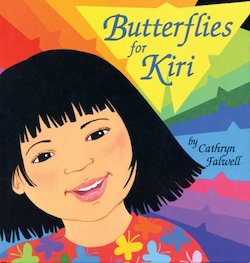
Last but not least is Butterflies for Kiri, a book about art and perseverance, that wraps its message in the beauty of a spring day. Cathryn Falwell's previous books have been favorites of ours, and this one's no exception, both intriguing to the mind and to the eye. When Kiri's Auntie Lu sends her a book of origami for her birthday, Kiri sets out at once to make a beautiful origami butterfly. But the paper folding is much harder than Kiri bargains for, and she soon gets frustrated. Still, she's determined, so every day she practices making a butterfly with scrap paper. And then one day, inspired by the gorgeous spring weather, Kiri decides to capture her feelings with an art project. At first things don't turn out how she intended them to, but this time Kiri's not giving up -- and all that practice pays off as she completes her piece with a perfectly folded butterfly. I love the message here, that difficult things take practice and patience, and I especially love the smile on Kiri's face as she shows off her completed masterpiece.
As the days get longer, there's more light for reading just one more bedtime pick. If you're squeezing in one of these springtime favorites, you may want to leave time for a reread (or two!).
And of course that spring weather means that we're in the mood to read about all things growing. Spring provides a host of excellent topics for children's books, providing an introduction into the growth cycle and the rhythm of the seasons. All the aspects of spring are so much fun, aren't they? Planting, watching flowers bloom, seeing butterflies and birds, getting outside and becoming more connected to the earth. Can't wait to do more of that this year with Sprout, now that he's getting old enough to do more than just eat handfuls of dirt. :)
We brought home a ton of great spring-themed reads from the library, and sorting through to find the best was no mean feat. I took my cue from Sprout on this one, as he once again has some very definite preferences among the titles we read together. His most favorite was a title that I added as an afterthought, and I'm glad I did: City Green by DyAnne DiSalvo-Ryan. This book has an urban setting, so it's perfect for kids who maybe won't be sowing seeds in their own backyards. When an old building is knocked down in Marcy's neighborhood, all the neighbors work together to turn the patch of land into something beautiful -- all but Old Man Hammer, who is nothing but unpleasant about the whole thing. But Marcy stumbles on Old Man Hammer's secret, and soon discovers that, just like with the earth, when you scratch the surface of someone, there are hidden places underneath. This is a lovely story of community involvement and intergenerational relationships, and the diversity included is definitely an added bonus.
A friendship between young and old also forms the basis for George Shannon's Seeds. Illustrated by Steve Björkman, the pictures capture the spirit of Shannon's story perfectly, lending a slightly impressionist feel that's energetic at the same time. Warren and Bill are friends -- Warren helps Bill in his yard, and the older man draws or plays games with Warren. But then Warren's family moves away, and he misses his friend terribly. So Warren writes Bill a letter, and Bill writes back, with a surprise that makes Warren's loneliness -- and his yard -- much brighter. Not only does this book touch on the themes of loss and connection, it also provides a great example of the notion that friendship, like a beautiful garden, blooms in unexpected places. (Check your library or used bookstore for this older title.)
One of my favorite things about spring is the blossoming of the flowering cherry trees. Sprout knows this, and so every time we see one when we're out and about, he yells, "There's your pink trees again, Mama!". And so the fact that Diane Muldrow's We Planted a Tree features a spread with pink cherry blossoms just delighted him, enough that we read this one several times together. This is definitely an eye-popper, with retro-vibed illustrations by the delightfully quirky Bob Staake. Honestly, I could look at his work forever, it's that fun and full of life, as is Muldrow's poem about the growth of trees and their connection to humans. The book shows people from all corners of the globe experiencing the joy of trees - from their leaves to their shade, from fruit and flower to maple syrup and beyond. The message, that as trees grow and thrive, so do we, is timely and spot-on. Best of all, there's a reference to the Green Belt Movement of Kenya's Dr. Wangari Maathai, a connection to East Africa that seals this one as a winner in our book.
Last but not least is Butterflies for Kiri, a book about art and perseverance, that wraps its message in the beauty of a spring day. Cathryn Falwell's previous books have been favorites of ours, and this one's no exception, both intriguing to the mind and to the eye. When Kiri's Auntie Lu sends her a book of origami for her birthday, Kiri sets out at once to make a beautiful origami butterfly. But the paper folding is much harder than Kiri bargains for, and she soon gets frustrated. Still, she's determined, so every day she practices making a butterfly with scrap paper. And then one day, inspired by the gorgeous spring weather, Kiri decides to capture her feelings with an art project. At first things don't turn out how she intended them to, but this time Kiri's not giving up -- and all that practice pays off as she completes her piece with a perfectly folded butterfly. I love the message here, that difficult things take practice and patience, and I especially love the smile on Kiri's face as she shows off her completed masterpiece.
As the days get longer, there's more light for reading just one more bedtime pick. If you're squeezing in one of these springtime favorites, you may want to leave time for a reread (or two!).
Monday, January 7, 2013
An Orange in January by Dianna Hutts Aston {The Children's Bookshelf}
Boy oh boy, does my kid love fruit. Really, I think it's his favorite thing to eat. He'd much rather have a slice of melon or an apple than a cookie any day. Every night we prepare his dinner plate plus a bowl of one of his favorites like grapes or pineapple on the side. And woe to us if we forget - to Sprout, a meal isn't a meal unless there's fruit involved.
Which is what made this particular library find all the sweeter, because not only does it focus on one of his all time most-preferred fruits, oranges, but also because it explains the cycle of how that orange comes to the table.
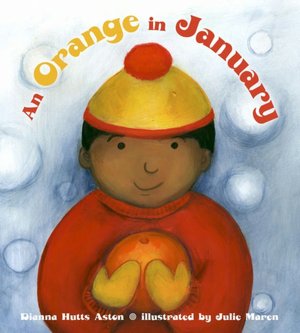
In An Orange in January, Dianna Hutts Aston starts by centering the story on one tiny blossom, glowing in the light of spring. From there, we follow the progress of the bees pollinating the blossom, to the orange itself beginning to manifest itself. Eventually the fruit is ripe, and it is picked by "a hand, brown with seasons of sun," then it is on its way to a grocery store. There it is selected by an adorable brown-skinned boy, who cradles his find carefully home, then takes it to school where he distributes pieces of the juicy treat to his friends. Yum!
Julie Maren illustrated this colorful title, and her pictures definitely add an air of realistic whimsy to the story Hutts Aston has to tell. In one fanciful spread, the boy pictures himself using his orange in various ways: as something to juggle, as a ball to pitch, as a globe to help him see the future. Sprout loves this part - he likes to laugh at the idea of doing anything with an orange but eating it, which he simply cannot imagine doing. He also likes the pictures at the end, when the hero has shared his orange with his friends on the playground. "They are sharing!" he says, delightedly. Another fantastic message to take away from this well-written book.
A big part of healthy eating is awareness, getting kids to understand the natural element in the food that they are consuming. With lyrical precision, Hutts Aston carries readers along for the journey of the food cycle. (That she made the main character a person of color is particularly wonderful - this is a message that all kids need to understand.) Helping to connect the dots between what's on our plates and where it came from, An Orange in January is a great way to make kids aware of agriculture and how food is sourced. No longer will they think of supermarket produce as springing only from boxes and bags - rather, they'll look at the trees and vines around them as a source of nutrition and deliciousness. And that's a treat that's everyone can appreciate!
An Orange in January by Dianna Hutts Aston, published by Dial Books for Young Readers
Ages 2-7
Source: library
Sample: "When morning came, the orange reached the end of its journey, bursting with the seasons inside it. / And two hands, pink with cold, shared its segments, so that everyone could taste the sweetness of an orange in January."
Recommended
----------------------------------------
This post is part of The Children’s Bookshelf, a weekly linky party with the goal of connecting parents with great books for their kids. Do you have a book review, literacy or book-related post that you think will be helpful for parents? If so, please add your link below.
NOTE: By linking up you are giving permission for any of the co-hosts to pin and/or feature a your photo on a future The Children’s Bookshelf post. Kindly link up to an individual post, not your blog’s homepage. The hosts reserve the right to delete any links to homepages, commercial links, repeat links or otherwise inappropriate links. Thank you for your understanding.
You can also follow The Children’s Bookshelf on Pinterest or visit TCB’s co-hosts: Sprout’s Bookshelf, What Do We Do All Day?, No Twiddle Twaddle, Smiling Like Sunshine, My Little Bookcase, The Picture Book Review, MemeTales and Mouse Grows, Mouse Learns. You can find more details here.
Which is what made this particular library find all the sweeter, because not only does it focus on one of his all time most-preferred fruits, oranges, but also because it explains the cycle of how that orange comes to the table.
In An Orange in January, Dianna Hutts Aston starts by centering the story on one tiny blossom, glowing in the light of spring. From there, we follow the progress of the bees pollinating the blossom, to the orange itself beginning to manifest itself. Eventually the fruit is ripe, and it is picked by "a hand, brown with seasons of sun," then it is on its way to a grocery store. There it is selected by an adorable brown-skinned boy, who cradles his find carefully home, then takes it to school where he distributes pieces of the juicy treat to his friends. Yum!
Julie Maren illustrated this colorful title, and her pictures definitely add an air of realistic whimsy to the story Hutts Aston has to tell. In one fanciful spread, the boy pictures himself using his orange in various ways: as something to juggle, as a ball to pitch, as a globe to help him see the future. Sprout loves this part - he likes to laugh at the idea of doing anything with an orange but eating it, which he simply cannot imagine doing. He also likes the pictures at the end, when the hero has shared his orange with his friends on the playground. "They are sharing!" he says, delightedly. Another fantastic message to take away from this well-written book.
A big part of healthy eating is awareness, getting kids to understand the natural element in the food that they are consuming. With lyrical precision, Hutts Aston carries readers along for the journey of the food cycle. (That she made the main character a person of color is particularly wonderful - this is a message that all kids need to understand.) Helping to connect the dots between what's on our plates and where it came from, An Orange in January is a great way to make kids aware of agriculture and how food is sourced. No longer will they think of supermarket produce as springing only from boxes and bags - rather, they'll look at the trees and vines around them as a source of nutrition and deliciousness. And that's a treat that's everyone can appreciate!
An Orange in January by Dianna Hutts Aston, published by Dial Books for Young Readers
Ages 2-7
Source: library
Sample: "When morning came, the orange reached the end of its journey, bursting with the seasons inside it. / And two hands, pink with cold, shared its segments, so that everyone could taste the sweetness of an orange in January."
Recommended
----------------------------------------
This post is part of The Children’s Bookshelf, a weekly linky party with the goal of connecting parents with great books for their kids. Do you have a book review, literacy or book-related post that you think will be helpful for parents? If so, please add your link below.
NOTE: By linking up you are giving permission for any of the co-hosts to pin and/or feature a your photo on a future The Children’s Bookshelf post. Kindly link up to an individual post, not your blog’s homepage. The hosts reserve the right to delete any links to homepages, commercial links, repeat links or otherwise inappropriate links. Thank you for your understanding.
You can also follow The Children’s Bookshelf on Pinterest or visit TCB’s co-hosts: Sprout’s Bookshelf, What Do We Do All Day?, No Twiddle Twaddle, Smiling Like Sunshine, My Little Bookcase, The Picture Book Review, MemeTales and Mouse Grows, Mouse Learns. You can find more details here.
Wednesday, January 2, 2013
Winter Wonderland - 5 Favorite Picture Books About Snow
Sprout's so disappointed - he was really hoping for a white Christmas, but it never materialized. I blame all these Christmas specials that show evergreens strung with lights against the snow, kids building magical snowmen, families skating on ice-covered ponds. What a bummer when you live here in the Pacific Northwest, where snow on Christmas is a once-in-every-so-many-years occurrence.
No matter though, because we're reading snowy books instead! First up was Denise Fleming's The First Day of Winter. We're fans of Fleming's unique illustration style, which combines dyed pulp and hand-cut stencils to create pictures with the flavor of collage and the depth of paintings. Beautiful! In this outing, Fleming uses the basis of the "Twelve Days of Christmas" carol to count down twelve days of winter, and all the things that a young boy gives to his snowman friend. By the end the snowman is bursting with life and has several woodland creatures to keep him company. Sprout enjoys keeping track of what's given each day and pointing it out in the pictures - great reinforcement for counting, too!
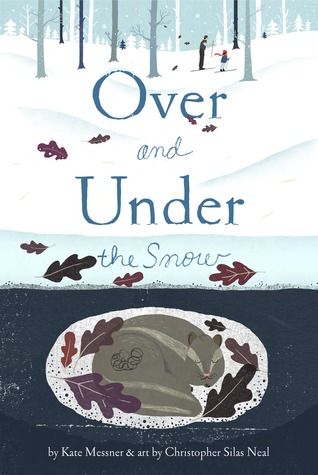
Kate Messner's fantastic Over and Under the Snow has been a favorite around here for several weeks, and we're sad to see it finally come due at the library. Beginning from the perspective of a family out for an afternoon cross-country skiing, Messner examines all the secret activity that goes on beneath the blanket of white that covers the landscape. Squirrels are nesting, bullfrogs brooding, tiny voles making their way through hidden tunnels. Sprout was captivated by the images of all this, done in cut-away fashion by Christopher Silas Neal. Having a sneak peek at the world of hibernating animals gave us plenty to talk about when the first hard freeze hit: "Mama, are the squirrels staying home in bed today?"
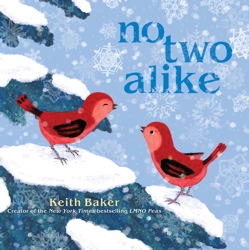
The next pick is one we first read last year, but enjoyed so much that we had to have it again this winter. Keith Baker's No Two Alike is just beautiful, a vivid look at the winter landscape that is set off by the presence of a pair of scarlet birds. As the friends venture through the wintry day, they examine all the things that appear at first glance to be the same -- snowflakes, branches, houses, roads -- but really are not. This is a gentle choice for storytime, as it captures the hushed feeling of a winter snowfall, and ends on just the right note. Fans of Baker's previous books will happily find the same stellar illustrations in this effort.
Phillis Gershator's When It Starts to Snow is another great title for looking at how winter weather affects animals and people differently. As a young boy excitedly roams in the building snow, he asks each animal he encounters "What do you do? Where do you go?". There's a different answer from everyone, but all are looking for a warm place to wait out the chilliness. From the rooster crowing in the barn rafters to the bear heading for his den, everyone has a plan for when the snow flies. And that includes our hero, who is so thrilled by the presence of the white stuff that he can't sleep! This one's for the kiddo in all of us, spellbound by the sight of the whiteness building and drifting just outside our windows.
For older kiddos, and their readers, Snowflake Bentley is a unique and delightful choice. Jacqueline Briggs Martin examines the life of Wilson Bentley, whose quest to capture photographs of snowflakes consumed him entirely. Bentley loved the snow, and he wished from a young age to share the beauty of it in a more permanent fashion than the temporary nature of snowflakes would permit. What I love most about this story is the way Bentley's family supports him absolutely, though they didn't understand his obsession -- that's a message every child should get, I think. Illustrator Mary Azarian created gorgeous Caldecott-winning illustrations for this title, which bring Bentley's thesis, the uniqueness of each snowflake among millions of its kind, to brilliant life.
Whether you're surrounded by snowbanks or camped out on a sandy beach, these wintry storytime additions are all full of icy delight!
No matter though, because we're reading snowy books instead! First up was Denise Fleming's The First Day of Winter. We're fans of Fleming's unique illustration style, which combines dyed pulp and hand-cut stencils to create pictures with the flavor of collage and the depth of paintings. Beautiful! In this outing, Fleming uses the basis of the "Twelve Days of Christmas" carol to count down twelve days of winter, and all the things that a young boy gives to his snowman friend. By the end the snowman is bursting with life and has several woodland creatures to keep him company. Sprout enjoys keeping track of what's given each day and pointing it out in the pictures - great reinforcement for counting, too!
Kate Messner's fantastic Over and Under the Snow has been a favorite around here for several weeks, and we're sad to see it finally come due at the library. Beginning from the perspective of a family out for an afternoon cross-country skiing, Messner examines all the secret activity that goes on beneath the blanket of white that covers the landscape. Squirrels are nesting, bullfrogs brooding, tiny voles making their way through hidden tunnels. Sprout was captivated by the images of all this, done in cut-away fashion by Christopher Silas Neal. Having a sneak peek at the world of hibernating animals gave us plenty to talk about when the first hard freeze hit: "Mama, are the squirrels staying home in bed today?"
The next pick is one we first read last year, but enjoyed so much that we had to have it again this winter. Keith Baker's No Two Alike is just beautiful, a vivid look at the winter landscape that is set off by the presence of a pair of scarlet birds. As the friends venture through the wintry day, they examine all the things that appear at first glance to be the same -- snowflakes, branches, houses, roads -- but really are not. This is a gentle choice for storytime, as it captures the hushed feeling of a winter snowfall, and ends on just the right note. Fans of Baker's previous books will happily find the same stellar illustrations in this effort.
Phillis Gershator's When It Starts to Snow is another great title for looking at how winter weather affects animals and people differently. As a young boy excitedly roams in the building snow, he asks each animal he encounters "What do you do? Where do you go?". There's a different answer from everyone, but all are looking for a warm place to wait out the chilliness. From the rooster crowing in the barn rafters to the bear heading for his den, everyone has a plan for when the snow flies. And that includes our hero, who is so thrilled by the presence of the white stuff that he can't sleep! This one's for the kiddo in all of us, spellbound by the sight of the whiteness building and drifting just outside our windows.
For older kiddos, and their readers, Snowflake Bentley is a unique and delightful choice. Jacqueline Briggs Martin examines the life of Wilson Bentley, whose quest to capture photographs of snowflakes consumed him entirely. Bentley loved the snow, and he wished from a young age to share the beauty of it in a more permanent fashion than the temporary nature of snowflakes would permit. What I love most about this story is the way Bentley's family supports him absolutely, though they didn't understand his obsession -- that's a message every child should get, I think. Illustrator Mary Azarian created gorgeous Caldecott-winning illustrations for this title, which bring Bentley's thesis, the uniqueness of each snowflake among millions of its kind, to brilliant life.
Whether you're surrounded by snowbanks or camped out on a sandy beach, these wintry storytime additions are all full of icy delight!
Wednesday, December 12, 2012
Picture Book Review - Lemonade in Winter by Emily Jenkins
Ooooh boy, does it seem like winter around here! In the Northwest that's more about rain and gray days than it is about snow, though Sprout is convinced it's going to snow ON CHRISTMAS and he will be super disappointed if (when?) it doesn't. And since he's been a little snow-obsessed these past few weeks we've been reading a bunch of books about wintry climes. Think penguins, polar bears, sledding, snowmen and of course our favorite Ezra Jack Keats classic (which honestly we just read all year round).
The other thing that's a running theme in the Kinser household these days is counting. Sprout is counting everything of late, with relish, and can actually get up to thirty, more or less accurately. Watching him learn these building blocks of knowledge is so exciting for us -- it's like having a front row seat to a pretty amazing discovery. The thrill for him in understanding how the numbers come together, and recognizing a pattern, is just palpable, and I love seeing this.
So with these two obsessions in mind, I was pretty thrilled to bring home today's pick, Lemonade in Winter: A Book About Two Kids Counting Money. This quirky picture book is written by Emily Jenkins, who happens to be the author of one of our big favorites from earlier this year, What Happens on Wednesdays. And it's illustrated by G. Brian Karas, who we also adore -- so, win-win right from the get-go.
Beyond that, how can you not be charmed by a book whose premise is siblings who, bored one very cold and snowy day, decide to have a lemonade stand. Yup, a for-real, on-the-corner, ice-cubes-and-all lemonade stand. Though Mom and Dad try to dissuade Pauline and John-John, the kids are determined. And so they count out money for supplies, mix up their product and hit the streets -- in parkas and earmuffs, no less -- chanting their slogan: "Lemon lemon lime, lemon LIMEade! / Lemon lemon lime, lemon LEMONade!" (Catchy, no?)
This tale of young entrepreneurship is not only fun, it's a great learning experience to boot. (Just skip over the subtitle when you read it to your kiddos -- without it the "learning part" will just sneak right up on them!) At every turn, Pauline is educating her young brother about counting money, how many coins make up a dollar and how they can make back their initial supply investment. You don't see that kind of thing too often in a book that is this accessible to the younger crowd, so kudos to Jenkins for including it. And then there's the perserverance both kiddos show. When business is slow, as you might expet it to be when you're selling cold drinks in wintertime, the siblings come up with creative ways to boost their sales. Plus -- huge bonus in my book -- there's a truly multicultural cast of characters here, which we see as we meet the various members of Pauline and John-John's neighborhood. Love that!
In the end, is Pauline and John-John's project a success? Well, you'll have to be the judge of that. But what I can tell you, with certainty, is that this is a picture book that's not only whimsical and bursting with community, but that's solidly based in math and counting skills as well. And in whatever season you read this amusing story, you're bound to get your money's worth!
Lemonade in Winter by Emily Jenkins, published by Schwartz and Wade
Ages: 3-6
Source: Library
Sample: "'Maybe nobody is on the street,' says Pauline, after a bit. 'Maybe nobody will want cold drinks.' / 'I'm on the street,' says John-John. 'I want them.' He grabs a cup of limeade. / 'Don't drink too much,' Pauline warns. 'It's fifty cents a cup.'"
Recommended
The other thing that's a running theme in the Kinser household these days is counting. Sprout is counting everything of late, with relish, and can actually get up to thirty, more or less accurately. Watching him learn these building blocks of knowledge is so exciting for us -- it's like having a front row seat to a pretty amazing discovery. The thrill for him in understanding how the numbers come together, and recognizing a pattern, is just palpable, and I love seeing this.
So with these two obsessions in mind, I was pretty thrilled to bring home today's pick, Lemonade in Winter: A Book About Two Kids Counting Money. This quirky picture book is written by Emily Jenkins, who happens to be the author of one of our big favorites from earlier this year, What Happens on Wednesdays. And it's illustrated by G. Brian Karas, who we also adore -- so, win-win right from the get-go.
Beyond that, how can you not be charmed by a book whose premise is siblings who, bored one very cold and snowy day, decide to have a lemonade stand. Yup, a for-real, on-the-corner, ice-cubes-and-all lemonade stand. Though Mom and Dad try to dissuade Pauline and John-John, the kids are determined. And so they count out money for supplies, mix up their product and hit the streets -- in parkas and earmuffs, no less -- chanting their slogan: "Lemon lemon lime, lemon LIMEade! / Lemon lemon lime, lemon LEMONade!" (Catchy, no?)
This tale of young entrepreneurship is not only fun, it's a great learning experience to boot. (Just skip over the subtitle when you read it to your kiddos -- without it the "learning part" will just sneak right up on them!) At every turn, Pauline is educating her young brother about counting money, how many coins make up a dollar and how they can make back their initial supply investment. You don't see that kind of thing too often in a book that is this accessible to the younger crowd, so kudos to Jenkins for including it. And then there's the perserverance both kiddos show. When business is slow, as you might expet it to be when you're selling cold drinks in wintertime, the siblings come up with creative ways to boost their sales. Plus -- huge bonus in my book -- there's a truly multicultural cast of characters here, which we see as we meet the various members of Pauline and John-John's neighborhood. Love that!
In the end, is Pauline and John-John's project a success? Well, you'll have to be the judge of that. But what I can tell you, with certainty, is that this is a picture book that's not only whimsical and bursting with community, but that's solidly based in math and counting skills as well. And in whatever season you read this amusing story, you're bound to get your money's worth!
Lemonade in Winter by Emily Jenkins, published by Schwartz and Wade
Ages: 3-6
Source: Library
Sample: "'Maybe nobody is on the street,' says Pauline, after a bit. 'Maybe nobody will want cold drinks.' / 'I'm on the street,' says John-John. 'I want them.' He grabs a cup of limeade. / 'Don't drink too much,' Pauline warns. 'It's fifty cents a cup.'"
Recommended
Labels:
city,
education,
food,
math,
multicultural,
picture book,
seasons,
siblings
Friday, November 30, 2012
30 Days of Picture Books - In November by Cynthia Rylant
This is it -- Day 30 of Picture Book Month. Have you had as much fun as we have? It's been wonderful to share some of our favorite books with you, books old and new. Many of these titles are ones we return to again and again -- we hope you've found some books among our picks that will be the same for you and yours.
I hope you've been following along not only with our little project, but also with the great things happening at the Picture Book Month site. So many amazing posts about picture books, how their art and words and their very spirit can change the lives of kids and adults alike. I think author/illustrator Joyce Wan said it best, in her November 29 post on the importance of picture books: "Picture books empower the underprivileged and give hope to the voiceless. They have the power to capture your heart and transform your soul. They are the first interaction we have with books and that initial connection creates a ripple effect that lasts a lifetime and for generations to come."
Today's pick is Cynthia Rylant's In November. This is often read at Thanksgiving, and that fits because of course the Thanksgiving feast is mentioned prominently. But it's also so much about the wrapping up of the world for winter, the way the birds take flight and the animals become lazier, and how the bite to the air becomes sharper. This is a book to read by the firelight, snuggled down with a blanket and the comforts of home to keep you.
This is one that I've been saving all month long, because it seems to sum up not only the spirit of this month, but also because it represents so much of what is best about picture books today. Its storyline is spare and tight, words dropped like jewels into place so that phrase each shines with a unique beauty. Its illustrations, beautifully done by Jill Kastner, are evocative, snapshots of the way the world looks at this time of year, with the light sifting through the clouds and the closeness of dark coming ever near. Of all the books written about fall, this is the one that for me best symbolizes the transition from autumn to winter, and celebrates that time as perfect for all it is.
I hope that through this past 30 days, you've encountered some books that will crack open the whole wide world for your children. When you read picture books to your children, you give them so much: laughter and knowledge, closeness and exploration, silliness and introspectiveness, dreams and honesty. You teach them and you learn from them, watching their experience with the words on the page and the pictures they lose themselves in. I've never read books in the same way as I have now that I read them to Sprout, even when I read them to other children, because I see each title as I se the world - much differently through his eyes.
As for us? We'll still be right here, a stack of books by our side, and many more where these came from.
In November by Cynthia Rylant, published by Harcourt
I hope you've been following along not only with our little project, but also with the great things happening at the Picture Book Month site. So many amazing posts about picture books, how their art and words and their very spirit can change the lives of kids and adults alike. I think author/illustrator Joyce Wan said it best, in her November 29 post on the importance of picture books: "Picture books empower the underprivileged and give hope to the voiceless. They have the power to capture your heart and transform your soul. They are the first interaction we have with books and that initial connection creates a ripple effect that lasts a lifetime and for generations to come."
Today's pick is Cynthia Rylant's In November. This is often read at Thanksgiving, and that fits because of course the Thanksgiving feast is mentioned prominently. But it's also so much about the wrapping up of the world for winter, the way the birds take flight and the animals become lazier, and how the bite to the air becomes sharper. This is a book to read by the firelight, snuggled down with a blanket and the comforts of home to keep you.
This is one that I've been saving all month long, because it seems to sum up not only the spirit of this month, but also because it represents so much of what is best about picture books today. Its storyline is spare and tight, words dropped like jewels into place so that phrase each shines with a unique beauty. Its illustrations, beautifully done by Jill Kastner, are evocative, snapshots of the way the world looks at this time of year, with the light sifting through the clouds and the closeness of dark coming ever near. Of all the books written about fall, this is the one that for me best symbolizes the transition from autumn to winter, and celebrates that time as perfect for all it is.
I hope that through this past 30 days, you've encountered some books that will crack open the whole wide world for your children. When you read picture books to your children, you give them so much: laughter and knowledge, closeness and exploration, silliness and introspectiveness, dreams and honesty. You teach them and you learn from them, watching their experience with the words on the page and the pictures they lose themselves in. I've never read books in the same way as I have now that I read them to Sprout, even when I read them to other children, because I see each title as I se the world - much differently through his eyes.
As for us? We'll still be right here, a stack of books by our side, and many more where these came from.
In November by Cynthia Rylant, published by Harcourt
Friday, November 9, 2012
30 Days of Picture Books - Red Sings from Treetops by Joyce Sidman
It's Day 9 of Picture Book Month. Today we're thinking about the senses. Picture books are an incredible way to teach kids about the different ways we interact with various stimuli in our environment. Seems a bit strange, though, right? How in the world can we exercise the five senses through picture books?
It's true that unless you have a touch-and-feel, scratch-and-sniff book you're not going to have those senses engaged while you're reading. But, I would argue, using picture books as a vehicle for experiences with elements in the real world is a powerful means to not only emphasize senses like smell and touch, but also to find ways to yet again connect literacy with life. You can do this through a series of planned activities (like all those awe-inspiring Pinterest moms do), or very simply through thinking and talking about the books you read. Choose books that emphasize certain characteristics, then as you're out running errands or playing on the playground, look for elements that were represented in your storytime choice.
Today's choice is an amazing one for connecting all five senses via the written word. Joyce Sidman's Red Sings from Treetops: A Year in Colors might seem like it's all about visual stimuli, but one read-through will show you how Sidman engages all our senses through her beautiful poetry. Like this snippet, from the section about fall: "Red splashes fall trees, seeps into every vein of every five-fingered leaf. / Red swells on branches bent low. / Red: crisp, juicy, crunch!" Reading this, we can not only see the scene Sidman describes, but we can feel it, hear it, taste it. And if you want to bring this alive with your little one, follow up this reading by a trip to the apple orchard. As you pluck a juicy piece of fruit off the tree, remind your kiddo that red tastes "crisp, juicy, crunch!". Then you can talk about how red sounds, how it smells, how it feels. Suddenly colors are more than just colors, they are phenomena that engage all the senses.
I'd be remiss if I didn't talk about Pamela Zagarenski's whimsical illustrations that accompany Sidman's poems. Each segment of the book features a season, and Zagarenski adapts her mixed-media paintings to bring the color described to vivid life. She conjures up a summer breeze on the dock for yellow ("Yellow melts everything it touches. . . smells like butter, tastes like salt."). She gives us winter green in frosty evergreens ("Green darkens, shrinks, stiffens into needles."). And in spring, as colors burst forth everywhere, she shows us white highlights ("White can be quiet, too: delicate petals filled with light smell white."). Simply gorgeous imagery, words and pictures alike.
If you want reading to be the more than just a bedtime ritual, help your little one make connections with what you read and what they hear, smell, taste and touch. When we do this, we're building readers whose imagination takes them far beyond the printed words on the page, into pictures of their own devising. And who knows where that influence will stop?
Red Sings from Treetops by Joyce Sidman, published by Houghton Mifflin Books for Children
It's true that unless you have a touch-and-feel, scratch-and-sniff book you're not going to have those senses engaged while you're reading. But, I would argue, using picture books as a vehicle for experiences with elements in the real world is a powerful means to not only emphasize senses like smell and touch, but also to find ways to yet again connect literacy with life. You can do this through a series of planned activities (like all those awe-inspiring Pinterest moms do), or very simply through thinking and talking about the books you read. Choose books that emphasize certain characteristics, then as you're out running errands or playing on the playground, look for elements that were represented in your storytime choice.
Today's choice is an amazing one for connecting all five senses via the written word. Joyce Sidman's Red Sings from Treetops: A Year in Colors might seem like it's all about visual stimuli, but one read-through will show you how Sidman engages all our senses through her beautiful poetry. Like this snippet, from the section about fall: "Red splashes fall trees, seeps into every vein of every five-fingered leaf. / Red swells on branches bent low. / Red: crisp, juicy, crunch!" Reading this, we can not only see the scene Sidman describes, but we can feel it, hear it, taste it. And if you want to bring this alive with your little one, follow up this reading by a trip to the apple orchard. As you pluck a juicy piece of fruit off the tree, remind your kiddo that red tastes "crisp, juicy, crunch!". Then you can talk about how red sounds, how it smells, how it feels. Suddenly colors are more than just colors, they are phenomena that engage all the senses.
I'd be remiss if I didn't talk about Pamela Zagarenski's whimsical illustrations that accompany Sidman's poems. Each segment of the book features a season, and Zagarenski adapts her mixed-media paintings to bring the color described to vivid life. She conjures up a summer breeze on the dock for yellow ("Yellow melts everything it touches. . . smells like butter, tastes like salt."). She gives us winter green in frosty evergreens ("Green darkens, shrinks, stiffens into needles."). And in spring, as colors burst forth everywhere, she shows us white highlights ("White can be quiet, too: delicate petals filled with light smell white."). Simply gorgeous imagery, words and pictures alike.
If you want reading to be the more than just a bedtime ritual, help your little one make connections with what you read and what they hear, smell, taste and touch. When we do this, we're building readers whose imagination takes them far beyond the printed words on the page, into pictures of their own devising. And who knows where that influence will stop?
Red Sings from Treetops by Joyce Sidman, published by Houghton Mifflin Books for Children
Monday, November 5, 2012
30 Days of Picture Books - On Earth by G. Brian Karas
It's Day 5 of Picture Book Month, and it's Nonfiction Monday, so today what's on my mind is information. Facts, if you will. We don't always stop to think how much cold hard data comes at us in the form of the picture books we read as kids, but it's a lot, really. For little ones, a picture book might be their first introduction to dinosaurs, to air travel, to plants and trees. We've certainly read some stellar nonfiction on these topics and many others. In fact, Sprout learned most of the names of fruits and veggies from a terrific picture book on the subject, and to this day, every time we go in the produce section together, he chants, "Broccoli, cauliflower, shout it out!". (Okay, so we get a few looks.)
Lots of times bookstores and libraries keep picture books they deem "nonfiction" in a separate section from your Splat the Cats or your Fancy Nancys. So it requires a bit more looking around to find these kinds of titles, but it's worth it. Sprout pores over a large format book on (what else) trains I brought home, and he's learned so much from it that I swear he can instantly identify each different type he sees.
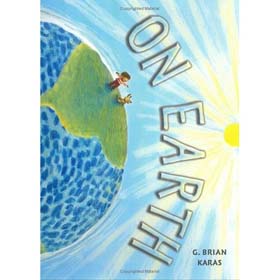
Today's choice is from the nonfiction shelves -- On Earth by G. Brian Karas. We checked this title out because we'd been having discussions about seasons and time change, and I needed a little backup to explain the whole notion in a simple way. I wanted something that would give an overview of the basic concepts, but not in a dry or boring fashion. The great thing about picture books is you can generally find multiple titles on a topic, selections suited to different age ranges so you can choose what's appropriate.
On Earth fills the bill nicely, as Karas explains the rotation of the Earth and movement around the sun, and how that impacts our seasons. With large format paintings brushed with just a hint of whimsy, he demonstrates how the weather is different according to what time of year it is, and also discusses the passage of time. Best of all, he carefully explains that there's a difference in seasons between the Southern and Northern hemispheres. The page illustrating this just blew Sprout's mind -- "snow up here but sun down there?" -- but it gave us a chance to talk about how his family in Ethiopia experiences different conditions because they are closer to the Equator. I'm always pleased when we can make connections between life here and life in his birth country, an opportunity that comes up frequently when we read together.
"On earth we go for a giant ride in space, spinning like a merry-go-round." This is the first sentence of Karas's excellent picture book, and one that I think represents factual titles quite well. Obviously you'll want more detail if reading to an older child. But the ability of a skilled author to translate complicated concepts into a succinct bit of imagery relatable to a young child is quite impressive.
Next time you're looking for information, don't just head for the computer -- give the picture book shelves a browse, and see how you can help your child learn and connect with books at the same time.
On Earth by G. Brian Karas, published by G.P. Putnam's Sons
Lots of times bookstores and libraries keep picture books they deem "nonfiction" in a separate section from your Splat the Cats or your Fancy Nancys. So it requires a bit more looking around to find these kinds of titles, but it's worth it. Sprout pores over a large format book on (what else) trains I brought home, and he's learned so much from it that I swear he can instantly identify each different type he sees.
Today's choice is from the nonfiction shelves -- On Earth by G. Brian Karas. We checked this title out because we'd been having discussions about seasons and time change, and I needed a little backup to explain the whole notion in a simple way. I wanted something that would give an overview of the basic concepts, but not in a dry or boring fashion. The great thing about picture books is you can generally find multiple titles on a topic, selections suited to different age ranges so you can choose what's appropriate.
On Earth fills the bill nicely, as Karas explains the rotation of the Earth and movement around the sun, and how that impacts our seasons. With large format paintings brushed with just a hint of whimsy, he demonstrates how the weather is different according to what time of year it is, and also discusses the passage of time. Best of all, he carefully explains that there's a difference in seasons between the Southern and Northern hemispheres. The page illustrating this just blew Sprout's mind -- "snow up here but sun down there?" -- but it gave us a chance to talk about how his family in Ethiopia experiences different conditions because they are closer to the Equator. I'm always pleased when we can make connections between life here and life in his birth country, an opportunity that comes up frequently when we read together.
"On earth we go for a giant ride in space, spinning like a merry-go-round." This is the first sentence of Karas's excellent picture book, and one that I think represents factual titles quite well. Obviously you'll want more detail if reading to an older child. But the ability of a skilled author to translate complicated concepts into a succinct bit of imagery relatable to a young child is quite impressive.
Next time you're looking for information, don't just head for the computer -- give the picture book shelves a browse, and see how you can help your child learn and connect with books at the same time.
On Earth by G. Brian Karas, published by G.P. Putnam's Sons
Friday, July 13, 2012
Nonfiction Picture Book - Bring Me Some Apples and I'll Make You a Pie by Robbin Gourley
Sun-ripened peaches. Juicy blackberries straight off the vine. Crunchy pecans and walnuts. Succulent tomatoes fresh out of the garden.
If your mouth is watering at the sound of this delectable fresh produce, then this is the book for you. Bring Me Some Apples and I'll Make You a Pie by Robbin Gourley is a fictionalized account of the childhood of famed chef Edna Lewis. A master of her craft, cooking delicious Southern food in some of the most popular restaurants in the country, Lewis believed strongly in using the freshest ingredients possible. She maintained the traditional methods of preparing food, always using the finest produce she could find, as that, she believed, made the dishes sing. In writing Apples, Robbin Gourley researched Lewis's life extensively, and created a tale that was inspired by Lewis's upbringing in Freetown, Virginia (a community founded by freed slaves, including Lewis's grandfather).
Apples is a perfect introduction for kids to the notion of eating seasonally. As each new crop comes in, Edna and her siblings take part in the harvest. From picking bucketsful of ripe cherries to gathering all sorts of beans from the garden, Edna can always think of something delicious to make with the fruits of her labor. The first crop is wild strawberries, and though her sister plans to eat as many as she picks, Edna's going to turn hers into strawberry shortcake. On it goes, up through the fall harvests of apples and of nuts, and at last Edna surveys the pantry, bursting full of preserved goods ready to get the family through winter with a little bit of summer for them to taste every day.
There's a lot to like about this title, from the gorgeous watercolor illustrations (the peaches look like you could pluck them right off the page) to the dynamic of family togetherness throughout. Gourley emphasizes the role that ever family member plays in putting food on the table; while things may be different now since many families don't gather their foodstuffs from the garden, the lessons in responsibility and participation carry over. And oh, the food - if the illustrations don't make you want to rush out to the farmer's market, then the children's plans for their bounty surely will. It's a summertime treat to read this when so many of these goodies are either in season or nearly there.
Reading this one with Sprout, he was especially taken by the illustration of plump tomatoes heavy on the vine. Though we didn't plant tomatoes this year (just too wet here in Northwest Washington), he remembers picking them from the vines himself last year. "I like these tomatoes, Mama," he tells me seriously. And in fact he did eat the ones we grew last summer, though he won't touch tomatoes from the grocery store. Smart kid that boy is!
Bring Me Some Apples and I'll Make You a Pie is a great book to share with young chefs and foodies, but don't expect to get off lightly when you read it. I'm already expecting to be baking pies with Sprout just as soon as those berries are ripe!
Bring Me Some Apples and I'll Make You A Pie by Robbin Gourley, published by Clarion Books
Ages 4-9
Source: Library
Sample: "Spring turns into summer, and Edna leads Daddy to a beehive she's found deep in the fragrant honeysuckle woods. He breaks the comb and gathers all the delicious dark-amber nectar. / Edna dips her finger in the bucket. 'Honey on hot biscuits sweetens the morning,' she says, smacking her lips."
Recommended
If your mouth is watering at the sound of this delectable fresh produce, then this is the book for you. Bring Me Some Apples and I'll Make You a Pie by Robbin Gourley is a fictionalized account of the childhood of famed chef Edna Lewis. A master of her craft, cooking delicious Southern food in some of the most popular restaurants in the country, Lewis believed strongly in using the freshest ingredients possible. She maintained the traditional methods of preparing food, always using the finest produce she could find, as that, she believed, made the dishes sing. In writing Apples, Robbin Gourley researched Lewis's life extensively, and created a tale that was inspired by Lewis's upbringing in Freetown, Virginia (a community founded by freed slaves, including Lewis's grandfather).
Apples is a perfect introduction for kids to the notion of eating seasonally. As each new crop comes in, Edna and her siblings take part in the harvest. From picking bucketsful of ripe cherries to gathering all sorts of beans from the garden, Edna can always think of something delicious to make with the fruits of her labor. The first crop is wild strawberries, and though her sister plans to eat as many as she picks, Edna's going to turn hers into strawberry shortcake. On it goes, up through the fall harvests of apples and of nuts, and at last Edna surveys the pantry, bursting full of preserved goods ready to get the family through winter with a little bit of summer for them to taste every day.
There's a lot to like about this title, from the gorgeous watercolor illustrations (the peaches look like you could pluck them right off the page) to the dynamic of family togetherness throughout. Gourley emphasizes the role that ever family member plays in putting food on the table; while things may be different now since many families don't gather their foodstuffs from the garden, the lessons in responsibility and participation carry over. And oh, the food - if the illustrations don't make you want to rush out to the farmer's market, then the children's plans for their bounty surely will. It's a summertime treat to read this when so many of these goodies are either in season or nearly there.
Reading this one with Sprout, he was especially taken by the illustration of plump tomatoes heavy on the vine. Though we didn't plant tomatoes this year (just too wet here in Northwest Washington), he remembers picking them from the vines himself last year. "I like these tomatoes, Mama," he tells me seriously. And in fact he did eat the ones we grew last summer, though he won't touch tomatoes from the grocery store. Smart kid that boy is!
Bring Me Some Apples and I'll Make You a Pie is a great book to share with young chefs and foodies, but don't expect to get off lightly when you read it. I'm already expecting to be baking pies with Sprout just as soon as those berries are ripe!
Bring Me Some Apples and I'll Make You A Pie by Robbin Gourley, published by Clarion Books
Ages 4-9
Source: Library
Sample: "Spring turns into summer, and Edna leads Daddy to a beehive she's found deep in the fragrant honeysuckle woods. He breaks the comb and gathers all the delicious dark-amber nectar. / Edna dips her finger in the bucket. 'Honey on hot biscuits sweetens the morning,' she says, smacking her lips."
Recommended
Tuesday, July 5, 2011
Poetry Review - A Child's Calendar by John Updike
Somehow the Fourth of July has come and gone again. We were fortunate to have beautiful sunny weather here all weekend, somewhat of a rarity in Northwest Washington, so we were able to get some yard work done and then enjoy the fruits of our labor. We had planned to take Sprout to his first-ever fireworks display yesterday but a day of playing in his wading pool, chasing the dog, blowing bubbles and throwing the ball in the back yard had him completely worn out even before his regular bedtime. But there's always next year!
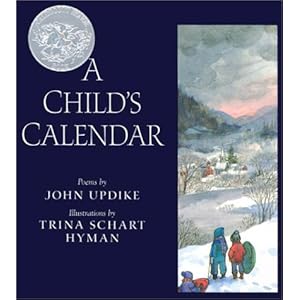
Having a little one around the house makes it even more fun to mark holidays and the passing of seasons. A great title for doing this is A Child's Calendar, a collection of poems written by John Updike (yes, that John Updike) and illustrated by Trina Schart Hyman. Each month is celebrated in its own poem, with the highs and lows of the seasons and holidays captured in simple, readable verse. Updike's knack for imagery takes a playful turn; of March, he says "The sun is nervous / as a kite / that can't quite keep / its own string tight." How well that sums up the fleeting glimpses of spring that March offers, teasing us with its promise of brighter days ahead! I also love his take on October (my personal favorite month): "Frost bites the lawn. / The stars are slits / in a black cat's eye / before she spits."
And these effortless yet succulent bits of poetry are made even more fun by the charming illustrations. I know, charming -- overused as a descriptor, but so perfect for these artistic snapshots. If you have any familiarity with Schart Hyman's work then you'll recognize her vividly color palette and wry humor at once. But what makes this title special for our family is that the illustrations depict a multiracial family, with hair and skin of all colors. The family here enjoys making Valentines, watering plants and picking flowers, taking a long walk on a November day. I love the underlying subtext: here is a family just like any other, complete with that one kid who strips down to nothing while playing in the ocean. I remember reading once that Schart Hyman was one of the first illustrators to depict multiracial families -- another reason to enjoy her work, besides her gorgeous scenery and the raw emotion she paints into every character.
This is the kind of book I wish we'd see more of, one where there's no heavy-handed message about racism or acceptance, just a gentle glimpse of a family enjoying the year in one another's company. A great addition to any family's bookshelf.
A Child's Calendar by John Updike, published by Holiday House
All ages
Caldecott Honor title
Sample quote: "November: The stripped and shapely / maple grieves / the loss of her / departed leaves."
Recommended
Having a little one around the house makes it even more fun to mark holidays and the passing of seasons. A great title for doing this is A Child's Calendar, a collection of poems written by John Updike (yes, that John Updike) and illustrated by Trina Schart Hyman. Each month is celebrated in its own poem, with the highs and lows of the seasons and holidays captured in simple, readable verse. Updike's knack for imagery takes a playful turn; of March, he says "The sun is nervous / as a kite / that can't quite keep / its own string tight." How well that sums up the fleeting glimpses of spring that March offers, teasing us with its promise of brighter days ahead! I also love his take on October (my personal favorite month): "Frost bites the lawn. / The stars are slits / in a black cat's eye / before she spits."
And these effortless yet succulent bits of poetry are made even more fun by the charming illustrations. I know, charming -- overused as a descriptor, but so perfect for these artistic snapshots. If you have any familiarity with Schart Hyman's work then you'll recognize her vividly color palette and wry humor at once. But what makes this title special for our family is that the illustrations depict a multiracial family, with hair and skin of all colors. The family here enjoys making Valentines, watering plants and picking flowers, taking a long walk on a November day. I love the underlying subtext: here is a family just like any other, complete with that one kid who strips down to nothing while playing in the ocean. I remember reading once that Schart Hyman was one of the first illustrators to depict multiracial families -- another reason to enjoy her work, besides her gorgeous scenery and the raw emotion she paints into every character.
This is the kind of book I wish we'd see more of, one where there's no heavy-handed message about racism or acceptance, just a gentle glimpse of a family enjoying the year in one another's company. A great addition to any family's bookshelf.
A Child's Calendar by John Updike, published by Holiday House
All ages
Caldecott Honor title
Sample quote: "November: The stripped and shapely / maple grieves / the loss of her / departed leaves."
Recommended
Subscribe to:
Posts (Atom)