We had a visit from the Tooth Fairy the other night.
Mama wasn't ready for this turn of events. Sprout is four - FOUR, people! He's waaaay too young to be losing teeth. But unfortunately, thanks to a nasty spill a couple of years ago at daycare, he ended up with a tooth that was in trouble, and had to be pulled early. Sprout was totally cool with this, I might add. Completely stoked to have a gap in his smile, and elated at the promise of receiving a surprise from the Tooth Fairy. (As usual, it was just me who was a basket case.)
Strangely enough we had just brought home a library book about the Tooth Fairy. Not because I had any notion that Sprout would be losing a tooth any time soon, but just because we were craving something by Bob Graham. You know, because all of his books are made.of.awesome.
Anyway, it was a fortuitous pick to have April and Esme, Tooth Fairies at the ready. Honestly Sprout didn't know much about the Tooth Fairy, being that Hubs and I thought we were a couple of years out from needing to address the topic. Therefore it wasn't much of a stretch for him to accept the notion of a family of Tooth Fairies, mom and dad and two daughters. The story opens with April, one of the girls, getting a call on her cell phone about a tooth visit to one Daniel Dangerfield. The caller is most insistent that the girls come, and so April and Esme manage to convince their reluctant parents that they are old enough to go on their own. Armed with a coin in a string bag (for the tooth), the girls head off into the night, flying through the wind and dark and finding Daniel's house on the first go. And they find the boys' room, and the tooth - but when Daniel wakes up, can the girls save the evening, and their secret?
Like all of Graham's books, April and Esme has the perfect blend of whimsy and edge. The girls are never in any sort of real peril, but it feels close enough to it that preschoolers and their parents will thrill when they make it safely to, and from, their tooth visit. Graham excels at small details, the kind that make his characters and his plots relatable. In this case, not only did we love the tooth fairy family's home (with teeth hanging from the rafters and a bathtub fashioned from a teacup), we also found the gorgeous cover and endpapers to just extend the story. Really, there's a lot to absorb in a book by Bob Graham - it's no wonder Sprout wants to hear each one over and over again.
Like the dream Daniel Dangerfield thinks he's had, April and Esme lingers with the reader in all the best ways. Whether your kids believe in the Tooth Fairy or not, this book is a lovely means to bring just a bit of magic into the everyday (and who's to say it isn't really real?).
April and Esme, Tooth Fairies by Bob Graham, published by Candlewick Press
Ages 3-6
Source: Library
First line: "Not so long ago, a tooth fairy took a call on her cell phone."
Recommended
Showing posts with label magic. Show all posts
Friday, October 4, 2013
Wednesday, June 13, 2012
Wayback Wednesday - Sylvester and the Magic Pebble (1969)
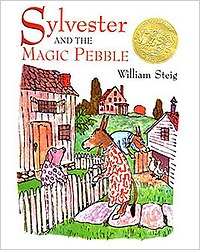
William Steig may be more well-known for a certain big green ogre, but my personal pick from his oeuvre has always been the tale of a donkey whose wish turns out to have unexpected consequences. Sylvester and the Magic Pebble was published in 1969, when Steig was in his 60s; though he came to children's books late in life, he displayed an incredible sense of how to write and illustrate books that speak to children. Sylvester won the Caldecott in 1970, and it's easy to see why - the emotional depth and range that Steig brings to his characters in the text is multiplied exponentially through his deceptively simple illustrations.
Sylvester was actually challenged in 12 states due to Steig's depiction of the police as pigs, something that surprised me a bit since it's not an aspect that jumped out at me at any point in the reading of this picture book. But books have been challenged for a lot less, after all. In Steig's Caldecott acceptance speech, he said that "(a)rt, including juvenile literature, has the power to make any spot on earth the living center of the universe; and unlike science, which often gives us the illusion of understanding things we really do not understand, it helps us to know life in a way that still keeps before us the mystery of things. It enhances the sense of wonder. And wonder is respect for life." Really, I think that's the larger point of all Steig's work, porcine law enforcement officers notwithstanding.
The plot of Sylvester is a perfect marriage of the mundane and the magical. Sylvester is a young donkey in search of pebbles for his collection. He finds an unusual one on a particularly rainy afternoon; still holding the pebble in his hoof, Sylvester thinks, "I wish it would stop raining". To his great surprise, it does, instantly. That the pebble is magic can be of no doubt. Sylvester accepts it as easily as any reader will. And he rejoices in his find, until he stumbles upon a nasty lion with a hungry look in his eyes. Panicking, Sylvester wishes he was a rock, and, being that he's holding the pebble, he of course immediately transforms. And such is Sylvester's dilemma: as a rock, he cannot possibly reach out and pick up the pebble, in order to wish himself back to donkey-dom.
I brought Sylvester home thinking it would be new for Sprout but to my great delight he said, "Oh, Sylvester! I like this one, Mama." Turns out his daycare teacher reads it often, and he knew the entire thing practically (at least the action). At the part where Sylvester turns into a rock, Sprout very gently tapped the page and said, "He's in there, Mama. It's okay," as if to reassure me. We've read it just about every night for the past week, and I can honestly say that I think Sylvester himself magic - Sprout's fallen asleep during almost every reading, preempting the nightly pleas for "one more story" and "need a drink". Gold, Mr. Steig. Pure gold.
Sylvester's on the long side, so best shared with preschoolers on up. Littler ones will enjoy the pictures but might miss out on the subtleties of the story, of which there are many. There's more than a bit of pathos here as we watch Sylvester's distraught parents come to terms with their son's disappearance. That in itself could be hard for younger children to grasp, but they will pick up on the jubilation with which his parents greet Sylvester, once he is at last transformed back into his natural state. And that's one of the best scenes in the book, in my estimation - the sun shining forth with a brilliant burst of light, as Sylvester's father dances with glee and his mother embraces her beautiful boy. It's absolutely heartwarming.
Sylvester may have been written more than 40 years ago but its lessons are just as relevant today - that when those we love are lost, we mourn them deeply. And if we are fortunate enough for them to come back to us, we should throw ourselves into celebration that is joyful and complete. That's a powerful thing for all readers to consider. Well, that and if you're ever holding a magic pebble, for God's sake don't wish you're a rock.
Wayback Wednesday Verdict? Holds up nicely
Sylvester and the Magic Pebble by William Steig, published by Simon and Schuster
Ages 3-7
Source: Library
Sample: "He imagined all the possibilities, and eventually he realized that his only chance of becoming himself again was for someone to find the red pebble and to wish that the rock next to it would be a donkey. Someone would surely find the red pebble -- it was so bright and shiny -- but what on earth would make them wish that a rock were a donkey? The chance was one in a billion at best."
Highly recommended
Bonus: William Steig's Caldecott acceptance speech (and a letter expressing his trepidation at making such a speech) from Letters of Note
Sylvester was actually challenged in 12 states due to Steig's depiction of the police as pigs, something that surprised me a bit since it's not an aspect that jumped out at me at any point in the reading of this picture book. But books have been challenged for a lot less, after all. In Steig's Caldecott acceptance speech, he said that "(a)rt, including juvenile literature, has the power to make any spot on earth the living center of the universe; and unlike science, which often gives us the illusion of understanding things we really do not understand, it helps us to know life in a way that still keeps before us the mystery of things. It enhances the sense of wonder. And wonder is respect for life." Really, I think that's the larger point of all Steig's work, porcine law enforcement officers notwithstanding.
The plot of Sylvester is a perfect marriage of the mundane and the magical. Sylvester is a young donkey in search of pebbles for his collection. He finds an unusual one on a particularly rainy afternoon; still holding the pebble in his hoof, Sylvester thinks, "I wish it would stop raining". To his great surprise, it does, instantly. That the pebble is magic can be of no doubt. Sylvester accepts it as easily as any reader will. And he rejoices in his find, until he stumbles upon a nasty lion with a hungry look in his eyes. Panicking, Sylvester wishes he was a rock, and, being that he's holding the pebble, he of course immediately transforms. And such is Sylvester's dilemma: as a rock, he cannot possibly reach out and pick up the pebble, in order to wish himself back to donkey-dom.
I brought Sylvester home thinking it would be new for Sprout but to my great delight he said, "Oh, Sylvester! I like this one, Mama." Turns out his daycare teacher reads it often, and he knew the entire thing practically (at least the action). At the part where Sylvester turns into a rock, Sprout very gently tapped the page and said, "He's in there, Mama. It's okay," as if to reassure me. We've read it just about every night for the past week, and I can honestly say that I think Sylvester himself magic - Sprout's fallen asleep during almost every reading, preempting the nightly pleas for "one more story" and "need a drink". Gold, Mr. Steig. Pure gold.
Sylvester's on the long side, so best shared with preschoolers on up. Littler ones will enjoy the pictures but might miss out on the subtleties of the story, of which there are many. There's more than a bit of pathos here as we watch Sylvester's distraught parents come to terms with their son's disappearance. That in itself could be hard for younger children to grasp, but they will pick up on the jubilation with which his parents greet Sylvester, once he is at last transformed back into his natural state. And that's one of the best scenes in the book, in my estimation - the sun shining forth with a brilliant burst of light, as Sylvester's father dances with glee and his mother embraces her beautiful boy. It's absolutely heartwarming.
Sylvester may have been written more than 40 years ago but its lessons are just as relevant today - that when those we love are lost, we mourn them deeply. And if we are fortunate enough for them to come back to us, we should throw ourselves into celebration that is joyful and complete. That's a powerful thing for all readers to consider. Well, that and if you're ever holding a magic pebble, for God's sake don't wish you're a rock.
Wayback Wednesday Verdict? Holds up nicely
Sylvester and the Magic Pebble by William Steig, published by Simon and Schuster
Ages 3-7
Source: Library
Sample: "He imagined all the possibilities, and eventually he realized that his only chance of becoming himself again was for someone to find the red pebble and to wish that the rock next to it would be a donkey. Someone would surely find the red pebble -- it was so bright and shiny -- but what on earth would make them wish that a rock were a donkey? The chance was one in a billion at best."
Highly recommended
Bonus: William Steig's Caldecott acceptance speech (and a letter expressing his trepidation at making such a speech) from Letters of Note
Subscribe to:
Posts (Atom)