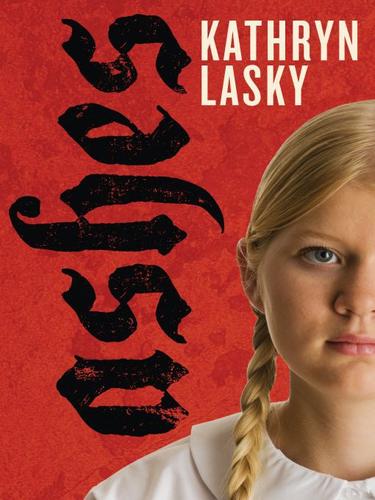
Some time periods in history are so widely written about that it hardly seems as if we need more books about it. World War II is arguably one of these. It's not that it isn't worth reading titles set during this timeframe, it's just that with so many quality options already on the shelves, are there still other viewpoints we haven't examined?
In Ashes, Kathryn Lasky manages to give us a different perspective - that of Gaby Schramm, an upper class German girl who gets an inside look at the formation of Hitler's Third Reich. Gaby's parents are close enough to the social elite that they know many powerful people in Germany's upper echelon. Professor Schramm is a colleague of Albert Einstein, and the two families vacation together during summers in Caputh. The Schramms watch with growing horror as Einstein and other prominent scientists are singled out for their "Jewish physics", as friends are banned from social events due to their ethnicity, and as those who make the wrong comment in a public setting suddenly disappear.
Gaby herself despises Hitler and all his government stands for; and yet, she finds herself going along with the required "Heil Hitler" salute when it becomes part of her school day. Though she refuses to join the Hitler Youth, it is not until one of the Reich's new policies touches close to home that Gaby finds the courage to really define her opposition, and to turn with her parents toward another life.
I picked Ashes up looking for something like The Book Thief; while I found Zusak's book more compelling, Ashes is still a strongly written title with a unique take on the events of Nazi Germany. As the heat gradually turns up around the Schramm family, Lasky shows us how the political events combine with Gaby's own internal struggles to give her an increasing awareness of the world at large. Forced to confront the effect that politics has on her own household, Gaby grows up very quickly - maybe too quickly, as she often has insights that seem beyond her own years. And yet, in times such as these, doesn't maturity come all too suddenly?
Though some libraries shelve this in the children's section, there are themes here that seem more suited to teens, particularly a plotline revolving around Gaby's sister Ulla and her boyfriend Karl. The overall message, too, is one that will speak to young adults in a more immediate way -- that of reconciling the world you've grown up with alongside that you've come to know, which in Gaby's case is one that conflicts in nearly every aspect with her pampered childhood. Lasky ties in connections to actual historical figures, weaving them into her cast of characters so seamlessly that the events of Nazi Germany come alive as we read.
Ashes is, above all, a subtle and unforgettable piece of historical fiction, and a worthy contribution to the canon of World War II literature.
Ashes by Kathryn Lasky, published by Viking
Ages 12 up
Source: Library
Sample: "I thought of that swirl of sugar on the kitchen floor from years before. How could Hitler cause so many problems? I put down the binoculars. The scrap of moon had slipped away, making the dark even darker and the stars even brighter. They scorched the blackness with their fire. Ninety-two elements to bake a universe and one madman to blow it up?"
Recommended
Sunday, April 15, 2012
Wednesday, April 11, 2012
National Bookmobile Day
I fell in love with reading because of the bookmobile.
Let me explain.
As a kid, we lived in a rural area with few other kids in the neighborhood. When school let out for the summer there really wasn't a whole lot to do. Sometimes my mom and I would take the bus into town, or one of my older sisters would come for the day, but for the most part I was hanging around the house. Needless to say, the days could get really long.
Enter the bookmobile.
Every other week the bookmobile would come to a community center nearby and we'd walk down to meet it. The rule was that I was allowed to take out as many books as I wanted, but I had to carry them all myself. Oh my word, was it heaven! I'd always been a reader and a devoted user of the school library during the academic year, but the bookmobile represented an embarrassment of riches. Suddenly there was no cranky school librarian restricting what sections I could look in (though I was a good reader, she believed younger students should only have access to picture books. I chafed at the ridiculousness of that restriction). There were chapter books, series with recurring characters, books we'd read in the classroom that I wanted to re-read, and entirely new authors to explore. And all of it there for me to take home, as long as I could carry it!
So because of that I continue to have a soft spot for bookmobiles. The very mission of these programs appeals to me, to take the library to those who might otherwise not have access to it, to open up the wealth of resources the library contains and take it out on the road. Sprout and I go to the library every week, and that's a commitment I plan to keep up until he will no longer tolerate it (by then I'm hoping he's been bit by the reading bug). And maybe that means he won't know what a bookmobile is, or what it does, so I've dug up a couple of titles to try to explain the whole thing to him.
In Wild About Books by Judy Sierra, readers will tag along with librarian Molly who accidentally takes her bookmobile into the zoo. In typical this-could-only-happen-in-a-picture-book fashion, Molly decides to just set up shop there and see what happens. Pretty soon all the zoo animals fall under the spell of the bookmobile (I told you these things have magic powers!) and are clamoring for books. Naturally this leads to a skirmish or two -- evidence the bears who "licked all the pictures right off of the pages" -- but Molly handles it all in indomitable librarian fashion. I read this to Sprout the other night and he was really taken by Marc Brown's riotous illustrations, more so than the text I'm sorry to say. But this is one that an older child would dearly love I'm sure, particularly for all the small details hidden throughout (the bunnies reading Goodnight Moon, for instance, or the scorpion who is a literary critic). Fun!
If you have a bookmobile in your area, take a moment to check out their services, or to show some appreciation for their hardworking staff. When you consider the influence books have on the course of even one child's future, it's pretty obvious that the bookmobile can be a vital part of any community, no matter how remote.
Let me explain.
As a kid, we lived in a rural area with few other kids in the neighborhood. When school let out for the summer there really wasn't a whole lot to do. Sometimes my mom and I would take the bus into town, or one of my older sisters would come for the day, but for the most part I was hanging around the house. Needless to say, the days could get really long. Enter the bookmobile.
Every other week the bookmobile would come to a community center nearby and we'd walk down to meet it. The rule was that I was allowed to take out as many books as I wanted, but I had to carry them all myself. Oh my word, was it heaven! I'd always been a reader and a devoted user of the school library during the academic year, but the bookmobile represented an embarrassment of riches. Suddenly there was no cranky school librarian restricting what sections I could look in (though I was a good reader, she believed younger students should only have access to picture books. I chafed at the ridiculousness of that restriction). There were chapter books, series with recurring characters, books we'd read in the classroom that I wanted to re-read, and entirely new authors to explore. And all of it there for me to take home, as long as I could carry it!
So because of that I continue to have a soft spot for bookmobiles. The very mission of these programs appeals to me, to take the library to those who might otherwise not have access to it, to open up the wealth of resources the library contains and take it out on the road. Sprout and I go to the library every week, and that's a commitment I plan to keep up until he will no longer tolerate it (by then I'm hoping he's been bit by the reading bug). And maybe that means he won't know what a bookmobile is, or what it does, so I've dug up a couple of titles to try to explain the whole thing to him.
In Wild About Books by Judy Sierra, readers will tag along with librarian Molly who accidentally takes her bookmobile into the zoo. In typical this-could-only-happen-in-a-picture-book fashion, Molly decides to just set up shop there and see what happens. Pretty soon all the zoo animals fall under the spell of the bookmobile (I told you these things have magic powers!) and are clamoring for books. Naturally this leads to a skirmish or two -- evidence the bears who "licked all the pictures right off of the pages" -- but Molly handles it all in indomitable librarian fashion. I read this to Sprout the other night and he was really taken by Marc Brown's riotous illustrations, more so than the text I'm sorry to say. But this is one that an older child would dearly love I'm sure, particularly for all the small details hidden throughout (the bunnies reading Goodnight Moon, for instance, or the scorpion who is a literary critic). Fun!
Miss Dorothy and Her Bookmobile by Gloria Houston is another lovesong to librarians and mobile libraries. Dorothy's dream is to work in a "fine brick library" one day, so she completes he
r education. But when she and her husband move to a rural area, there is no library building. Gradually Dorothy realizes that she can still be a librarian, without a building, and the town bands together to finance a bookmobile. Susan Condie Lamb illustrated this one and I love the fact that her finely wrought pictures really bring out the details of Miss Dorothy's story, such as the winding country roads and the tractor pulling the bookmobile out of the mud. This is unquestionably a biography not only of Miss Dorothy but of the town that she supported through her bookmobile. A great pairing for this would be Sarah Stewart's The Library, about booklover Elizabeth Brown.
If you have a bookmobile in your area, take a moment to check out their services, or to show some appreciation for their hardworking staff. When you consider the influence books have on the course of even one child's future, it's pretty obvious that the bookmobile can be a vital part of any community, no matter how remote.
Friday, April 6, 2012
Easy Readers - The "Max" Series by Adria F. Klein
I've said it before, and I'll say it again: there is a huge need for early reader books featuring characters of color. Series titles in particular are thin on the ground. If you don't believe me, take a look at your local library or bookstore next time. Beyond Diego and Dora, and the occasional Little Bill title, it's pretty darn white over in the easy readers. And yes, I realize that there are excellent choices like "Frog and Toad" and "Little Bear" - but there's also a real lack of representation of diversity in this section of most collections.

Enter Adria F. Klein, a professor in the Education department at California State University and the author of the Max books, published by Picture Window Books. These are entries in the "Read-it! Readers" series, a set of leveled readers that is similar to "I Can Read" or "Step into Reading". The Max titles we've read are at the beginning end of the spectrum: purple and red, the first two steps in the "Read-it!" system.
There's a lot to love about Max. For starters, here's a character with some color! The Library of Congress info page lists Max as "Hispanic-American", which fits, but quite frankly Sprout thinks Max looks just like him, and we are good with that. In the titles we've read there aren't any cultural details clearly linking Max to a particular ethnicity, though if there were we'd welcome that too. What's important is that for once we have a series character of color who is book-based only. Love it! And bonus: many, if not all, of the Max titles are available in bilingual English/Spanish editions. Whether your focus is bilingual education or ESL, these books provide a high-quality option.
So far we've read three Max titles: Max Goes to School, Max Goes to the Barber and Max and the Adoption Day Party. Each one is charmingly simple, with vivid and bright illustrations that support the text in meaningful ways. These are great books not only for fostering reading readiness and supporting emerging readers, but also for introducing kids to new and different situations. Sprout's fascinated by the School title, as it walks kids through the essentials of Max's day: meeting his teacher, finding his desk, eating his lunch, playing at recess. Adoption Day Party provides a basic familiarity with adoption celebrations; while it focuses more on the party aspect rather than on the notion of what adoption means, the book's greatest strength comes from showing that being adopted doesn't mean you're different from everyone else.
A quick online search reveals lots more titles in the Max series. Name a situation, and Max probably has it covered, from staying overnight to going to the dentist to taking his dog to the vet. Fortunately our library carries several Max titles. If yours doesn't, I'd strongly recommend making a purchase suggestion, as these provide much-needed depth and diversity to the early reader section. We're looking forward to exploring more titles with Max -- can't wait until Sprout's reading these to me on his own!
Friday, March 30, 2012
Picture Book Review - Going Home by Eve Bunting
Picture books truly are a format that can work with any and all ages. For those who think they're only for the youngest child, I would counter that there are books that encompass the complexity and nuance of certain subjects every bit as well as chapter books or nonfiction. Of course, these selections need to be used with the right audience, but when chosen carefully, picture books shed new light on a topic or open up opportunities for critical thinking for children and adults alike.
A perfect example of this is the work by Eve Bunting and David Diaz. Never ones to shy away from a tough subject, Bunting and Diaz have produced some stunningly beautiful literary works. Their collaboration Smoky Night, written in response to the LA riots, won a Caldecott for its unique and dazzling illustrations, which underscore the tense, emotional plotline. One glimpse through this title and you'll see why it draws strong responses from its readers.
Going Home, their next book together, is a similar melding of thought-provoking text and complex, evocative illustrations. In the book, Carlos and his family are on their way home to Mexico for Christmas. The family hasn't been back since Mama and Papa left years before; though the parents are looking forward to going back, Carlos and his sisters really don't know what to expect. After all, California is home to them. It may not be perfect -- Papa and Mama must do backbreaking labor in the fields, and Carlos never seems to see the opportunities that immigration promised them -- but it's what the children know.
But now the world of their homeland begins to open up to the children. As they drive they see the land that their parents left behind, and it isn't what they expected. There is beauty here, lots of it: in the flowers and trees, in the buildings and little villages, in the faces of relatives and those who knew their parents, once upon a time. And most of all there is beauty in Mama and Papa, who come alive in this place in a way that Carlos and his sisters have never seen.
What Bunting and Diaz have created here is a masterful opening to any conversation about immigration and the experience of people who leave their home for another. We can approach this topic from a variety of ideologies, but one common root remains: the notion that finding oneself far from home is hard, no matter what the reasons are for leaving. For older children, pair this with a title like Return to Sender by Julia Alvarez; younger readers might be ready for Grandfather's Journey by Allan Say or La Mariposa by Francisco Jimenez, for a look at the immigrant experience.
Going Home by Eve Bunting and David Diaz, published by HarperCollins
Ages 6-10
Source: Library
Sample: "There is a wooden plow outside Grandfather's house. I remember when Mama and Papa saved the money for it. Later they also sent money for two oxen. I wonder where the oxen are and if we will be friends."
Recommended
Bonus: Video interview with Eve Bunting from Reading Rockets
Friday, March 16, 2012
Picture Book Review - Big Red Lollipop by Rukhsana Khan
Ah, birthday parties. Whether you lived through it yourself or via your own children (or both), most of us are familiar with the dynamic of birthday parties in elementary school. Who's coming and who's not, which of your friends are invited, what it feels like when you're included (elation!) and what it feels like when you're not (depression). For girls especially, this whole birthday party thing can take on a life of its own, and make or break you -- or so it seems.
In Big Red Lollipop, author Rukhsana Khan presents us with Rubina's dilemma: she's invited to her first-ever birthday party, but her mother insists she bring her little sister Sana along. Rubina protests, sure that her new friends won't understand, but Ami stands firm. Of course Rubina's friend says it's all right, but Sana doesn't know how to act at the party. Rubina's only consolation is the huge red lollipop that Sally's mom gives out as party favors. While Sana gobbles hers down right away, Rubina saves it for the next morning, dreaming all night about her sweet treat. But Sana manages to spoil that as well.
Rubina is so mad at Sana - about the lollipop, yes, but also for ruining Rubina's chances at being invited to more parties. Until Sana receives her own invitation to a party. . .
Lollipop is amazing on so many levels, and it is one of those rare titles that works for just about any child. In one sense, you have the sibling relationship: older sister plus pesky younger sister. The way Khan resolves the conflict is surprising, but completely perfect, and it speaks volumes about how we really should treat others. On another level, this is a story about fitting in: the cultural norms that Rubina's family is familiar with don't fit with the society they are living in. Rubina is caught between what the kids at school think is normal and what her mother wants her to do. And on yet another plane, this is a story about right and wrong - when doing what you want to do is not the best solution.
Wrap all that up in a multicultural package and you have a charming yet deep picture book. The illustrations by Sophie Blackall are beguiling in her signature fashion - colorful and energetic, simple and expressive, perfectly suited to Rukhsana Khan's story. I love the hidden depths that are hinted at in this one, something that the pictures really carry forth. There's a lot to think about here; this would be a perfect classroom pick as the possibilities for discussion are numerous.
Big Red Lollipop is the kind of book you need to read through more than once, for each time another aspect of the story reveals itself to you. Khan has given us a sensitive and thoughtful story that will make you laugh, and think, in equal measures. Don't miss this one!
Big Red Lollipop by Rukhsana Khan, illustrated by Sophie Blackall. Published by Viking
Ages 3-7
Source: Library
Sample: "I beg and plead, but Ami won't listen. I have no choice. I have to call. Sally says "All right." But it doesn't sound all right. I know she thinks I'm weird."
Bonus: check out this interview with Rukhsana Khan at Paper Tigers
Labels:
acceptance,
girls,
immigrants,
Muslim,
picture book,
siblings
Subscribe to:
Posts (Atom)


