A few months back, my husband got a flyer in the mail from some travel company or another (among his other pursuits, he also writes a blog focusing on disabled travel). This particular brochure had a page advertising trips to China, which featured a picture of the terracotta warriors. Since China isn't in the travel plans just now, Jake put the brochure in the recycle bin, where Sprout promptly found and rescued it. For several weeks, he packed that picture of the terracotta warriors around, asking all about it. Those are in China, we said, and maybe one day we'll see them.
End of conversation, or so we thought.
Then Sprout was watching Thomas and saw an episode featuring a Chinese dragon. He's seen it before, so no big deal, right? But for some reason this time it stuck with him. "That from China, Mom?" he asked, and so we talked about how the dragon is a feature in Chinese culture. And then he remembered that they'd talked about Chinese New Year at his daycare. And then he saw me reading Grace Lin's The Year of the Rat, and so that prompted more talk about China. Honestly, I think the boy was getting a little obsessed.
So when we ran into the book Crouching Tiger by Ying Chang Compestine during a trip to the library, I was pretty sure he'd be interested. And sure enough, he was very excited to hear that the book was about a young boy, Vinson, whose grandfather visits from China. Surprisingly, though the book is a little long for his age, Sprout stuck with it, and has enjoyed looking over Yan Nascimbene's finely drawn illustrations on his own as well.
Crouching Tiger is a story about culture, family and identity; not only is it beautifully illustrated, it is sensitively and thoughtfully told to boot. In the book, Vinson doesn't know his grandfather very well, but he's impressed to see Grandpa practicing what he thinks is a martial art. Tai chi is not like kung fu, though, and Vinson quickly loses patience with the methodical movements Grandpa teaches him. In fact, everything about Grandpa seems frustratingly foreign: the way he always speaks Chinese, and how he insists on using Vinson's Chinese name, Ming Da. In fact, Vinson starts trying to avoid Grandpa - until an incident on the street gives Vinson a new appreciation for his grandfather's skills. Soon he begins to understand that while Grandpa's ways are different than his American friends' habits, they are still pretty amazing. And a Chinese New Year festival gives Vinson a whole new perspective on his ancestry and his grandfather both.
The dilemma that Vinson faces in Crouching Tiger is one familiar to many who grow up with a foot in two worlds. There's the pull of the new life, shiny and modern with its sense of excitement. And then there is the quiet steadiness of one's heritage, a part of identity that can seem dull in comparison but which forms the basis of who we are. Vinson learns that he is two things, both Chinese and American, and that there is value in each, a lesson that I hope we can give Sprout as he reconciles his Ethiopian ancestry with his life in America. If nothing else, I want him to see that there is beauty in tradition, just as Vinson does, and that he should never be ashamed of who he is.
And I guess we'd better start saving up to visit China too.
Crouching Tiger by Ying Chang Compestine, published by Candlewick
Ages 5-12
Source: Library
Sample: "On New Year's Eve, we cleaned the whole house. Dad cut my hair, and Mom cooked a big traditional meal. Grandpa handed me a red silk jacket embroidered with dragons. 'Ming Da, wear this for the parade tomorrow.' My heart sank. All my friends would be there and see me in this silly jacket. I excused myself and left the table."
Recommended
Thursday, October 4, 2012
Saturday, September 29, 2012
Cinderella Around the World - Mufaro's Beautiful Daughters by John Steptoe
I'm thrilled to be participating in the "Cinderella Around the World" project dreamed up by Becky of Kid World Citizen. A ton of very talented bloggers, and yours truly, are posting their reviews of Cinderella tales from many different cultures. Once all the posts are up, I'll link to a complete list of all the reviews. Until then, here's my take on one such tale!
If there's one thing that unites us as people, all around the globe, it's story. Stories tell us not only where we've been, but where we're going and what we hold dear. When you study the storytelling traditions of a particular culture, you learn something about the unique perspective of its people, not to mention its history. For centuries stories were passed down in the oral tradition, and as that happened the tales themselves deepened and changed, becoming particular creations of the teller and inspiring others to put their individual spin on the tale. As cultural values changed, so stories changed with them, blossoming into what we today consider folklore.
Or, as the author Rafe Martin put it:
Folklore maps the territory, shows us the roads before us, and sets us free to walk the roads we choose-after allowing us to experience each road for ourselves. For, in stories, folk stories, all the characters are so universal as to be not individual characters as in fiction, but more generally recognizable aspects of our own psyches; characters common to all.
And with only a quick study of folklore, it becomes readily apparent how universal those characters and themes truly are. From fables to myths, from tall tales to epics, the same themes continue to emerge, across cultures and countries. Sure, the setting may be different from one place to the next, and the values may change, but it's remarkable how much of the essence of the story stays the same.
Take Cinderella, for instance. Most of us grew up with the cotton-candy Disney version, all taffeta and glass slippers. [Disney based their take on the Charles Perrault version, finding it a lot more palatable than the Grimm brothers tale, in which the stepsisters maim themselves in order to fit into the slipper (shudder).] And the moral of the Disney version, naturally, is that Cinderella is rewarded for her goodness by marriage and "happily ever after". Fine, of course, but hardly the end of the story.
What's interesting is that Cinderella stories are not solely a Western European construct, but rather pop up all around the globe, from China to Ireland, Indonesia to Appalachia. Name a culture and you can probably find a Cinderella version for it. And why is this theme so popular? Most likely because we all want to see good rewarded and evil punished. We all want to think that the honest, hardworking person will eventually get her due, and those who made her life miserable will get theirs in the end, too. It may seem simplistic in this modern age, but look at the way folktales are pervading our culture and you can see that there's still plenty of appeal in this familiar theme.
So, on to the title at hand: Mufaro's Beautiful Daughters, a gorgeously wrought Cinderella story by John Steptoe. This version is based on a Cinderella story from Zimbabwe and Steptoe populated his illustrations with scenes representative of the country. The pictures are lush and detailed, capturing perfectly the African nature of this story; ball gowns and pumpkin coaches are replaced with fine linen and festive drummers. In the book, the two sisters Manyara and Nyasha are as different as can be. Though both girls are beautiful, Manyara is concerned with power and position, while Nyasha is kind to all. When the Great King announces that he is seeking a wife, both girls prepare to travel to the city. On the way each encounters a number of individuals, and their responses couldn't be more different; while virtuous Nyasha shares her food with a beggar and gives gifts to an old woman, haughty Manyara rushes on. Once each girl reaches the city, they are surprised to find that the King does not appear in his human form - to Manyara, he is a vicious monster, while Nyasha finds only a small garden snake that she has already befriended, and which soon turns into the King himself.
Of course, the moral here is consistent with that of all Cinderella tales and justice is served: Nyasha, the good sister, triumphs, while Manyara is forced to become a servant in Nyasha's household. But the story stays true to its African roots, keeping the focus on community and the necessity of helping others. Because Manyara is selfish, she does not get the spotlight; instead her sister, who gives freely to others, is rewarded. Rather than the emphasis being on material comforts, Steptoe suggests that a life of worth is one that is lived in service to others. Food for thought, for those of us who grew up with castles and princes and glass slippers, after all.
Sprout's still a little young for Mufaro, though he did enjoy flipping through the pages and browsing the arresting pictures that complement Steptoe's words. I'm looking forward to exploring more folklore with him, including other Cinderella tales, in the years to come - there's so much to learn from these stories, lessons that truly span the globe.
Mufaro's Beautiful Daughters by John Steptoe, published by HarperCollins
Ages 5-9
Source: Library
Sample: "Mufaro knew nothing of how Manyara treated Nyasha. Nyasha was too considerate of her father's feelings to complain, and Manyara was always careful to behave herself when Mufaro was around."
Recommended
Thursday, September 27, 2012
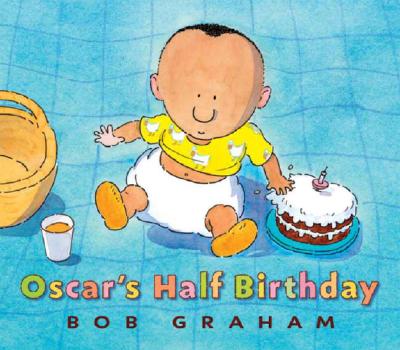
Picture Book Review - Oscar's Half Birthday by Bob Graham
I first encountered Bob Graham's work eons ago as a bookseller, when his title "Let's Get a Pup!" Said Kate was newly published. The book resonated with me for a lot of reasons - the nontraditional vibe about the family (tattoos! nose rings!), the really-real household environment (clutter and all), the fact that the family ends up with not one dog but two. It was one of those I bought and stuck away for my own kiddo, someday.
One of my personal picks from among Graham's excellent catalog of titles is 2005's Oscar's Half Birthday. It's fair to say that this one probably stands out because of its multiracial family - Mom's dark-skinned with braids, Dad's light-skinned with a soul patch, and the kiddos, Millie and Oscar, are a beautiful blend of both. We don't have enough of this in kidlit, and it's especially nice that the family just is, no mention of skin color necessary, thank you very much. I love how deftly Graham mixes in diversity with all of his titles, like a pinch of spice that livens up the whole concoction.
But beyond the broad color palette, Oscar's Half Birthday is just a solidly built piece of children's literature. Oscar's having a half-birthday party - mostly because no one can wait for his real birthday - and that forms the central plot of this cozy tale. Mom and Dad and Millie pack up picnic fixings and set out for a hilltop park, pushing Oscar in his stroller and led by Boris the dog. Along the way there are adventures, none too scary but just thrilling enough: squawking gulls overhead, a train rocketing down the tracks, a meandering path through the woods as Oscar slumbers. One really feels that the journey is most of the adventure. At last the family makes it to the hilltop and finds the perfect picnic place. Suddenly the family's circle has expanded to take in a whole crowd of bystanders, and all join in the chorus of "Happy Birthday" to Oscar.
Like so many of his other works, Oscar's Half Birthday celebrates not only family and camaraderie but also community and the place we all have in one another's lives. That all the characters are drawn to the birthday celebrations seems natural, simple and perfect. And the ending is pitch-perfect too. After the action on the hilltop, Graham brings his characters back to their comfy apartment home, for the tried-and-true ritual of bath and cuddles for Millie and Oscar, a little slow dancing for Mom and Dad.
Reading this together at bedtime is like slipping into a pair of favorite pjs, soft and familiar. There's something new to look at each time through, so much detail for Sprout to examine and exclaim over. It affords us plenty of chances to talk about our own day's activities, the perfect key-down to another busy day of fun and family.
Oscar's Half Birthday by Bob Graham, published by Candlewick Press
Ages 3-7
Source: Library
Sample: "Near the top, the path goes through woods. They listen to the wind in the trees and the drone of distant traffic. Boris chases rabbits. / Oscar frowns in the dim light -- six different expressions on his face in the time it takes a leaf to fall."
Highly recommended
Bonus: Author Suzy Becker on her visit to Bob Graham, from Publisher's Weekly (file this under "things about which I am profoundly jealous")
Fast forward to today when I actually do have my own wee one, and what do you know, Bob Graham's one of his favorite author/illustrators. We've read not only Kate, but also Graham's April and Esme, Tooth Fairies and most recently (and repeatedly) A Bus Called Heaven, which can and probably will be the subject of its own post. How this talented man hasn't received more awards and accolades I'll never know - just to pick up one of his titles is to be transported into a world where the prosaic and magical intersect in the form of angelic toddlers with messy hands and fairy godmother-esque grandmas bearing chocolate cakes. The books Graham creates are equal parts unique and comforting, the kinds of experiences you never knew you always wanted.
One of my personal picks from among Graham's excellent catalog of titles is 2005's Oscar's Half Birthday. It's fair to say that this one probably stands out because of its multiracial family - Mom's dark-skinned with braids, Dad's light-skinned with a soul patch, and the kiddos, Millie and Oscar, are a beautiful blend of both. We don't have enough of this in kidlit, and it's especially nice that the family just is, no mention of skin color necessary, thank you very much. I love how deftly Graham mixes in diversity with all of his titles, like a pinch of spice that livens up the whole concoction.
But beyond the broad color palette, Oscar's Half Birthday is just a solidly built piece of children's literature. Oscar's having a half-birthday party - mostly because no one can wait for his real birthday - and that forms the central plot of this cozy tale. Mom and Dad and Millie pack up picnic fixings and set out for a hilltop park, pushing Oscar in his stroller and led by Boris the dog. Along the way there are adventures, none too scary but just thrilling enough: squawking gulls overhead, a train rocketing down the tracks, a meandering path through the woods as Oscar slumbers. One really feels that the journey is most of the adventure. At last the family makes it to the hilltop and finds the perfect picnic place. Suddenly the family's circle has expanded to take in a whole crowd of bystanders, and all join in the chorus of "Happy Birthday" to Oscar.
Like so many of his other works, Oscar's Half Birthday celebrates not only family and camaraderie but also community and the place we all have in one another's lives. That all the characters are drawn to the birthday celebrations seems natural, simple and perfect. And the ending is pitch-perfect too. After the action on the hilltop, Graham brings his characters back to their comfy apartment home, for the tried-and-true ritual of bath and cuddles for Millie and Oscar, a little slow dancing for Mom and Dad.
Reading this together at bedtime is like slipping into a pair of favorite pjs, soft and familiar. There's something new to look at each time through, so much detail for Sprout to examine and exclaim over. It affords us plenty of chances to talk about our own day's activities, the perfect key-down to another busy day of fun and family.
Oscar's Half Birthday by Bob Graham, published by Candlewick Press
Ages 3-7
Source: Library
Sample: "Near the top, the path goes through woods. They listen to the wind in the trees and the drone of distant traffic. Boris chases rabbits. / Oscar frowns in the dim light -- six different expressions on his face in the time it takes a leaf to fall."
Highly recommended
Bonus: Author Suzy Becker on her visit to Bob Graham, from Publisher's Weekly (file this under "things about which I am profoundly jealous")
Labels:
bedtime,
birthday,
boys,
city,
family,
multiracial,
picture book,
siblings,
toddler
Monday, September 24, 2012
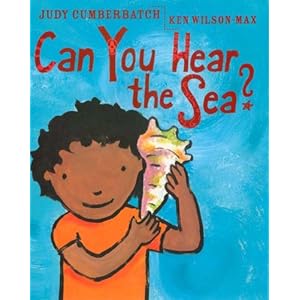
Library Find - Can You Hear the Sea?
The other day, I was headed back to my work area when something on a cart caught my eye. I should mention, in case you don't already know it, that I am privileged to work at the administrative center for a regional library system. The building I work in houses not only all the staff who support our system, but also shelves containing older titles and materials that are in transit to one of our library branches. Books are coming in and going out literally all day long. It is a bibliophile's dream and nightmare all at the same time. Small wonder my library card gets such a workout.
The story is set in an unnamed country in West Africa but the author's bio notes that she grew up in Ghana so it's not too much of a leap to think it was set there. The narrative explores the relationship between Sarah and her beloved grandfather. On a Saturday before he leaves, Grandpa gives Sarah a beautiful seashell; he tells her to hold it to her ear and listen closely, for she will hear the sea. Though Sarah knows that Grandpa would never lie to her, she can't hear the sound, no matter how hard she tries. Instead, each day of the week, Sarah only hears the sounds of the everyday world around her - the drums in church on Sunday, the monkeys in the trees on Wednesday, the honking taxis on Friday. But then Grandpa returns and shows Sarah just how to listen. And suddenly there it is, the sound of the waves on the shore and the roaring, rushing power of the ocean.
What I love about this simple story is all the layers it incorporates. There are the building blocks of learning, like the progression of the week which teaches about sequences and the passing of time. There are the vivid colors and multilayered illustrations, which stimulate young readers' senses. And then there is the emotional component, in which Sarah knows she should trust her grandfather but then begins to doubt his word. In the end, Sarah's trust is restored as she learns to listen, just as her Grandpa has instructed her. This reaffirms the bond between the two, and provides a gently reassuring ending to this sweet story.
Though I wish there were a few more cultural details - a further development of the setting and the use of culturally correct names or language terms - this is a solidly written and gorgeously illustrated story that will engage any child. Use with other West African stories like Jane Kurtz's In the Small, Small Night or Penda Diakite's I Lost My Tooth in Africa to build a unit about this diverse region of Africa.
Can You Hear the Sea? by Judy Cumberbatch, published by Bloomsbury
Ages 2-6
Source: Library
Sample: "On Monday, Sarah listened to her shell by the river as she and Grandma did the washing. But what she heard was. . . water splashing, Grandma beating out the sheets, and the clothes flip-flapping in the wind."
Recommended
Anyway, right off I recognized the book in question as being illustrated by Ken Wilson-Max. Eons ago, before Sprout came into our family, our children's librarian recommended some titles she thought we might like (and she was spot on, by the way). Among them were Karen Baicker's I Can Do It Too! and You Can Do It Too!, both illustrated by Wilson-Max. Sprout loved both of these books from the first time we read them and they have been frequent revisits since. This new title, Can You Hear the Sea?, written by Judy Cumberbatch, appealed to me right off (don't let anyone tell you we don't judge books by the cover, we all do it). I was pretty sure Sprout would like it, and -- no surprise here -- he firmly declared it "really just good, Mama!"
The story is set in an unnamed country in West Africa but the author's bio notes that she grew up in Ghana so it's not too much of a leap to think it was set there. The narrative explores the relationship between Sarah and her beloved grandfather. On a Saturday before he leaves, Grandpa gives Sarah a beautiful seashell; he tells her to hold it to her ear and listen closely, for she will hear the sea. Though Sarah knows that Grandpa would never lie to her, she can't hear the sound, no matter how hard she tries. Instead, each day of the week, Sarah only hears the sounds of the everyday world around her - the drums in church on Sunday, the monkeys in the trees on Wednesday, the honking taxis on Friday. But then Grandpa returns and shows Sarah just how to listen. And suddenly there it is, the sound of the waves on the shore and the roaring, rushing power of the ocean.
What I love about this simple story is all the layers it incorporates. There are the building blocks of learning, like the progression of the week which teaches about sequences and the passing of time. There are the vivid colors and multilayered illustrations, which stimulate young readers' senses. And then there is the emotional component, in which Sarah knows she should trust her grandfather but then begins to doubt his word. In the end, Sarah's trust is restored as she learns to listen, just as her Grandpa has instructed her. This reaffirms the bond between the two, and provides a gently reassuring ending to this sweet story.
Though I wish there were a few more cultural details - a further development of the setting and the use of culturally correct names or language terms - this is a solidly written and gorgeously illustrated story that will engage any child. Use with other West African stories like Jane Kurtz's In the Small, Small Night or Penda Diakite's I Lost My Tooth in Africa to build a unit about this diverse region of Africa.
Can You Hear the Sea? by Judy Cumberbatch, published by Bloomsbury
Ages 2-6
Source: Library
Sample: "On Monday, Sarah listened to her shell by the river as she and Grandma did the washing. But what she heard was. . . water splashing, Grandma beating out the sheets, and the clothes flip-flapping in the wind."
Recommended
Friday, September 21, 2012
Chapter Book Review - The Year of the Book by Andrea Cheng
Sometimes I just desperately wish for time travel. Usually it's because I'd like to go back and shake my 20-something-year-old self into finishing my degree (since I always wonder how much further I'd be in my career if I'd done it then instead of now). Sometimes it's because I'd like to reassure my 30-something-year-old self that this adoption thing really is going to turn out great and totally be worth the risk. But most often, it's because I come across a book that I would love, dearly love, to go back in time and present to my grade-school self.
Most recently that desire was sparked by Andrea Cheng's The Year of the Book. This is the kind of book I would have lived for as a middle-grader, one that is bursting at the seams with character and heart and all kinds of fantastic novels to boot. Oh, and just about the most adorable drawings, courtesy of the delightful illustrator Abigail Halpin (whose pictures for Penny Dreadful made me love that fantastic book even more, if that's possible!).
Anna's the kind of girl I was at her age -- bookish, slightly lonely and yet fulfilled in herself. She was best friends with Laura, but now all of a sudden Laura's hanging out with a different crowd and they don't seem to have time for Anna. This bothers her, but she's got her own life: her friendship with crossing guard Ray, her creative pursuits in the realm of sewing, and of course, her books. In fact, a book is the place Anna'd most like to be, when she's feeling out of place in Chinese school for being ABC (American-born Chinese) or when she's embarrassed by her report on winter break, when she built paper airplanes with her brother most days. As each novel she reads unfolds, Anna not only learns more about her fictional friends, but also finds more confidence in who she is, and what she has to offer to a real-life friend.
Fans of Grace Lin's Pacey novels (The Year of the Dog, The Year of the Rat, and Dumpling Days) will find a lot to love about Anna Wang as well. For starters, Anna is also a girl with a foot in two worlds, both American and Chinese, and she doesn't always feel she fits in either one. Then, too, there is the search to find a friend, which both Pacey and Anna experience. I love that Cheng gives us a very realistic scenario for Anna to face, that of friends suddenly changing allegiances for no apparent reason. That's grade school for you, isn't it? And though Laura and Anna keep the thread of friendship, it isn't quite the same while Laura's hanging out with another crowd. There's also the fact that Anna isn't always sure how she feels about her parents. While she's proud of her mother for learning to drive and attempting to master English, Anna sometimes finds herself embarrassed by her mom's Chinese-ness. Kids of all backgrounds will identify with Anna's struggle to reconcile her feelings.
Though The Year of the Book is pretty short, and the story is comparatively quiet, there's a lot to think about here. It's great to see an Asian American heroine for this age, one who is totally relatable to the audience Cheng is writing for.The story is well-told, the characters finely drawn, and overall it's a real and true pleasure to read. And Halpin's illustrations add just the right note of whimsy - her renditions of familiar book covers are particularly charming, and kids just may find some new titles for their reading lists. What could be better than that?
The Year of the Book by Andrea Cheng, published by Houghton Mifflin Harcourt
Ages 8-12
Source: Library
Sample: "Writing that makes me think about Mom. I always wished I had a mom who spoke perfect English and who got her driver's license when she turned sixteen. But if Mom wasn't the way she is, she wouldn't be my mom and I wouldn't be me. Suddenly I just want to go home, but I have to finish my work first."
Recommended
Subscribe to:
Posts (Atom)