Showing posts with label language. Show all posts

Sunday, June 9, 2013

Library Find: In the Park by Huy Voun Lee

Wow oh wow, are we glad to see the warmer weather around these parts! I'm telling you, it's no mean feat keeping a four-year-old busy and engaged when the weather's too foul to play outside. And so we soak up as much outdoor time as we can once the clouds start to dissipate. This year we've been working on a big yard project, and Sprout's been right in the thick of things, helping us dig, hauling dirt and weeds in his wagon, and riding his brand-new birthday bike. Bonus: he sleeps like the dead every night! :)

Of course we had to read some summer-themed books to sustain the mood, right? And among the treasures we unearthed on a recent library trip is Huy Voun Lee's picture book In the Park. This title is part of Lee's Season Series, which includes At the Beach, In the Snow, and In the Leaves. Today's pick is an oldie, so you might have to look a bit for it - I'd try the library, or a good used bookstore if you want to own your own copy.


I'm hard put to say what we like most about this title, because there are several elements that make it not only fun to read but also a treat for the eyes. Firstly, there's the plot: as the weather turns nice, Xiao Ming and his mother head to the park to enjoy an afternoon outside. Mother suggests that they work on their Chinese characters together while they are there. As the pair explores, she finds opportunities to teach Xiao Ming new characters based on what they see. The character for earth, for instance, looks like a plant growing. The sight of a bird in flight presents a chance to learn the character for bird. Even a spring storm helps Mother introduce the character for umbrella.

What's great about the Chinese characters is that Lee helps readers learn how to write them, presenting visual examples as well as helpful hints for remembering them. Each character is tied to an event in the book, and kids will have fun guessing what character the pair will be writing based on what the illustrations show. And let me tell you, these illustrations are really stunning, as Lee uses cut-paper collage to articulate the actions of the story. Each page includes lots of small elements that deepen the visual impact, such as shadows on a hilltop or dandelion seeds wisping in the wind. There's a ton of diversity here too, a real bonus for all audiences. Lee elevates what could be a didactic premise into a gorgeous one, that not only celebrates a culture but also the relationship between a mother and son.

The first and last pages of In the Park are a glossary of the Chinese characters included. For each character, Lee has included a visual reference, the character itself, its meaning, and the written word in Chinese, with its pronunciation. This is a very nice touch and helps take the book to the next level, in my estimation. Families familiar with Mandarin will en;joy the book, but it's also a nice one to share with children as an aid to reinforce linguistic similarities and differences. And kids can't help but be intrigued by the images formed by these characters - Sprout was fascinated at the thought that each word is its own little picture!

I've said it before but I'll say it again - tying books into the events happening in our lives is one of the best ways to reinforce the relevance of literature for children. And when there's an opportunity to do so while including a multicultural theme, the benefits grow exponentially. Check this one out and see what I mean!

In the Park by Huy Voun Lee, published by Henry Holt
Ages 3-6
Source: Library
Sample: "Xiao Ming and his mother walk until they come to a stream. 'What does this look like to you?' she asks Xiao Ming as she stops to draw. 'It looks like water flowing,' Xiao Ming says. 'It must be the character for stream."
Recommended

Monday, August 27, 2012

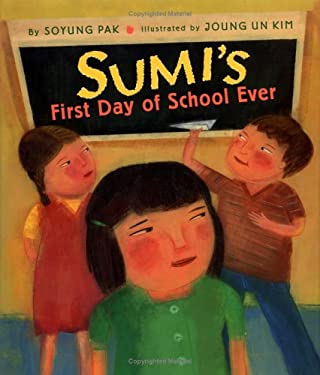
Picture Book Review - Sumi's First Day of School Ever by Soyung Pak

Fall is in the air! It's hard to believe, because our summer started so late, but pretty soon those big yellow buses will be rolling out and the kiddos will be on their way back into the classroom. And as with all transitions, the new school year can be a tough thing for many students, especially those who are learning new languages and new living situations as well. Whether the child is an adoptee or part of a family of immigrants, an unfamiliar place presents more than a few challenges and fears.


In Sumi's First Day of School Ever, Soyung Pak tells the story of a young girl just beginning her first day of classes. Sumi is Korean, and she speaks very little English, though her mother has taught her what to say if someone asks her name. She's never been to school before and she finds the whole experience frightening. From the forbidding fence around the schoolyard to the noisy, boisterous children who all seem to know just where they belong, Sumi is overwhelmed. School is a scary place, Sumi thinks, and she hangs back, watching others to know just what she should be doing. It's all pretty intense for this shy newcomer.

Fortunately Sumi's teacher is kind and gently encouraging to her new student. When she's allowed to draw a picture later in the morning, things begin to seem a little better. And then at recess, Sumi finds a stick and is drawing in the dirt when another student approaches. Mary quietly joins Sumi in drawing a scene, then introduces herself. And Sumi knows just what to say, thanks to her mother. Maybe, Sumi thinks, school is not-so-lonely after all.

Pak's sensitive portrayal of a young girl struggling to find her place in a new environment will hit home with many readers, particularly those who have felt the same way Sumi does, like she's in over her head. Joung Un Kim's soft color palette and warm backgrounds add depth to the story, and Sumi's emotions are evident in every scene. Kim keeps Sumi as the focal point of each spread, but provides appropriate context for what's happening, such as the scene where another boy makes fun of Sumi (he later apologizes after prompting from the teacher). Most importantly, the book doesn't make light of Sumi's feelings or her struggle to find her footing. Rather, it emphasizes that the most important key to fitting in might just lie in being yourself. When Sumi begins to draw, she finds common ground with another student, and in such a simple moment a friendship is born.

For those transitioning to a new environment, whether that means a new school or a new country, Sumi's First Day of School Ever can be a great tool to open discussion about how they are feeling. Equally important, this is a great way to talk with other kids about how to reach out to an unfamiliar face in their classroom, making a new friend and building a connection that benefits everyone.

NOTE: this is an older title and not readily available - check your library or a used bookstore, it's worth finding!

Sumi's First Day of School Ever by Soyung Pak, published by Viking
Ages 3-7
Source: Library
Sample: "A boy stuck out his tongue. He made a noise. He squished his eyes. / School is a mean place, Sumi thought."
Recommended