We've been thinking a lot about transitions around here lately. For one thing, I'm in the process of transitioning to a new job -- as Collection Development Librarian for the library system I'm currently in. It's absolutely a dream job for me, made even better by the fact that I didn't have to leave the team of folks I already love working with. But as with all new situations it requires a bit of a shift in mindset and workflow, and so I'm between two worlds right at the moment.
Of course, Sprout's about to be in transition himself, as he'll be leaving his beloved preschool behind in the fall when he enters the big time. Kindergarten. I'm in total denial about this, or I was until preschool graduation last night when the director introduced us to the class of 2027. Yeeeeeep. That's a step Mommy's going to have to adjust to gradually -- good things we've got two more months at preschool to get used to the idea.
Transitions are rough for lots of reasons, probably the most significant being that vague fear of the unknown that happens to take hold when you least expect it. I had that in mind when Sprout and I read Jacqui Robbins' The New Girl...and Me, a library pick that we just recently discovered. The story follows a young girl whose class is welcoming a new student. Shakeeta is quiet; all she tells the class by way of introduction is that she has a pet iguana. Our narrator Mia wants to befriend Shakeeta, but she just isn't sure - it can be scary to befriend someone new, after all. Then an incident on the playground leaves both girls on the sidelines, and suddenly Mia works up the courage to reach out. And what she discovers is that sometimes laughter is the best way to bridge the gaps between us.
This is a thoughtful, sensitive story that's as much about being the new child in an already-settled classroom as it is about making friends with a stranger. I love the realness of the story, that there isn't any big dramatic scene but rather a small conflict that kids will really relate to. Being on the sidelines isn't any fun, and of course Shakeeta gets upset, which is what ends up drawing the two girls together. Robbins' skill in telling this story is the way she shoes the quiet strength of friendship, and how relationships can blossom even when there doesn't seem to be much to get them started.
And of course I couldn't talk about this book without mentioning the illustrations by Matt Phelan. At the time this book was done, he was relatively new to the kidlit scene, but of course now he's illustrated books by some of my favorite authors. It's not hard to see why, with his relatable, energetic style that suits the classroom dynamic in this story to a T. There are a few spreads that I find especially poignant: in particular, I love the one-page evolution of the friendship between Mia and Shakeeta, where Phelan shows us the two girls coming together in the space of a walk between playground and school door. It's a great example of the power of words and pictures to work together, the strength of all great picture books.
Making a transition yourself, or anticipating one in the near future? Check out The New Girl...and Me. It's older, so you may need to hit the library, but this is one pitch-perfect picture book that you'll want to read more than once.
The New Girl...And Me by Jacqui Robbins, published by Atheneum Books for Young Readers
Ages 4-6
Source: Library
Recommended
Showing posts with label transition. Show all posts
Thursday, June 19, 2014
Sunday, November 17, 2013
30 Days of Picture Books - It's Time for Preschool by Esmé Raji Codell
It's Day 10 of our 30 Days of Picture Books. What's your favorite of the titles we've shared so far?
Today happens to be Sunday, and as he does almost every weekend day, the second he woke up, Sprout wanted to know, "Is it a school day??" Sprout loves his preschool, and so do we. He's been fortunate to have had excellent day care providers, and now is in a more structured preschool program where he really shines. His teachers are involved and creative, thoughtful and kind. As a parent, it makes my day so much better when I know that Sprout is thriving in his everyday environment.
When Sprout first started preschool, we read and recommended a number of excellent titles for the transition. It's Time for Preschool! by Esmé Raji Codell is a great addition to that list. One glimpse at the cover and you know you're in for a good time with this one. Lively and fun, this is a great look at all the activities that most preschools incorporate into their regular routine. The only downside I can think to this title is that it makes me want to spend all day in such a cool place.
Codell is a teacher, librarian and reading specialist, so you know you're in good hands with the text here. She's got an engaging thread of rhyme that crops up now and again, and she does a fantastic job of explaining just what an average day in preschool looks like. She even covers special events, like field trips and fire drills, that are left out of most preschool-prep titles. Sue Ramá did the illustrations for this title, and true to form with her other work, she includes a healthy dose of diversity among teachers and students. There's loads of variety in the games and activities , as well - boys and girls alike playing house, making crafts, playing dinosaurs (and princess dinosaurs!).
Best of all, the book includes acknowledgements that kiddos may have a hard time during the day, and addresses worries like a parent not showing up at pick-up time ("But never never never / (I will say it with a shout) / Would your folks forget to pick you up. / It's not even worth thinking about.") This is a nice reassurance for kids who may feel uneasy about this new phase in life.
Whether your kiddo's a preschool veteran or still has that phase to look forward to, It's Time for Preschool! is a great escape into the fun of a busy school day.
It's Time for Preschool! by Esmé Raji Codell, published by Greenwillow Books
Today happens to be Sunday, and as he does almost every weekend day, the second he woke up, Sprout wanted to know, "Is it a school day??" Sprout loves his preschool, and so do we. He's been fortunate to have had excellent day care providers, and now is in a more structured preschool program where he really shines. His teachers are involved and creative, thoughtful and kind. As a parent, it makes my day so much better when I know that Sprout is thriving in his everyday environment.
When Sprout first started preschool, we read and recommended a number of excellent titles for the transition. It's Time for Preschool! by Esmé Raji Codell is a great addition to that list. One glimpse at the cover and you know you're in for a good time with this one. Lively and fun, this is a great look at all the activities that most preschools incorporate into their regular routine. The only downside I can think to this title is that it makes me want to spend all day in such a cool place.
Codell is a teacher, librarian and reading specialist, so you know you're in good hands with the text here. She's got an engaging thread of rhyme that crops up now and again, and she does a fantastic job of explaining just what an average day in preschool looks like. She even covers special events, like field trips and fire drills, that are left out of most preschool-prep titles. Sue Ramá did the illustrations for this title, and true to form with her other work, she includes a healthy dose of diversity among teachers and students. There's loads of variety in the games and activities , as well - boys and girls alike playing house, making crafts, playing dinosaurs (and princess dinosaurs!).
Best of all, the book includes acknowledgements that kiddos may have a hard time during the day, and addresses worries like a parent not showing up at pick-up time ("But never never never / (I will say it with a shout) / Would your folks forget to pick you up. / It's not even worth thinking about.") This is a nice reassurance for kids who may feel uneasy about this new phase in life.
Whether your kiddo's a preschool veteran or still has that phase to look forward to, It's Time for Preschool! is a great escape into the fun of a busy school day.
It's Time for Preschool! by Esmé Raji Codell, published by Greenwillow Books
Monday, November 26, 2012
30 Days of Picture Books - Nightsong by Ari Berk
Down to our last week of Picture Book Month -- sob! We will miss sharing our daily picture book picks with you, dear reader, though I am looking forward to blogging about some chapter books and a few other choice bits we've run across in the past month. And don't forget to check out our Pinterest boards for even more title lists and other bookish fun!
So, our Day 26 pick is a tale of adventure. Picture books, as I've said before, allow readers to try on new personas. All books do this, really, and isn't that why reading is such wonderful fun? Through a book you can be anyone, go anywhere, try anything. For me, as a quite introverted kid, that was the pure magic of reading, and most likely why I love it so. And that's one of the best gifts we can give our kids, I think, the gift of possibility and imagination and worlds without limits.
Today's selection is Nightsong, written by Ari Berk and illustrated by Loren Long. You'll recognize Long as the author/illustrator of our Day 2 pick. Though this is just as much a spectacle visually speaking, it's got a very different tone than Otis. Here, Long makes use of a darker palette to bring to life Berk's tale of a young bat named Chiro, headed out for his very first solo expedition. Being a bat, Chiro is flying out into the darkness; when he expresses his reservations about this to his mother, she tells her child "There are other ways to see. . . other ways to help you make your way in the world."
Night is a character here, a force that imprints Chiro's experience indelibly. At first the little bat is frightened, but soon he realizes that his "good sense", as his mother calls it, can indeed help him to see in new ways. After eating his fill at the pond ("Eeeeewww, he eats bugs!" Sprout shudders gleefully at this bit), Chiro decides to venture a bit further. And here is where the nightsong changes, where Chiro hears and feels and senses in an entirely different fashion than he has known before.
Oh, this is a lovely book, and distinctly different from Stellaluna, Janell Cannon's classic work to which there will be inevitable comparisons. Berk's evocatively written narrative is so much about testing one's wings, about venturing out even as we keep the memory of what is safe nestled close to ourselves, that we might return to that safeness when adventure is done. The whole book is lush and beautiful, the kind of deeply extravagant piece that is an experience unto itself. Even as it casts its own glow, Nightsong reflects the best of children's literature with its enduring themes of exploration and discovery.
As Chiro's mother tells him, "Sense is the song you sing out into the world, and the song the world sings back to you. Sing, and the world will answer. That is how you'll see." Whether you read this with your own kiddos, share with extended family or simply dip into it on your own, Nightsong is a treasure you won't want to miss.
Nightsong by Ari Berk, published by Simon & Schuster
So, our Day 26 pick is a tale of adventure. Picture books, as I've said before, allow readers to try on new personas. All books do this, really, and isn't that why reading is such wonderful fun? Through a book you can be anyone, go anywhere, try anything. For me, as a quite introverted kid, that was the pure magic of reading, and most likely why I love it so. And that's one of the best gifts we can give our kids, I think, the gift of possibility and imagination and worlds without limits.
Today's selection is Nightsong, written by Ari Berk and illustrated by Loren Long. You'll recognize Long as the author/illustrator of our Day 2 pick. Though this is just as much a spectacle visually speaking, it's got a very different tone than Otis. Here, Long makes use of a darker palette to bring to life Berk's tale of a young bat named Chiro, headed out for his very first solo expedition. Being a bat, Chiro is flying out into the darkness; when he expresses his reservations about this to his mother, she tells her child "There are other ways to see. . . other ways to help you make your way in the world."
Night is a character here, a force that imprints Chiro's experience indelibly. At first the little bat is frightened, but soon he realizes that his "good sense", as his mother calls it, can indeed help him to see in new ways. After eating his fill at the pond ("Eeeeewww, he eats bugs!" Sprout shudders gleefully at this bit), Chiro decides to venture a bit further. And here is where the nightsong changes, where Chiro hears and feels and senses in an entirely different fashion than he has known before.
Oh, this is a lovely book, and distinctly different from Stellaluna, Janell Cannon's classic work to which there will be inevitable comparisons. Berk's evocatively written narrative is so much about testing one's wings, about venturing out even as we keep the memory of what is safe nestled close to ourselves, that we might return to that safeness when adventure is done. The whole book is lush and beautiful, the kind of deeply extravagant piece that is an experience unto itself. Even as it casts its own glow, Nightsong reflects the best of children's literature with its enduring themes of exploration and discovery.
As Chiro's mother tells him, "Sense is the song you sing out into the world, and the song the world sings back to you. Sing, and the world will answer. That is how you'll see." Whether you read this with your own kiddos, share with extended family or simply dip into it on your own, Nightsong is a treasure you won't want to miss.
Nightsong by Ari Berk, published by Simon & Schuster
Monday, August 27, 2012
Picture Book Review - Sumi's First Day of School Ever by Soyung Pak
Fall is in the air! It's hard to believe, because our summer started so late, but pretty soon those big yellow buses will be rolling out and the kiddos will be on their way back into the classroom. And as with all transitions, the new school year can be a tough thing for many students, especially those who are learning new languages and new living situations as well. Whether the child is an adoptee or part of a family of immigrants, an unfamiliar place presents more than a few challenges and fears.
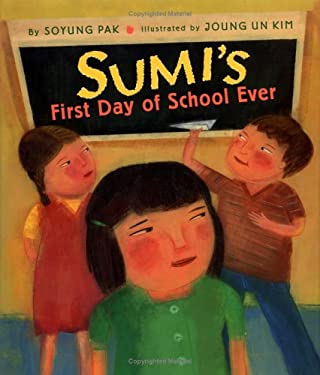
In Sumi's First Day of School Ever, Soyung Pak tells the story of a young girl just beginning her first day of classes. Sumi is Korean, and she speaks very little English, though her mother has taught her what to say if someone asks her name. She's never been to school before and she finds the whole experience frightening. From the forbidding fence around the schoolyard to the noisy, boisterous children who all seem to know just where they belong, Sumi is overwhelmed. School is a scary place, Sumi thinks, and she hangs back, watching others to know just what she should be doing. It's all pretty intense for this shy newcomer.
Fortunately Sumi's teacher is kind and gently encouraging to her new student. When she's allowed to draw a picture later in the morning, things begin to seem a little better. And then at recess, Sumi finds a stick and is drawing in the dirt when another student approaches. Mary quietly joins Sumi in drawing a scene, then introduces herself. And Sumi knows just what to say, thanks to her mother. Maybe, Sumi thinks, school is not-so-lonely after all.
Pak's sensitive portrayal of a young girl struggling to find her place in a new environment will hit home with many readers, particularly those who have felt the same way Sumi does, like she's in over her head. Joung Un Kim's soft color palette and warm backgrounds add depth to the story, and Sumi's emotions are evident in every scene. Kim keeps Sumi as the focal point of each spread, but provides appropriate context for what's happening, such as the scene where another boy makes fun of Sumi (he later apologizes after prompting from the teacher). Most importantly, the book doesn't make light of Sumi's feelings or her struggle to find her footing. Rather, it emphasizes that the most important key to fitting in might just lie in being yourself. When Sumi begins to draw, she finds common ground with another student, and in such a simple moment a friendship is born.
For those transitioning to a new environment, whether that means a new school or a new country, Sumi's First Day of School Ever can be a great tool to open discussion about how they are feeling. Equally important, this is a great way to talk with other kids about how to reach out to an unfamiliar face in their classroom, making a new friend and building a connection that benefits everyone.
NOTE: this is an older title and not readily available - check your library or a used bookstore, it's worth finding!
Sumi's First Day of School Ever by Soyung Pak, published by Viking
Ages 3-7
Source: Library
Sample: "A boy stuck out his tongue. He made a noise. He squished his eyes. / School is a mean place, Sumi thought."
Recommended
In Sumi's First Day of School Ever, Soyung Pak tells the story of a young girl just beginning her first day of classes. Sumi is Korean, and she speaks very little English, though her mother has taught her what to say if someone asks her name. She's never been to school before and she finds the whole experience frightening. From the forbidding fence around the schoolyard to the noisy, boisterous children who all seem to know just where they belong, Sumi is overwhelmed. School is a scary place, Sumi thinks, and she hangs back, watching others to know just what she should be doing. It's all pretty intense for this shy newcomer.
Fortunately Sumi's teacher is kind and gently encouraging to her new student. When she's allowed to draw a picture later in the morning, things begin to seem a little better. And then at recess, Sumi finds a stick and is drawing in the dirt when another student approaches. Mary quietly joins Sumi in drawing a scene, then introduces herself. And Sumi knows just what to say, thanks to her mother. Maybe, Sumi thinks, school is not-so-lonely after all.
Pak's sensitive portrayal of a young girl struggling to find her place in a new environment will hit home with many readers, particularly those who have felt the same way Sumi does, like she's in over her head. Joung Un Kim's soft color palette and warm backgrounds add depth to the story, and Sumi's emotions are evident in every scene. Kim keeps Sumi as the focal point of each spread, but provides appropriate context for what's happening, such as the scene where another boy makes fun of Sumi (he later apologizes after prompting from the teacher). Most importantly, the book doesn't make light of Sumi's feelings or her struggle to find her footing. Rather, it emphasizes that the most important key to fitting in might just lie in being yourself. When Sumi begins to draw, she finds common ground with another student, and in such a simple moment a friendship is born.
For those transitioning to a new environment, whether that means a new school or a new country, Sumi's First Day of School Ever can be a great tool to open discussion about how they are feeling. Equally important, this is a great way to talk with other kids about how to reach out to an unfamiliar face in their classroom, making a new friend and building a connection that benefits everyone.
NOTE: this is an older title and not readily available - check your library or a used bookstore, it's worth finding!
Sumi's First Day of School Ever by Soyung Pak, published by Viking
Ages 3-7
Source: Library
Sample: "A boy stuck out his tongue. He made a noise. He squished his eyes. / School is a mean place, Sumi thought."
Recommended
Friday, August 3, 2012
Preschool Bound
Much as I hate to say it, my baby is growing up. Suddenly he's all kid and we've left the infant and even toddler years behind. Yep, folks, we've got us a little man in the house, God help us.
Part of this now-I'm-a-big-boy process has meant moving him from his beloved in-home daycare to a more formal preschool environment. This means bye-bye to his familiar, more laid-back routine and hello to a structured program. It's a blessing in a lot of ways (not least because we really needed five-day-per-week care) but like every other transition it requires a bit of advance preparation on our part.
Bibliotherapy, if you must know.
As with every other phase in our lives, when we found a preschool for Sprout I immediately zipped off to the library in search of books to help walk him through what this change was going to mean. And fortunately I found some great titles that were really helpful in beginning to think about how his day was going to be structured, what kinds of activities he'd likely be doing and just what being a "big boy preschooler" actually meant.
First up is My Preschool by Anne Rockwell. Rockwell is a legend in kidlit, with books on just about every topic and transition kids experience. In this entry, a preschooler explains his day, walking the reader through all the fun things he gets to do and how his school works. This was a great one to start out with for Sprout, as it introduced concepts like circle time and sharing, choice time and music. Sprout likes the part where the kids do yoga, especially the boy in tree pose ("That's silly, Mama! He's not a tree!"). Rockwell also touches on the conflicts that inevitably arise at school, when our hero's block tower gets knocked over by his friend Will. The incident is swiftly and satisfyingly resolved, and the kids head outside for playtime. Like all of Rockwell's work, My Preschool rings with clarity and simplicity, and its smudgy monoprint art strikes just the right note.
Little School by Beth Norling has a more diverse focus, following 20 little ones throughout their day at preschool. This one has a great representation of diversity, with children of multiple ethnicities depicted engaging in all the usual preschool activities. I love the fact that each child's experience is unique and yet they are all experiencing the same basic framework of art, play time, story time, etc. Norling presents every one of the kids as an individual and shows how the program they are in develops and builds their day. This one's practical, too - even bathroom time is included, in a tasteful way. Colorful and full of detail, we loved looking at this one together. (NOTE: this is an older title and not widely available for purchase; check your library or used bookstore!)
And though the notion of taking turns wasn't unfamiliar to Sprout, we felt he needed to understand that in preschool, no one gets their way all the time. For that we turned to Sometimes You Get What You Want by Meredith Gary, illustrated by Lisa Brown. In this simple yet effective title, a pair of siblings experiences school together. Each spread presents two scenarios: in one, the child gets what he or she wants, while in the other, he or she goes along with the group. For example, "Sometimes your friends want to do what you're doing. Sometimes they want to do something else." This quiet but affecting title really got Sprout to thinking, and we have revisited it a couple of times since preschool began. Slowly he's realizing that it's all right if things don't always go his way, that he'll get a turn, though it isn't always soon enough (it's a work in progress).
If you've got a little one starting a new school this fall, consider conducting a little bibliotherapy of your own. Books can present great opportunities to see behaviors being modeled, and to soothe apprehensions about what a typical day will be like. Best of all, they open up the chance to dialogue with your kiddo about what preschool means - and they might just make everyone feel a little more at ease with this whole growing-up scenario.
Part of this now-I'm-a-big-boy process has meant moving him from his beloved in-home daycare to a more formal preschool environment. This means bye-bye to his familiar, more laid-back routine and hello to a structured program. It's a blessing in a lot of ways (not least because we really needed five-day-per-week care) but like every other transition it requires a bit of advance preparation on our part.
Bibliotherapy, if you must know.
As with every other phase in our lives, when we found a preschool for Sprout I immediately zipped off to the library in search of books to help walk him through what this change was going to mean. And fortunately I found some great titles that were really helpful in beginning to think about how his day was going to be structured, what kinds of activities he'd likely be doing and just what being a "big boy preschooler" actually meant.
First up is My Preschool by Anne Rockwell. Rockwell is a legend in kidlit, with books on just about every topic and transition kids experience. In this entry, a preschooler explains his day, walking the reader through all the fun things he gets to do and how his school works. This was a great one to start out with for Sprout, as it introduced concepts like circle time and sharing, choice time and music. Sprout likes the part where the kids do yoga, especially the boy in tree pose ("That's silly, Mama! He's not a tree!"). Rockwell also touches on the conflicts that inevitably arise at school, when our hero's block tower gets knocked over by his friend Will. The incident is swiftly and satisfyingly resolved, and the kids head outside for playtime. Like all of Rockwell's work, My Preschool rings with clarity and simplicity, and its smudgy monoprint art strikes just the right note.
Little School by Beth Norling has a more diverse focus, following 20 little ones throughout their day at preschool. This one has a great representation of diversity, with children of multiple ethnicities depicted engaging in all the usual preschool activities. I love the fact that each child's experience is unique and yet they are all experiencing the same basic framework of art, play time, story time, etc. Norling presents every one of the kids as an individual and shows how the program they are in develops and builds their day. This one's practical, too - even bathroom time is included, in a tasteful way. Colorful and full of detail, we loved looking at this one together. (NOTE: this is an older title and not widely available for purchase; check your library or used bookstore!)
And though the notion of taking turns wasn't unfamiliar to Sprout, we felt he needed to understand that in preschool, no one gets their way all the time. For that we turned to Sometimes You Get What You Want by Meredith Gary, illustrated by Lisa Brown. In this simple yet effective title, a pair of siblings experiences school together. Each spread presents two scenarios: in one, the child gets what he or she wants, while in the other, he or she goes along with the group. For example, "Sometimes your friends want to do what you're doing. Sometimes they want to do something else." This quiet but affecting title really got Sprout to thinking, and we have revisited it a couple of times since preschool began. Slowly he's realizing that it's all right if things don't always go his way, that he'll get a turn, though it isn't always soon enough (it's a work in progress).
If you've got a little one starting a new school this fall, consider conducting a little bibliotherapy of your own. Books can present great opportunities to see behaviors being modeled, and to soothe apprehensions about what a typical day will be like. Best of all, they open up the chance to dialogue with your kiddo about what preschool means - and they might just make everyone feel a little more at ease with this whole growing-up scenario.
Tuesday, January 31, 2012
Picture Book Review - My Mei Mei by Ed Young
When you're preparing to add a member to your family through adoption, there's a lot of getting ready to do. Preparing a room, checking out daycares or schools, babyproofing (or big kid-proofing), picking a pediatrician -- there are a million little details. If you have other children in the home, a big part of the preparations is explaining the adoption process, and what it will feel like when their new sibling joins the household.
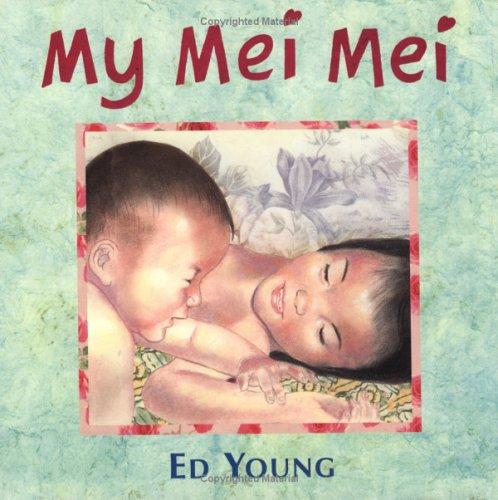
Luckily there are a lot of great picture books to facilitate these discussions, and My Mei Mei by Ed Young is one of them. Young, himself an adoptive dad, was motivated to write and illustrate this picture book through his own experience adding a second daughter from China. Young's firsthand knowledge of this situation shines through on every page.
Antonia desperately wants a mei mei (little sister) to play and share secrets with. She plays at being jieh-jieh (big sister) and she just knows she'll be a really good one. And then the day finally arrives, and the family travels to China to bring Mei Mei home. Antonia is so excited! But Mei Mei turns out to be nothing like Antonia thinks she would be, and soon jealousy is creeping in. Will the sisters ever get used to each other? Will Antonia like being a big sister after all?
Young is not only an adoptive dad, he's also a Caldecott medalist, and his talents bring this very personal story to life. The colors he uses are vibrant and vivid, emphasizing the emotional journey that all the family members move through. And as the girls' relationship changes, so does the perspective, and soon the two are totally intertwined.
Whether you're bringing home a child through international adoption, foster care, or having a birth child, there's a lot here to help ease the transition from only child to older sibling. Sharing Young's gentle tale as a family is an excellent way to open a discussion about life changes or to remember another child's adoption story. A beautiful book, beautifully told!
Luckily there are a lot of great picture books to facilitate these discussions, and My Mei Mei by Ed Young is one of them. Young, himself an adoptive dad, was motivated to write and illustrate this picture book through his own experience adding a second daughter from China. Young's firsthand knowledge of this situation shines through on every page.
Antonia desperately wants a mei mei (little sister) to play and share secrets with. She plays at being jieh-jieh (big sister) and she just knows she'll be a really good one. And then the day finally arrives, and the family travels to China to bring Mei Mei home. Antonia is so excited! But Mei Mei turns out to be nothing like Antonia thinks she would be, and soon jealousy is creeping in. Will the sisters ever get used to each other? Will Antonia like being a big sister after all?
Young is not only an adoptive dad, he's also a Caldecott medalist, and his talents bring this very personal story to life. The colors he uses are vibrant and vivid, emphasizing the emotional journey that all the family members move through. And as the girls' relationship changes, so does the perspective, and soon the two are totally intertwined.
Whether you're bringing home a child through international adoption, foster care, or having a birth child, there's a lot here to help ease the transition from only child to older sibling. Sharing Young's gentle tale as a family is an excellent way to open a discussion about life changes or to remember another child's adoption story. A beautiful book, beautifully told!
Saturday, December 17, 2011
12 Days of Christmas Picture Books - Christmas Cricket
I love the holidays. Love the hustle and bustle, all the lead-up to Christmas and the crazy chaos of celebrating together. But let's face it -- it can be pretty overwhelming, particularly for the little people in our lives. It's hard for kids not to get lost in the shuffle of all there is to see and do at Christmastime.
Enter Eve Bunting and her sweet story Christmas Cricket. Bunting gives us a glimpse into the world of a little insect who "felt small and worthless in the bigness of night". Looking for warmth, Cricket slips into a house and takes refuge in a Christmas tree, where he begins to sing. But then someone hears him, and comes looking for the source of the song. Should Cricket run away? Or is he safe to sing, even in a place that doesn't seem at all familiar?
Bunting's a masterful storyteller, and one who doesn't shy away from tough subjects (her collaboration with David Diaz, Smoky Night, is one of the most powerful and poignant picture books I've ever seen). And though you might not think Christmas is a tough subject, it can be for many. Though this isn't a book about adoption, as an adoptive parent I couldn't help reading Christmas Cricket with an eye toward children in new family situations. For them, and their families, the holidays can be a time both exciting and scary, as everyone learns their place in the whole scheme of things. Like Cricket, children might feel "small and worthless in the bigness" of Christmas with a family who loves them, maybe in ways they don't even understand quite yet. And new parents, too, can be overwhelmed, as their children don't seem to be enjoying the holidays like they imagined.
As happy as this time of year can be, it's worth reminding ourselves that taking joy in the small things means every bit as much. In the end, Cricket learns that there is joy in his own song, sung in the way only he can sing it. And at Christmas, isn't that the best gift of all?
Enter Eve Bunting and her sweet story Christmas Cricket. Bunting gives us a glimpse into the world of a little insect who "felt small and worthless in the bigness of night". Looking for warmth, Cricket slips into a house and takes refuge in a Christmas tree, where he begins to sing. But then someone hears him, and comes looking for the source of the song. Should Cricket run away? Or is he safe to sing, even in a place that doesn't seem at all familiar?
Bunting's a masterful storyteller, and one who doesn't shy away from tough subjects (her collaboration with David Diaz, Smoky Night, is one of the most powerful and poignant picture books I've ever seen). And though you might not think Christmas is a tough subject, it can be for many. Though this isn't a book about adoption, as an adoptive parent I couldn't help reading Christmas Cricket with an eye toward children in new family situations. For them, and their families, the holidays can be a time both exciting and scary, as everyone learns their place in the whole scheme of things. Like Cricket, children might feel "small and worthless in the bigness" of Christmas with a family who loves them, maybe in ways they don't even understand quite yet. And new parents, too, can be overwhelmed, as their children don't seem to be enjoying the holidays like they imagined.
As happy as this time of year can be, it's worth reminding ourselves that taking joy in the small things means every bit as much. In the end, Cricket learns that there is joy in his own song, sung in the way only he can sing it. And at Christmas, isn't that the best gift of all?
Monday, November 14, 2011
Audio Review - Schooled by Gordon Korman
I'm a sucker for the fish-out-of-water novel, mostly because I think there's not a kid or adult alive who hasn't felt that way. Especially in middle school, when it's kind of a revolving door of outside-inside, where every day brings a fresh new opportunity to end up labeled a complete loser. And in Schooled, Gordon Korman gives us a doozy of kid out of his depth, in the character of Cap Anderson.
Cap -- as in short for Capricorn -- does that give you a clue why this boy might be a bit of an outsider? Cap's grown up on Garland Farm, a commune run by his grandmother Rain, and it's the only world he's ever known. Garland's kind of small -- in fact, Cap and Rain are the only members left -- and so when Rain has an accident and has to go into the hospital for a while, there's no one for Cap to turn to. Suddenly Cap finds himself living with a social worker and her snarky daughter, and enrolled at Claverage Middle School, better known as C Average by the student body. Can life get any weirder? As it turns out, it can, when Cap's elected 8th grade president, has to plan the Halloween dance, and starts teaching a high schooler to drive. Oh, and becomes the greatest philanthropist in the history of middle school.
Schooled moves along at a rapid clip, with plenty of hilarity along the way, but manages to wrap in some important lessons too -- about being true to yourself, sure, but also about being true to others, and being the kind of friend we all really need.
Schooled by Gordon Korman, published by Hyperion Books
Ages 10-13
Source: Library
Sample quote: "Something tingled directly beneath the peace sign I wore around my neck. I was developing a sixth sense for when trouble was coming my way. But what good was advance warning? Advance warning of what? I wasn't going to understand it anyway."
Recommended
Just when you think you've figured out where Korman's going with this one, he throws another twist in the mix. And while the cast of characters is huge, the audio sorts this out nicely by having a different actor voice each part. (Even so, I'll admit I occasionally got lost and forgot who was who.) Cap is a wholly original character, a blend of modern kid with a whole lot of sixties hippie thrown in for good measure. The way he approaches life is unique, but believable in the context of a boy who has grown up only knowing one other person, his grandmother. And the lessons Cap teaches his fellow middle schoolers follow right along with his worldview, that of a boy who's never seen television and honestly thinks he needs to learn every students name.
Schooled moves along at a rapid clip, with plenty of hilarity along the way, but manages to wrap in some important lessons too -- about being true to yourself, sure, but also about being true to others, and being the kind of friend we all really need.
Schooled by Gordon Korman, published by Hyperion Books
Ages 10-13
Source: Library
Sample quote: "Something tingled directly beneath the peace sign I wore around my neck. I was developing a sixth sense for when trouble was coming my way. But what good was advance warning? Advance warning of what? I wasn't going to understand it anyway."
Recommended
Labels:
audio,
boys,
foster care,
middle grade,
novel,
transition
Tuesday, October 25, 2011
Chapter Book Review - Penny Dreadful by Laurel Snyder
Penny Dreadful is the kind of book that librarians and teachers live for. This is the book that you secretly keep in the back of your mind, just waiting for the earnest boy or girl who comes to you and asks for something new. This is what you hold on to for the summer doldrums or the winter blahs, when kids are tired of required reading and want something comforting. Penny Dreadful is like your favorite flavor of ice cream, reliably tasty and never disappointing.
The plot is simple and remarkably classic. Penelope Grey lives a life that many other kids would dream of, with a huge house, loving if distant parents, a private tutor and every creature comfort. Yet her life is boring, nothing at all like the life of children in books. So Penelope makes one wish, a small and simple wish that something interesting would happen.
She has absolutely no idea what she's in for.
Before she knows it, Penelope's comfortable life is turned upside down. Her father has quit his job and soon the family is out of money. Their lavish lifestyle rapidly disappears. Soon the only option the Greys have left is to move to Thrush Junction, Tennessee, the home of Mrs Grey's elderly aunt who recently passed away. Great-Aunt Betty owned a rambling house there, which she left to Penelope's mom. The plan is to start life over again in Thrush Junction -- and that is just what the family does, with some amazing results. Very soon Penelope has become someone she would scarcely have recognized in her old life, and she's determined to hang on to her new self no matter what it takes.
Laurel Snyder has a good thing going here, something that many writers aspire to but aren't able to pull off. There's scarcely a misstep in Penny Dreadful -- the characters are quirky but believable, the problems are those kids can actually identify with, and there's even a whiff of magic to keep things interesting. Readers will want to move into Thrush Junction and meet Penny's clever and adventurous friends (especially Luella, my absolute favorite. Is it too much to hope Laurel Snyder brings Luella back again??). I love the way Penny relates to the books she's read, wanting to spice up her own life so it more closely resembles the stories she loves. Although at the beginning of the book Penny lives a life of privilege, she's no Mary Lennox from The Secret Garden. Rather, she's an ordinary little girl craving an extraordingary life. I was exactly the same way as a kid, and I suspect there are more than a few of us out there (if you're reading this, you probably were too).
Bottom line: Penny Dreadful is a believable yet dreamily hopeful novel that is just right for readers who want something different and still reminiscent of familiar favorites. I firmly believe this is one that will have a long life on many recommended reading lists, and it's a great choice for reading aloud together.
Penny Dreadful by Laurel Snyder, published by Random House
Ages 8-12
Source: Library
Sample quote: "With an unfamiliar flutter in her chest, Penelope unfolded the scrap of paper and read what she'd written one last time. I wish something interesting would happen when I least expect it, just like in a book. Penelope refolded her wish carefully and tossed it into the well. Then she leaned over and peered down after it."
Highly recommended
The plot is simple and remarkably classic. Penelope Grey lives a life that many other kids would dream of, with a huge house, loving if distant parents, a private tutor and every creature comfort. Yet her life is boring, nothing at all like the life of children in books. So Penelope makes one wish, a small and simple wish that something interesting would happen.
She has absolutely no idea what she's in for.
Before she knows it, Penelope's comfortable life is turned upside down. Her father has quit his job and soon the family is out of money. Their lavish lifestyle rapidly disappears. Soon the only option the Greys have left is to move to Thrush Junction, Tennessee, the home of Mrs Grey's elderly aunt who recently passed away. Great-Aunt Betty owned a rambling house there, which she left to Penelope's mom. The plan is to start life over again in Thrush Junction -- and that is just what the family does, with some amazing results. Very soon Penelope has become someone she would scarcely have recognized in her old life, and she's determined to hang on to her new self no matter what it takes.
Laurel Snyder has a good thing going here, something that many writers aspire to but aren't able to pull off. There's scarcely a misstep in Penny Dreadful -- the characters are quirky but believable, the problems are those kids can actually identify with, and there's even a whiff of magic to keep things interesting. Readers will want to move into Thrush Junction and meet Penny's clever and adventurous friends (especially Luella, my absolute favorite. Is it too much to hope Laurel Snyder brings Luella back again??). I love the way Penny relates to the books she's read, wanting to spice up her own life so it more closely resembles the stories she loves. Although at the beginning of the book Penny lives a life of privilege, she's no Mary Lennox from The Secret Garden. Rather, she's an ordinary little girl craving an extraordingary life. I was exactly the same way as a kid, and I suspect there are more than a few of us out there (if you're reading this, you probably were too).
Bottom line: Penny Dreadful is a believable yet dreamily hopeful novel that is just right for readers who want something different and still reminiscent of familiar favorites. I firmly believe this is one that will have a long life on many recommended reading lists, and it's a great choice for reading aloud together.
Penny Dreadful by Laurel Snyder, published by Random House
Ages 8-12
Source: Library
Sample quote: "With an unfamiliar flutter in her chest, Penelope unfolded the scrap of paper and read what she'd written one last time. I wish something interesting would happen when I least expect it, just like in a book. Penelope refolded her wish carefully and tossed it into the well. Then she leaned over and peered down after it."
Highly recommended
Tuesday, September 20, 2011
Picture Book Review - Goyangi Means Cat by Christine McDonnell
Soo Min isn't sure about this new home of hers. Nothing is like it was back home in Korea. The food, her new house, the sounds outside her window at night. Though her American mother and father are nice, they cannot speak her language. Soo Min teaches them some Korean words, but it isn't the same. The only thing that Soo Min finds comforting is Goyangi, the American cat. Goyangi's fur is soft and he is quiet, which makes Soo Min feel peaceful too.
Goyangi Means Cat is a gentle story that explores the loneliness a newly adopted child feels, when he or she is settling into an entirely strange and sometimes frightening place. The artwork by Steve Johnson and Lou Fancher is fantastic -- these are the kind of pictures you could pore over, examining all the small details woven into the backgrounds via paper collage. An especially nice touch is the interweaving of Korean words into the text, a technique the artists used to demonstrate the blending together of Soo Min's experiences, both at home in Korea and now at home in America. This title would make a great addition to any child's library, but is especially wonderful for Korean children as a touchstone with their heritage and culture.
For siblings and family members who want to understand better what their children are going through, as well as for the child feeling all alone in a world they do not recognize, this is a simple and reassuring tale. It's also a good reminder for parents that although our children may act as though everything is all right, inside they may be confused and lonely. Even a small change in Soo Min's routine, like a trip to the library, seems like too much at first, and Soo Min longs for the comfort of her friend Goyangi. Although Soo Min knows her American parents care for her, she feels isolated without a common language. But the language of her four-footed friend sustains her, helping ease Soo Min into the transition of a new home and family.
Goyangi Means Cat by Christine McDonnell, published by Viking Penguin
All ages
Source: Library
Sample quote: "At night Goyangi curled up on Soo Min's bed. When she was frightened by a siren in the street, she stroked Goyangi's soft fur. When Soo Min missed her Korean friends, Goyangi licked her hand with his towelly tongue."
Highly recommended
But then one morning Goyangi gets out of the house, and Soo Min can't stop worrying about her friend. All day Soo Min and her mother look for Goyangi, but the cat does not reappear. What will Soo Min do without Goyangi? She is very worried -- and at last, when Goyangi comes back at the end of the night, Soo Min realizes that this is home, with her new parents, in this unfamiliar house, but with Goyangi right there by her side.
Goyangi Means Cat is a gentle story that explores the loneliness a newly adopted child feels, when he or she is settling into an entirely strange and sometimes frightening place. The artwork by Steve Johnson and Lou Fancher is fantastic -- these are the kind of pictures you could pore over, examining all the small details woven into the backgrounds via paper collage. An especially nice touch is the interweaving of Korean words into the text, a technique the artists used to demonstrate the blending together of Soo Min's experiences, both at home in Korea and now at home in America. This title would make a great addition to any child's library, but is especially wonderful for Korean children as a touchstone with their heritage and culture.
For siblings and family members who want to understand better what their children are going through, as well as for the child feeling all alone in a world they do not recognize, this is a simple and reassuring tale. It's also a good reminder for parents that although our children may act as though everything is all right, inside they may be confused and lonely. Even a small change in Soo Min's routine, like a trip to the library, seems like too much at first, and Soo Min longs for the comfort of her friend Goyangi. Although Soo Min knows her American parents care for her, she feels isolated without a common language. But the language of her four-footed friend sustains her, helping ease Soo Min into the transition of a new home and family.
Goyangi Means Cat by Christine McDonnell, published by Viking Penguin
All ages
Source: Library
Sample quote: "At night Goyangi curled up on Soo Min's bed. When she was frightened by a siren in the street, she stroked Goyangi's soft fur. When Soo Min missed her Korean friends, Goyangi licked her hand with his towelly tongue."
Highly recommended
Friday, August 26, 2011
Picture Book Review - A New Barker in the House by Tomie dePaola
Beloved author and illustrator Tomie dePaola weaves adoption into the storyline of A New Barker in the House, part of his series about the Barker family. Mama, Papa, Morgan and Moffat are excited to be adding a new member to their family: three-year-old Marcos. The twins cannot wait to show their new brother all their favorite toys, and especially want to take him to show-and-tell at their school. They begin to think about all the fun they will have together.
But when Marcos comes home with Papa, he speaks Spanish, which Morgie and Moffie can't understand. And the only English word Marcos knows is "potty", but he uses that one a lot! Marcos doesn't like the things the twins like, and he doesn't want to play ball or dolls either. Mama gently explains that Marcos may not want to eat the same food, or play the same games, and encourages the twins to ask Marcos what he wants to do. Before long Marcos and the twins are playing together on the playground, and everyone is learning how to speak one another's language.
As always, dePaola's illustrations are bright and expressive, homey depictions of the contented Barker family at home together. The layout makes use of panels to represent the various characters' points of view, especially effective when demonstrating how the twins each want to share their own favorite things with Marcos. The discussion of adoption is brief and straightforward; dePaola assumes that the audience understands what adoption's about, and doesn't get bogged down in lengthy explanations. Rather, this title focuses on the transition of a new child into a family, and the way siblings must learn to accommodate and appreciate their brother or sister's preferences. If the storyline resolves quickly, that is to be expected for the intended age group. The big benefit is that dePaola opens up plenty of opportunities for further discussion and examination.
Bottom line: Overall, a good title to introduce the topic of adoption to a family, and get siblings thinking and talking about what the new family member may want or need. Sensitive, gentle and thoughtful, A New Barker in the House is another well-rounded title from a favorite author!
A New Barker in the House by Tomie dePaola, published by G.P. Putnam's Sons
Ages 2-6
Source: Library
Sample quote: "The next morning at breakfast, Morgie gave Marcos a big spoonful of Morgie's favorite cereal - Dino Pops. Marcos didn't like it! Moffie gave Marcos a big spoonful of her favorite cereal - Alphabet Bits. Marcos didn't like it. Marcos SPIT it all out! 'Mama!' the twins yelled."
Recommended
As always, dePaola's illustrations are bright and expressive, homey depictions of the contented Barker family at home together. The layout makes use of panels to represent the various characters' points of view, especially effective when demonstrating how the twins each want to share their own favorite things with Marcos. The discussion of adoption is brief and straightforward; dePaola assumes that the audience understands what adoption's about, and doesn't get bogged down in lengthy explanations. Rather, this title focuses on the transition of a new child into a family, and the way siblings must learn to accommodate and appreciate their brother or sister's preferences. If the storyline resolves quickly, that is to be expected for the intended age group. The big benefit is that dePaola opens up plenty of opportunities for further discussion and examination.
Bottom line: Overall, a good title to introduce the topic of adoption to a family, and get siblings thinking and talking about what the new family member may want or need. Sensitive, gentle and thoughtful, A New Barker in the House is another well-rounded title from a favorite author!
A New Barker in the House by Tomie dePaola, published by G.P. Putnam's Sons
Ages 2-6
Source: Library
Sample quote: "The next morning at breakfast, Morgie gave Marcos a big spoonful of Morgie's favorite cereal - Dino Pops. Marcos didn't like it! Moffie gave Marcos a big spoonful of her favorite cereal - Alphabet Bits. Marcos didn't like it. Marcos SPIT it all out! 'Mama!' the twins yelled."
Recommended
Subscribe to:
Posts (Atom)