Wow! Can't believe the response to our 30 Days of Picture Books series. This is such a fun project for us to do, and it's nice to hear how it's affecting readers. For all those who've told us how much you enjoyed our picks, or mentioned that you're adding titles to your library list - thank you! And don't worry, we're already thinking about books to feature in next year's list. :)
In preparation for this year's 30 Days, Sprout and I read a ton of picture books, but that wasn't all I was reading. Today I'm featuring a title I read a while back, that touched me so much I couldn't help but share it with you. Holly Goldberg Sloan's Counting by 7s is being compared by many to R.J. Palacio's Wonder, and for good reason - both books feature narrators with compelling voices, unique challenges, and incredible people in their lives. But you can't really compare these books on any significant level, because each brings such individual strengths and impact to the reader. So let's acknowledge that one and move on, m'kay?
Counting by 7s tells the story of Willow Chance. Willow's a middle schooler who's best described as different from others she encounters. Willow's family is transracial, as Willow, who is multiracial, was adopted by "two of the whitest white people in the world (no exaggeration.)". But this isn't an adoption story. Willow's a genius, finishing the state proficiency exam so quickly that the school puts her into behavioral counseling. But this isn't a smart kid story. Willow's an oddball, not quite fitting in with anyone else at her middle school because of her talents and her interests. But this isn't an odd-girl-out story.
No, what defines this story is what happens to Willow in almost the first couple of pages: Willow's parents are killed in a car accident, and Willow, the adoptee/smart girl/oddball, is suddently and irrevocably on her own. Willow's got no support network to speak of, but from the emptiness around her, a web of family begins to appear. There's Mai Nguyen, a Vietnamese-Mexican girl who encounters Willow at the counselor's office and becomes a friend almost against her will. There's Pattie, Mai's mother, who sees Willow's plight and becomes convinced that foster care is no place for this tremendous child. There's Quang-ha, Mai's brother who disdains Willow but can't help but be impressed by her talents. And there's Dell Duke, the going-nowhere counselor who's treading water in his job until he becomes entangled with Willow and her story, and suddenly finds his whole life turned upside down.
It's tough for me to sum up in mere words just how much I loved this book. As with Wonder (here we go with the comparisons again), Counting by 7s is a watershed book, one whose story stays with you and that makes you think differently about assumptions you've previously held. Willow's a remarkable character in that her unswerving focus on her particular interests sweeps up everyone around her, a force that's changing their lives before they even realize it's happened. Though the narrative is propelled by a tragic event, this is by no means a sad book -- rather, it's a book about hope, about the goodness of human nature and how every minute can be a turning point. Willow's story speaks to the cynic in all of us, proving that even the most isolated and insular among us can be moved outside of our bubbles to be a force of change in another's life.
I highly recommend Counting by 7s for middle school readers, and for older readers as well, because I think even adults can learn a lot from this wise girl and her story, lessons about valuing yourself and about reaching out, believing that we can change the world. If you read one chapter book this year, make it Holly Goldberg Sloan's - and if you give one, make it this as well. You'll be glad on both counts.
Counting by 7s by Holly Goldberg Sloan, published by Dial Books for Young Readers
Ages 9-12 +
Source: Library
Sample: "I was taken to see an educational consultant that autumn and the woman did an evaluation. She sent my parents a letter.
I read it.
It said I was 'highly gifted.'
Are people 'lowly gifted'?
Or 'medium gifted'?
Or just 'gifted'? It's possible that all labels are curses. Unless they are on cleaning products.
Because in my opinion it's not really a great idea to see people as one thing.
Every person has lots of ingredients to make them into what is always a one-of-a-kind creation.
We are all imperfect genetic stews."
Highly recommended
Showing posts with label novel. Show all posts
Sunday, December 15, 2013
Tuesday, July 23, 2013
Better Nate Than Ever by Tim Federle
Whew, lots going on around here at the moment! In addition to the Multicultural Kid Blogs Pinterest Scavenger Hunt we are participating in (are you pinning along?), I've recently been promoted to a librarian position at the regional library system where I work. That's a dream come true for me, frankly, and though it isn't a children's services position, I'll still be doing acquisitions for our children's department, so no shortage of new books any time soon. But while I've been adjusting to all of this, the blog has taken a back seat of sorts, and I do apologize for the lack of new content. Fear not, more is coming!
Of all the books I've recently read, though, one is so unique that I couldn't take it back to the library unblogged. In his debut novel for middle graders, Better Nate Than Ever, Tim Federle gives us a fast, funny and oh-so-relatable tale of a fish out of water who may just have finally found his true calling. Nate Foster hasn't always known he wanted to be on Broadway, but he has always felt he didn't quite fit in his hometown of Jankburg, Pennsylvania. With the help of best friend Libby, Nate's finally figuring out that he was born for the stage - and he may be getting his big break, when Libby helps him hatch a plot to sneak off to New York for a Broadway audition. It's for the stage version of Nate's favorite film -- E.T.: The Musical -- and Nate just feels in his bones that he's meant to play Elliott. So Nate screws up all his courage and takes the city by storm. But with every twist and turn, it seems it's not going to be an easy road to stardom. Should Nate give up and head for home, or keep on keeping on to make his big dreams a reality?
This one isn't going to strike a chord with every kid, but for those to whom it rings true, this one may just be a lifesaver. Federle's frank about Nate's struggles to figure out his place in the world; this is an especially good choice for young teens who are gay or questioning. There are lots of other weighty issues as well, including religion, happiness at home, sibling rivalry, bullying and the drama of not fitting in. But lest you think this is a heavy book, far from it. Parts of this warm and witty novel had me laughing out loud, and every single page had me rooting for Nate that he'd find his place in the world, now or later.
Federle's mined his own experiences for the story of Nate, and the truth of his writing shines through on every page. You can't help but smile at a kid who uses failed musicals as curse words, and who's almost single-minded about getting to eat at the Times Square Applebee's. There's the perfect pitch here between adulthood and childhood, between a kid who is dazzled by the white lights of Broadway and one who just wants to, once and for all, find the place he's meant to be. For all of us who've ever felt there was a version of life out there with kindred spirits, and who suffered through some years of being odd one out before finding it, Better Nate Than Ever says it all.
Better Nate Than Ever by Tim Federle, published by Simon and Schuster
Ages 9-13+
Source: Library
Sample: "And now I'm staring out the window at a familiar world zooming past, colors bleeding from grey (Pittsburgh) to bright red and blue (a car accident) to brown (somewhere thirty minutes out of town). Libby shared a really good technique that is thus far working beautifully: Crumple up a bunch of Kleenex and put them on the seat next to yours, and nobody will sit next to you on long bus trips. Try it sometime, guys."
Recommended
Of all the books I've recently read, though, one is so unique that I couldn't take it back to the library unblogged. In his debut novel for middle graders, Better Nate Than Ever, Tim Federle gives us a fast, funny and oh-so-relatable tale of a fish out of water who may just have finally found his true calling. Nate Foster hasn't always known he wanted to be on Broadway, but he has always felt he didn't quite fit in his hometown of Jankburg, Pennsylvania. With the help of best friend Libby, Nate's finally figuring out that he was born for the stage - and he may be getting his big break, when Libby helps him hatch a plot to sneak off to New York for a Broadway audition. It's for the stage version of Nate's favorite film -- E.T.: The Musical -- and Nate just feels in his bones that he's meant to play Elliott. So Nate screws up all his courage and takes the city by storm. But with every twist and turn, it seems it's not going to be an easy road to stardom. Should Nate give up and head for home, or keep on keeping on to make his big dreams a reality?
This one isn't going to strike a chord with every kid, but for those to whom it rings true, this one may just be a lifesaver. Federle's frank about Nate's struggles to figure out his place in the world; this is an especially good choice for young teens who are gay or questioning. There are lots of other weighty issues as well, including religion, happiness at home, sibling rivalry, bullying and the drama of not fitting in. But lest you think this is a heavy book, far from it. Parts of this warm and witty novel had me laughing out loud, and every single page had me rooting for Nate that he'd find his place in the world, now or later.
Federle's mined his own experiences for the story of Nate, and the truth of his writing shines through on every page. You can't help but smile at a kid who uses failed musicals as curse words, and who's almost single-minded about getting to eat at the Times Square Applebee's. There's the perfect pitch here between adulthood and childhood, between a kid who is dazzled by the white lights of Broadway and one who just wants to, once and for all, find the place he's meant to be. For all of us who've ever felt there was a version of life out there with kindred spirits, and who suffered through some years of being odd one out before finding it, Better Nate Than Ever says it all.
Better Nate Than Ever by Tim Federle, published by Simon and Schuster
Ages 9-13+
Source: Library
Sample: "And now I'm staring out the window at a familiar world zooming past, colors bleeding from grey (Pittsburgh) to bright red and blue (a car accident) to brown (somewhere thirty minutes out of town). Libby shared a really good technique that is thus far working beautifully: Crumple up a bunch of Kleenex and put them on the seat next to yours, and nobody will sit next to you on long bus trips. Try it sometime, guys."
Recommended
Labels:
boys,
city,
debut,
fitting in,
growing up,
identity,
LGBTQ,
novel,
teen,
YA
Tuesday, March 12, 2013
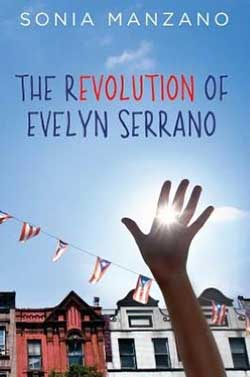
Teen Review - The Revolution of Evelyn Serrano by Sonia Manzano
For my teen literature class last semester, I compiled a list of historical fiction titles as my end-of-term project. It was a fun list to put together, and I was shocked at how many historicals I'd read in recent memory. But what struck me about the list was how many books about certain eras there are. Take World War II, for instance -- one of the most fascinating periods in world history, for lots of reasons, and as you might expect there are tons of books on the subject. But look for teen books on other eras and you might be hard pressed to find anything at all, much less anything worth reading.
The 60's are one of those eras that tend to be somewhat untapped when it comes to teen lit. I can't figure out why -- maybe it's not long past enough to be truly historical for some? Not really sure, but it seems to me that I've read some really extraordinary books set during this turbulent timeframe. And it's a natural match to the turmoil of adolescence, with all the uncertainty and the shades of black and white fading into gray in so many areas of life. Seems like gold to a novelist, I would think.
And that's certainly true of the debut novel by Sonia Manzano, The Revolution of Evelyn Serrano. Manzano's name probably sounds familiar -- she's best known as the actress who plays Maria on Sesame Street. I'm not ashamed to admit that Sesame Street made a huge impact on me, as it did to so many of us babies of the 1970s. The second I read about Manzano's book, it went on my reading list, because, hello? It's Maria! And I'm so glad I jumped at it, because this affecting, emotional novel is truly a gem that deserves a spot on every reading list.
Evelyn Serrano used to be known as Rosa Maria, but when she turned 14 she decided a name change was in order. Besides, there are entirely two many Rosas and Marias in her Spanish Harlem neighborhood, and Evelyn doesn't want to blend in. She also doesn't want to be like her Mami, clinging to the ways things were in Puerto Rico, fashions and decorating and all of that. So she's breaking out on her own a bit, and things are going pretty well -- until her abuela turns up, Mami's mother from Puerto Rico. Abuela's not like any of the other grandmothers - she's sassy and brash and she knows things, political things, that Mami never wants to talk about. Evelyn's drawn to Abuela and her politics, and before long all three of the Serrano women are embroiled in activism, as the Young Lords, a protest group, make a stand in Evelyn's Spanish Harlem neighborhood.
Manzano may be on her first outing as a novelist here, but her talents for characterization are clearly well-honed. Evelyn is a believable and interesting narrator, one modern readers will identify with as she struggles to find her footing in a world of upheaval and uncertainty. The issues Evelyn faces -- issues of family, politics, love, and identity -- are universal, which makes their placement amidst this historical setting all the more powerful. Personally I didn't know much at all about the Young Lords, and I found Manzano's account not only stirring but informative. Much like Rita Williams-Garcia's stellar novel One Crazy Summer, and its depiction of the Black Panthers, Manzano's novel gives us a side of the conflict in Spanish Harlem that most of us may not fully understand. All this while keeping the action moving, an impressive feat for a debut novelist.
More than just a book about politics, though, Revolution is ultimately a book about a young girl, and the transformation she undergoes not only with how she sees herself but how she understands her friends and family. The relationship between Evelyn and her mother is a thorny one (much like that between Mami and Abuela), and Manzano shows us the whole thing, unstintingly. These are real people, which makes them all the more complex and interesting - and ultimately, believable.
I can't wait to read more from Manzano, and I'm thrilled that her recent Pura Belpre honor for this title will take her book to that much wider an audience.
The Revolution of Evelyn Serrano by Sonia Manzano, published by Scholastic
Ages 12 up
Source: Library
Sample: "At the kitchen table sat a woman whose eyebrows were drawn on with a black makeup pencil. On her eyelids was a thick spread of eye shadow the same blue as my snow cone. The woman's lips were as pink as the inside of a seashell. And, oh, her hair -- it was as orange as Bozo's, puffed up and piled on top of her head like a wad of cotton candy. Mami was serving this strange lady a cup of coffee. / Mami spoke in a very tired way. 'Mija, this is your abuela.'"
Recommended
The 60's are one of those eras that tend to be somewhat untapped when it comes to teen lit. I can't figure out why -- maybe it's not long past enough to be truly historical for some? Not really sure, but it seems to me that I've read some really extraordinary books set during this turbulent timeframe. And it's a natural match to the turmoil of adolescence, with all the uncertainty and the shades of black and white fading into gray in so many areas of life. Seems like gold to a novelist, I would think.
And that's certainly true of the debut novel by Sonia Manzano, The Revolution of Evelyn Serrano. Manzano's name probably sounds familiar -- she's best known as the actress who plays Maria on Sesame Street. I'm not ashamed to admit that Sesame Street made a huge impact on me, as it did to so many of us babies of the 1970s. The second I read about Manzano's book, it went on my reading list, because, hello? It's Maria! And I'm so glad I jumped at it, because this affecting, emotional novel is truly a gem that deserves a spot on every reading list.
Evelyn Serrano used to be known as Rosa Maria, but when she turned 14 she decided a name change was in order. Besides, there are entirely two many Rosas and Marias in her Spanish Harlem neighborhood, and Evelyn doesn't want to blend in. She also doesn't want to be like her Mami, clinging to the ways things were in Puerto Rico, fashions and decorating and all of that. So she's breaking out on her own a bit, and things are going pretty well -- until her abuela turns up, Mami's mother from Puerto Rico. Abuela's not like any of the other grandmothers - she's sassy and brash and she knows things, political things, that Mami never wants to talk about. Evelyn's drawn to Abuela and her politics, and before long all three of the Serrano women are embroiled in activism, as the Young Lords, a protest group, make a stand in Evelyn's Spanish Harlem neighborhood.
Manzano may be on her first outing as a novelist here, but her talents for characterization are clearly well-honed. Evelyn is a believable and interesting narrator, one modern readers will identify with as she struggles to find her footing in a world of upheaval and uncertainty. The issues Evelyn faces -- issues of family, politics, love, and identity -- are universal, which makes their placement amidst this historical setting all the more powerful. Personally I didn't know much at all about the Young Lords, and I found Manzano's account not only stirring but informative. Much like Rita Williams-Garcia's stellar novel One Crazy Summer, and its depiction of the Black Panthers, Manzano's novel gives us a side of the conflict in Spanish Harlem that most of us may not fully understand. All this while keeping the action moving, an impressive feat for a debut novelist.
More than just a book about politics, though, Revolution is ultimately a book about a young girl, and the transformation she undergoes not only with how she sees herself but how she understands her friends and family. The relationship between Evelyn and her mother is a thorny one (much like that between Mami and Abuela), and Manzano shows us the whole thing, unstintingly. These are real people, which makes them all the more complex and interesting - and ultimately, believable.
I can't wait to read more from Manzano, and I'm thrilled that her recent Pura Belpre honor for this title will take her book to that much wider an audience.
The Revolution of Evelyn Serrano by Sonia Manzano, published by Scholastic
Ages 12 up
Source: Library
Sample: "At the kitchen table sat a woman whose eyebrows were drawn on with a black makeup pencil. On her eyelids was a thick spread of eye shadow the same blue as my snow cone. The woman's lips were as pink as the inside of a seashell. And, oh, her hair -- it was as orange as Bozo's, puffed up and piled on top of her head like a wad of cotton candy. Mami was serving this strange lady a cup of coffee. / Mami spoke in a very tired way. 'Mija, this is your abuela.'"
Recommended
Saturday, March 2, 2013
Chapter Book Review - Lone Bean by Chudney Ross
Ramona Quimby was one of my favorite fictional characters when I was a kiddo. Ramona was so relatable to me, with all the scrapes she was always getting herself into and the way she often acted first and thought about it later. Her adventures, and the entire dynamic of the Quimby family and friends, made a huge impact on me -- so much so, in fact, that when creating this blog I almost named it in honor of this wonderful series of books.
I'm thrilled that Ramona has endured and continues to capture the attention of a new generation. But I can't help but wonder what fictional characters of this era will fill the same niche, especially in a multicultural sense. So many of the books I loved are absent of any diversity at all - and so many wonderful books with diversity are "issues" books, about heavy thoughts but not always about the everyday reality of life as a middle grader. The Ramonas of this world should be not just Caucasian, but Latina, African American, Asian and biracial. We need characters of color not only for the girls and boys who look like them, but for the many who don't, and who need to see their own experiences lived by someone whose life is somewhat different.
For that reason, and many others, I was excited to get my hands on the debut children's novel from author Chudney Ross, Lone Bean. Among other activities, Ross is the owner of Books and Cookies, a combination children's bookstore and bakery in Santa Monica (this place is going on our must-visit list for sure!). And I suspect that her years as a bookseller and educator are what makes Lone Bean such a well-rounded portrait of a young girl's experiences. Bean is not only a relatable and realistic kiddo, she's also a lot of fun, very like Ramona and so many other classic characters.
The book opens as Bean Gibson begins third grade, which she's quite looking forward to. But almost right away, things go awry. First her best friend Carla has found someone new to hang out with over the summer. Then Bean tangles with the class bully, Terrible Tanisha. Then she has to be partners with Stanley, and everyone in the class thinks she likes him. And then her dad announces that Bean has to start music lessons, on the piano of all things! It seems nothing will ever go right in third grade.
Throughout the story, Bean navigates her way through social mishaps and conflicts with her parents and siblings, all the while finding her place in the new order of things. Bean's outlook on life is one that many kids will relate to; Ross gives us a heroine who is by no means perfect, but who makes mistakes and learns from them (eventually). Bean has a great support system in place, and it's nice to see a story where the main character tests her limits but never doubts her family's love for her. Eventually all the drama sorts itself out -- not exactly how Bean would have liked it to, but in a way that's great nonetheless. Kind of like real life, I'd say.
Next time you're thinking about handing your kiddo a classic like Ramona Quimby, Age 8, reach a little further and consider a book like Lone Bean instead. With characters who are familiar and yet unique, this is a novel worth reading, and I for one am hoping for a sequel -- looking forward to more from this spirited girl and her creator!
Lone Bean by Chudney Ross, published by Amistad Books
Ages 9-12
Source: Library
Sample: "I'm the youngest of three girls and we're all named after flowers. Mom said she wanted her own bouquet, but I think she got a thorn bush with my sisters because they are m-e-a-n MEAN! I have a flower name too, of course, but it is long and hard to spell and terrible. I'll never tell anyone what it is. Mom and Dad sometimes call me by my real name when I'm in big trouble, but otherwise I'm just called Bean."
Recommended
I'm thrilled that Ramona has endured and continues to capture the attention of a new generation. But I can't help but wonder what fictional characters of this era will fill the same niche, especially in a multicultural sense. So many of the books I loved are absent of any diversity at all - and so many wonderful books with diversity are "issues" books, about heavy thoughts but not always about the everyday reality of life as a middle grader. The Ramonas of this world should be not just Caucasian, but Latina, African American, Asian and biracial. We need characters of color not only for the girls and boys who look like them, but for the many who don't, and who need to see their own experiences lived by someone whose life is somewhat different.
For that reason, and many others, I was excited to get my hands on the debut children's novel from author Chudney Ross, Lone Bean. Among other activities, Ross is the owner of Books and Cookies, a combination children's bookstore and bakery in Santa Monica (this place is going on our must-visit list for sure!). And I suspect that her years as a bookseller and educator are what makes Lone Bean such a well-rounded portrait of a young girl's experiences. Bean is not only a relatable and realistic kiddo, she's also a lot of fun, very like Ramona and so many other classic characters.
The book opens as Bean Gibson begins third grade, which she's quite looking forward to. But almost right away, things go awry. First her best friend Carla has found someone new to hang out with over the summer. Then Bean tangles with the class bully, Terrible Tanisha. Then she has to be partners with Stanley, and everyone in the class thinks she likes him. And then her dad announces that Bean has to start music lessons, on the piano of all things! It seems nothing will ever go right in third grade.
Throughout the story, Bean navigates her way through social mishaps and conflicts with her parents and siblings, all the while finding her place in the new order of things. Bean's outlook on life is one that many kids will relate to; Ross gives us a heroine who is by no means perfect, but who makes mistakes and learns from them (eventually). Bean has a great support system in place, and it's nice to see a story where the main character tests her limits but never doubts her family's love for her. Eventually all the drama sorts itself out -- not exactly how Bean would have liked it to, but in a way that's great nonetheless. Kind of like real life, I'd say.
Next time you're thinking about handing your kiddo a classic like Ramona Quimby, Age 8, reach a little further and consider a book like Lone Bean instead. With characters who are familiar and yet unique, this is a novel worth reading, and I for one am hoping for a sequel -- looking forward to more from this spirited girl and her creator!
Lone Bean by Chudney Ross, published by Amistad Books
Ages 9-12
Source: Library
Sample: "I'm the youngest of three girls and we're all named after flowers. Mom said she wanted her own bouquet, but I think she got a thorn bush with my sisters because they are m-e-a-n MEAN! I have a flower name too, of course, but it is long and hard to spell and terrible. I'll never tell anyone what it is. Mom and Dad sometimes call me by my real name when I'm in big trouble, but otherwise I'm just called Bean."
Recommended
Friday, February 15, 2013
Teen Review - Endangered by Eliot Schrefer
Last month at ALA I ran into a former colleague from my bookselling days. It was great to catch up with her, and hear all about what her amazing children are up to. She's now working as a sales rep for Scholastic, so of course I asked what new books on their list I should be sure not to miss. And without missing a beat, Chris whipped a copy of Eliot Schrefer's Endangered off the display shelf behind her and proceeded to tell me it was the best thing she'd read in ages.
Well, that's high praise coming from a former bookstore owner and children's book expert. I wasn't about to waste time debating her recommendation, so I hightailed it to the library holds list. And I'm pleased to say that Chris was 100% right - this is a stunningly written book and perhaps the most evocative, compelling novel I have read in quite some time.
And that cover - in a word, breathtaking.
The plot of Endangered is really unique by current teen fiction trends, and I think that's a big selling point. Sure, we all love our fantasy, but what about a great adventure novel? Survival is what drives the story of Sophie Biyoya-Ciardulli, a narrator whose voice is completely unforgettable. Sophie is "home" in Congo, visiting her mother who runs a sanctuary for bonobos there. Sophie and her mother have a complex relationship, made even more fraught by the fact that when Sophie and her father moved back to Miami, her mother stayed behind with the bonobos. For Sophie, who spent a large chunk of her childhood in Congo, the trip is emotional to begin with - but then when she rescues a young bonobo from a trader, Sophie finds herself involved on a much deeper level.
And then war breaks out.
It is Congo, after all, and so not terribly unexpected that there should be political upheaval. But this is like nothing Sophie's ever dealt with - her mother is away, and Sophie's alone with the staff at the sanctuary when rebels come and take it over. Forced to flee with her young bonobo, Otto, Sophie first seeks refuge in the bonobo enclosure, a large parcel of land where the rehabilitated apes roam free. But it isn't long before even the enclosure isn't safe for Sophie and Otto, or the rest of the bonobos, and the fight to survive becomes a conflict of all new proportions.
It's not often that a book has me on the edge of my seat but Endangered absolutely did. There's no guarantee that Sophie will make it out alive, much less that her primate friends will, but as a reader I was pulling for all of them. The odds are more than insurmountable -- disease, dehydration, starvation, and exposure are all very real threats, equal to those faced at the hands of rebels with guns, not to mention the dangers of predators. Just when you think all is lost, Schrefer turns up the intensity a little more, and suddenly new elements of the story come into play. This is an author who's not pulling any punches, which makes the reading experience that much more intense.
Schrefer's made his way onto my list of must-read authors, and I can't wait to go back and explore his other titles as well. Give this to teens who crave adventure, but read it yourself as well. Trust me when I say that this stacks up against any adult title - it's sharply written, with compelling characters (human and bonobo), and enough thrills to keep you turning pages like a crazy person. And the emotion -- and relationships -- are as raw as the jungle itself.
Endangered by Eliot Schrefer, published by Scholastic
Ages 13+
Source: Library
First Words: "Concrete can rot. It turns green and black before crumbling away. Maybe only people from Congo know that."
Highly recommended
Well, that's high praise coming from a former bookstore owner and children's book expert. I wasn't about to waste time debating her recommendation, so I hightailed it to the library holds list. And I'm pleased to say that Chris was 100% right - this is a stunningly written book and perhaps the most evocative, compelling novel I have read in quite some time.
And that cover - in a word, breathtaking.
The plot of Endangered is really unique by current teen fiction trends, and I think that's a big selling point. Sure, we all love our fantasy, but what about a great adventure novel? Survival is what drives the story of Sophie Biyoya-Ciardulli, a narrator whose voice is completely unforgettable. Sophie is "home" in Congo, visiting her mother who runs a sanctuary for bonobos there. Sophie and her mother have a complex relationship, made even more fraught by the fact that when Sophie and her father moved back to Miami, her mother stayed behind with the bonobos. For Sophie, who spent a large chunk of her childhood in Congo, the trip is emotional to begin with - but then when she rescues a young bonobo from a trader, Sophie finds herself involved on a much deeper level.
And then war breaks out.
It is Congo, after all, and so not terribly unexpected that there should be political upheaval. But this is like nothing Sophie's ever dealt with - her mother is away, and Sophie's alone with the staff at the sanctuary when rebels come and take it over. Forced to flee with her young bonobo, Otto, Sophie first seeks refuge in the bonobo enclosure, a large parcel of land where the rehabilitated apes roam free. But it isn't long before even the enclosure isn't safe for Sophie and Otto, or the rest of the bonobos, and the fight to survive becomes a conflict of all new proportions.
It's not often that a book has me on the edge of my seat but Endangered absolutely did. There's no guarantee that Sophie will make it out alive, much less that her primate friends will, but as a reader I was pulling for all of them. The odds are more than insurmountable -- disease, dehydration, starvation, and exposure are all very real threats, equal to those faced at the hands of rebels with guns, not to mention the dangers of predators. Just when you think all is lost, Schrefer turns up the intensity a little more, and suddenly new elements of the story come into play. This is an author who's not pulling any punches, which makes the reading experience that much more intense.
Schrefer's made his way onto my list of must-read authors, and I can't wait to go back and explore his other titles as well. Give this to teens who crave adventure, but read it yourself as well. Trust me when I say that this stacks up against any adult title - it's sharply written, with compelling characters (human and bonobo), and enough thrills to keep you turning pages like a crazy person. And the emotion -- and relationships -- are as raw as the jungle itself.
Endangered by Eliot Schrefer, published by Scholastic
Ages 13+
Source: Library
First Words: "Concrete can rot. It turns green and black before crumbling away. Maybe only people from Congo know that."
Highly recommended
Friday, December 7, 2012
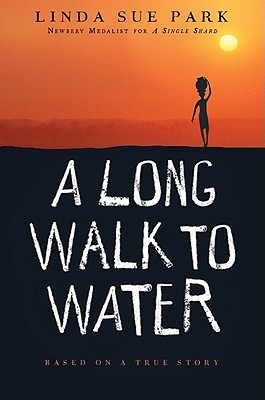
Chapter Book Review - A Long Walk to Water by Linda Sue Park
It's the holiday season, and at this time of year thoughts naturally turn to all we have to do. Gifts to make or buy (and wrap), rooms to clean, meals to prepare, cards to send -- it can get a little bit overwhelming and crazy. I myself am very far behind this year. Though we have our Christmas tree up, I've yet to even order cards and still have quite a bit to do on holiday gifts. And like most Americans, these are things that seem important to me.
Until I stop to consider the daily reality of most people around the globe. To them, priorities like trimming the Christmas tree or baking cookies aren't even on the radar. Instead, they're laboring every day for food, for shelter, for clean water and for safety for their children. And that thought humbles me, as it does every time I open my cupboards and find them full of food, or look through my closet and consider all I have to wear. It humbles me, and it makes me mindful of all I have that others do not.
That thought was ever-present in my mind as I read Linda Sue Park's short but powerful novel A Long Walk to Water. Park based her book on the real-life experiences of Sudanese-born Salva Dut. The novel opens in 1985, when Salva is eleven, on a regular school day. Suddenly rebel forces open fire and the students are forced to flee into the bush, leaving their families behind. In the ensuing scuffle, Salva ends up being left behind by the group of survivors. Alone, he struggles to find safety, looking for news of his family and village as he walks to who-knows-where. Along the way he encounters many who are kind and helpful, some who mean him harm, and much tragedy. Even when Salva finds shelter in a refugee camp, the trouble isn't over, and it is many, many years before Salva will know what became of his loved ones on that terrible day.
Park intersperses Salva's story with that of modern-day Nya. Nya's tale is much shorter, but no less moving. We learn of the girl that much of her life revolves around water. The process of getting clean water for her family takes up an enormous amount of Nya's time, as she must travel many miles on foot each day, carrying a large plastic container on her head. Though at certain times Nya's family lives near a lake, the fighting between neighboring tribes means that it's only really possible to stay there during the dry season, when the warring factions are preoccupied with survival. The rest of the year, Nya must walk to water, and doing so is consuming her life and that of her friends as well.
The stories of Salva and Nya are different but parallel, and when Park draws the two disparate threads together it is with a satisfying sense of rightness. Though sparely written, A Long Walk to Water is emotionally charged, and readers will feel a connection to both main characters from the first page on. Park's voice throughout this novel is respectful but never patronizing. While we empathize with the situation, Park never makes either character an object of pity but instead helps readers to recognize the extraordinary dignity and strength that both Nya and Salva display. You cannot help but be moved by this story -- as I envison Nya walking miles each day to gather water that is very likely contaminated, my heart simply breaks.
In reading Salva's story, kids will be inspired to action, to find out how they can help provide clean water for those in Sudan and so many other nations around the world. Salva Dut's organization Water for South Sudan is doing amazing work providing safe drinking water and changing lives. This holiday season, as you make your gift list, consider adding the gift of clean water for someone you've never met -- I guarantee it will be a gift that is never forgotten.
A Long Walk to Water by Linda Sue Park, published by Clarion Books
Ages 8-12
Source: Library
Sample: "The water that filled the hole was filthy, more mud than liquid. It seeped in so slowly that it took a long time to collect even a few gourdsful. Nya would crouch by the hole, waiting. / Waiting for water. Here, for hours at a time. And every day for five long months, until the rains came and she and her family could return home."
Recommended
Bonus: Linda Sue Park and Salva Dut discuss the book and the mission of Water for South Sudan
Until I stop to consider the daily reality of most people around the globe. To them, priorities like trimming the Christmas tree or baking cookies aren't even on the radar. Instead, they're laboring every day for food, for shelter, for clean water and for safety for their children. And that thought humbles me, as it does every time I open my cupboards and find them full of food, or look through my closet and consider all I have to wear. It humbles me, and it makes me mindful of all I have that others do not.
That thought was ever-present in my mind as I read Linda Sue Park's short but powerful novel A Long Walk to Water. Park based her book on the real-life experiences of Sudanese-born Salva Dut. The novel opens in 1985, when Salva is eleven, on a regular school day. Suddenly rebel forces open fire and the students are forced to flee into the bush, leaving their families behind. In the ensuing scuffle, Salva ends up being left behind by the group of survivors. Alone, he struggles to find safety, looking for news of his family and village as he walks to who-knows-where. Along the way he encounters many who are kind and helpful, some who mean him harm, and much tragedy. Even when Salva finds shelter in a refugee camp, the trouble isn't over, and it is many, many years before Salva will know what became of his loved ones on that terrible day.
Park intersperses Salva's story with that of modern-day Nya. Nya's tale is much shorter, but no less moving. We learn of the girl that much of her life revolves around water. The process of getting clean water for her family takes up an enormous amount of Nya's time, as she must travel many miles on foot each day, carrying a large plastic container on her head. Though at certain times Nya's family lives near a lake, the fighting between neighboring tribes means that it's only really possible to stay there during the dry season, when the warring factions are preoccupied with survival. The rest of the year, Nya must walk to water, and doing so is consuming her life and that of her friends as well.
The stories of Salva and Nya are different but parallel, and when Park draws the two disparate threads together it is with a satisfying sense of rightness. Though sparely written, A Long Walk to Water is emotionally charged, and readers will feel a connection to both main characters from the first page on. Park's voice throughout this novel is respectful but never patronizing. While we empathize with the situation, Park never makes either character an object of pity but instead helps readers to recognize the extraordinary dignity and strength that both Nya and Salva display. You cannot help but be moved by this story -- as I envison Nya walking miles each day to gather water that is very likely contaminated, my heart simply breaks.
In reading Salva's story, kids will be inspired to action, to find out how they can help provide clean water for those in Sudan and so many other nations around the world. Salva Dut's organization Water for South Sudan is doing amazing work providing safe drinking water and changing lives. This holiday season, as you make your gift list, consider adding the gift of clean water for someone you've never met -- I guarantee it will be a gift that is never forgotten.
A Long Walk to Water by Linda Sue Park, published by Clarion Books
Ages 8-12
Source: Library
Sample: "The water that filled the hole was filthy, more mud than liquid. It seeped in so slowly that it took a long time to collect even a few gourdsful. Nya would crouch by the hole, waiting. / Waiting for water. Here, for hours at a time. And every day for five long months, until the rains came and she and her family could return home."
Recommended
Bonus: Linda Sue Park and Salva Dut discuss the book and the mission of Water for South Sudan
Labels:
Africa,
boys,
family,
immigrants,
middle grade,
novel,
refugee,
Sudan,
water
Thursday, October 25, 2012
Teen Review - The Absolutely True Diary of a Part-Time Indian by Sherman Alexie
Authenticity is pretty darn important in lots of arenas, but when it comes to books about a particular culture or population, it's crucial. Sure, it's possible to write about a culture you have no experience with, but let's be honest - you're probably going to miss some details, leave out key points and generally make a botch of things. If you haven't been raised in that culture, you're definitely going to have to do your homework to make sure that things ring true. It's kind of like learning to speak a language: while you can learn a little bit from books and CDs, pretty soon you're going to have to converse with some actual speakers of that dialect, and that's where you're going to find out what you should really be saying.
So I'm always a little suspect when I come across a book where the author doesn't have any kind of connection to the culture. There are some fine examples out there of authors and illustrators who have captured a world about which they have very little direct knowledge. But the best books, the books that move you to your core and transport you to a specific time or place, those books are written by people who have been there, people who KNOW.
You can't fake that, my friends.
This semester I'm taking a YA lit class (*waves to classmates*) and so far we've read some really incredible titles, about which I'll be blogging in the weeks to come. This week one of the selections was a book that's long been on my radar but which I haven't read until now - The Absolutely True Diary of a Part-Time Indian by Sherman Alexie. Alexie's kind of a legend in the Pacific Northwest, for his portraits of life as a Native American growing up in this part of the country. He won the National Book Award for this novel, his first foray into writing for teens, which has incidentally appeared on a whole slew of "Best Of" lists. If you're the kind of person who is put off by critical acclaim, though, don't be tempted to cast Alexie aside - this novel is well worth your time.
Diary is a semi-autobiographical tale about Arnold 'Junior' Spirit, a teenager growing up in the middle of nowhere on the Spokane Indian Reservation, aka 'The Rez'. Like Alexie himself, Junior hasn't had the easiest time growing up: plagued by a host of medical problems since birth, he's also been tormented by nearly every other rez kid, and even some of the adults. He's got his best friend Rowdy, though, who sticks up for him no matter what. Until Junior reaches a turning point in his life, deciding that he needs to "go somewhere where people have hope" - he's going to leave school on the rez and enroll at Reardan, the all-white school nearly 30 miles away.
It won't be easy, Junior knows, even though he is stubborn enough to forge ahead no matter what. Just getting to school will be a challenge, not to mention trying to find his way as the only Indian in a sea of white faces. But Junior isn't counting on the personal toll he'll pay, when the people he's known his entire life turn their backs on him, including Rowdy, branding him a traitor for leaving the rez. And that's just the beginning of what's staring Junior down, as he tries to find his way and do what only he can do for himself.
So, wow. This is a novel that sneaks up on you, peppered as it is with cartoons (Junior's artistic POV is captured by illustrator Ellen Forney), gross-out moments and deep-down hilarious anecdotes. Junior's forthright, brutally so. He holds just about nothing back, and his honesty about life on the rez is as funny as it is unvarnished. Be prepared to run the gamut of emotions as you read - rarely will you cringe with embarrassment, laugh yourself silly and then be on the verge of tears within a few pages, but that's exactly what will happen here. Just as you're lulled into thinking this is another book about a teenage boy struggling to find friends, though, Alexie pulls out the big guns, reminding us that being a Native American in our society is to be among those counted out and pushed aside. Even as Junior makes light of his circumstances, readers can see his pain, often not too far under the surface, but he never invites our pity, only our understanding.
Alexie's voice here is wholly unique and entirely authentic - he lived this life, and he's given readers a unique window into what his own adolescence might have been like, polishing our vision of Junior's world to a fine sheen. This is the kind of reading experience that's intense and powerful, a take-no-prisoners trip through adolescence with a narrator whose voice is wise, profane, self-deprecating and reckless, entirely unlike any other. Hard truths are fair game for Alexie, who takes them head-on: everything from the drunken Indian to the white folks who wish they were Natives. And even as we recognize pieces of ourselves in the characters who populate Junior's story, we're forced to consider how all of us play a role in the kind of world Junior grows up in.
The epigraph of Diary is a quote by Yeats: "There is another world, but it is in this one." Alexie gives us this world, for those who will look unflinchingly.
The Absolutely True Diary of a Part-Time Indian by Sherman Alexie, published by Little Brown
Ages 14+
Source: personal collection
Sample: "And it's not like my mother and father were born into wealth. It's not like they gambled away their family fortunes. My parents came from poor people who came from poor people who came from poor people, all the way back to the very first poor people. / Adam and Eve covered their privates with fig leaves; the first Indians covered their privates with their tiny hands."
Recommended
Bonus: Conversation with Sherman Alexie from public television
So I'm always a little suspect when I come across a book where the author doesn't have any kind of connection to the culture. There are some fine examples out there of authors and illustrators who have captured a world about which they have very little direct knowledge. But the best books, the books that move you to your core and transport you to a specific time or place, those books are written by people who have been there, people who KNOW.
You can't fake that, my friends.
This semester I'm taking a YA lit class (*waves to classmates*) and so far we've read some really incredible titles, about which I'll be blogging in the weeks to come. This week one of the selections was a book that's long been on my radar but which I haven't read until now - The Absolutely True Diary of a Part-Time Indian by Sherman Alexie. Alexie's kind of a legend in the Pacific Northwest, for his portraits of life as a Native American growing up in this part of the country. He won the National Book Award for this novel, his first foray into writing for teens, which has incidentally appeared on a whole slew of "Best Of" lists. If you're the kind of person who is put off by critical acclaim, though, don't be tempted to cast Alexie aside - this novel is well worth your time.
Diary is a semi-autobiographical tale about Arnold 'Junior' Spirit, a teenager growing up in the middle of nowhere on the Spokane Indian Reservation, aka 'The Rez'. Like Alexie himself, Junior hasn't had the easiest time growing up: plagued by a host of medical problems since birth, he's also been tormented by nearly every other rez kid, and even some of the adults. He's got his best friend Rowdy, though, who sticks up for him no matter what. Until Junior reaches a turning point in his life, deciding that he needs to "go somewhere where people have hope" - he's going to leave school on the rez and enroll at Reardan, the all-white school nearly 30 miles away.
It won't be easy, Junior knows, even though he is stubborn enough to forge ahead no matter what. Just getting to school will be a challenge, not to mention trying to find his way as the only Indian in a sea of white faces. But Junior isn't counting on the personal toll he'll pay, when the people he's known his entire life turn their backs on him, including Rowdy, branding him a traitor for leaving the rez. And that's just the beginning of what's staring Junior down, as he tries to find his way and do what only he can do for himself.
So, wow. This is a novel that sneaks up on you, peppered as it is with cartoons (Junior's artistic POV is captured by illustrator Ellen Forney), gross-out moments and deep-down hilarious anecdotes. Junior's forthright, brutally so. He holds just about nothing back, and his honesty about life on the rez is as funny as it is unvarnished. Be prepared to run the gamut of emotions as you read - rarely will you cringe with embarrassment, laugh yourself silly and then be on the verge of tears within a few pages, but that's exactly what will happen here. Just as you're lulled into thinking this is another book about a teenage boy struggling to find friends, though, Alexie pulls out the big guns, reminding us that being a Native American in our society is to be among those counted out and pushed aside. Even as Junior makes light of his circumstances, readers can see his pain, often not too far under the surface, but he never invites our pity, only our understanding.
Alexie's voice here is wholly unique and entirely authentic - he lived this life, and he's given readers a unique window into what his own adolescence might have been like, polishing our vision of Junior's world to a fine sheen. This is the kind of reading experience that's intense and powerful, a take-no-prisoners trip through adolescence with a narrator whose voice is wise, profane, self-deprecating and reckless, entirely unlike any other. Hard truths are fair game for Alexie, who takes them head-on: everything from the drunken Indian to the white folks who wish they were Natives. And even as we recognize pieces of ourselves in the characters who populate Junior's story, we're forced to consider how all of us play a role in the kind of world Junior grows up in.
The epigraph of Diary is a quote by Yeats: "There is another world, but it is in this one." Alexie gives us this world, for those who will look unflinchingly.
The Absolutely True Diary of a Part-Time Indian by Sherman Alexie, published by Little Brown
Ages 14+
Source: personal collection
Sample: "And it's not like my mother and father were born into wealth. It's not like they gambled away their family fortunes. My parents came from poor people who came from poor people who came from poor people, all the way back to the very first poor people. / Adam and Eve covered their privates with fig leaves; the first Indians covered their privates with their tiny hands."
Recommended
Bonus: Conversation with Sherman Alexie from public television
Wednesday, August 1, 2012
Wayback Wednesday - From the Mixed-Up Files of Mrs. Basil E. Frankweiler (1967)
A bit of a departure for Wayback Wednesday this week, something I haven't yet read with Sprout but that I absolutely cannot wait to: From the Mixed-Up Files of Mrs. Basil E. Frankweiler by E.L. Konigsburg. When I think back on my childhood, this is one of those titles that stands well outside the pack, a shimmering bit of perfection that I think I realized, even then, was the kind of book that stood the test of time. It's most definitely the first book that I remember finishing, putting down, then picking back up almost right away to reread.
That scene is vividly imprinted on my memory - a dreary summer afternoon, a colander full of green grapes to snack on, sitting on my bedroom floor listening to the rain drum on the roof and reading about Claudia and Jamie. I had heard about the book from my older sister, who mentioned offhand once that she read it when she was about my age and really enjoyed it. That was all the convincing it took for me to seek it out during my regular visit to the bookmobile. Right from the beginning it was evident that Claudia was pretty much my literary soul mate. This sentence was all it took: "She was bored with simply being straight-A's Claudia Kincaid." I sat up straighter and began to concentrate on every word after that.
Claudia, you see, has decided that in order for her family to fully appreciate her, she must run away. But she does not want to just take off - no, Claudia is not nearly that impulsive. Instead she crafts a plan wherein she and her middle brother Jamie will run away to the most hospitable and inspiring place she can think of: the Metropolitan Museum of Art. It's a good plan, and one that Claudia and Jamie manage to carry out with a relatively small incidence of peril. But soon the siblings find that they have run right into a bit of a mystery, concerning a small statuette recently acquired from the enigmatic Mrs. Basil E. Frankweiler, which may or may not be the work of Michelangelo. Claudia and Jamie begin to investigate, and their search for the truth leads them straight to the very last place two runaway children may have expected to find themselves.
Quite simply, From the Mixed-Up Files has it all: familiar but not derivative characters, a crisply believable plot, some mystery, some humor, and a wholly original setting. It is firmly set within a specific era and yet has the whiff of timelessness about it, the kind of book that though the details may change (train fare for $1.60? hot fudge sundaes for $.40?) will still be relatable for readers for decades to come. Even to a child like me, for whom New York City was about as far away as the moon in relation to my real life, the adventures of Claudia and Jamie felt immediate and tangible. I could see myself hiding in that bathroom stall waiting for the guard to pass, or hiding my violin case in a sarcophagus (never mind that I never played a musical instrument). And that, dear reader, is what makes something a classic - the fact that though the world in which it was set may seem lightyears away from our modern age, the story still feels fresh and current, like it really could happen to you or someone you know.
E.L. Konigsburg had her first two books published in 1967, this and Jennifer, Hecate, Macbeth, William McKinley and Me, Elizabeth. Both were nominated for the Newbery in 1968, and she took the award for From the Mixed-Up Files and the Honor for Jennifer (the only person to have won both the award and the honor in the same year). Starting a career out like that had to have been more than a little daunting -- how do you follow up such huge success -- but Konigsburg has maintained a long and distinguished track record of publishing amazing literature for children. What I think has made her so successful is the fact that she never writes "down to" her audience. Konigsburg's characters, Claudia and Jamie included, tackle some very real problems, experience deep emotions and grapple with the larger stuff of life. And yet there's always humor, always lightness to cut the gravity.
If you've never read a Konigsburg novel, From the Mixed-Up Files is a great place to start. It still rings as true for me as the day I first read it, so long ago, and I hope that one day Sprout feels the same.
Wayback Wednesday verdict? Quiet adventure that still resonates
From the Mixed-Up Files of Mrs. Basil E. Frankweiler by E. L. Konisburg, published by Simon & Schuster
Ages 8-12
Source: personal collection
Sample: "What happened was: they became a team, a family of two. There had been times before they ran away when they had acted like a team, but those were very different from feeling like a team. Becoming a team didn't mean the end of their arguments. But it did mean that the arguments became a part of the adventure, became discussions not threats."
Highly recommended
That scene is vividly imprinted on my memory - a dreary summer afternoon, a colander full of green grapes to snack on, sitting on my bedroom floor listening to the rain drum on the roof and reading about Claudia and Jamie. I had heard about the book from my older sister, who mentioned offhand once that she read it when she was about my age and really enjoyed it. That was all the convincing it took for me to seek it out during my regular visit to the bookmobile. Right from the beginning it was evident that Claudia was pretty much my literary soul mate. This sentence was all it took: "She was bored with simply being straight-A's Claudia Kincaid." I sat up straighter and began to concentrate on every word after that.
Claudia, you see, has decided that in order for her family to fully appreciate her, she must run away. But she does not want to just take off - no, Claudia is not nearly that impulsive. Instead she crafts a plan wherein she and her middle brother Jamie will run away to the most hospitable and inspiring place she can think of: the Metropolitan Museum of Art. It's a good plan, and one that Claudia and Jamie manage to carry out with a relatively small incidence of peril. But soon the siblings find that they have run right into a bit of a mystery, concerning a small statuette recently acquired from the enigmatic Mrs. Basil E. Frankweiler, which may or may not be the work of Michelangelo. Claudia and Jamie begin to investigate, and their search for the truth leads them straight to the very last place two runaway children may have expected to find themselves.
Quite simply, From the Mixed-Up Files has it all: familiar but not derivative characters, a crisply believable plot, some mystery, some humor, and a wholly original setting. It is firmly set within a specific era and yet has the whiff of timelessness about it, the kind of book that though the details may change (train fare for $1.60? hot fudge sundaes for $.40?) will still be relatable for readers for decades to come. Even to a child like me, for whom New York City was about as far away as the moon in relation to my real life, the adventures of Claudia and Jamie felt immediate and tangible. I could see myself hiding in that bathroom stall waiting for the guard to pass, or hiding my violin case in a sarcophagus (never mind that I never played a musical instrument). And that, dear reader, is what makes something a classic - the fact that though the world in which it was set may seem lightyears away from our modern age, the story still feels fresh and current, like it really could happen to you or someone you know.
E.L. Konigsburg had her first two books published in 1967, this and Jennifer, Hecate, Macbeth, William McKinley and Me, Elizabeth. Both were nominated for the Newbery in 1968, and she took the award for From the Mixed-Up Files and the Honor for Jennifer (the only person to have won both the award and the honor in the same year). Starting a career out like that had to have been more than a little daunting -- how do you follow up such huge success -- but Konigsburg has maintained a long and distinguished track record of publishing amazing literature for children. What I think has made her so successful is the fact that she never writes "down to" her audience. Konigsburg's characters, Claudia and Jamie included, tackle some very real problems, experience deep emotions and grapple with the larger stuff of life. And yet there's always humor, always lightness to cut the gravity.
If you've never read a Konigsburg novel, From the Mixed-Up Files is a great place to start. It still rings as true for me as the day I first read it, so long ago, and I hope that one day Sprout feels the same.
Wayback Wednesday verdict? Quiet adventure that still resonates
From the Mixed-Up Files of Mrs. Basil E. Frankweiler by E. L. Konisburg, published by Simon & Schuster
Ages 8-12
Source: personal collection
Sample: "What happened was: they became a team, a family of two. There had been times before they ran away when they had acted like a team, but those were very different from feeling like a team. Becoming a team didn't mean the end of their arguments. But it did mean that the arguments became a part of the adventure, became discussions not threats."
Highly recommended
Monday, June 25, 2012
Chapter Book Review - Wonder by RJ Palacio
"I know I'm not an ordinary ten-year-old kid. I mean, sure, I do ordinary things. I eat ice cream. I ride my bike. I play ball. I have an XBox. Stuff like that makes me ordinary. I guess. And I feel ordinary. Inside. But I know ordinary kids don't make other ordinary kids run away screaming in playgrounds. I know ordinary kids don't get stared at wherever they go."
Thus begins RJ Palacio's Wonder, an aptly named middle-grade novel that just may be my favorite book of 2012.
And that's saying something, because I've read some fantastic stuff this past year. But Wonder is like nothing else -- funny, heartbreaking, emotional, and absolutely an all-around incredible piece of work. I've seen a lot of hype about this one in the blogosphere, and having just turned the last page, I can tell you that all that high praise is richly deserved.
Wonder is Palacio's debut, and it's hard to know where she'll go from here, because she's definitely set a high mark for herself. The novel tells the story of August "Auggie" Pullman, who is in every way a pretty normal fifth grader, with the usual interests of a boy his age. But there's one thing very, very different about Auggie - he was born with a rare genetic disorder that manifests itself in a "craniofacial abnormality", as his older sister Via describes it. Auggie and his family have spent their lives dealing with Auggie's condition, through multiple surgeries and treatments to the looks and whispered comments from others when they first see Auggie. And the Pullmans have gotten pretty good at handling all of it.
But when Auggie starts fifth grade, his parents decide it's time for real school. No more homeschooling with his mom. Auggie's not sure he's ready, and he's more than a little nervous about how things will go with the other kids. Will he make any friends? Will the other kids ever get past Auggie's face and look at who he really, really is?
Palacio completely nails the experience of being the one who doesn't blend into the crowd. And still, she never makes Auggie a pathetic character or someone to be pitied - far from it. Writing from the point of view of Auggie, as well as several other pivotal characters, she tells Auggie's story as it impacts everyone. His presence at Beecher Prep not only changes Auggie's life, but many other people's as well, in ways that no one could have foreseen when the school year started. The reader begins to understand how Auggie's face serves as a mirror to all those around him; looking at Auggie, you see yourself in unexpected ways. How each character deals with that unexpected reaction provides the narrative drive for the story, and is what makes this an outstanding novel for everyone, not just middle schoolers. I'm hard pressed to think of a book that exemplifies the experience of empathy in such a way, by showing what it looks in real life, not after-school specials.
The center point around which Auggie's story turns is a quote by Wayne Dyer: "When given the choice between being right and being kind, choose kind." It's one thing to talk to our kids about bullying, about the importance of standing up for others and not joining in with the crowd. It's another to show them what bullying looks like. This is a book that can do that, without preaching or shutting kids down. I know it's one that I'll be reading with Sprout when he's older.
Share Wonder with the kids in your life, but read it yourself first. Auggie Pullman is someone you'll want to know.
Wonder by R.J. Palacio
Ages 9-13
Source: Library
Sample: "The thing is, when I was little, I never minded meeting new kids because all the kids I met were really little, too. What's cool about really little kids is that they don't say stuff to try to hurt your feelings, even though sometimes they do say stuff that hurts your feelings. But they don't actually know what they're saying. Big kids, though: they know what they're saying."
Highly recommended
Bonus: Hear what inspired the novel, as NPR interviews author R.J. Palacio
More reviews:
Jen Robinson's Book Page
Fuse #8
100 Scope Notes
More Than True
Abby the Librarian
Thus begins RJ Palacio's Wonder, an aptly named middle-grade novel that just may be my favorite book of 2012.
And that's saying something, because I've read some fantastic stuff this past year. But Wonder is like nothing else -- funny, heartbreaking, emotional, and absolutely an all-around incredible piece of work. I've seen a lot of hype about this one in the blogosphere, and having just turned the last page, I can tell you that all that high praise is richly deserved.
Wonder is Palacio's debut, and it's hard to know where she'll go from here, because she's definitely set a high mark for herself. The novel tells the story of August "Auggie" Pullman, who is in every way a pretty normal fifth grader, with the usual interests of a boy his age. But there's one thing very, very different about Auggie - he was born with a rare genetic disorder that manifests itself in a "craniofacial abnormality", as his older sister Via describes it. Auggie and his family have spent their lives dealing with Auggie's condition, through multiple surgeries and treatments to the looks and whispered comments from others when they first see Auggie. And the Pullmans have gotten pretty good at handling all of it.
But when Auggie starts fifth grade, his parents decide it's time for real school. No more homeschooling with his mom. Auggie's not sure he's ready, and he's more than a little nervous about how things will go with the other kids. Will he make any friends? Will the other kids ever get past Auggie's face and look at who he really, really is?
Palacio completely nails the experience of being the one who doesn't blend into the crowd. And still, she never makes Auggie a pathetic character or someone to be pitied - far from it. Writing from the point of view of Auggie, as well as several other pivotal characters, she tells Auggie's story as it impacts everyone. His presence at Beecher Prep not only changes Auggie's life, but many other people's as well, in ways that no one could have foreseen when the school year started. The reader begins to understand how Auggie's face serves as a mirror to all those around him; looking at Auggie, you see yourself in unexpected ways. How each character deals with that unexpected reaction provides the narrative drive for the story, and is what makes this an outstanding novel for everyone, not just middle schoolers. I'm hard pressed to think of a book that exemplifies the experience of empathy in such a way, by showing what it looks in real life, not after-school specials.
The center point around which Auggie's story turns is a quote by Wayne Dyer: "When given the choice between being right and being kind, choose kind." It's one thing to talk to our kids about bullying, about the importance of standing up for others and not joining in with the crowd. It's another to show them what bullying looks like. This is a book that can do that, without preaching or shutting kids down. I know it's one that I'll be reading with Sprout when he's older.
Share Wonder with the kids in your life, but read it yourself first. Auggie Pullman is someone you'll want to know.
Wonder by R.J. Palacio
Ages 9-13
Source: Library
Sample: "The thing is, when I was little, I never minded meeting new kids because all the kids I met were really little, too. What's cool about really little kids is that they don't say stuff to try to hurt your feelings, even though sometimes they do say stuff that hurts your feelings. But they don't actually know what they're saying. Big kids, though: they know what they're saying."
Highly recommended
Bonus: Hear what inspired the novel, as NPR interviews author R.J. Palacio
More reviews:
Jen Robinson's Book Page
Fuse #8
100 Scope Notes
More Than True
Abby the Librarian
Sunday, June 10, 2012
48 Hour Book Challenge - Sparrow Road by Sheila O'Connor
Just under 6 hours left in my allotted timeframe for the 48 Hour Book Challenge. So far I have read/blogged for 10 hours and finished 4 books, plus am halfway through an audiobook. Husband is headed out of the house soon with the toddler to give me a little extra peace and quiet for the last leg of the challenge. I have to say, this has not been easy - even though I'd planned to read for most of the day today, a rare-for-us sunny morning could not be ignored, so we headed off for a bike ride instead. And of course any time I would sit down on the couch in Sprout's eye-view it meant he had to come over and ask "Whatcha reading?" and then bring me his own selection of books to read ("This is better book," he says solemnly).
But I have to say, what I've read has been truly outstanding. Of the four books it's hard to pick a favorite, but Sheila O'Connor's Sparrow Road is definitely a contender. I hadn't heard much about this title before I picked it up but knowing that it was set in a falling-down mansion that once held an orphanage peaked my interest. But lest you think that this is a gothic tale, it's not -- Sparrow Road is very much contemporary and deals with modern-day situations and sensibilities.
Raine O'Rourke is blindsided by her mother's sudden announcement that they are leaving their Milwaukee home and spending the summer at Sparrow Road, an artists colony held in the aforementioned creepy old home. Sparrow Road is located precisely in the middle of nowhere, and Raine's less than excited to be stuck out in the country for several months. Stranger still, her mother keeps entirely mum on just why they are there. And the rules - silence until supper, no interacting with the artists and no leaving the grounds without Mama. Raine can hardly stand it and plans to leave at the first opportunity.
But then she meets Lillian, the sweet poet whose elderly mind seems locked permanently in the past. And Josie, the energetic bohemian and Diego, the charming artist who seems enchanted with both Raine and her mama. These incredible people are more than enough to make Raine suddenly start seeing Sparrow Road in a new way. All that and a mystery too - Raine soon discovers that Sparrow Road once housed dozens of orphans, some of whom seem to still be connected to this haunting place. And then there's Mama, and her mysterious trips to town with Viktor, Sparrow Road's creepy caretaker. . . Raine hardly knows which rocks to start uncovering first.
O'Connor does a masterful job of integrating Raine's own history and struggle for identity with that of the other residents of Sparrow Road, both past and present. She deals head-on with issues related to loss and longing for parents, in the orphans that once lived in the home and in Raine's own missing father. Children who have themselves experienced a tragic loss, or who have grown up without knowing one or both of their parents will find their stories reflected in this novel, and may have some of their own feelings resolved by following Raine's journey. At the very least, they will have a touchstone to know they are not alone.
This is O'Connor's first foray into kidlit but I hope not her last - not only does she exhibit a deft hand with plot and character development, she also sets a scene that makes the reader feel compelled to turn pages. I thoroughly enjoyed Sparrow Road, and I'm incredibly glad I included it as part of my 48 Hour Book Challenge.
Sparrow Road by Sheila O'Connor, published by G.P. Putnam's Sons
Ages 9-13
Source: Library
Sample: "It was a boy's voice I imagined, a boy's voice speaking in my daydream. A story, just like Diego promised. A boy I'd never seen, but there he was. In old wool pants that hung below his knees, scuffed ankle boots, a flannel shirt rolled up at the sleeves. A boy who lived up in that attic. His skinny lower legs were nicked and scarred. His face was round, his eyes the same grassy green as Mama's. / Life just has a way, he said. I think you must know what I mean. Even parents can get lost."
Highly recommended
But I have to say, what I've read has been truly outstanding. Of the four books it's hard to pick a favorite, but Sheila O'Connor's Sparrow Road is definitely a contender. I hadn't heard much about this title before I picked it up but knowing that it was set in a falling-down mansion that once held an orphanage peaked my interest. But lest you think that this is a gothic tale, it's not -- Sparrow Road is very much contemporary and deals with modern-day situations and sensibilities.
Raine O'Rourke is blindsided by her mother's sudden announcement that they are leaving their Milwaukee home and spending the summer at Sparrow Road, an artists colony held in the aforementioned creepy old home. Sparrow Road is located precisely in the middle of nowhere, and Raine's less than excited to be stuck out in the country for several months. Stranger still, her mother keeps entirely mum on just why they are there. And the rules - silence until supper, no interacting with the artists and no leaving the grounds without Mama. Raine can hardly stand it and plans to leave at the first opportunity.
But then she meets Lillian, the sweet poet whose elderly mind seems locked permanently in the past. And Josie, the energetic bohemian and Diego, the charming artist who seems enchanted with both Raine and her mama. These incredible people are more than enough to make Raine suddenly start seeing Sparrow Road in a new way. All that and a mystery too - Raine soon discovers that Sparrow Road once housed dozens of orphans, some of whom seem to still be connected to this haunting place. And then there's Mama, and her mysterious trips to town with Viktor, Sparrow Road's creepy caretaker. . . Raine hardly knows which rocks to start uncovering first.
O'Connor does a masterful job of integrating Raine's own history and struggle for identity with that of the other residents of Sparrow Road, both past and present. She deals head-on with issues related to loss and longing for parents, in the orphans that once lived in the home and in Raine's own missing father. Children who have themselves experienced a tragic loss, or who have grown up without knowing one or both of their parents will find their stories reflected in this novel, and may have some of their own feelings resolved by following Raine's journey. At the very least, they will have a touchstone to know they are not alone.
This is O'Connor's first foray into kidlit but I hope not her last - not only does she exhibit a deft hand with plot and character development, she also sets a scene that makes the reader feel compelled to turn pages. I thoroughly enjoyed Sparrow Road, and I'm incredibly glad I included it as part of my 48 Hour Book Challenge.
Sparrow Road by Sheila O'Connor, published by G.P. Putnam's Sons
Ages 9-13
Source: Library
Sample: "It was a boy's voice I imagined, a boy's voice speaking in my daydream. A story, just like Diego promised. A boy I'd never seen, but there he was. In old wool pants that hung below his knees, scuffed ankle boots, a flannel shirt rolled up at the sleeves. A boy who lived up in that attic. His skinny lower legs were nicked and scarred. His face was round, his eyes the same grassy green as Mama's. / Life just has a way, he said. I think you must know what I mean. Even parents can get lost."
Highly recommended
Friday, June 8, 2012
48 Hour Book Challenge - When Zachary Beaver Came to Town by Kimberly Willis Holt
One of my goals for the 48 Hour Book Challenge was to catch up on some older kidlit that I'd previously overlooked. I also want to get some more award-winners under my belt. Kimberly Willis Holt's When Zachary Beaver Came to Town fit both categories nicely, as an older title (1999) that won the National Book Award plus ALA Notable status. And I'd read Holt's novel The Water Seeker last year and really enjoyed that, so I've been looking forward to this one.
Zachary Beaver did not disappoint. Despite being a quick read, it was a surprisingly emotional and impactful one, with lots of heavy themes that are carried out with the lightest of touches. Holt's depiction of small-town Texas life is realistic, and her characters are personalities but never charicatures. Zachary Beaver breezes into town as a sideshow attraction, "the fattest boy in the world," and like everyone else in town, Toby and his best buddy Cal can't miss out on the show. But when Zachary's guardian leaves him behind, Toby discovers a sudden kinship with this boy, unexpected since Toby himself never realized how much his own life parallels Zachary's. Left behind by his mother who's gone seeking fame and fortune, Toby struggles to reconcile his feelings about his mom with his newfound friendship with Zachary, worry about Cal's older brother Wayne in Vietnam, and his attempts to woo the beautiful Scarlett Stallings. In the end, Toby sees that though external appearances may differ, people are all the same deep within, and loss touches us all in ways we could never imagine.
Holt's not shy about facing difficult situations, and about putting her characters in places that other authors might think twice about. But the result is a well-developed plot that is peopled with the kind of folks we all know, and that we're sure to recognize in our own friends, family and selves. This is a well-rounded and highly readable award winner that belongs in every classroom and library - lots to discuss here, in a story that will keep young readers turning pages.
When Zachary Beaver Came to Town by Kimberly Willis Holt, published by Henry Holt
Ages 9-13
Source: Library
Sample: "Cars and pickups pull into the Dairy Maid parking lot. Some people make no bones about it. They just get in line to see him. Ohters try to act like they don't know anything about the buzz. They enter the Dairy Maid, place their orders, and exit with Coke floats, chocolate-dipped cones, or curlicue fries, then wander to the back of the line. They don't fool me."
Recommended
Thursday, May 17, 2012
Chapter Book Review - Ten Rules for Living with My Sister by Ann M. Martin
Many readers recognize the name Ann M. Martin from her prolific Babysitters' Club series of novels. Oh, the thousands upon thousands of middle school girls who have pored over these books! I never read them myself -- being more of a Nancy Drew girl -- but many of my friends did, and they continued to be popular long through my career as a bookseller.
Lest you think that's all Martin's got up her sleeve, though, please note that she's also written a number of critically acclaimed stand-alone novels, including A Corner of the Universe, which received a Newbery Honor. (And which, oh my word, is a flat-out incredible novel - one of the few I've seriously considered rereading of late.) Seems to me there's something to be said for all those Babysitters books -- through them Martin honed her craft, especially where starring roles for middle-grade girls are concerned.
That's where Pearl Littlefield comes in. The star of Martin's latest novel, Ten Rules for Living with My Sister, Pearl has a unique voice and perspective all her own. Fourth-grader Pearl's stuck between two worlds, idolizing (and terrorizing) her older sister Lexie and mentoring her best friend, first-grader Justine. Pearl can't help noticing all the ways that she and Lexie are different, and Lexie just has no tolerance for Pearl and her antics, no matter how good they are. And believe me, they're good -- Pearl's not one to let that "No Pearl" sign on Lexie's door stand without a fight.
Just when things between the sisters are reaching a fever pitch, though, the game changes. Suddenly Pearl and Lexie's grandfather, Daddy Bo, is moving in with the family, and the girls become unwilling roommates. By everyone's estimation, this is a recipe for disaster. And Pearl figures she'd better start making herself some rules, if she's going to live through this experience. But as she soon finds out, not even the most carefully constructed list of rules can cover every eventuality that life has to offer. Expecting the unexpected is only the beginning.
With Pearl, Martin's given us a snapshot of a girl smack dab in the middle -- of her family and of her maturity. This is something a lot of kids can relate to, I think, that feeling of not quite belonging but desperately wanting to. To call Pearl spirited is an understatement (annoying her sister is something Pearl's brought to an art form) but when things in the Littlefield family dynamic shift, Pearl steps up in ways no one thought possible. What's really great about Ten Rules is the glimpse it gives us into some important relationships: between sisters, between friends, and between a grandparent and grandchild. There are some honest and compelling scenes in this novel, ones that make you laugh even as they make you think about the relationships in your own life.
Ten Rules shows us that sometimes the defining moments in our lives are the ones no rules can cover. For Pearl, and for many of us, real life is all about the gaps in between.
Ten Rules for Living with My Sister by Ann M. Martin, published by Feiwel and Friends
Ages 9-13
Source: ARC provided by the publisher for review purposes
Sample: "I am no stranger to the silent treatment. When Lexie is mad at me she shouts, 'I'm not speaking to you!'. Sometimes after that she whips her head away from me, or turns her back, or stomps into her room and slams the door. / And then sometimes one of my parents will mutter 'Teenagers.' (They only mean Lexie, not me, since you don't qualify as a teenager until you are thirteen.)"
Recommended
Lest you think that's all Martin's got up her sleeve, though, please note that she's also written a number of critically acclaimed stand-alone novels, including A Corner of the Universe, which received a Newbery Honor. (And which, oh my word, is a flat-out incredible novel - one of the few I've seriously considered rereading of late.) Seems to me there's something to be said for all those Babysitters books -- through them Martin honed her craft, especially where starring roles for middle-grade girls are concerned.
That's where Pearl Littlefield comes in. The star of Martin's latest novel, Ten Rules for Living with My Sister, Pearl has a unique voice and perspective all her own. Fourth-grader Pearl's stuck between two worlds, idolizing (and terrorizing) her older sister Lexie and mentoring her best friend, first-grader Justine. Pearl can't help noticing all the ways that she and Lexie are different, and Lexie just has no tolerance for Pearl and her antics, no matter how good they are. And believe me, they're good -- Pearl's not one to let that "No Pearl" sign on Lexie's door stand without a fight.
Just when things between the sisters are reaching a fever pitch, though, the game changes. Suddenly Pearl and Lexie's grandfather, Daddy Bo, is moving in with the family, and the girls become unwilling roommates. By everyone's estimation, this is a recipe for disaster. And Pearl figures she'd better start making herself some rules, if she's going to live through this experience. But as she soon finds out, not even the most carefully constructed list of rules can cover every eventuality that life has to offer. Expecting the unexpected is only the beginning.
With Pearl, Martin's given us a snapshot of a girl smack dab in the middle -- of her family and of her maturity. This is something a lot of kids can relate to, I think, that feeling of not quite belonging but desperately wanting to. To call Pearl spirited is an understatement (annoying her sister is something Pearl's brought to an art form) but when things in the Littlefield family dynamic shift, Pearl steps up in ways no one thought possible. What's really great about Ten Rules is the glimpse it gives us into some important relationships: between sisters, between friends, and between a grandparent and grandchild. There are some honest and compelling scenes in this novel, ones that make you laugh even as they make you think about the relationships in your own life.
Ten Rules shows us that sometimes the defining moments in our lives are the ones no rules can cover. For Pearl, and for many of us, real life is all about the gaps in between.
Ten Rules for Living with My Sister by Ann M. Martin, published by Feiwel and Friends
Ages 9-13
Source: ARC provided by the publisher for review purposes
Sample: "I am no stranger to the silent treatment. When Lexie is mad at me she shouts, 'I'm not speaking to you!'. Sometimes after that she whips her head away from me, or turns her back, or stomps into her room and slams the door. / And then sometimes one of my parents will mutter 'Teenagers.' (They only mean Lexie, not me, since you don't qualify as a teenager until you are thirteen.)"
Recommended
Wednesday, February 8, 2012
YA Review - How to Save a Life by Sara Zarr
Teen fiction is not what it used to be. There's a lot been said in recent months about the darkness of it, about how vampires and werewolves and paranormal romance are going to be the undoing of modern youth (which I highly doubt - if anything, it's getting them reading, right?). But what I think is most significant is that authors who write for teens are willing to explore new topics and themes. Yes, some of these lead to dark places, but others just examine the messy business that is real life, which so rarely comes wrapped up with a cutesy little bow. (Maureen Johnson says it better here than I possibly could.)
Take Sara Zarr, for instance. Zarr writes realistic contemporary fiction for teens - in other words, no time traveling detectives here. And what she writes are novels that peel back the layers, one by one, that construct the experience of teens in this reality, right now. These are kids who face difficult problems, many of which are brought on by forces outside their control, just like kids always have, but who do so in a culture that is often frantic and always changing. You know what I mean.
In How to Save a Life, Zarr brings us a whole slew of issues in the form of Jill, her mother Robin, and Mandy, a pregnant teenager whose baby Robin hopes to adopt. Jill's bitter, and angry, not about the baby so much as she is about the sudden death of her father in a car accident almost a year ago. She's dealt with her grief by building walls around herself, pushing away anyone and everyone who cares, and not letting anyone new inside her circle. And here comes Mandy, bursting with life and new possibilities, but with secrets and pain of her own. Mandy knows Jill doesn't like her, but she's so grateful to be in a safe place, a real home, not the cobbled-together life she's lived with her mother's rotating boyfriends. OK, so maybe Mandy has misrepresented herself a teeny bit, but it's for a good reason, right?
And then the carefully constructed facade that each character has made for herself begins to crumble. Mandy's never had someone care for her like Robin does, and she's not sure she's ready to give that up -- or her baby, for that matter. Jill thinks she knows the role everyone in her life has to play, and it's all structured. But then an unexpected encounter in the parking lot leads to a new friend that Jill just can't shake, and a growing realization that the emotions she's kept bottled up won't stay there forever. Both girls struggle to find their footing on this shaky new territory, and to reexamine what they thought they knew about themselves at the most elemental core of their being.
Zarr's writing is balanced and fluid, her gaze unflinching as she peers into the most secret corners of her characters' lives. No one is wholly good or entirely bad, and for that I applaud her -- if you're looking for stereotypes, you won't find any here. Most interesting of all, she turns adoption inside out, giving voice to the experience from all angles. As a birth mother, Mandy wrestles with the idea that her daughter will one day feel abandoned, or think that Mandy didn't love her. As a prospective adoptive parent, Robin wonders if what she's doing is enough, or if she owes a greater debt. And as a soon-to-be older sibling, Jill fluctuates from feeling betrayed to mourning the fact that her sister will never know the father that Jill so adored.
Those who say they don't read "kids books" are really missing out when it comes to authors like Sara Zarr. Honestly, I'd put How to Save a Life up against anything from an "adult" author and it would hold its own. Strong characters, skilled writing and a story that sticks with the reader long after the last page is turned. In my book, that's quality fiction, no matter where it's shelved.
How to Save a Life by Sara Zarr, published by Little, Brown
Ages: 12 up
Source: Library
Sample:
Mandy -- "My mother says that when another girl steps up to you, just smile and let her have the last word. My mother says it's usually jealousy or her wanting something you have. But I can't think of one thing I have that Jill, who has everything, could want. And I can't smile when we're talking about a tragedy."
Recommended
Take Sara Zarr, for instance. Zarr writes realistic contemporary fiction for teens - in other words, no time traveling detectives here. And what she writes are novels that peel back the layers, one by one, that construct the experience of teens in this reality, right now. These are kids who face difficult problems, many of which are brought on by forces outside their control, just like kids always have, but who do so in a culture that is often frantic and always changing. You know what I mean.
In How to Save a Life, Zarr brings us a whole slew of issues in the form of Jill, her mother Robin, and Mandy, a pregnant teenager whose baby Robin hopes to adopt. Jill's bitter, and angry, not about the baby so much as she is about the sudden death of her father in a car accident almost a year ago. She's dealt with her grief by building walls around herself, pushing away anyone and everyone who cares, and not letting anyone new inside her circle. And here comes Mandy, bursting with life and new possibilities, but with secrets and pain of her own. Mandy knows Jill doesn't like her, but she's so grateful to be in a safe place, a real home, not the cobbled-together life she's lived with her mother's rotating boyfriends. OK, so maybe Mandy has misrepresented herself a teeny bit, but it's for a good reason, right?
And then the carefully constructed facade that each character has made for herself begins to crumble. Mandy's never had someone care for her like Robin does, and she's not sure she's ready to give that up -- or her baby, for that matter. Jill thinks she knows the role everyone in her life has to play, and it's all structured. But then an unexpected encounter in the parking lot leads to a new friend that Jill just can't shake, and a growing realization that the emotions she's kept bottled up won't stay there forever. Both girls struggle to find their footing on this shaky new territory, and to reexamine what they thought they knew about themselves at the most elemental core of their being.
Zarr's writing is balanced and fluid, her gaze unflinching as she peers into the most secret corners of her characters' lives. No one is wholly good or entirely bad, and for that I applaud her -- if you're looking for stereotypes, you won't find any here. Most interesting of all, she turns adoption inside out, giving voice to the experience from all angles. As a birth mother, Mandy wrestles with the idea that her daughter will one day feel abandoned, or think that Mandy didn't love her. As a prospective adoptive parent, Robin wonders if what she's doing is enough, or if she owes a greater debt. And as a soon-to-be older sibling, Jill fluctuates from feeling betrayed to mourning the fact that her sister will never know the father that Jill so adored.
Those who say they don't read "kids books" are really missing out when it comes to authors like Sara Zarr. Honestly, I'd put How to Save a Life up against anything from an "adult" author and it would hold its own. Strong characters, skilled writing and a story that sticks with the reader long after the last page is turned. In my book, that's quality fiction, no matter where it's shelved.
How to Save a Life by Sara Zarr, published by Little, Brown
Ages: 12 up
Source: Library
Sample:
Mandy -- "My mother says that when another girl steps up to you, just smile and let her have the last word. My mother says it's usually jealousy or her wanting something you have. But I can't think of one thing I have that Jill, who has everything, could want. And I can't smile when we're talking about a tragedy."
Recommended
Friday, December 9, 2011
Audio Review - Strings Attached by Judy Blundell
Atmosphere -- as a character in one of her books might say, Judy Blundell's got it in spades. Her books are like a step back in time, literally. You are so transported to the place and time she's writing about that it will likely be a shock for you to look up from the book and realize you're not in a smoky 1940's nightclub. If you want to be totally swept away from your life for a bit, Judy Blundell can do that for you.
I've listened to both of Blundell's books on CD now, and both are simply amazing. What I Saw and How I Lied won the National Book Award, and it's easy to see why -- though I didn't review that one because honestly? I wasn't sure I could say much other than "read it, read it, read it now". It's that good.
And Strings Attached is a very, very close second. It's 1950, the war years are over, and Kit Corrigan has left her hometown of Providence, Rhode Island with no looking back. Kit's going to make it on Broadway, though when we meet her, she's dancing in the chorus of "That Girl from Scranton" and not making much of anything doing it. But then she runs into her ex-boyfriend Billy's father, who makes her an extraordinary offer. Nate Benedict is connected, and he's willing to use those connections to help Kit open some doors. Almost before she knows it, Kit's installed in a swank new apartment and working as one of the "Lido Dolls" at the most famous nightclub in New York. But the glamorous life comes at a price, as Kit quickly discovers -- and suddenly Kit's realizing that behind the velvet curtains is a world she's not sure she's ready for.
Oh, but this is good, historical fiction at its very best. In fact, I'm hesitant to even use the term "historical" because it might scare some readers away. And even though Kit's life and her struggles are very much couched in the issues and mores of the day, these are familiar themes even today. Kit's the kind of person who jumps in first and thinks it out later, and as a result she soon finds herself down a road she never intended to follow. Blundell is unsparing in her depiction of Kit, and of the other characters -- though you may at times want to scream at them, they are always true to their own motives and their own perceptions of the world as they know it. This is what makes for great fiction, and for the kind of story that lingers in readers' minds well after the story's end.
I loved having the audio version of this -- Emma Galvin's voice captures Kit's youth as well as a bit of world-weariness that comes from having lived life absent of softness. The other characters are shaded just as well -- Billy's edgy distrustfulness, Nate's smooth veneer, Delia's commanding righteousness. We are bound up with these characters for the entire course of the narrative, and soon we, like Kit, can hardly tell what's real and what's just what we want to believe.
Blundell's definitely not for the younger set (though not graphic, these are novels with teens in adult situations) but she's got a whip-crack sense of timing and the environment couldn't be richer. Be forewarned though -- once you crack the spine, you're not likely to put it down until you turn the last page.
Strings Attached by Judy Blundell (audio narrated by Emma Galvin), published by Scholastic
Ages 12 and up
Source: Library
Sample quote: "Nate hung up with a soft click. No chance for me to say no. It was like he knew whatever I'd say would be a waste of his time. He knew I wouldn't turn this down. He knew I'd be crazy to say no. I didn't like him knowing all that. I didn't like how staying here suddenly made me available to him whenever he felt like calling. I hadn't counted on that."
Highly recommended
I've listened to both of Blundell's books on CD now, and both are simply amazing. What I Saw and How I Lied won the National Book Award, and it's easy to see why -- though I didn't review that one because honestly? I wasn't sure I could say much other than "read it, read it, read it now". It's that good.
And Strings Attached is a very, very close second. It's 1950, the war years are over, and Kit Corrigan has left her hometown of Providence, Rhode Island with no looking back. Kit's going to make it on Broadway, though when we meet her, she's dancing in the chorus of "That Girl from Scranton" and not making much of anything doing it. But then she runs into her ex-boyfriend Billy's father, who makes her an extraordinary offer. Nate Benedict is connected, and he's willing to use those connections to help Kit open some doors. Almost before she knows it, Kit's installed in a swank new apartment and working as one of the "Lido Dolls" at the most famous nightclub in New York. But the glamorous life comes at a price, as Kit quickly discovers -- and suddenly Kit's realizing that behind the velvet curtains is a world she's not sure she's ready for.
Oh, but this is good, historical fiction at its very best. In fact, I'm hesitant to even use the term "historical" because it might scare some readers away. And even though Kit's life and her struggles are very much couched in the issues and mores of the day, these are familiar themes even today. Kit's the kind of person who jumps in first and thinks it out later, and as a result she soon finds herself down a road she never intended to follow. Blundell is unsparing in her depiction of Kit, and of the other characters -- though you may at times want to scream at them, they are always true to their own motives and their own perceptions of the world as they know it. This is what makes for great fiction, and for the kind of story that lingers in readers' minds well after the story's end.
Blundell's definitely not for the younger set (though not graphic, these are novels with teens in adult situations) but she's got a whip-crack sense of timing and the environment couldn't be richer. Be forewarned though -- once you crack the spine, you're not likely to put it down until you turn the last page.
Strings Attached by Judy Blundell (audio narrated by Emma Galvin), published by Scholastic
Ages 12 and up
Source: Library
Sample quote: "Nate hung up with a soft click. No chance for me to say no. It was like he knew whatever I'd say would be a waste of his time. He knew I wouldn't turn this down. He knew I'd be crazy to say no. I didn't like him knowing all that. I didn't like how staying here suddenly made me available to him whenever he felt like calling. I hadn't counted on that."
Highly recommended
Wednesday, December 7, 2011
Chapter Book Review - Breadcrumbs by Anne Ursu
So wouldn't it be great if you could hand your child a thrilling, well-crafted, engrossing novel in which neither race nor adoption were the driving force behind the plot?
Thought so.
If you'd like to do just that, Anne Ursu's Breadcrumbs is a must-have. I was excited to read this one not only because the main character, Hazel, is part of a multiracial family formed by adoption, but also because I've read and loved Ursu's adult novels Spilling Clarence and The Disapparation of James. Both were favorite handsells back in my retail days, for the clever mixing of intriguing characters and fantastical turns of everyday reality.
And Ursu didn't disappoint me in Breadcrumbs, which I think is a strong contender for the Newbery this year (please please please). In the book, Hazel and Jack are two peas in a pod, sharing everything from a love of fantasy to a talent at superhero baseball (a game of their own invention). But one day Jack just -- goes away. Oh, he's there in body, all right, but he's no more Hazel's best friend than a stranger on the street. Jack just looks right through Hazel like he doesn't even see her. Hazel's crushed, and she can't accept what her mother tells her, that "these things happen". And when Jack disappears for real, Hazel doesn't believe for one second that he's with his elderly Aunt Bernice. No, Hazel's going to get to the bottom of this -- and for that, she must set off into the frigid Minnesota woods to rescue her very best friend.
Now, I could go on and on about all the things there are to love about Breadcrumbs, from the way Ursu interweaves fantasy into common events and how she turns fairytale conventions upside down, while never betraying their essence. Particularly well-done are the scenes once Hazel enters the woods, so evocative that I was amazed to look up from reading them and find myself at home tucked up in bed. But what many readers will take away from Breadcrumbs is the sense of holding fast to your sense of self and letting that be your compass. Hazel never wavers from the notion that Jack, the real Jack is still in there, and that he needs her now even more than he ever has. Quite a commentary on growing up but not away, this one.
Breadcrumbs is that rare thing, a novel that's not genre- (or gender) defined, neither wholly fictive nor entirely true. Honestly, I can't say enough about this smart, funny, surprising novel, which I found so compelling that I truly regretted turning the last page. For kids who feel on the outside, either because of something like adoption, or because they're finding their way across that looming chasm between childhood and growing up, Breadcrumbs will be a great gift. And if you feel that way as an adult? Guess what -- it'll speak to you too.
Breadcrumbs by Anne Ursu, published by HarperCollins
Ages 10-13
Source: Library
Sample Quote: "Hazel blinked. It occurred to her that Mikaela was being nice to her. She did not know how to react, for when your heart has been poisoned and someone picks a dandelion for you -- because it is bright and yellow and you seem like you could use something like that -- all you can do is contemplate the funny ways of weeds."
Highly recommended
Want to read more? Check out this guest post from Anne Ursu at The Book Smugglers blog, or visit her official author site.
Thought so.
If you'd like to do just that, Anne Ursu's Breadcrumbs is a must-have. I was excited to read this one not only because the main character, Hazel, is part of a multiracial family formed by adoption, but also because I've read and loved Ursu's adult novels Spilling Clarence and The Disapparation of James. Both were favorite handsells back in my retail days, for the clever mixing of intriguing characters and fantastical turns of everyday reality.
And Ursu didn't disappoint me in Breadcrumbs, which I think is a strong contender for the Newbery this year (please please please). In the book, Hazel and Jack are two peas in a pod, sharing everything from a love of fantasy to a talent at superhero baseball (a game of their own invention). But one day Jack just -- goes away. Oh, he's there in body, all right, but he's no more Hazel's best friend than a stranger on the street. Jack just looks right through Hazel like he doesn't even see her. Hazel's crushed, and she can't accept what her mother tells her, that "these things happen". And when Jack disappears for real, Hazel doesn't believe for one second that he's with his elderly Aunt Bernice. No, Hazel's going to get to the bottom of this -- and for that, she must set off into the frigid Minnesota woods to rescue her very best friend.
Now, I could go on and on about all the things there are to love about Breadcrumbs, from the way Ursu interweaves fantasy into common events and how she turns fairytale conventions upside down, while never betraying their essence. Particularly well-done are the scenes once Hazel enters the woods, so evocative that I was amazed to look up from reading them and find myself at home tucked up in bed. But what many readers will take away from Breadcrumbs is the sense of holding fast to your sense of self and letting that be your compass. Hazel never wavers from the notion that Jack, the real Jack is still in there, and that he needs her now even more than he ever has. Quite a commentary on growing up but not away, this one.
Breadcrumbs is that rare thing, a novel that's not genre- (or gender) defined, neither wholly fictive nor entirely true. Honestly, I can't say enough about this smart, funny, surprising novel, which I found so compelling that I truly regretted turning the last page. For kids who feel on the outside, either because of something like adoption, or because they're finding their way across that looming chasm between childhood and growing up, Breadcrumbs will be a great gift. And if you feel that way as an adult? Guess what -- it'll speak to you too.
Breadcrumbs by Anne Ursu, published by HarperCollins
Ages 10-13
Source: Library
Sample Quote: "Hazel blinked. It occurred to her that Mikaela was being nice to her. She did not know how to react, for when your heart has been poisoned and someone picks a dandelion for you -- because it is bright and yellow and you seem like you could use something like that -- all you can do is contemplate the funny ways of weeds."
Highly recommended
Want to read more? Check out this guest post from Anne Ursu at The Book Smugglers blog, or visit her official author site.
Labels:
adoption,
boys,
fantasy,
friendship,
girls,
growing up,
identity,
India,
middle grade,
Newbery hopeful,
novel
Sunday, November 20, 2011
Chapter Book Review - What Happened on Fox Street by Tricia Springstubb
What Happened on Fox Street by Tricia Springstubb is one of those books that's been on my TBR list for a long time but which I wasn't really excited about. To be honest, though it was receiving rave reviews, it didn't seem like something that felt terribly relevant to me, probably because the cover just didn't draw me in. All that white space, I think, and the cutesy fox taking a nap in the O of "Fox". Adorable, but maybe a little too much so.
But with all the heavy-duty reading I've been doing for school of late, I felt like I needed something frothy and light. Enter Fox Street -- but frothy and light? Try substantive and thought-provoking.
Mo Wren's lived on Fox Street her whole life, with her father and her crazy little sister Dottie. Mo knows everything about everyone on Fox Street, and she can't imagine ever living anywhere else, because whatever she needs is all around her. Most of all, the neighbors on Fox Street have looked after Mo and Dottie since their mother died, particularly Da, the persnickety former school teacher whose red beans and rice are Mo's favorite food. Da's granddaughter Mercedes is Mo's best friend, and she spends every summer on Fox Street.
The whole thing is pretty idyllic, really. But this summer things in Mo's world are starting to unravel. First Mercedes shows up with fancy new clothes and an attitude to match, telling Mo that this will be her last summer visit. And then there's the strange behavior of cranky old Mrs. Steinbott -- Starchbutt to the Fox Street kids. Is she really having a change of heart? Then Mo's dad gets a mysterious letter in the mail, and suddenly he's making plans -- plans that Mo fears will take the family away from Fox Street for good.
So my initial assessment of Fox Street was basically dead wrong. Here's a book that's anything but frothy, about a character who is spirited, determined and deeply introspective. Mo Wren is one of those girls who sticks with you, as devoted to her family and friends as she is frustrated by them and determined to always do the right thing. Mercedes is far more than a sidekick, but a fully developed character in her own right, struggling to integrate her new stepfather into a place in her life where only a hole had been. And Dottie -- oh, Dottie! A little bit of Dottie goes a very long way, which is a good thing. Just when you count her out as nothing more than the "wild child", Dottie does something to stir everything up again. I'd love to see more of Dottie in later books about the Wren family; I have a feeling she, like many other literary little sisters, is in for some fascinating adventures of her own.
And here's a lesson in not judging a book, literally. Though the cover art features a decidedly Caucasian Mo, there's a great multiracial storyline in here that decidedly increases the appeal to children of color. Mercedes is biracial, but she's never known anything about her father except that he is white. Without giving away any plot spoilers, suffice to say that this becomes a major subplot of the book, and one that is handled brilliantly by Springstubb. Though the resolution comes a little too neatly, this is a minor point in an otherwise engaging and realistic story thread.
Overall, a great read and one that will appeal to kids and adults alike. Can't wait for the next adventure of the family in Mo Wren, Lost and Found.
Source: Library
Sample quote: "Climbing down the hill, she took her time, making as little noise as she could, her eyes peeled. Fox Street had gotten its name for a reason, and sometimes, especially toward dusck, the air took on a mysterious, deep red texture. At those moments, Mo felt a beautiful pair of amber-colored eyes watching her. She'd sense a rust-colored tail, tip dipped in cream, disappearing just behind her. But no matter how quickly she turned, Mo never saw anything."
Recommended
But with all the heavy-duty reading I've been doing for school of late, I felt like I needed something frothy and light. Enter Fox Street -- but frothy and light? Try substantive and thought-provoking.
Mo Wren's lived on Fox Street her whole life, with her father and her crazy little sister Dottie. Mo knows everything about everyone on Fox Street, and she can't imagine ever living anywhere else, because whatever she needs is all around her. Most of all, the neighbors on Fox Street have looked after Mo and Dottie since their mother died, particularly Da, the persnickety former school teacher whose red beans and rice are Mo's favorite food. Da's granddaughter Mercedes is Mo's best friend, and she spends every summer on Fox Street.
The whole thing is pretty idyllic, really. But this summer things in Mo's world are starting to unravel. First Mercedes shows up with fancy new clothes and an attitude to match, telling Mo that this will be her last summer visit. And then there's the strange behavior of cranky old Mrs. Steinbott -- Starchbutt to the Fox Street kids. Is she really having a change of heart? Then Mo's dad gets a mysterious letter in the mail, and suddenly he's making plans -- plans that Mo fears will take the family away from Fox Street for good.
So my initial assessment of Fox Street was basically dead wrong. Here's a book that's anything but frothy, about a character who is spirited, determined and deeply introspective. Mo Wren is one of those girls who sticks with you, as devoted to her family and friends as she is frustrated by them and determined to always do the right thing. Mercedes is far more than a sidekick, but a fully developed character in her own right, struggling to integrate her new stepfather into a place in her life where only a hole had been. And Dottie -- oh, Dottie! A little bit of Dottie goes a very long way, which is a good thing. Just when you count her out as nothing more than the "wild child", Dottie does something to stir everything up again. I'd love to see more of Dottie in later books about the Wren family; I have a feeling she, like many other literary little sisters, is in for some fascinating adventures of her own.
And here's a lesson in not judging a book, literally. Though the cover art features a decidedly Caucasian Mo, there's a great multiracial storyline in here that decidedly increases the appeal to children of color. Mercedes is biracial, but she's never known anything about her father except that he is white. Without giving away any plot spoilers, suffice to say that this becomes a major subplot of the book, and one that is handled brilliantly by Springstubb. Though the resolution comes a little too neatly, this is a minor point in an otherwise engaging and realistic story thread.
What Happened on Fox Street by Tricia Springstubb, published by Balzer + Bray
Ages 8-12Source: Library
Sample quote: "Climbing down the hill, she took her time, making as little noise as she could, her eyes peeled. Fox Street had gotten its name for a reason, and sometimes, especially toward dusck, the air took on a mysterious, deep red texture. At those moments, Mo felt a beautiful pair of amber-colored eyes watching her. She'd sense a rust-colored tail, tip dipped in cream, disappearing just behind her. But no matter how quickly she turned, Mo never saw anything."
Recommended
Monday, November 14, 2011
Audio Review - Schooled by Gordon Korman
I'm a sucker for the fish-out-of-water novel, mostly because I think there's not a kid or adult alive who hasn't felt that way. Especially in middle school, when it's kind of a revolving door of outside-inside, where every day brings a fresh new opportunity to end up labeled a complete loser. And in Schooled, Gordon Korman gives us a doozy of kid out of his depth, in the character of Cap Anderson.
Cap -- as in short for Capricorn -- does that give you a clue why this boy might be a bit of an outsider? Cap's grown up on Garland Farm, a commune run by his grandmother Rain, and it's the only world he's ever known. Garland's kind of small -- in fact, Cap and Rain are the only members left -- and so when Rain has an accident and has to go into the hospital for a while, there's no one for Cap to turn to. Suddenly Cap finds himself living with a social worker and her snarky daughter, and enrolled at Claverage Middle School, better known as C Average by the student body. Can life get any weirder? As it turns out, it can, when Cap's elected 8th grade president, has to plan the Halloween dance, and starts teaching a high schooler to drive. Oh, and becomes the greatest philanthropist in the history of middle school.
Schooled moves along at a rapid clip, with plenty of hilarity along the way, but manages to wrap in some important lessons too -- about being true to yourself, sure, but also about being true to others, and being the kind of friend we all really need.
Schooled by Gordon Korman, published by Hyperion Books
Ages 10-13
Source: Library
Sample quote: "Something tingled directly beneath the peace sign I wore around my neck. I was developing a sixth sense for when trouble was coming my way. But what good was advance warning? Advance warning of what? I wasn't going to understand it anyway."
Recommended
Just when you think you've figured out where Korman's going with this one, he throws another twist in the mix. And while the cast of characters is huge, the audio sorts this out nicely by having a different actor voice each part. (Even so, I'll admit I occasionally got lost and forgot who was who.) Cap is a wholly original character, a blend of modern kid with a whole lot of sixties hippie thrown in for good measure. The way he approaches life is unique, but believable in the context of a boy who has grown up only knowing one other person, his grandmother. And the lessons Cap teaches his fellow middle schoolers follow right along with his worldview, that of a boy who's never seen television and honestly thinks he needs to learn every students name.
Schooled moves along at a rapid clip, with plenty of hilarity along the way, but manages to wrap in some important lessons too -- about being true to yourself, sure, but also about being true to others, and being the kind of friend we all really need.
Schooled by Gordon Korman, published by Hyperion Books
Ages 10-13
Source: Library
Sample quote: "Something tingled directly beneath the peace sign I wore around my neck. I was developing a sixth sense for when trouble was coming my way. But what good was advance warning? Advance warning of what? I wasn't going to understand it anyway."
Recommended
Labels:
audio,
boys,
foster care,
middle grade,
novel,
transition
Friday, October 21, 2011
Chapter Book Review - The Cheshire Cheese Cat by Carmen Agra Deedy & Randall Wright
With some notable exceptions (Charlotte's Web, The Cricket in Times Square, Bunnicula, The Mouse and the Motorcycle), I'm usually not that thrilled with chapter books that have animal narrators. I'm not sure just why -- maybe it feels a bit contrived, and maybe the anthropomorphism just goes too far with some books. Hard to say. With picture books, I'm a lot more forgiving, but a chapter book usually has to run at least a little bit on empathy and shared experience, and, well, I've never been a cat or a dog or a mouse, so how should I know what that feels like?
All that goes out the window, though, for a book that marries Dickensian wit with a nice twisty plot, and lines like "Animals carry time in their bones." More, please!
Carmen Agra Deedy and Randall Wright have crafted a pitch-perfect book in The Cheshire Cheese Cat: A Dickens of a Tale. The plot seems straightforward: alley cat Skilley has found the perfect gig at Ye Olde Cheshire Cheese, an inn in the heart of London renowned for its amazing cheese. Since the inn is overrun with mice (see: amazing cheese), Skilley's pretty much got a job for life as far as the humans go. But Skilley is not what he seems, and he'll do anything -- including forming an alliance with a rascally mouse named Pip -- to keep his secret hidden. Enter a villain in the form of skulking, sneaking tomcat Pinch, and an even more mysterious personage in the attic, and you have the makings of a novel that captures the very spirit of Dickens' best.
There's a good bit of authentic dialogue here, which might trip up a less fluent reader. However, this is easily handled with the inclusion of a glossary at the back, which provides a great opportunity to teach a few research skills as well. The illustrations by Barry Moser are moodily evocative and put you right inside the Cheshire Cheese with Skilley and Pip as they flee the domineering cook. I love the addition of illustrations in a book like this, where complex vocabulary and plot combine with plenty of white space and pictures, in a balance that keeps readers from being overwhelmed. The drama builds to an appropriately thrilling climax that is complex enough to satisfy adults but not so hard to grasp that kids will be lost. All in all, a perfect title for reading aloud -- with short enough chapters that "just one more" seems a reasonable request.
Bottom line: if you love Merry Olde England and want to share that with your kids, The Cheshire Cheese Cat is the book for you. But don't be disappointed if they read on ahead -- a book like this is too much fun to hold back!
The Cheshire Cheese Cat by Carmen Agra Deedy & Randall Wright, published by Peachtree Publishers
Ages 8-12
Source: Library
Sample quote: "He was the best of toms. He was the worst of toms." (Love it!)
Recommended
Bonus! Read more about how this novel came about on the Peachtree Publishers blog.
All that goes out the window, though, for a book that marries Dickensian wit with a nice twisty plot, and lines like "Animals carry time in their bones." More, please!
Carmen Agra Deedy and Randall Wright have crafted a pitch-perfect book in The Cheshire Cheese Cat: A Dickens of a Tale. The plot seems straightforward: alley cat Skilley has found the perfect gig at Ye Olde Cheshire Cheese, an inn in the heart of London renowned for its amazing cheese. Since the inn is overrun with mice (see: amazing cheese), Skilley's pretty much got a job for life as far as the humans go. But Skilley is not what he seems, and he'll do anything -- including forming an alliance with a rascally mouse named Pip -- to keep his secret hidden. Enter a villain in the form of skulking, sneaking tomcat Pinch, and an even more mysterious personage in the attic, and you have the makings of a novel that captures the very spirit of Dickens' best.
There's a good bit of authentic dialogue here, which might trip up a less fluent reader. However, this is easily handled with the inclusion of a glossary at the back, which provides a great opportunity to teach a few research skills as well. The illustrations by Barry Moser are moodily evocative and put you right inside the Cheshire Cheese with Skilley and Pip as they flee the domineering cook. I love the addition of illustrations in a book like this, where complex vocabulary and plot combine with plenty of white space and pictures, in a balance that keeps readers from being overwhelmed. The drama builds to an appropriately thrilling climax that is complex enough to satisfy adults but not so hard to grasp that kids will be lost. All in all, a perfect title for reading aloud -- with short enough chapters that "just one more" seems a reasonable request.
Bottom line: if you love Merry Olde England and want to share that with your kids, The Cheshire Cheese Cat is the book for you. But don't be disappointed if they read on ahead -- a book like this is too much fun to hold back!
The Cheshire Cheese Cat by Carmen Agra Deedy & Randall Wright, published by Peachtree Publishers
Ages 8-12
Source: Library
Sample quote: "He was the best of toms. He was the worst of toms." (Love it!)
Recommended
Bonus! Read more about how this novel came about on the Peachtree Publishers blog.
Tuesday, October 11, 2011
Chapter Book Review - Maya Running by Anjali Banerjee
"I don't want to be ethnic." Maya Mukherjee is tired of feeling like she's in between. When she and her parents are with other Indian families, Maya's on the outside -- she doesn't speak Bengali, she doesn't wear a sari -- not Indian enough. When she's at school, she's the only brown kid, noticeable for the rice and dahl in her lunchbox and the customs everyone assumes she follows. All Maya wants is to blend in, and to have Jamie Klassen finally notice her.
Anjali Banerjee's Maya Running turned out to be much different from what I thought initially, with an element of mysticism that I absolutely didn't see coming. Maya's relationship with Pinky is the turning point of the book, and though she is the one who initially wanted Pinky to come, after Pinky's arrival Maya is more of an outsider than ever. That things don't turn out how she planned is a big stumbling point for Maya, and feeds into the central conflict of a character who is at war within herself. I appreciate especially that Maya is authentic and her struggles are believable, which makes her someone readers can understand and will root for.
As Maya deals with the unexpected feelings that her plea to Ganesh has brought about, she gradually begins to understand the value of not being just like everyone else. Although I felt that Banerjee rushes the resolution a bit -- I would have liked to see Maya resolve her issues in a more realistic fashion -- she still demonstrates that Maya is able to come to terms with her place in society and become more comfortable with who she is.Maya's conflicts are pretty familiar for her age range, and even kids who don't feel singled out for their skin color can relate to her seemingly ever-present visibility. Didn't we all go through a similar thing at this age, where different is bad and all we want to do is blend in? I know this is something we'll deal with as Sprout gets older, particularly if we stay in an area that is predominately white. Hopefully we'll be able to guide him through it, to help him celebrate the uniqueness that is his heritage and to be proud, not ashamed. Books like this, we hope, will help affirm and support him in the process.
Maya Running by Anjali Banerjee, published by Random House
Ages 8-12
Source: Library
Sample quote: "There are no black people in our town, so I guess I'm the next best target. When I die, I'll become an exhibit at the local museum. Mayasri Mukherjee, born in India to a Bengali father and an Anglo-Indian mother. Nobody knew exactly how to classify Maya, but we do know this: she was all mixed up. I am Nowhere Girl in my Nowhere Land, between Canada and India."
Recommended
Then Maya's cousin Pinky arrives from India, and more than ever all eyes are on Maya's family. Exotic Pinky, with her Kathak dancing, her perfume and kohl, captures the attention and the admiration of even Maya's closest friends. Even Jamie, who had been slowly beginning to notice Maya, seems to have fallen under Pinky's spell. So Maya makes a little plea to the gold Ganesh statue Pinky has broug
ht with her. Just a small request, Maya thinks, from the god who "removes obstacles to truth". Suddenly, though, it seems like everything has turned upside down -- and Maya finds herself wishing for changes she never thought she'd be seeking out.Anjali Banerjee's Maya Running turned out to be much different from what I thought initially, with an element of mysticism that I absolutely didn't see coming. Maya's relationship with Pinky is the turning point of the book, and though she is the one who initially wanted Pinky to come, after Pinky's arrival Maya is more of an outsider than ever. That things don't turn out how she planned is a big stumbling point for Maya, and feeds into the central conflict of a character who is at war within herself. I appreciate especially that Maya is authentic and her struggles are believable, which makes her someone readers can understand and will root for.
As Maya deals with the unexpected feelings that her plea to Ganesh has brought about, she gradually begins to understand the value of not being just like everyone else. Although I felt that Banerjee rushes the resolution a bit -- I would have liked to see Maya resolve her issues in a more realistic fashion -- she still demonstrates that Maya is able to come to terms with her place in society and become more comfortable with who she is.Maya's conflicts are pretty familiar for her age range, and even kids who don't feel singled out for their skin color can relate to her seemingly ever-present visibility. Didn't we all go through a similar thing at this age, where different is bad and all we want to do is blend in? I know this is something we'll deal with as Sprout gets older, particularly if we stay in an area that is predominately white. Hopefully we'll be able to guide him through it, to help him celebrate the uniqueness that is his heritage and to be proud, not ashamed. Books like this, we hope, will help affirm and support him in the process.
Maya Running by Anjali Banerjee, published by Random House
Ages 8-12
Source: Library
Sample quote: "There are no black people in our town, so I guess I'm the next best target. When I die, I'll become an exhibit at the local museum. Mayasri Mukherjee, born in India to a Bengali father and an Anglo-Indian mother. Nobody knew exactly how to classify Maya, but we do know this: she was all mixed up. I am Nowhere Girl in my Nowhere Land, between Canada and India."
Recommended
Monday, October 3, 2011
Chapter Book Review - Nerd Camp by Elissa Brent Weissman
Sleepaway camp.
Those two words conjure up lots of images for most of us: bunkmates, roasting marshmallows, inane camp songs, canoeing, dubious arts-and-crafts projects, even more dubious camp food. Add in enrichment classes (mainly math and science), learning twenty digits of pi, and an all-camp Jeopardy! tournament and you have Gabe's best summer yet -- six weeks at the Summer Center for Gifted Enrichment.
Gabe's never really thought of himself as a geek before. He just enjoys learning, has insatiable curiosity and never met a book he didn't want to crack open. His friends are all the same, and they love their classwork in the Gifted program at school. But now Gabe's dad is getting remarried, and Gabe will finally have a brother. Suddenly Gabe is considering his own life through Zack's eyes, and he's not sure about what he sees. Will Zack think Gabe's interests are cool or impossibly nerdy?
Just in case, Gabe's not telling Zack that the sleepaway camp he's headed for is SCGE. Instead, Gabe describes for Zack the "normal" things he and his friends do at camp. Meanwhile, Gabe's compiling a logic proof determined to settle the question once and for all: is Gabe nerdy, or not?
With Nerd Camp, Elissa Brent Weissman taps into the ongoing struggle many kids have with being accepted by their peers. Geek may be chic in popular culture (The Big Bang Theory, Chuck and other TV shows prove that), but what about in middle school? It can still be very tough to swim against the tide for kids who don't have support from friends, family or peers. Gabe's the kind of kid that has always been true to himself, but when faced with the notion that he might be somehow deficient, he begins to question that self-loyalty. It's only through a summer of scavenger hunts, rocket science and a whole lot of math equations that Gabe begins to see that being who you are is the first step on the road to true contentment.
Weissman weaves a good deal of smart-kid stuff into the plot of Nerd Camp, but strikes a good balance. There's action, comedy and enough gross-out humor to keep boys (and girls) turning pages The plot's never inaccessible, and Gabe remains an "everykid" despite his above-average intelligence. More importantly, she never disparages Gabe or his friends for the things they are interested in, whether that's poetry writing or logical reasoning. And the ending is just right, not too perfect or neatly wrapped up -- believable, which I think is incredibly important for books like this one.
Bottom line: Nerd Camp is a fast, funny read about the kind of kiddo we hope Sprout turns out to be: geek at heart!
Nerd Camp by Elissa Brent Weissman
Ages 8-12
Source: Library
Sample quote: "It was a story that would go down in camp history. But when Gabe settled into his bed and took out his notepad before lights out, he realized that, once again, it wasn't one that he could tell to Zack. Despite all the cool stuff that was filling up the first column, there were just as many condemning things filling up the second."
Recommended
Those two words conjure up lots of images for most of us: bunkmates, roasting marshmallows, inane camp songs, canoeing, dubious arts-and-crafts projects, even more dubious camp food. Add in enrichment classes (mainly math and science), learning twenty digits of pi, and an all-camp Jeopardy! tournament and you have Gabe's best summer yet -- six weeks at the Summer Center for Gifted Enrichment.
Gabe's never really thought of himself as a geek before. He just enjoys learning, has insatiable curiosity and never met a book he didn't want to crack open. His friends are all the same, and they love their classwork in the Gifted program at school. But now Gabe's dad is getting remarried, and Gabe will finally have a brother. Suddenly Gabe is considering his own life through Zack's eyes, and he's not sure about what he sees. Will Zack think Gabe's interests are cool or impossibly nerdy?
Just in case, Gabe's not telling Zack that the sleepaway camp he's headed for is SCGE. Instead, Gabe describes for Zack the "normal" things he and his friends do at camp. Meanwhile, Gabe's compiling a logic proof determined to settle the question once and for all: is Gabe nerdy, or not?
With Nerd Camp, Elissa Brent Weissman taps into the ongoing struggle many kids have with being accepted by their peers. Geek may be chic in popular culture (The Big Bang Theory, Chuck and other TV shows prove that), but what about in middle school? It can still be very tough to swim against the tide for kids who don't have support from friends, family or peers. Gabe's the kind of kid that has always been true to himself, but when faced with the notion that he might be somehow deficient, he begins to question that self-loyalty. It's only through a summer of scavenger hunts, rocket science and a whole lot of math equations that Gabe begins to see that being who you are is the first step on the road to true contentment.
Weissman weaves a good deal of smart-kid stuff into the plot of Nerd Camp, but strikes a good balance. There's action, comedy and enough gross-out humor to keep boys (and girls) turning pages The plot's never inaccessible, and Gabe remains an "everykid" despite his above-average intelligence. More importantly, she never disparages Gabe or his friends for the things they are interested in, whether that's poetry writing or logical reasoning. And the ending is just right, not too perfect or neatly wrapped up -- believable, which I think is incredibly important for books like this one.
Bottom line: Nerd Camp is a fast, funny read about the kind of kiddo we hope Sprout turns out to be: geek at heart!
Nerd Camp by Elissa Brent Weissman
Ages 8-12
Source: Library
Sample quote: "It was a story that would go down in camp history. But when Gabe settled into his bed and took out his notepad before lights out, he realized that, once again, it wasn't one that he could tell to Zack. Despite all the cool stuff that was filling up the first column, there were just as many condemning things filling up the second."
Recommended
Labels:
boys,
friendship,
insecurity,
middle grade,
novel,
siblings,
summer
Subscribe to:
Posts (Atom)