Showing posts with label transracial family. Show all posts

Tuesday, February 17, 2015

Picture Book of the Day - Wolfie the Bunny by Ame Dyckman

I'm always on the lookout for picture books about adoption and transracial families. Sometimes that means digging below the obvious choices -- many of which are overly sentimental, to be totally honest -- and seeking out titles that might not be instantly recognizable as fitting the bill for us. Fortunately that search paid off with our most recent read, and Sprout's current favorite, Wolfie the Bunny.


To tell the truth, we've been looking forward to Wolfie the Bunny for quite some time, as we were huge fans of author Ame Dyckman's first book Boy + Bot, a can't-miss choice if your kiddos love robots. Also we already knew illustrator Zachariah Ohora from No Fits, Nilson, about a gorilla with a real penchant for temper tantrums (super fun). So any project with the combined talents of these two wunderkinds was automatically on our TBR list. And luckily, Wolfie the Bunny not only lived up to our expectations, it far exceeded them - I had no idea that Wolfie was going to be such a great choice for its themes about sibling relationships, adoption, and families that don't exactly match.

The real star of Wolfie the Bunny isn't the title character, but his big sister Dot. Dot and her family, a respectable rabbit clan, are stunned when a baby wolf ends up on their doorstep. Dot's parents are totally enchanted from the get-go, but Dot's not convinced. Hello, he's a WOLF! Yet try as she might, Dot can't get anyone to listen to her concerns. Then one day, there's a showdown - will Dot's worst fears be realized??!?

I won't spoil the ending for you, but let's just say that this buck-toothed wolf baby is not the big villain of the story. Though they are rabbit and wolf, the relationship between these two kiddos mirrors any sibling relationship that humans have ever had. (Of course, being that he's an only, that dynamic mostly went over Sprout's head, but Hubs and I found it all-too-familiar.) As with Boy + Bot, Dyckman was clearly in her element writing Wolfie, because the humor throughout is totally spot-on. And bless the editorial hand that matched up this author and illustrator - Ohora's style matches Dyckman's lively narrative like the two were born to create picture books. So many great touches here, particularly the character development of the lovably-bescowled Dot. (Confession: she's my super-fave.)

If you're looking for a sibling story with just a bit of bite, look no further than Wolfie the Bunny. This family may not match on the outside, but when it all comes down to it, they're perfectly paired!

Thursday, January 15, 2015

Picture Book Review - Where's Lenny? by Ken Wilson-Max

A little tip for all those folks who have emergent readers in your house -- don't box up the board books just yet. You may have felt like you could move on from these super-simple titles once your little one entered grade school, but the truth is that board books are perfect for kids just learning to read. The pictures are simple, giving lots of clues to support the interpretation of text. And the words tend to be manageable as well, with plenty of repetition and catchy phrases that inspire emergent readers. Plus your kids will be proud as punch to read some of their "baby" books on their own!


I was reminded of this as I sat down to blog about tonight's pick, Where's Lenny? by Ken Wilson-Max. Sprout wandered in, delaying his trip to the bath, and began immediately to puzzle through this cheery picture book. Though not a board book per se, the paper style and trim size definitely lend themselves to the youngest set. But Sprout was lured to it by the bright colors and that cover photo of Lenny, which made him want to read the book for himself. And really, who wouldn't want to read about this adorable chap?

Where's Lenny? features a game of hide-and-seek between the title character and his dad. The game takes the pair all over the house, encountering the dog, the goldfish and even Mummy. Lenny is clearly delighted to be leading his father on a wild goose chase, and the more Daddy guesses wrong, the more fun the sturdy toddler is having. At long last, Daddy and Mummy join forces and find their boy hiding under a blanket. And the escapade ends with a good bunch of cuddles, and some tickling for good measure. So fun!

Where's Lenny? is just one of several Lenny adventures by Wilson-Max. I love these titles because they include a multiracial family - it's always great to find books with parents of two different races, especially when the titles are as fun and upbeat as the Lenny books. Colorful and happy, these titles are a pure joy to read. Once you've read one, you'll be on the lookout for the rest!

Where's Lenny? by Ken Wilson-Max, published by Frances Lincoln Children's Books
Ages 2-5
Source: Library

Look for Lenny Has Lunch, Lenny in the Garden, and Lenny Goes to Nursery School too!

Wednesday, December 17, 2014

Picture Book Review - 'Twas Nochebuena by Roseanne Greenfield Thong

Christmas is a week away, can you believe it?? I'm in total shock. It feels like the past few weeks have just flown by, with a flurry of shopping, decorating and readying for all the events we've had going on. Last night was the Nativity play at Sprout's school, an absolutely terrific event that was full of just what you'd expect - a bit of confusion, some dropped lines, but lots of shining faces and kids singing enthusiastically with joy in their hearts. Such a special moment for us and for Sprout.


Tonight's pick is for all those who celebrate Christmas and want to add a bit of diversity into the mix. Roseanne Greenfield Thong is fast becoming one of my go-to authors for high-quality multicultural titles (in fact, I have two titles of her titles sitting on my desk at the moment!). And her new book 'Twas Nochebuena is just spectacular - a winner for Spanish-speakers as well as those who are still learning the language.

The story in 'Twas Nochebuena mirrors Clement C. Moore's poem 'Twas the Night Before Christmas, but puts an entirely fresh storyline in place. Gone are the nightcaps and that bowl full of jelly, to be replaced by farols and tamales. The heroine relates her family's Christmas tradition, making food together, decorating, visiting house to house, attending mass. The night culminates with fireworks, a midnight feast and lots of gifts. It's a joyous, exuberant celebration that readers will want to jump right into!

The festivities are captured by Thong's skillful rhymes, which integrate Spanish phrases into the text, allowing readers to discern meaning from context. That's a strategy I much prefer to the repetition that some books employ - I think this method makes books more accessible to all audiences. Sara Palacios did the illustrations for 'Twas Nochebuena and I *love* them. The tone is absolutely on-point: festive, fun, full of life and spirit, just like the holidays should be. Love the colors, the touches of collage, and the inclusion of multiracial families as well.

Add 'Twas Nochebuena to your holiday bookshelf and think about reading it as part of your Christmas Eve celebrations. Fair warning, though - you'll want to have champurrado (hot chocolate) close at hand!

'Twas Nochebuena by Roseanne Greenfield Thong, published by Viking
Ages 4-6
Source: Library
Recommended

Sunday, November 16, 2014

30 Days of Diverse Picture Books - What's So Yummy? by Robie H. Harris

Today's Day 16 of our 30 Days of Diverse Picture Books. Nope, we haven't run out of picks yet - in fact, as always with this series, I'm starting to wonder if I'll get everything included! 


Tonight's pick is nonfiction, and I chose this one specifically because I think it's important to remember that nonfiction choices should also be inclusive. It's really easy to focus on the topic and worry less about diversity when choosing informative titles, but in my opinion, we need to be just as mindful there, if not more so. Fortunately there are plenty of good choices, such as What's So Yummy? by Robie H. Harris. The latest entry in the Let's Talk About You and Me series by Harris and Nadine Bernard Westcott, this title focuses on healthy eating and exercise, so it's a great choice to share with preschoolers on up!

Harris writes What's So Yummy? with an informative yet never boring tone - including plenty of facts that kids will find intriguing. There's even a discussion of allergies, something Sprout found relevant as two of his best school friends have significant allergies. But for me the icing on the cake with this title is the pictures - the main characters are a transracial family, a huge bonus for us. And the background is populated with folks of different ages, races, genders, and abilities. It's really a lovely recognition of the fact that our world is diverse and books for children should acknowledge that, no matter what their topic.

Teachers, librarians and parents: you can't go wrong with any of the titles by Harris and Westcott, but What's So Yummy? is especially delightful. Hats off to quality, inclusive nonfiction!

What's So Yummy? by Robie H. Harris, published by Candlewick Press


Tuesday, February 4, 2014

You Were the First by Patricia MacLachlan

A couple of nights ago, feeling nostalgic, Hubs & I cracked out a few old photos and videos of Sprout when he first joined our family. It was fun for us, and for Sprout, to marvel over how small he was, how adorably squishy and cute, with his mop of curls and big eyes. We told Sprout story after story about his first days home: when he ate ice cream (and cried inconsolably at the cold); the way he used to stand in front of the oven and watch food cooking (Hubs called it "food tv"); the obsession with trains that meant we had track spread all over the living room. It seems like yesterday to us, of course, but to Sprout it's almost unthinkable that he was ever that small, and he loves to hear about himself at that age.


Tonight's title puts me in mind of that fascination that Sprout, like most kiddos I've known, has with hearing about himself as a baby. Patricia MacLachlan's You Were the First is a wonderful look back at a young child's early days, as told from the perspective of his doting parents. "You were the first to sleep in the basket with the yellow ribbon wound round," the book begins, opposite a picture of Mom and Dad (and puppy) gazing down at their newborn. On it goes, through early experiences like laughing at the dog, to milestones like learning to crawl, to reveling in the thrill of snow with Dad. On each page, there are tender family moments, and at the end, a reassurance: "One day there may be a second -- or a third -- to sleep in the basket with the yellow ribbon wound round. / But you will always be the first."

You Were the First is a beautiful book, gentle and sweet, written by a skilled author who knows what children enjoy. If you haven't read a Patricia MacLachlan title, you're missing out -- there are so many that we love, I'm hard-pressed to name them all . And this is a very worthy addition to her canon of modern classics, which is really what she writes, after all. While goofy and trendy titles capture attention, and are great for what they are, it is quiet books like this that parents can share with their children when it matters, when they need bolstering from the world around them. (And it could easily work for adoptive families, as there's no mention of pregnancy or birth, just an opening scene of the darling boy in his bassinet.)

MacLachlan's words are elegantly set off by Stephanie Graegin's illustrations. Graegin hasn't garnered as much attention as I feel she deserves, but she's one to seek out. Her finely articulated illustrations truly match the mood conjured by MacLachlan's prose. There are also lots of small touches that kiddos will enjoy - the presence of the baby's stuffed elephant, popping up here and there, the beaming puppy who is clearly besotted with his boy, and the cozy domesticity that's present in every image of the little family. Even the endpapers are adorable, small jewels of images that trace a baby's early months and days. 

It's worth noting that this is a transracial family, Asian American and white, which for me is a huge bonus. It's always nice to find a title like this that reads so easily and soothingly -- and diversity too? Almost too good to be true. Jump at the chance to read You Were the First to your little ones, whether they are onlies like Sprout, or the first (or tenth) of several. Because it's the kind of inclusive, peerless book we need more of for our children, and for ourselves as well.

You Were the First by Patricia MacLachlan, published by Little, Brown
Ages 2-6
Source: Library
Highly recommended

Sunday, December 15, 2013

Counting by 7s - Holly Goldberg Sloan

Wow! Can't believe the response to our 30 Days of Picture Books series. This is such a fun project for us to do, and it's nice to hear how it's affecting readers. For all those who've told us how much you enjoyed our picks, or mentioned that you're adding titles to your library list - thank you! And don't worry, we're already thinking about books to feature in next year's list. :)


In preparation for this year's 30 Days, Sprout and I read a ton of picture books, but that wasn't all I was reading. Today I'm featuring a title I read a while back, that touched me so much I couldn't help but share it with you. Holly Goldberg Sloan's Counting by 7s is being compared by many to R.J. Palacio's Wonder, and for good reason - both books feature narrators with compelling voices, unique challenges, and incredible people in their lives. But you can't really compare these books on any significant level, because each brings such individual strengths and impact to the reader. So let's acknowledge that one and move on, m'kay?

Counting by 7s tells the story of Willow Chance. Willow's a middle schooler who's best described as different from others she encounters. Willow's family is transracial, as Willow, who is multiracial, was adopted by "two of the whitest white people in the world (no exaggeration.)". But this isn't an adoption story. Willow's a genius, finishing the state proficiency exam so quickly that the school puts her into behavioral counseling. But this isn't a smart kid story. Willow's an oddball, not quite fitting in with anyone else at her middle school because of her talents and her interests. But this isn't an odd-girl-out story.

No, what defines this story is what happens to Willow in almost the first couple of pages: Willow's parents are killed in a car accident, and Willow, the adoptee/smart girl/oddball, is suddently and irrevocably on her own. Willow's got no support network to speak of, but from the emptiness around her, a web of family begins to appear. There's Mai Nguyen, a Vietnamese-Mexican girl who encounters Willow at the counselor's office and becomes a friend almost against her will. There's Pattie, Mai's mother, who sees Willow's plight and becomes convinced that foster care is no place for this tremendous child. There's Quang-ha, Mai's brother who disdains Willow but can't help but be impressed by her talents. And there's Dell Duke, the going-nowhere counselor who's treading water in his job until he becomes entangled with Willow and her story, and suddenly finds his whole life turned upside down.

It's tough for me to sum up in mere words just how much I loved this book. As with Wonder (here we go with the comparisons again), Counting by 7s is a watershed book, one whose story stays with you and that makes you think differently about assumptions you've previously held. Willow's a remarkable character in that her unswerving focus on her particular interests sweeps up everyone around her, a force that's changing their lives before they even realize it's happened. Though the narrative is propelled by a tragic event, this is by no means a sad book -- rather, it's a book about hope, about the goodness of human nature and how every minute can be a turning point. Willow's story speaks to the cynic in all of us, proving that even the most isolated and insular among us can be moved outside of our bubbles to be a force of change in another's life.

I highly recommend Counting by 7s for middle school readers, and for older readers as well, because I think even adults can learn a lot from this wise girl and her story, lessons about valuing yourself and about reaching out, believing that we can change the world. If you read one chapter book this year, make it Holly Goldberg Sloan's - and if you give one, make it this as well. You'll be glad on both counts.

Counting by 7s by Holly Goldberg Sloan, published by Dial Books for Young Readers
Ages 9-12 +
Source: Library
Sample: "I was taken to see an educational consultant that autumn and the woman did an evaluation. She sent my parents a letter.
I read it.
It said I was 'highly gifted.'
Are people 'lowly gifted'?
Or 'medium gifted'?
Or just 'gifted'? It's possible that all labels are curses. Unless they are on cleaning products.
Because in my opinion it's not really a great idea to see people as one thing.
Every person has lots of ingredients to make them into what is always a one-of-a-kind creation.
We are all imperfect genetic stews."
Highly recommended

Wednesday, November 27, 2013

30 Days of Picture Books - Blackout by John Rocco

It's Day 20 in our series of 30 Days of Picture Books. With the holiday season upon us, there's so much to do that it's easy to get caught up in our busy-ness. Life is crazy anyway, with work and school and all our other responsibilities - add a bunch of holiday festivities on top of things and some parts of life get pushed to the side. Unfortunately in my own life, that sometimes means my family takes a backseat, which means I need to stop, reevaluate my priorities, and make time for what's really important, which is spending time with the people I love.


That's the message behind today's pick, which, although it takes place in the dead of summer, is perfect for this busy, hectic season. With Blackout, John Rocco explores what happens when our regular routine is interrupted and we have to think creatively. The action starts on a hot summer night when the whole family is engaged in activity - solitary activity - and the youngest member can't get anyone's attention. (Sound familiar? Our Day 11 pick, Journey, starts under similar circumstances.) Bored, he resorts to a video game, somewhat half-heartedly. But then the lights suddenly go out, not just in the family's apartment but all across the city. What's a family to do? Crouch inside in the hot dark house? No way - they head up to the roof for exploring or down to the street to see what everyone else is up to!

Rocco is an incredible artist, and it almost goes without saying that Blackout is a visual splendor (it won a Caldecott Honor). The way he translates the night sky, with its glowing stars and welcoming dark, lends a feeling of endless possibility to the world. The use of light here is fantastic too; the play of shadow and darkness against the bursts of illumination make for a stunning effect. Above all, Rocco gives us a great contrast, between the harsh light of early evening, when everyone is focused on their own pursuits, and the friendly sense of community that comes out when the electricity's cut.

All good things must come to an end, though, and so the power comes back on. But our hero isn't satisfied with that - he was having too much fun! - and he comes up with a solution that the whole family can get behind.

Blackout is a great choice for preschoolers, who'll appreciate not only the spare text (allowing them to insert their own interpretation of certain events) but also the absorbing illustrations. Be forewarned though - reading this title may lead you to your own spontaneous family fun - which sounds like just the ticket for a holiday weekend!

Blackout by John Rocco, published by Hyperion Books

Thursday, March 7, 2013

Of Missed Opportunities

Do you ever feel slightly let down by a book? Like maybe what you hoped it would be was just not completely realized? This is a feeling I recognize in myself more and more frequently. Maybe it's that I'm getting older (big birthday this year - keeping it in perspective). Or maybe it's just that I've reached the point where I've read so many knockout titles that when a book doesn't go deliver as much as it could, I feel a bit cheated.

I find this happening a lot now that I'm reading kidlit pretty much exclusively (with the exception of textbooks, of course). There are a ton of fantastic kid's books on the shelves in libraries and bookstores these days. Overall the quality really rivals anything I remember from my own childhood. That's especially true of multicultural kidlit, where phenomenal authors like Rita Williams Garcia and Grace Lin and Christopher Paul Curtis and Pam Munoz Ryan turn out consistently top-notch books where diversity is interwoven seamlessly into the storyline. And so when I find a book that just doesn't go quite far enough, I feel a little like it's been a wasted opportunity.


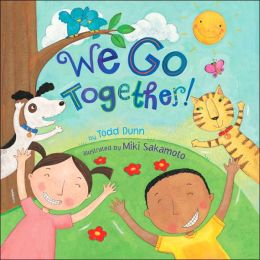
I found this to be the case with one book in particular lately. I really hesitated writing about this book, because I wanted to like it, but just couldn't 100% embrace it, and I couldn't figure out why. The book in question is We Go Together by Todd Dunn, illustrated by Miki Sakamoto. Sprout nabbed this one on a recent library visit and I suspect that's mostly because of the cover - bright sunshine, animals and birds, a white-skinned girl and brown-skinned boy with huge smiles. What's not to like?

The text and illustrations are perfectly suited, as Sakamoto's cheerful figures and palette match Dunn's bounce rhymes very well. There's no real narrative here, just a depiction of things that go very well together - like moon and night, for instance, or string and kite. Each spread has a sly joke or whimsical touch that works quite nicely. Sometimes there's a double meaning included, like "We go together like elephant and trunk", which shows a chipper purple elephant bearing a small chest on his back. Cute, in all, and upbeat, which always makes for a nice addition to any reading session.

So what was it that bothered me? It took a while to figure out, but I finally narrowed it down to the last spread. Throughout the book we have a reasonable attempt to depict diversity - most of the spreads with more than one human character has multiple ethnicities represented. But on the last page, the text reads: "We go together, that's what we do. We go together because you love me and I love you!". Sweet, but here's where the missed opportunity comes in for me: the mother and daughter depicted on the page look almost exactly identical: white skin, rosy cheeks, brown hair turned up at the ends.

For me this is a misstep - the whole book is about things that go together, so why not use this spread as a chance to emphasize that things don't have to look alike to go together? This would have been a great opportunity to depict a transracial family, or at the very least two people who looked dissimilar. Maybe mom could have red curly hair and be hugging a boy with straight black hair? Would that be too much to ask? Couldn't the creators of the book have used this as a way to drive home the point to kids that belonging isn't about looking just exactly the same, but rather belonging has to do with the feelings mentioned in the page text?

Don't get me wrong, I have nothing against this particular book, and it's not one that I would prevent Sprout from reading. It's cute enough, the illustrations are well-done, and it's something the author and illustrator should be very proud of creating. I also don't think that every single kids' book should cater to transracial families -- because come on, where's the reality in that? But I couldn't help but wonder how much stronger this little slice of kidlit could have been with just a tweak in the approach.

And here's where the missed opportunity comes in: because changing our environment and embracing more diversity is as simple as the decision to show the world families don't all have to match. The message of the title could have been that much more impactful, for my mind, with just a shift in this one editorial choice. These are the kinds of things that don't escape my notice, now that I'm parenting transracially. And you can be sure that if I'm noticing it, Sprout and all the other kids his age aren't letting these messages, however slight, pass them by. This kind of small choice strengthens the argument for kids on the playground who ask us questions like, "Are you his mom? Why don't you look like him?"

Listen, there are a host of reasons that parents and kids don't resemble one another, and adoption certainly isn't the only one. So let's be brave, kidlit creators: let's teach our kids that matching is more than just having the same hair color or wearing the same outfit. Let's throw them a curve and show them a daddy in a wheelchair or a mama and baby with different skin tones. Let's trust that kids can handle the challenge of seeing a parent and child for what they are, even when they don't look the same. Because that's an opportunity -- for thought, discussion, inclusion -- that no one should miss.

Wednesday, February 6, 2013

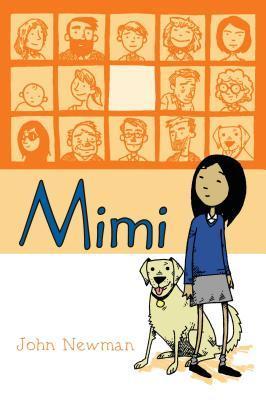
Chapter Book Review - Mimi by John Newman

I'm incredibly proud of our adoption. I'm glad every single day that we chose that method to grow our family. But I have to say when we look at our son, we don't immediately think "adopted", even though he doesn't look a thing like us. He's just our Sprout, our funny and messy and creative and smart and stubborn and loving little dude. Good and bad, he's our kid, and while adoption is part of our story as a family, it isn't our whole story.


And that's why I was thrilled to run across the middle grade novel Mimi by John Newman. In this book, which takes place in the UK, the title character Mimi is adopted -- but that part of her story comes secondary to the fact that Mimi's dealing with some pretty tremendous changes in her home life. Oh, Mimi mentions her ethnicity right away, in an offhand way: her grandad's teaching her chess because she's Chinese and he thinks the Chinese invented chess. (In fact chess is thought to have originated in India, which Mimi fills us in on later.) But other than that there's not much mentioned about how Mimi's family came together, until it becomes important to the rest of her story.

When the book opens, it's been 149 days since Mimi's mum passed away, and things are pretty much falling apart at her house. Her dad's just about catatonic, her brother Conor just wants to bang away on his drums with his door closed and her sister Sally has taken up with a bunch of Goths. Mimi's doing her best to stay together but it's hard when there's no one to wash her school uniform or check her homework. Before long it's clear that the family is unraveling. Outsiders start to notice first: the dentist finds cavities, the neighbors complain about noise, the sub calls out Mimi's missing homework. And then it all gets really crazy, for Mimi and her siblings, who are just trying to fill the hole that Mum left behind.

I won't give away the ending, but suffice to say when a bully uses an aspect of Mimi's family life as a weapon, things come to an emotional breaking point. Newman's novel is honest and true, a real reflection of what grief and love look and feel like to a young girl. And while he sprinkles the plot with elements that relate in some ways to her history and their family composition, Newman never uses "adoption" or "transracial family" as the easy conflict. Instead he builds a story that works on multiple levels with a complexity that's beyond the average middle grade fare. Mimi mourns her mother, yes, but she also mourns the death of her family life, and the shift in how she relates to everyone, especially her father. What Mimi's facing is all wrapped up in relationships, which is so reflective of how we all live as families, isn't it?

Though a few of its more British references may be a challenge for some kids, I think Mimi is ultimately a story with which many young readers can connect. It's sad but funny, honest but ordinary all at once. Certainly kids who live in transracial families will respond to a story that isn't all about race, but rather about loss and loneliness, and how families can pull together to overcome the isolation that these emotions produce. And best of all is Mimi's clear voice, that shines like the brightest star throughout, making her a character you'll love from the very first bit.

Mimi by John Newman, published by Candlewick Press
Ages 9-12
Source: Library
Sample: "I used to find it hard to sleep with all the noise in our house. But you can get used to anything, and after a few words with Socky my eyes begin to close and my thumb slips into my mouth. 'Good night, Socky,' I tell my sock puppet, and he nods and says, 'Good night, you.' And then I slip him off my hand and tuck him under my pillow."
Recommended

Wednesday, January 9, 2013

Nonfiction Picture Book - Who's in My Family? by Robie H. Harris

We're in a phase right now around our house that is simultaneously the most entertaining and the most annoying one ever -- the "why" phase. I thought we'd been through this once before, and we had, but this new incarnation seems to be a deeper and more questioning one. Now instead of "why is the car wet?" it's more "why does it rain?". Everything is more philosophical. And it's great, if a bit frustrating when the question is something like "why are pancakes made out of eggs and milk and flour and salt?" (an honest-to-goodness query from last night's dinner).


So a quick flip through today's pick, Who's In My Family? by Robie H. Harris, told me this one would be just the thing for Sprout's current quizzical turn. Harris's goal with this and her other titles, including books on bodies, birth and health, is to present information in a clear and age-appropriate manner. And clarity is certainly the watchword here: Harris examines all the facets of what makes up a family, as well as the various aspects that different family members may either share or that may differ from person to person.

There's a lot here to recommend it as an addition for home libraries and classrooms alike. The prose is concise and straightforward, easy for kids to understand, which parents and teachers will appreciate. While the dialogue between the two main characters, Nellie and Gus, is a little stilted, the general upbeat tone works well with the pictures. Nadine Bernard Westcott did the illustrations, and they are charming, lively and fun, with lots of small details that make the spreads visually appealing. A whole chunk of the book centers around a trip to the zoo, so there are even family groups among animals shown here, reinforcing the overall message of Harris's text.

A big plus for us is the diversity - transracial families are featured prominently, as are same-sex parents, extended family members, older parents, and characters with disabilities. Differences are discussed in an open manner, and I appreciate Harris's no-nonsense approach to matters like varying skin colors within a family unit. This is great not only for kids whose families don't "match", like ours, but even more critical for families who do match, so all children can see that the bonds that unite family members go far beyond similarities in hair or skin color.

When you're looking to tackle the big topics with your kiddo, books like Who's In My Family? are exactly what you want on hand. And maybe a few adults should read it too -- you know, to remind us that "Most of all, and most of the time, and no matter what -- children and grown-ups and their families really do love one another!".

Who's In My Family? by Robie H. Harris, published by Candlewick Press
Ages 3-9
Source: Library
Sample: "Parents, sisters, brothers, grandparents, cousins, aunts, and uncles can all be part of a child's family. Often, good friends or a pet can be part of a child's family too."
Highly recommended

Sunday, September 9, 2012

Picture Book Review - All the World by Liz Garton Scanlon

We're gearing up for a crazy fall around our house. School has begun for me, so I'm back juggling classes along with work and family responsibilities. As it's my second-to-last semester, I'm also taking comps for my degree, so that will knock out my free time for an approximately three-week period. And my husband recently started a business, so he's busy getting that up and running along with all the rest of his other tasks. Plus then there's Sprout, always busy but even more so now that he's got a social life of his own -- there's always a playdate, birthday party or swim lesson at least one of our weekend days.

With all that's going on, it seemed like we might just need a bit of a breather to gear ourselves up for things. So we scheduled a little getaway to the San Juan Islands, a few days to play on the beach, read, explore, sleep in and make s'mores. (Actually Sprout's one-and-only request for this vacation is that he wants to eat ice cream. Done and done, little man.)


And since we've been talking about this getaway for a while, it seemed like the perfect time to crack out one of my favorite recent picture books to share with Sprout. All the World by Liz Garton Scanlon is a heady dream of a book that celebrates life and interconnectedness of people and place. It came to mind for me because I've always felt sure that Scanlon and illustrator Marla Frazee set the book on an island - it has that meandering pace that reminds me of vacation and leisurely time with family and friends.

The book starts out with a narrow focus - two curly-headed kiddos digging and building on the shore -- and gradually expands outward, encompassing multiple groups, couples and singles and families, who all encounter the glorious day together and yet separately. Each spread gives us a different perspective on the day, from the older gentleman feeding the birds to the family in a rowboat to the lady walking her dog, all of whom are converged on the same scene but from different angles. Nature is a character here too, as through Frazee's jaw-droppingly gorgeous illustrations we can feel the wind sweeping the sky, blowing up a sudden summer downpour. And then, as night falls on this idyllic day, we feel the closeness of the characters coming together in one terrific gathering, playing music, talking and laughing. Really, you just want to pull up a chair in this scene and join the gaiety.

What makes All the World so unique, and to my mind so incredibly lovely, is the way Scanlon's text and Frazee's illustrations are paired. A strict reading of the text provides the spirit of what happens, in terms of a simple, moving poemic jewel. And Frazee's drawings on their own are terrific fun to look at (Sprout likes to pick out familiar elements in every scene, looking for the daddy who has cocoa skin, like him, and the mama whose skin is pink, like mine). But it is in the intersection of these elements that the book really comes alive, and becomes something that transcends the genre. It is an affirmation, a nod to the elemental truth that all parts of our world, however small, are intertwined in myriad ways. All the World is an amazing book for pre-readers to look at in particular, because so much of the story is carried in visual form. And, too, this is a book for everyone, a thoughtful consideration of the way we are connected to one another and to the world we all share.

All the World was a Caldecott Honor title in 2010, and it's not much of a stretch to see why. It seems to me that this is the kind of book that will endure for a long time to come, not just because of its award status, but also because it speaks to universal themes. And even more than that, it's a true joy to read and to share with a child, the finishing touch to a day's activities that will leave little ones with plenty of fodder for joyous dreaming.

All the World by Liz Garton Scanlon, published by Simon & Schuster
All ages
Source: Library
Sample: "Rock, stone, pebble, sand / Boy, shoulder, arm, hand / A moat to dig, a shell to keep / All the world is wide and deep"
Highly recommended

Bonus: Kirkus Reviews interviews author Liz Garton Scanlon and illustrator Marla Frazee

Thursday, September 6, 2012

Picture Book Review - My Family is Forever by Nancy Carlson

As a bookseller, one of the titles I remember seeing come across my counter with particular frequency was Nancy Carlson's I Like Me!. There's something about this title - its bright pink cover, and that exuberantly happy pig dressed in a tutu-esque princess dress that just jumps right out at you. Whenever someone asked for something to help bolster a child's self-esteem, this was the first title that popped into my head, and I can't be alone because this one's got real staying power. Published in the late 1980s, I Like Me! remains popular - a quick check of our library catalog as I'm typing this post reveals that our copies are all checked out.


In a similar vein, Carlson's picture book My Family is Forever aims to bolster the self-esteem and identity of children who have been adopted. Told from the point of view of a young Asian girl (who I'm guessing is Korean, based on the author's note), the book opens up the topic of transracial families right away. The narrator's friend Jeffrey "has his mom's red hair and his dad's big ears", while she herself looks "just like. . . me! (And I'm pretty cute.)". She explains that this is because her family was formed by adoption - I appreciate that this is dealt with matter-of-factly, and that adoption is discussed as one of many ways families are formed.

Our heroine goes on to discuss all the ways she's similar to her adoptive parents, in their interests and talents and ways they enjoy spending their time. But she also wonders about her birth parents. Carlson deals with this head-on, as the girl wonders if she favors certain members of her birth family in certain ways. While it's clear that she has a connection to her past, one that her parents have discussed and which she is encouraged to embrace, she's also decidedly an important member of her adoptive family. A spread depicting a holiday with the extended family shows plenty of diversity in  hair and skin colors, as well as ages. Everyone is part of this group, it's clear, and the bonds that tie the family together are truly forever.

Striking a careful balance, Carlson honors the protagonist's first family while finding lots of ways to celebrate the fact that the girl now has a forever family that clearly adores her. My Family is Forever is a cheerful, upbeat discussion-starter that adoptive families will be glad to share with even the youngest child. An excellent choice for families of all sorts!

My Family is Forever by Nancy Carlson, published by Viking
Ages 3-8
Source: Library
Sample: "Being a family means helping each other out. / We love each other in good times, and we love each other even when things don't go quite right."
Recommended

Saturday, July 28, 2012

Review and GIVEAWAY!! - Shopping with Dad by Matt Harvey

When Sprout joined our family (more than two years ago now - how on earth is that possible??), we were fortunate to have a full month together at home to bond as a family. Those were great days, or at least I think they were. It's kind of a blur, to be honest, probably because we were all more than a little sleep-deprived. But soon that honeymoon period was over and I had to head back to work, leaving Sprout and his daddy home together for another six weeks.

Frankly, I think we were all terrified.

Undaunted, my darling husband set about incorporating Sprout into our everyday routine. This meant that if there were errands to do, the boys were out and about doing them. It wasn't easy - Jake had to figure out how to navigate a busy store with his wheechair and a little one along - but they got creative. They always had an interesting story for Mommy at the end of the day. And to this day they are shopping buddies, with the weekend likely to find them headed to Costco and Target after swim lessons or a trip to the park.


So when our friend Liz of Barefoot Books offered to sponsor our first giveaway here on Sprout's Bookshelf, it seemed pretty fitting that the book was Shopping with Dad by Matt Harvey.


Sprout was delighted to read this lively picture book about a young girl taking a trip to the store with her dad. Mom makes a list with some pretty zany ingredients (Sprout's favorite: octopus underpants!) and the pair heads through the aisles trying to find everything. But when the little girl is overtaken by a sneeze -- a HUGE sneeze to be precise -- the whole store is suddenly in an uproar. And worst of all, everyone's pointing the finger at Dad for causing all the trouble. Oh no! Will our heroine be brave enough to own up to her part in the mess? And will they ever get their shopping done??

Where to begin with all the things we love about Shopping with Dad. . . for starters, there's the adorable illustrations by Miriam Latimer, bursting with fun and so much energy, just like the preschooler who narrates the tale. (And if you've ever shopped with a three-year-old, you'll recognize a few of the scenarios in this book!) I love all the fun details included in the background - the mouse that peeks into several spreads, the dog running amok with his owner right behind. The multiracial cast of characters is fantastic, and includes people of all ages too. Our heroine's family is transracial, but that's beside the point of the action, which makes the book all the stronger for my mind. And the rhyme scheme is generally pretty cohesive (it does get sticky in a few points), but the big sneeze in the middle is what kids will really love, especially if you put all your best effort into it.

Want a copy of Shopping with Dad for your own library? We just happen to be GIVING AWAY a copy to one lucky reader. Enter using the form below. This contest is open to readers with United States addresses only (sorry, international friends!). Hurry, the contest ends Sunday, August 5th at 12:01 am EST.

a Rafflecopter giveaway

Don't want to take your chances on the contest? You can purchase a copy of Shopping for Dad for yourself from our friend Liz at Barefoot Books. They have so many other wonderful titles too - many of their books are multicultural in theme and feature not only loads of diversity but also great content!


Best of all, if you order using this link (also posted above) between now and the end of August, 20% of the proceeds of your purchase will be donated to the Tesfa Foundation, an amazing organization that is right now fundraising for their 5x3 Initiative, aiming to build 5 schools in Ethiopia in the next 3 years. What could be better than that?? Get some awesome new books and help kids in Ethiopia at the same time!

Shopping with Dad by Matt Harvey, published by Barefoot Books
Source: provided by publisher for our review (but this review represents our true and honest opinion of this title)
Ages: 3-6
Sample: "My Mom made a list and she gave it to us, To me and my Dad, and we went on the bus. / We got off the bus at the stop by the shop, Dad found us a cart and then -- / WHOOSH! We were off."
Recommended

Friday, March 2, 2012

Nonfiction Review - The Great Big Book of Families by Mary Hoffman

Lately, Sprout's been kind of obsessed with the notion of family. He likes to talk about our family: who's in it ("Daddy, Mama, Maxie, me!"), our common traits, what we like to do, where we are going to go together. It's fun watching his understanding of family change. He knows that he has family he lives with, family he sees only sometimes, and family he doesn't get to see. And he's gradually learning that not every family looks like ours.


In The Great Big Book of Families, Mary Hoffman takes a good long look at what makes families different, and the same. Beginning with an acknowledgement that "in real life, families come in all sorts of shapes and sizes", Hoffman explores all the ways families can be unique. She starts by looking at who children might live with, and how those families may have come together. Small drawings along the edges of the page emphasize that everyone's family looks just a bit different from everyone else's.

She also looks at all the characteristics that set one family apart from another, beyond just who makes up the family. Homes, for instance: some people live in small houses, some in apartments, some in large houses. Some have no homes at all. Holidays are another point. Some families celebrate in big ways, some in small, and not everybody observes the same days. The list of categories goes on and on -- clothes, transportation, school,  even feelings -- and each category contains a wealth of rich detail in the illustrations by Ros Asquith.

It may take a bit of hunting to find The Great Big Book of Families in your local library. Ours is shelved in nonfiction, so you might try there, or with the picture books (it's kind of two things at once). Sprout and I read this together and he pored over each page; kids who like to study a lot of small illustrations, a la Richard Scarry, will find this worth a look. Best of all, for me, was the way that Hoffman and Asquith combine and recombine family structures, mixing skin colors, genders, ages, ability, and everything in between. The subtitle of this visually appealing book could well be "a joyful celebration of all kinds of families", because it surely is. We love it!

The Great Big Book of Families by Mary Hoffman, published by Dial Books for Young Readers
Ages 2-10
Source: Library
Sample: "Some people have lots of brothers and sisters. . . and uncles and aunties. . . and cousins. . . and grandmas and grandpas. And even great-grandmas and great-grandpas. But some people have really small families. You can be a family with just two people."
Recommended

Sunday, February 19, 2012

Mom's Bookshelf - How Eskimos Keep Their Babies Warm by Mei-Ling Hopgood

When it comes to parenting notions, most of us don't stray too far outside the realm of what we know to be true. We might do what our parents did, or actively try not to do what they did. We consult parenting books that receive high marks, check out websites, seek out the advice of other moms and dads for particularly thorny issues. But most of us don't look much beyond our cultural comfort zone when considering how to discipline our kiddos or what time we should be putting them to bed.

And then there's Mei-Ling Hopgood.

Hopgood and her husband were thrilled to add daughter Sofia to their family, while living abroad in Argentina. Pretty much everything the couple knew about kids they had learned through their own cornfed American upbringings. Essential gear? Strollers and pull-ups. Approved play? Mommy and me. Sleeping arrangements? Bedtime and crib for one.

But then Hopgood started noticing how Argentine parents treated bedtime - more of a suggestion than anything, with young kids present in restaurants and out and about far later than American children generally are. Digging deeper, Hopgood found the roots of this practice in the culture of her adopted homeland. What she found was less about sleep habits and more about what the Argentine approach to bedtime says about their attitude toward children as a whole. And far from negligent parenting (which is, let's be honest, what most of us might think here if we saw kids eating dinner at 10 p.m.), in Argentina it's considered an important part of family togetherness.


This led Mei-Ling Hopgood to begin exploring parenting practices around the globe, compiling her findings in the fascinating book How Eskimos Keep Their Babies Warm: And Other Adventures in Parenting. Hopgood's research is incredibly insightful, as she digs into why Mayan children participate (happily!) in household chores and how French moms and dads get their children (willingly!) eating veggies. In each case that Hopgood examines, we learn a little something about the particular cultural norms that are transmitted from parent to child, and how those norms support the larger values and beliefs of that cultural system.

As an undergrad sociology/anthropology major, this stuff is right up my alley, and it really made me think about why we hold the beliefs we do about proper nutrition, playtime, and yes, even bedtime. Much of what we do is in all honesty pretty arbitrary, when it all comes down to it. And in fact it could just be that the Japanese are on to something when they let kids work out their own petty squabbles with -- shock of shocks! -- little or no adult intervention. Can you imagine??!

Though I'm not giving up our stroller just yet, I'll admit that Hopgood makes some pretty intriguing points here. And if nothing else, I'll feel a lot less guilty next time we stay up a little past bedtime.

Tuesday, December 27, 2011

Picture Book Review - The Red Thread by Grace Lin

It's hard for me to find anything not to like about a Grace Lin book. From her realistic yet adorable illustrations, to her sensitive characters and her affinity for detail (both in words and pictures), Lin just about never takes a misstep.


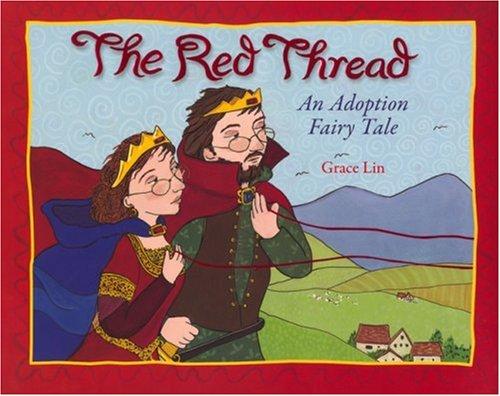
And there's a lot to like about Lin's picture book, The Red Thread. For one thing, this is a great way for adoptive families to share with young children the story of their own experience. Lin sets the story as a traditional fairy tale with familiar elements. The king and queen of a prosperous land have everything, but they are very sad and in great pain. After consulting a mysterious peddler, the king and queen discover there is a red thread pulling from their hearts. The more they pull away from the thread, the more it hurts. The only solution is to follow the red thread. It is an arduous journey, but at last they come to a distant land and discover what is on the other end of the thread - a beautiful baby girl who belongs to them!

In typical Lin fashion this book is gorgeous, with lots of small details that add texture to the picture. The story, too, comes to life with details - the king and queen's journey, for example, and the fact that they gradually lose their fine appearance and become tattered and ragged. I also love that the tale is bookended by a transracial family who is reading the story to their own child, presumably who herself is adopted.

Just a couple small things nag at me, however. First, I don't love the subtitle: "an adoption fairy tale". Maybe it's because of that assumption that adoption automatically equates to "happily ever after" (which it may, but it also may not), maybe it's just that the pairing of the terms feels off to me -- either way, I could do without this part. Also, the tale itself is singular in focus, very much geared toward what the prospective adoptive parents go through and with little consideration given to the child or her first family. I'm not comfortable with how readily the king and queen scoop up their baby and return to their normal lives. Adoption isn't this seamless, in most cases, nor should it be.

Granted, adoption is a complex issue, many would argue too complex for a picture book to examine fully. Also, this is presented as a fairy tale, and therefore idealized. But it's worth noting these issues so that adoptive families who might be sharing the book with their own families can be aware of them, and discuss with their kids as necessary. When I read it with Sprout, we talked about his Ethiopia family, retelling their story to him and emphasizing the centrality of their place in his life.

Overall, however, this is a great book with lots to recommend it, and an excellent addition to home, school and public libraries. Use this to start the adoption conversation with all children, no matter how they came into their family.

The Red Thread by Grace Line, published by Albert Whitman and Company
Ages 2-7
Source: Library
Sample: "And sure enough, when the queen put on the glasses, she could see a brilliant red thread coming from her heart. It ran around the room, out the castle door, and far beyond. With every move she made, the thread pulled and twisted, causing her pain."
Recommended

Wednesday, November 16, 2011

Picture Book Review - I'm Adopted! by Shelley Rotner and Sheila M. Kelly

It's a fact well known that babies and toddlers love to look at pictures of other little ones. I've read a number of theories about why this is, but I suspect it might just add up to the fact that babies of all races are stinkin' cute, and they captivate kids as much as they do (most) adults. Many books and movies have taken advantage of that to great effect. The recent film Babies is a prime example -- with no dialogue and very little footage of other family members, this movie manages to catch and hold your interest throughout. As we see the babies growing and changing, we notice a lot about culture and social norms, but we also notice just how adorable these kiddos are, every last one uniquely individual.

We watched Babies as a family not long after Sprout came into our family, and like us he was taken with it,. His most-requested book during that period was Global Babies, a vibrant pictorial board book that represents little ones from around the globe. I recommend this book highly to all adoptive parents, particularly those who are bringing home babies and toddlers -- it's a great way to express to a small child, especially one with whom you might not have a shared language, that people come in a rainbow of colors and that though they may look different, the kids your new son or daughter will play with are babies just like them. Sound like too much to read into a simple board book? Well maybe, but it's what I hope for, anyway.

Fast forward to now, when reading books together is a treasured part of our daily routine. Now, interspersed with books like Snow Day and What's Up, Duck are titles that share with Sprout the journey of our becoming a family through adoption. Though he's heard the word "adoption" since day one, and though we've told him his story many times already, we recognize that this isn't a concept he can yet grasp -- but still, we feel it's essential to introduce it now.

Having read and loved some of Shelley Rotner's earlier books (click here to read my review of Shades of People), I was thrilled to see her listed as one of the authors of I'm Adopted!. Rotner and frequent collaborator Sheila M. Kelly bring readers a sensitive yet factual look at adoption that's geared for the youngest readers. No easy feat, this, and yet Rotner and Kelly pull it off enormously well. First because of the format of their book -- those aforementioned pictures of babies, toddlers and kids of all races. Gorgeous shots abound, from the copper-skinned beauty on the cover to the adorable Asian, African American, Caucasian, Latino/a, and multiracial darlings inside. Serious cuteness here!

Then there's the text. You wouldn't think that adoption would be a topic you could boil down succintly and yet thoroughly, but Rotner and Kelly have nailed it. Their explanations are clear without being drawn out, and encompass all perspectives. I've seen great picture books that take the adoptive family's point of view, and equally well-done titles from the adoptee's angle. But this is the first picture book I've run across that addresses the birth mother's side of things, and discusses reasons that children may not have been able to stay with their family of origin. This is handled frankly but sensitively, and presents a great opportunity to open discussion about your particular situation.

International and domestic adoption are both mentioned as well, leading into a discussion about transracial families. "I don't look like my sister, but we like to do the same things" reads one bit of dialogue, and really, how much better could one sum up the essence of multiracial families? In a brief afterword, the authors address the fact that not all adoption situations can be adequately discussed in such a format; this sensitive recognition of the uniqueness of every adoptive family is reflected throughout the book, as the authors honor every child they depict.

I truly believe this title belongs on the shelf of every adoptive family and should be part of every school or library's collection. Bravo, Shelley Rotner and Sheila Kelly -- you've given us an adoption classic for the ages!

I'm Adopted! by Shelley Rotner and Sheila M. Kelly, published by Holiday House
All ages
Source: Library
Sample quote: "Children are happy in their families, no matter where they were born. . . when they know they are cared for and loved."
Highly recommended

Thursday, October 6, 2011

Library Find - What's Special About Me, Mama? by Kristina Evans

There's a scene in the Pixar movie The Incredibles where Mrs. Incredible tells her son Dash, "Everyone is special." Dash's response is "If everyone is special, then no one is." I think Dash's point is a good one, and it certainly addresses a particular school of thought that discourages singling kids out of the crowd for specific talents, with the idea that doing so will increase competitiveness and jealousy. For the record, I don't subscribe to that notion -- we want Sprout to grow up to learn that everyone is good at some things and not so great at others, and that there's nothing wrong with that.

However, I do think that each child has special qualities and that everybody's uniqueness should be celebrated. That's the message behind What's Special About Me, Mama?, a picture book written by Kristina Evans and illustrated by Javaka Steptoe. In it a little boy asks his mama the title question, and she replies, "So many things, Love", then begins to articulate each one. But the boy persists in his question -- yes, his freckles are special, but Auntie Jade has those too. Yes, his kindness is special, but sometimes he doesn't feel like sharing. So what about him, just him, is truly unique?

Kristina Evans' text is warm and comforting, as the mama continues to affirm her son with loving observations of his individuality. No matter how many objections her son brings up, this mama has an answer for all of them that underscores the point she's making. This is perfect for the stage that all kiddos seem to hit, where they need continual reassurance of parental love and of their own place in mama or daddy's heart. (We're not there with Sprout yet, but I know it's coming!)

And if that's not enough of a reason to pick this up, then how about Javaka Steptoe's illustrations? I have to say, the illustrations were what initially sparked our interest -- not only because the mama and son have skin of different shades, but also because Steptoe's style is truly delightful to look at. Mingling torn paper with materials of varying textures, Steptoe creates collage spreads that you can return to again and again. The expressiveness of the characters is something that drew Sprout's eye right away, and the emotion that Evans creates in the text is mirrored in the faces of each person we meet through the book.The layering of shades adds depth to the backgrounds and draws the story and its message together nicely. We love it!

Bottom line: African American and transracial families will enjoy this one, but there's a lot here for all families -- a message of constant love and affirmation that will resonate with toddlers and preschoolers, and moms and dads too.

What's Special About Me, Mama? by Kristina Evans, published by Disney/Jump at the Sun
Ages 2-6
Source: Library
Sample quote: "Please, Mama, tell me what's special about me! / Your laugh, Love, and the way your laughter fills the house with joy. It's just like when sun fills the sky on a cloudy day."
Recommended

Tuesday, September 20, 2011

Picture Book Review - Goyangi Means Cat by Christine McDonnell

Soo Min isn't sure about this new home of hers. Nothing is like it was back home in Korea. The food, her new house, the sounds outside her window at night. Though her American mother and father are nice, they cannot speak her language. Soo Min teaches them some Korean words, but it isn't the same. The only thing that Soo Min finds comforting is Goyangi, the American cat. Goyangi's fur is soft and he is quiet, which makes Soo Min feel peaceful too.

But then one morning Goyangi gets out of the house, and Soo Min can't stop worrying about her friend. All day Soo Min and her mother look for Goyangi, but the cat does not reappear. What will Soo Min do without Goyangi? She is very worried -- and at last, when Goyangi comes back at the end of the night, Soo Min realizes that this is home, with her new parents, in this unfamiliar house, but with Goyangi right there by her side.

Goyangi Means Cat is a gentle story that explores the loneliness a newly adopted child feels, when he or she is settling into an entirely strange and sometimes frightening place. The artwork by Steve Johnson and Lou Fancher is fantastic -- these are the kind of pictures you could pore over, examining all the small details woven into the backgrounds via paper collage. An especially nice touch is the interweaving of Korean words into the text, a technique the artists used to demonstrate the blending together of Soo Min's experiences, both at home in Korea and now at home in America. This title would make a great addition to any child's library, but is especially wonderful for Korean children as a touchstone with their heritage and culture.

For siblings and family members who want to understand better what their children are going through, as well as for the child feeling all alone in a world they do not recognize, this is a simple and reassuring tale. It's also a good reminder for parents that although our children may act as though everything is all right, inside they may be confused and lonely. Even a small change in Soo Min's routine, like a trip to the library, seems like too much at first, and Soo Min longs for the comfort of her friend Goyangi. Although Soo Min knows her American parents care for her, she feels isolated without a common language. But the language of her four-footed friend sustains her, helping ease Soo Min into the transition of a new home and family.

Goyangi Means Cat by Christine McDonnell, published by Viking Penguin
All ages
Source: Library
Sample quote: "At night Goyangi curled up on Soo Min's bed. When she was frightened by a siren in the street, she stroked Goyangi's soft fur. When Soo Min missed her Korean friends, Goyangi licked her hand with his towelly tongue."
Highly recommended

Tuesday, August 30, 2011

YA Review - Close to Famous by Joan Bauer

Every avid reader has a stable of sure-thing authors. You know what I mean -- the writers who consistently deliver the right balance of absorbing plot, engaging characters and intriguing themes. For me Joan Bauer is right at the top of that sure-thing list, and has been ever since I first cracked Rules of the Road. That novel, about Jenna, a teenage shoe salesperson who ends up driving her cantankerous elderly boss across country, has pretty much everything you'd look for in a great story, including seemingly insurmountable conflict and crackling good dialogue.

Bauer's latest novel doesn't disappoint, and it has cupcakes. What's not to love? In Close to Famous, Foster McGee has a plate full of troubles, starting with her mama's nasty Elvis-impersonator ex-boyfriend. When Foster and her mom run away from Huck, there's nowhere for them to go, and soon they wash up in the tiny town of Culpepper. Before long Foster's met all the local characters, including Macon, an amateur filmmaker, and the faded Hollywood star Miss Charleena. But all Foster wants is to hit it big with her own show on Food Network -- and even though her muffins are the kind people would line up for, how's she ever going to be discovered in this backwater burg?

Joan Bauer creates characters that are believable, the kind of strong, determined girls who may have the deck stacked against them but don't ever give up on the ones they love. In Foster's case, she's also dealing with learning disabilities and missing her daddy, whose Army helicopter was shot down. (She's multiracial too, but Bauer doesn't use this as a conflict, just as a fact of Foster's life. It's always great to find solid novels featuring people of color that don't turn exclusively around the race of their protagonist.) Foster knows that her baking is the best hope for a future, but also that it's a very long shot. And yet she presses on, one chocolate chip muffin at a time, determined she'll have a better life. Foster is the kind of girl that readers can root for, one who faces trouble at every turn but doesn't quit trying.

But this is far from a one-note novel. In Culpepper, Bauer has created a location that mirrors Foster's own life, the kind of place that everyone counts out but that has plenty to offer. True, the plot turns around Foster, but the secondary characters are pretty unforgettable too. Slowly Foster wins over even the most oppositional individuals with her fantastic cooking, the scent of which fairly wafts off the pages -- butterscotch muffins, pineapple upside-down cupcakes, brown sugar brownies. Don't read this one on an empty stomach or you will absolutely be sorry.

The recent furor raised by an opinion piece in the Wall Street Journal paints all YA fiction as impossibly dark and grim. Foster's story is anything but. Personally I don't know how the author could overlook authors like Joan Bauer (and Ally Carter, and Sarah Dessen, and Maureen Johnson, and and and). In Close to Famous, Bauer gives us a protagonist who struggles against insurmountable odds but manages to keep her sense of humor and determination intact. This is one a diverse audience can relate to, the kinds of issues that Foster grapples with being those that many kids might see in themselves. It's a quick read and some may find it wraps up a little too neatly. Still, there's a lot to like in this solidly written novel, and it's sure to bring Bauer even more devoted followers.

Close to Famous by Joan Bauer, published by Viking
Ages 11-14
Source: Library
Sample quote: "I walk to the bathroom, hearing the slap slap of my flowered flip-flops on the floor. Sonny Kroll, my favorite Food Network cook, who can make a meal out of anything that's lying around, always says 'Go with what you've got.' Well, I have Mama and she has me. I hope Huck has four flat tires and is left in a ditch."
Recommended