It's Day 25 of our 30 Days of Diverse Picture Books. Tonight's Thanksgiving Eve, and there's a lot of excitement in our house thanks to a four-day break from work and school. I don't know about you, but these days I feel more pressure and more busy-ness every day - it's exceedingly wonderful to know we have a few days to rest, relax, enjoy one another's company.
Tonight's pick is Joseph Bruchac's Buffalo Song, a title that honors the Native peoples of our land, and commemorates the work they did to rebuild the great buffalo herds that once called North America home. It's important to note that Bruchac is himself Abenaki, which makes him a cultural insider and therefore capable of avoiding all the stereotypes that so frequently surround depictions of Native Americans in children's books. Bruchac's title is one I've been anxious to share, not only because it comes highly recommended by sources I trust, but also because it's sensitive and thoughtfully written.
Expect some questions with Buffalo Song -- after all, in the opening pages, a young calf is orphaned by white hunters who kill her mother and herd. But the story, ultimately, is one of hope and honor, as it tells of Salish tribal member Walking Coyote and his wife Mary, who among others gave much of themselves to foster the then-declining buffalo population in the late 1800s. Bruchac examines the obstacles Walking Coyote faced, and doesn't gloss over the difficulties, which makes this a great title for discussing how we as individuals can remain committed to a vision and follow it through to an ending that really can change the world.
Buffalo Song carries a message that I think we all really need to hear right now. And that it celebrates Native peoples makes it an essential title for any diverse collection.
Buffalo Song by Joseph Bruchac, published by Lee & Low
Showing posts with label loss. Show all posts
Wednesday, November 26, 2014
Sunday, February 2, 2014
Knock, Knock: My Dad's Dream for Me by Daniel Beaty
This past Monday was a huge day in kidlit circles. Not only was it the first annual Multicultural Children's Book Day (see the list of diverse titles linked up here) but also Monday was the day the ALA Youth Media Awards were announced. This is kind of like the Super Bowl for us kidlit geeks - the day we wait all year for, when we find out at last who won the biggest children's lit awards given by librarians. It's always fun to find out which titles I've read and loved, which winners are surprises, and which just caught me by surprise.
Overall I was pretty thrilled with this year's list, especially the fact that Brian Floca's Locomotive won the Caldecott. (Honestly that was not even one I thought about, since the Caldecott is rarely given for nonfiction, but it was probably Sprout's favorite book of the entire year.) And I was happy to see a title we recently read, Daniel Beaty's Knock Knock: My Dad's Dream for Me, awarded a Coretta Scott King Illustrator Award for Bryan Collier's incredible art.
Full disclosure: this is an honest book about a very tough situation, and it may not be for every kid. Certainly I'd say approach with caution when reading this one with a child who has been through early trauma, particularly the abrupt loss of a parent. It's a great book for discussing those events - but just know going in that there *will* be discussion from any kid, and maybe some upset from a wee one who's had early trauma. But while the subject matter is difficult -- Beaty writes from the point of view of a young boy whose father, like Beaty's one, drops out of his life one day -- I think Knock Knock absolutely has a place and a use with the appropriate audience. I applaud Beaty's willingness to tackle tough topics, and do so thoughtfully and sensitively.
Beaty's own story influenced the plot here; his father was incarcerated when the author was just three years old, and Beaty didn't get to see his dad for many years. That's an incredible burden for a young boy whose father is the center of his life, and that's what we see in Knock Knock: the daddy who has been such a fixture for the main character is one day absent, and he doesn't come back, though our hero waits and hopes. Beaty describes the loss the boy feels in concrete terms -- it's the scrambled eggs Daddy makes, and the absence of a return knock in their familiar game. One day the boy writes his father a letter, leaving it on his desk, and after a while a return missive comes. It's a heartbreaking answer, one that acknowledges the pain the boy feels but also relates the dreams the father has for his son, his hopes and wishes for the boy he knows he'll not see in the same way again.
Knock Knock is very beautifully written, and readers can feel Beaty's emotions through every line. This is an author who has lived this truth, and created something marvelous to help other children through the same sort of event. And the images by Bryan Collier are, as you might expect, amazing. Collier blends collage with his own watercolors to create pictures that are deep and introspective, even haunting. The character's expressions display their feelings, and kids who have experienced loss will recognize the look in our hero's eyes as he waits for his father. Toward the end of the story, as we read the father's letter to his son, Collier gives us a glimpse of the boy's future - we see him growing up, learning a career, and building a family of his own. Throughout, though, we know the father has never truly left his son, but is there in spirit and in thought.
Knock Knock absolutely deserves the attention it received and has earned its place in ALA award history. Read this one before you share it with your kiddos, but don't shy away just because the subject matter is hard - this is a title that will speak to kids who have been through a similar event, and create empathy and understanding for children who haven't yet had this kind of loss.
Knock, Knock: My Dad's Dream for Me by Daniel Beaty, published by Little, Brown
Ages 5-7
Source: Library
First lines: "Every morning, I play a game with my father. He goes KNOCK KNOCK on my door, and I pretend to be asleep till he gets right next to the bed."
Recommended
Sunday, December 15, 2013
Counting by 7s - Holly Goldberg Sloan
Wow! Can't believe the response to our 30 Days of Picture Books series. This is such a fun project for us to do, and it's nice to hear how it's affecting readers. For all those who've told us how much you enjoyed our picks, or mentioned that you're adding titles to your library list - thank you! And don't worry, we're already thinking about books to feature in next year's list. :)
In preparation for this year's 30 Days, Sprout and I read a ton of picture books, but that wasn't all I was reading. Today I'm featuring a title I read a while back, that touched me so much I couldn't help but share it with you. Holly Goldberg Sloan's Counting by 7s is being compared by many to R.J. Palacio's Wonder, and for good reason - both books feature narrators with compelling voices, unique challenges, and incredible people in their lives. But you can't really compare these books on any significant level, because each brings such individual strengths and impact to the reader. So let's acknowledge that one and move on, m'kay?
Counting by 7s tells the story of Willow Chance. Willow's a middle schooler who's best described as different from others she encounters. Willow's family is transracial, as Willow, who is multiracial, was adopted by "two of the whitest white people in the world (no exaggeration.)". But this isn't an adoption story. Willow's a genius, finishing the state proficiency exam so quickly that the school puts her into behavioral counseling. But this isn't a smart kid story. Willow's an oddball, not quite fitting in with anyone else at her middle school because of her talents and her interests. But this isn't an odd-girl-out story.
No, what defines this story is what happens to Willow in almost the first couple of pages: Willow's parents are killed in a car accident, and Willow, the adoptee/smart girl/oddball, is suddently and irrevocably on her own. Willow's got no support network to speak of, but from the emptiness around her, a web of family begins to appear. There's Mai Nguyen, a Vietnamese-Mexican girl who encounters Willow at the counselor's office and becomes a friend almost against her will. There's Pattie, Mai's mother, who sees Willow's plight and becomes convinced that foster care is no place for this tremendous child. There's Quang-ha, Mai's brother who disdains Willow but can't help but be impressed by her talents. And there's Dell Duke, the going-nowhere counselor who's treading water in his job until he becomes entangled with Willow and her story, and suddenly finds his whole life turned upside down.
It's tough for me to sum up in mere words just how much I loved this book. As with Wonder (here we go with the comparisons again), Counting by 7s is a watershed book, one whose story stays with you and that makes you think differently about assumptions you've previously held. Willow's a remarkable character in that her unswerving focus on her particular interests sweeps up everyone around her, a force that's changing their lives before they even realize it's happened. Though the narrative is propelled by a tragic event, this is by no means a sad book -- rather, it's a book about hope, about the goodness of human nature and how every minute can be a turning point. Willow's story speaks to the cynic in all of us, proving that even the most isolated and insular among us can be moved outside of our bubbles to be a force of change in another's life.
I highly recommend Counting by 7s for middle school readers, and for older readers as well, because I think even adults can learn a lot from this wise girl and her story, lessons about valuing yourself and about reaching out, believing that we can change the world. If you read one chapter book this year, make it Holly Goldberg Sloan's - and if you give one, make it this as well. You'll be glad on both counts.
Counting by 7s by Holly Goldberg Sloan, published by Dial Books for Young Readers
Ages 9-12 +
Source: Library
Sample: "I was taken to see an educational consultant that autumn and the woman did an evaluation. She sent my parents a letter.
I read it.
It said I was 'highly gifted.'
Are people 'lowly gifted'?
Or 'medium gifted'?
Or just 'gifted'? It's possible that all labels are curses. Unless they are on cleaning products.
Because in my opinion it's not really a great idea to see people as one thing.
Every person has lots of ingredients to make them into what is always a one-of-a-kind creation.
We are all imperfect genetic stews."
Highly recommended
Monday, September 30, 2013
Fletcher and the Falling Leaves by Julia Rawlinson
Oh, fall. I knew you were coming, but somehow you still managed to sneak up on me, with your windy weather and your ever-so-rainy days. Last week Hubs and I scrambled in vain to get a backyard project finished, one we've been working on for most of the summer, but alas, we didn't quite make it before the blustery weather roared in. (Holding out hope for a respite in the rain later this week.)
In all honesty, though, fall is my favorite season. I'm an October baby, and that's probably why I love most of the aspects of this time of year: crisp fall days, soup simmering on the stove, visits to the pumpkin patch, baking pie with juicy fresh-picked apples. And in the interest of full disclosure, I should admit that I don't really even mind the rainy days, because those give me one more excuse to snuggle inside on the couch with a good book -- like I need one more excuse. :)
We have a lot of favorite fall titles around here, but we're always looking for another to add to our roster. This year we rounded up an older title, Julia Rawlinson's Fletcher and the Falling Leaves. This one was new to Sprout, though it's a title I'd read before. Honestly the first time I read it, I wasn't that impressed - but I can say that reading this with my own kiddo gave me a fresh perspective, and I realized I'd misjudged it somehow. (Hey, it happens, and I'm okay with admitting when I'm wrong.)
Sprout thoroughly enjoyed this story of a little fox named Fletcher and the changes that come to his favorite tree. Fletcher notices that something's up when the leaves of the tree starting turning colors and getting crinkly, but it's when the leaves begin to fall to the ground that Fletcher gets really worried. He looks for solutions to put the leaves back on the tree, but Fletcher's ingenuity is no match for the strong autumn winds. Try as he might, Fletcher can't save his friend's leaves - but he discovers that, for a tree, losing leaves is not only inevitable, it also might bring something even better.
Rawlinson's story is a gentle introduction into the topic of change and dealing with loss, something that I think is important for all kids. This is an excellent way to begin discussing these subjects, along with the notion that sometimes the changes we fear turn out for the best after all. The illustrations by Tiphanie Beeke are one of the best parts of Fletcher's story - awash with light and subtle color, Beeke's spreads set off the smudgy fox and his friends to good effect. It's clear that Beeke spent some time studying nature before she did these pictures, as those color choices reflect a knowledge of what trees really look like, for example. And of course the final spread is full of wow factor, which you know if you've read this one (if you haven't, I'm not spoiling it for you!).
I'm quite glad I gave this one a second chance. The combination of Rawlinson's sensitive story and Beeke's pictures make this a real winner for any autumn bookshelf. Grab a cup of tea, a warm blanket and Fletcher and the Falling Leaves, for a cozy fall read-aloud session that you and your kiddos will love!
Fletcher and the Falling Leaves by Julia Rawlinson, published by Greenwillow Books
Ages 3-6
Source: Library
Sample: "The world was changing. Each morning, when Fletcher bounded out of the den, everything seemed just a little bit different. The rich green of the forest was turning to a dusty gold, and the soft, swiching sound of summer was fading to a crinkly whisper. Fletcher's favorite tree looked dull, dry, and brown. Fletcher was beginning to get worried."
Recommended
Labels:
animals,
emotion,
friendship,
loss,
picture book,
seasons
Tuesday, May 21, 2013
Beholding Bee by Kimberly Newton Fusco
Summer is right around the corner, and that can only mean one thing - Summer Reading! If you've followed this blog for very long, you know that I was a very bookish child who has become a bookish adult with a serious soft spot for Summer Reading. It was my favorite time of year: curling up in a sunny spot with my dog and a good book, or making a pilgrimage to the bookmobile (later the library) only to emerge with a bag of books I could barely carry. I read everything that caught my fancy in those years, and many things that I never would have otherwise tried, but for the fact that I suddenly had plenty of leisure time to explore new literary worlds.
Heaven, for me, is books, no question.
And today's pick is one that the young me would have devoured, and then gone right back to for a second read-through. Kimberly Newton Fusco's previous books have garnered starred reviews and awards, and no wonder, because they are just amazing. But in her latest book, Beholding Bee, a WWII-era novel, Fusco has scored a home run - a character whose voice is so indelible and unforgettable that she draws you right into her story, and you never look back.
Bee has lived with Pauline ever since her parents died when she was three, and the traveling carnival where Pauline works is the only world Bee's ever known. It's not an easy life, and it's made tougher by the presence of Bee's "diamond", a prominent birthmark that draws the attention of everyone who comes to buy hot dogs from Pauline. Bee knows her diamond makes her special, but it sometimes seems too much to bear. And then things get even tougher: Pauline takes up with a boyfriend and leaves Bee behind to manage the hot dog cart all by herself. Bee takes as much as she can stand from unpleasant carnival boss Ellis. But finally she's had enough, so Bee and her dog Peabody, plus a piglet named Cordelia take off at a run, literally. And eventually Bee finds herself at a house that looks like gingerbread, where two quirky old ladies seem to have been expecting her. It's not what Bee bargained for, but it might just be everything she needs.
Beholding Bee is a historical novel for all kinds of kids, but especially for those who know what it's like to be an outsider. As an orphan and an outcast, Bee's developed a unique perspective on the world, and that informs her every decision in a way that makes her a character you can't help but root for. She reminds me so much of other strong girls in literature: Gilly Hopkins, for one, or Hollis Woods, even a younger Dicey Tillerman. She's got heart, but she's not fragile - Bee's a girl who has taken what life dishes out to her and keeps going, because she must. I love the complexity of this character, and Fusco never takes the easy way out for Bee, which makes me love her all the more.
Older readers will likely suss out some of the more mysterious elements a little sooner, but that doesn't take away from the pure enjoyment of the story. And believe me when I tell you that Bee's voice will linger in your mind: I finished this novel over a week ago, and I can't stop replaying Bee's story, thinking about her and the other characters in this vivid, unforgettable tale. With this effort, Fusco confirms her place on my list of writers I'll continue to look out for -- and I hope the Newbery committee feels the same.
Beholding Bee by Kimberly Newton Fusco, published by Alfred A. Knopf
Ages 9-12
Source: Library
Sample: "I hear one lady tell her girl I must have done something horrid to be stained all over my face like that. Or maybe my mama is the one who did something awful, or maybe my daddy, and I am the one being punished. . . . But Pauline holds me and whispers they are not right. Otherwise, why would I have a beautiful jewel on my cheek the color of a rose at dusk and they do not? / I do so like Pauline's way of looking at things."
Highly recommended
Friday, March 29, 2013
Picture Book Review - The Quiet Place by Sarah Stewart
Once in a while you find a book that hits on all the right notes: gorgeous to look at, spectacularly written, sensitive, thoughtful and one your kiddo wants to hear over and over. It's rare, this type of book, I'm not going to kid you. It's especially rare to find one that fits the last criterion. Sprout tends to focus on books that are really energetic and lively, which is great of course, but doesn't always make for the most impactful choice.
And so it surprised me when he became especially taken with a book by one of my favorite author-illustrator duos, Sarah Stewart and David Small. Both have received numerous accolades for their work, together and separately. David Small's graphic memoir Stitches was a selection we read in my teen lit class last semester and it is probably the one that I found most haunting and memorable. And I've adored Sarah Stewart's body of work for a long time, so a new picture book from her was definitely going on my TBR list. But when I brought it home, Sprout seized it out of my read-and-review pile and appropriated it for bedtime reading almost immediately.
The Quiet Place is a story of immigration, of change and finding oneself in a world that's far from the familiar. Told through letters from Isabel to her Auntie Lupita back home in Mexico, the story begins with the illustrations - the opening endpapers show the family preparing to leave and then driving away from their village home. The first letter just after Isabel's family has crossed the border, and it's her first letter using the English words she's learned from Aunt Lupita. As we follow Isabel's story, we learn more of the things she misses, and of the new things she's discovering in this foreign life -- snow, for instance, a bright spot in the otherwise colorless world that seems to be Isabel's now.
Isabel yearns for a place that is her own, a quiet place, and her resourceful nature helps her come up with the perfect solution to make a retreat when she needs one. And gradually, bit by bit, Isabel finds that there is value not only in quiet, but in laughter and music and dancing and noise and life, the bursting new life that seems to be flowering all around her, almost without her notice. Though she misses Aunt Lupita fiercely, by the end of the book we know that Isabel will make her own way in America, and that the lives of those she meets will be all the richer for it.
I love this book, not only because of its theme but because of the perfect symbiosis between picture and story. In the best picture books, you cannot separate the two forms of art without a loss to the tale they are telling, and that's certainly the case here. What Stewart's perfectly chosen words hint at, Small's nuanced illustrations embody, and vice versa. Isabel as a character comes alive through the missives she pens to her aunt, but what she doesn't write down is ours to peek into anyway -- her reticence to join in a birthday part, her wistfulness while watching Fourth of July fireworks. Though her heart is always partly home in Mexico, Isabel's joy slowly comes alive in her new home, which is a thrill to witness.
Though I'm sure most of the deeper themes about immigration and identity went right past my almost-four-year-old, Sprout displayed a real sensitivity toward this book. And therein lies a lesson, my friends -- don't hold back the good stuff from your little ones just because you think they aren't ready. They are often old souls, our children, and fine books like The Quiet Place may touch them deeply in a place even their parents cannot entirely understand.
The Quiet Place by Sarah Stewart, published by Farrar Straus Giroux
Ages 4-10
Source: Library
Sample: "The spots on this letter are from my tears. A big storm blew across Lake Michigan yesterday. I had left my box outside and the rain ruined it. So many new things are in my life, not just new words but new people and new places. I loved how safe I felt in that box! Mother is letting me write this letter under the kitchen table. It isn't the same."
Recommended
Bonus: interview with Sarah Stewart and David Small about the inspiration for The Quiet Place
And so it surprised me when he became especially taken with a book by one of my favorite author-illustrator duos, Sarah Stewart and David Small. Both have received numerous accolades for their work, together and separately. David Small's graphic memoir Stitches was a selection we read in my teen lit class last semester and it is probably the one that I found most haunting and memorable. And I've adored Sarah Stewart's body of work for a long time, so a new picture book from her was definitely going on my TBR list. But when I brought it home, Sprout seized it out of my read-and-review pile and appropriated it for bedtime reading almost immediately.
Isabel yearns for a place that is her own, a quiet place, and her resourceful nature helps her come up with the perfect solution to make a retreat when she needs one. And gradually, bit by bit, Isabel finds that there is value not only in quiet, but in laughter and music and dancing and noise and life, the bursting new life that seems to be flowering all around her, almost without her notice. Though she misses Aunt Lupita fiercely, by the end of the book we know that Isabel will make her own way in America, and that the lives of those she meets will be all the richer for it.
I love this book, not only because of its theme but because of the perfect symbiosis between picture and story. In the best picture books, you cannot separate the two forms of art without a loss to the tale they are telling, and that's certainly the case here. What Stewart's perfectly chosen words hint at, Small's nuanced illustrations embody, and vice versa. Isabel as a character comes alive through the missives she pens to her aunt, but what she doesn't write down is ours to peek into anyway -- her reticence to join in a birthday part, her wistfulness while watching Fourth of July fireworks. Though her heart is always partly home in Mexico, Isabel's joy slowly comes alive in her new home, which is a thrill to witness.
Though I'm sure most of the deeper themes about immigration and identity went right past my almost-four-year-old, Sprout displayed a real sensitivity toward this book. And therein lies a lesson, my friends -- don't hold back the good stuff from your little ones just because you think they aren't ready. They are often old souls, our children, and fine books like The Quiet Place may touch them deeply in a place even their parents cannot entirely understand.
The Quiet Place by Sarah Stewart, published by Farrar Straus Giroux
Ages 4-10
Source: Library
Sample: "The spots on this letter are from my tears. A big storm blew across Lake Michigan yesterday. I had left my box outside and the rain ruined it. So many new things are in my life, not just new words but new people and new places. I loved how safe I felt in that box! Mother is letting me write this letter under the kitchen table. It isn't the same."
Recommended
Bonus: interview with Sarah Stewart and David Small about the inspiration for The Quiet Place
Labels:
family,
friendship,
girls,
identity,
immigrants,
loss,
Mexico,
picture book
Sunday, March 17, 2013
The Island Baby by Holly Keller {The Children's Bookshelf}
Confession time: we love us some vacation around the Kinser household. Really love it. Some days the thought that we have vacation time coming up is the only thing that gets us through all we have to take care of. And when we don't have a vacation planned, we love to dream about where we want to go next -- and get a little twitchy if there's nothing on the horizon. (We love to travel so much that Hubs even has a blog all about accessible options for wheelchair travelers.)
One way we dream about vacation, of course, is through the books we read. I purposely try to seek out stories for Sprout that come from all over the globe. I do that not just because we feel it's important to expose him to a range of cultures but also because we like to imagine ourselves visiting all these far-flung places. And armchair travel via picture books? Kind of the best bedtime adventure ever!
A recent literary trip we've been indulging in takes us to the Caribbean, to an island lush with palm trees, flowers and gorgeous birds everywhere. Island Baby is an older title by Holly Keller, one we were fortunate to discover -- where else? -- through our library. There's so much that's great about this book: its vivid, Caribbean-infused color palette, the simple illustrative style, and its themes of intergenerational relationships and helpfulness to others. It's the kind of book that sneaks up on you with its quiet grace, and that communicates deep truths in subtle ways.
Simon's grandfather runs a bird hospital on the little island where they live. Simon loves to help Pops with the birds; he's good at his jobs and he enjoys feeling like he's not only helping the birds but his beloved grandfather as well. Because of his knowledge, when Simon sees a young bird struggling in the water, waves pushing it against the rocks, Simon can't bring himself to just walk away. Fortunately Pops comes to the rescue with a net, and the two capture the little one and bring him to the hospital. Simon names the bird Baby, caring for his flamingo friend tenderly until at last it's time to set Baby free. It's not easy for Simon -- he can't imagine leaving his friend -- but the feeling of pride Simon takes away, as he watches a flock of flamingos take flight, eases the pain just enough.
There's an easy grace to this book that makes its impact that much more significant; Keller's sensitive understanding of a young child's complex feelings is evident in her prose. The first time we read this, we closed the cover and just sat for a moment, then Sprout asked to hear it again. And I suspect that's the sort of reaction that keeps this gem on the library shelf (you may have to look at a used bookstore to find your own copy). Because the books that make us think, about our relationship to one another as well as to the natural world, are the books that linger with us, don't you find?
We may have opened this book because we wanted to dream of beautiful islands, but we took away so much more than just an escape. At the end, as we mourn with Simon the loss of his friend, we also share his joy at a life saved and made whole. And that's a takeaway that makes this island dream even more magical.
Island Baby by Holly Keller, published by Greenwillow Books
Ages 3-6
Source: Library
First lines: "Pops poured a mug of juice for Simon and one for himself. Then they sat on the front steps without talking and watched the sea."
Recommended
Bonus: an interview with Holly Keller from the Cooperative Children's Book Center
----------------------------------------------------------------------------
This post is part of The Children’s Bookshelf, a weekly linky party with the goal of connecting parents with great books for their kids. Do you have a book review, literacy or book-related post that you think will be helpful for parents? If so, please add your link below.
NOTE: By linking up you are giving permission for any of the co-hosts to pin and/or feature a your photo on a future The Children’s Bookshelf post. Kindly link up to an individual post, not your blog’s homepage. The hosts reserve the right to delete any links to homepages, commercial links, repeat links or otherwise inappropriate links. Thank you for your understanding.
You can also follow The Children’s Bookshelf on Pinterest or visit TCB’s co-hosts: Sprout’s Bookshelf, What Do We Do All Day?, No Twiddle Twaddle, Smiling Like Sunshine, My Little Bookcase, The Picture Book Review, MemeTales and Mouse Grows, Mouse Learns. You can find more details here.
Thursday, March 14, 2013
Chapter Book Review - Navigating Early by Claire Vanderpool
Happy Pi Day! Yep, that's right - it's 3/14, also written as 3.14, which is of course the beginning sequence of that famously irrational number itself, pi. Every year this day sneaks up on me, which is kind of ironic since it's always the same date. But anyhoo, I always remember too late to do something special.
Luckily this year, however, I just finished reading a book that ties into Pi Day perfectly: the new novel by Newbery Medalist Claire Vanderpool, author of the incredible historical Moon Over Manifest. This new outing is also a historical, one that is similar in some ways to her award-winning debut but different enough to stand all on its own. Navigating Early is a wild ride of a novel, full of meditations on loss and loneliness, friendship and the power of belief. Yet it's not an introspective read -- this is a book about adventure and exploration, with plenty of action to keep the plot moving along.
It starts quietly, with Jack Baker, who has moved to Maine from Kansas after the death of his mother. Jack's father, a military man, is at loose ends with the loss of his wife, so he decides a boarding school is the best solution for Jack. And so the boy enters Morton Hill Academy, where he quickly makes a friend -- Early Auden, a decidedly quirky schoolmate who rarely goes to class and lives almost entirely within his own mind. Jack doesn't pretend to understand most of what Early goes on about: a giant black bear of near-mythical proportions, timber rattlesnakes (which Early stubbornly believes live in Maine, despite common knowledge to the contrary), and a bizarre story based on the never-repeating sequences of the number pi.
But when Jack finds himself stranded at school break, teaming up with Early to go on an adventure seems like the next best choice. Jack figures it's a fools errand, seeing as Early is on a quest to find Pi, the hero of his numerically-inspired tale. Still, there's nothing better to do, so the two boys head up the Kennebec River in a rowboat, with no idea of what's in store: pirates, a volcano, an ancient woman and a giant, and of course that enormous mankiller of a bear.
The quest is what will hook readers, and it's where Vanderpool's talents as a storyteller really shine forth. Really this novel contains so many disparate elements, from the bear to the math to the rowing trip to a missing war hero. It's fascinating to watch how she weaves in the elements of Early's story about Pi, deftly bringing the mythology to life and throwing our heroes right down in the middle of it. Don't kid yourself, these boys are in real peril, and Vanderpool pulls no punches. But even as we're fleeing with them through the forest, Vanderpool's pulling at our heartstrings, making the emotional climax that much more stirring and involving.
Early Auden's a narrator I'll not soon forget, with his singular perspective and habits, and his ability to see stories in the patterns of numeric sequence. But though Jack's is a quieter voice, it's no less strong -- for its articulation of loss, and the way we're all found, in the chorus of those we draw near.
Navigating Early by Claire Vanderpool, published by Random House Kids
Ages 9-12
Source: ARC provided by the publisher; opinions, however, are all my own
Sample: "If I'd known what there was to know about Early Auden, that strangest of boys, I might have been scared off, or at least kept my distance like all the others. But I was new to the Morton Hill Academy for Boys, and to Cape Fealty, Maine. Fact was, I was new to anyplace outside of northeastern Kansas."
Highly recommended
Labels:
boys,
chapter books,
diversity,
emotion,
family,
friendship,
loss,
math
Wednesday, February 6, 2013
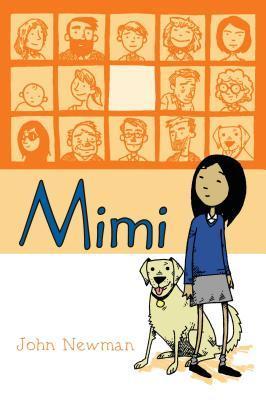
Chapter Book Review - Mimi by John Newman
I'm incredibly proud of our adoption. I'm glad every single day that we chose that method to grow our family. But I have to say when we look at our son, we don't immediately think "adopted", even though he doesn't look a thing like us. He's just our Sprout, our funny and messy and creative and smart and stubborn and loving little dude. Good and bad, he's our kid, and while adoption is part of our story as a family, it isn't our whole story.
And that's why I was thrilled to run across the middle grade novel Mimi by John Newman. In this book, which takes place in the UK, the title character Mimi is adopted -- but that part of her story comes secondary to the fact that Mimi's dealing with some pretty tremendous changes in her home life. Oh, Mimi mentions her ethnicity right away, in an offhand way: her grandad's teaching her chess because she's Chinese and he thinks the Chinese invented chess. (In fact chess is thought to have originated in India, which Mimi fills us in on later.) But other than that there's not much mentioned about how Mimi's family came together, until it becomes important to the rest of her story.
When the book opens, it's been 149 days since Mimi's mum passed away, and things are pretty much falling apart at her house. Her dad's just about catatonic, her brother Conor just wants to bang away on his drums with his door closed and her sister Sally has taken up with a bunch of Goths. Mimi's doing her best to stay together but it's hard when there's no one to wash her school uniform or check her homework. Before long it's clear that the family is unraveling. Outsiders start to notice first: the dentist finds cavities, the neighbors complain about noise, the sub calls out Mimi's missing homework. And then it all gets really crazy, for Mimi and her siblings, who are just trying to fill the hole that Mum left behind.
I won't give away the ending, but suffice to say when a bully uses an aspect of Mimi's family life as a weapon, things come to an emotional breaking point. Newman's novel is honest and true, a real reflection of what grief and love look and feel like to a young girl. And while he sprinkles the plot with elements that relate in some ways to her history and their family composition, Newman never uses "adoption" or "transracial family" as the easy conflict. Instead he builds a story that works on multiple levels with a complexity that's beyond the average middle grade fare. Mimi mourns her mother, yes, but she also mourns the death of her family life, and the shift in how she relates to everyone, especially her father. What Mimi's facing is all wrapped up in relationships, which is so reflective of how we all live as families, isn't it?
Though a few of its more British references may be a challenge for some kids, I think Mimi is ultimately a story with which many young readers can connect. It's sad but funny, honest but ordinary all at once. Certainly kids who live in transracial families will respond to a story that isn't all about race, but rather about loss and loneliness, and how families can pull together to overcome the isolation that these emotions produce. And best of all is Mimi's clear voice, that shines like the brightest star throughout, making her a character you'll love from the very first bit.
Mimi by John Newman, published by Candlewick Press
Ages 9-12
Source: Library
Sample: "I used to find it hard to sleep with all the noise in our house. But you can get used to anything, and after a few words with Socky my eyes begin to close and my thumb slips into my mouth. 'Good night, Socky,' I tell my sock puppet, and he nods and says, 'Good night, you.' And then I slip him off my hand and tuck him under my pillow."
Recommended
Friday, January 4, 2013
Chapter Book Review - Keeping Safe the Stars by Sheila O'Connor
Last summer I participated in MotherReader's 48 Hour Book Challenge, which was an awesome experience (can't wait to do it again!). Though I didn't get to read as much as I'd hoped to, what I read was fantastic stuff, and probably my favorite title was Sheila O'Connor's Sparrow Road, her debut in children's literature. The book was not only beautifully written, it featured a host of interesting characters, the kind of people you just want to know more about.
So when I saw that O'Connor had a new title for children out this fall, I was, to say the least, pretty jazzed. Of course there's always that worry that the next book won't be as good, that it will feel like a repeat or fall flat in one sense or another. But that worry didn't prove out with O'Connor's latest title, Keeping Safe the Stars, a family story that's as tender as it is compelling.
The novel opens with thirteen-year-old Pride, the oldest of the three Star children, trying to decide just what she's going to do about the family's current situation. The kids -- Pride, her sister Nightingale and their brother Baby -- have had a hard road in life, losing their parents already and now living with their somewhat reclusive grandfather Old Finn on his remote patch of land. Old Finn is wonderful for the Stars, teaching them all sorts of things that most kids never get to know and always remaining sensitive to their uniqueness. (His reclusiveness comes from his criticism of the government, particularly President Nixon who at the time of the novel is on the verge of resigning.)But now Old Finn has been stricken with a brain infection, taken to the hospital in Duluth, and the three Stars are left alone on the land, with only the ancient Miss Addie for supervision -- though truthfully, Miss Addie needs more supervision herself.
Pride's got to keep the family going, she knows that. And most importantly, she's got to keep the Social Services people away. Otherwise she, Nightingale and Baby will end up with fosters, and there's no guarantee that those fosters will be the sorts of people Old Finn is, or that the Stars can stay together if they have to leave. Still, how's a young girl, barely thirteen, supposed to look after her siblings and a senior citizen, not to mention find the money to keep everyone fed, all while hiding Old Finn's absence from outsiders?
This novel reminded me of Cynthia Voigt's Homecoming, and Pride of Voigt's heroine Dicey Tillerman. Like Dicey, Pride is stubborn and driven, determined to keep her family together no matter the cost. And like Dicey, Pride results to any means necessary to provide for the Stars and protect them from the frightening graveness of their situation. But Pride is her own person, and the Stars wholly individual as well. Though the resolution to their situation could strain the realms of believability, in O'Connor's skilled hands it comes off as natural, inevitable. And though there are certain stereotypes reinforced here -- parent-like older sibling, smart but quirky middle sibling, reckless baby of the family -- the Stars never feel like cut-outs of some more well-worn cloth.
Though the historical setting may be a stretch for some, I think this would be a hit with readers who favor independent, resourceful narrators. Pride isn't perfect, and therein lies her charm; while she makes mistakes, and knows even as she does some things that she's gone off the past, ultimately she's motivated by her huge heart and love for her entire family. As she did in Sparrow Road, O'Connor has once again created a novel that's driven by careful plotting and intriguing characters, the sort you hope to return to, if only to see how they all turn out.
Keeping Safe the Stars by Sheila O'Connor, published by G.P. Putnam's Sons
Ages 9-12
Source: Library
Sample: "Mama used to say I came to earth a doer. Nightingale a dreamer. Baby came to earth a darer -- it's why he tried to fly and why he had twelve stitches in his chin. / Still, different as the Stars were, all of us were part of the same heart -- Mama's heart -- and even gone, her love kept us a family. No matter what, we hardly ever fought. I didn't want to fight with Nightingale now."
Recommended
Sunday, December 23, 2012
12 Days of Christmas Picture Books - Uncle Vova's Tree by Patricia Polacco
It's Day 11 of our 12 Days of Christmas Picture Books series. Today's choice is a bittersweet one, probably because this time of year is both joyous and sad. We think of Christmases that went before, loved ones who aren't with us any longer, and we keep traditions that help bring these past years alive once again. It's one of the things I love most about the holidays, reminiscing with family and friends and bringing the past into the present (and presents).
I've been waiting quite a while to introduce Sprout to Patricia Polacco, the author of today's pick, Uncle Vova's Tree. Polacco's books are amazing but tend to be a bit long, better for an older preschooler than for a toddler. Her art is very folk-inspired, with a lot of color and small details that make her books just as pleasing to the eye as to the ear. And she's done a number of Christmas titles, but this is one of my favorites because of its themes of family and heritage.
In Uncle Vova's Tree, young children recall the visits to see their Uncle Vova and Aunt Svetlana at the holiays, and all the traditions the family observed that connected them to their Russian roots. There were the special foods, with all the aunts preparing the variation that was popular in their home region. There were the paper stars and the sleigh rides. And there was Uncle Vova's tree, planted in the yard when they came from Russia, which the family decorated every year with berries, grain and popcorn for the birds and wild animals in appreciation and gratitude. This was one of the children's favorite parts of Christmas with Uncle Vova. He told them always to follow the tradition, even if he wasn't there -- and the very next year, they did, in remembrance of their beloved Uncle.
This sentimental classic is one of Polacco's best, and will resonate most particularly with those who have missing spaces at the Christmas table. At the end of this lovely story, the animals and birds come on their own to decorate Uncle Vova's tree, in an emotional moment that virtually guarantees no dry eyes among the adults reading the story. For a holiday tale that reinforces the importance of family and tradition, Uncle Vova's Tree hits all the right notes.
Uncle Vova's Tree by Patricia Polacco, published by Penguin Group
Ages 4-8
Source: Library
Sample: "Uncle Vova clicked and gently tugged the reins, and the sleigh swooshed smoothly down the hill. Billows of steam came out of the horse's nostrils with a soft puffing sound, and his hooves made a muffled clip, clop, clop as they met the new snow."
Recommended
Saturday, November 17, 2012
30 Days of Picture Books - City Dog, Country Frog by Mo Willems
Today is Day 17 of Picture Book Month, and today I'm thinking about time. As most parents do, we are constantly looking back on the years and months gone by since Sprout joined our family, and wondering where it all went. It seems like just an eyeblink since this little boy was only a whisper, and then a picture, and then a chubby pair of hands clinging fiercely to mine as we boarded an airplane to his new home. And now he is 3 1/2, a "big boy" preschooler with his own set of friends and experiences that make up his day, both with and without us.
It makes me smile, and yet it's a little sad too -- I'm sure you can relate.
Change is inevitable as time passes, and that's something that's as tough for little ones to grasp as it is for us as parents. We look at pictures together and Sprout cocks his head, amused by the sight of himself not walking but crawling, buckled into his high chair and smacking a spoon on his tray. "What happened to the baby me?" he asked me the other night. "You got bigger," I told him, and as he snuggled into my lap for a story, I thought how much bigger still he will eventually be. All the more reason to savor each moment.
Lots of picture books speak to the passage of time, and there are as many takes on this subject as there are authors to write about it. One that captures the particular poignancy of love and friendship, and loss, is City Dog, Country Frog by Mo Willems. Most of us know Willems for his hilarious titles starring crazy characters like Pigeon, or Elephant and Piggie. But in this outing, Willems shows his true range as an author, bringing us an introspective story of two friends and the changes that come in their relationship. City Dog and Country Frog meet in Spring, play in Summer, reminisce together in Fall. And then in Winter, things are different for the pair - but Spring, as it always does, comes again, and with it friendship sparks anew.
Jon Muth is the artist responsible for this title's outstanding watercolor illustrations. Honestly, as in so many books, I can't imagine more perfect pictures to bring alive the message of this simple story. Muth portrays the friendship between City Dog and Country Frog, in all its phases -- first acquaintanceship, then playmates, then companions -- and in each set of illustrations the qualities of light and color mirror the relationship's progression. As with Willems's text, the pictures are wistful and yet hopeful, just as we all are when looking back at time gone by.
Sprout's as taken with this heartfelt book as his parents are, and it's given us plenty of opportunity to talk about the way things change, over time. You won't soon forget City Dog or Country Frog. Share this with your little ones and with older ones too -- it'll make you want to hold everyone just a little closer, in this moment.
City Dog, Country Frog by Mo Willems, published by Hyperion Books for Children
Friday, August 17, 2012
Chapter Book Review - Summer of the Gypsy Moths by Sara Pennypacker
The name Sara Pennypacker is probably most familiar for her early chapter book series Clementine. In these books, our high-spirited heroine seems always to land herself in the most outrageous kinds of trouble (cutting her best friend's hair off, for instance, and then coloring it back in with permanent marker). Clementine defines the word irrepressible, and it's all her poor parents can do to keep up with her. She's a lot of outrageous fun, a Ramona Quimby for the post-millenial set.
But if you're looking for a Clementine-esque character in Pennypacker's new novel, Summer of the Gypsy Moths, you may be a bit disappointed. While the author gives us two very strong girls in the form of Stella and Angel, and while there are some funny moments, Clementine these ladies definitely are not.
In fact Stella, the narrator, is really more like a little adult than she is a girl of twelve. Most of that is due to Stella's familiarity with loss. She's had more than her fair share of it already, from the father she never knew to the grandmother who's now passed on. And Stella's mother - let's just say she's flighty at best, but far closer to neglectful. In fact, that's how Stella came to be living with her Great-aunt Louise, at the Linger Longer Summer Cottages on Cape Cod. Louise is the caretaker of the cottages, and of Stella too, now that her mother's run off yet again. And Louise has taken in another child besides, the mysterious Angel, who wants Stella to keep her distance at all times. Angel seems always poised to run, which Stella can't quite understand, since she thinks living at the Cape is the closest thing to perfect she's ever known.
And then a giant rock crashes through the clear glass that surrounds Stella's fragile world, and suddenly everything is a huge mess. Stella's used to relying on herself - she does, after all, take care of everything possible since her mother is so "restless" - but this is all very different. She needs someone else, and surprisingly enough she finds that someone in Angel. Oh, Angel's resistent to the idea at first also, but the two girls are forced to pull together in order to survive, literally. And soon they are faced with the hard truth: like it or not, there's more that unites them than sharing a roof at Linger Longer.
I won't say more (though I'm itching to) because I don't want to give away everything. Suffice it to say that these two girls are some of the fiercest seen in kidlit since Gilly Hopkins. Just when you think that they're presented with truly insurmountable odds, they manage to pull through, by working together. And in that is the real lesson, that life is difficult and the deck is often stacked against us, so we need to find strength wherever we can. Even if that's in someone we always thought we couldn't stand. When Stella comes to realize that her mother isn't just scatter-brained, but really has some emotional issues, it's a hard moment for her and for us. And as we get to know Angel, find out more about her Portuguese heritage and see the pain that drives her deep inside her shell, we come to recognize her beauty also.
Stella and Angel are high-risk kids, no question. And Pennypacker doesn't shy away from revealing that to readers, letting us see the difficult bits a little at a time. Don't be fooled by the gauzy, wistful cover art - there are some really hard moments in this book, especially at the beginning. But that to me is the real test of great writing, that an author can blindside you with events you never anticipated and you still hang on for the whole wild ride. There are a ton of quietly moving scenes in this novel, scenes that make you think about the whole notion of family and trust, and ultimately to consider what bonds really hold us most deeply.
Pair this with books like Katherine Paterson's The Same Stuff as Stars or Patricia Reilly Giff's Pictures of Hollis Woods for more about foster kids in difficult situations. And I won't be at all surprised come Newbery time if this isn't at least on the short list - it's that fine of a novel.
Summer of the Gypsy Moths by Sara Pennypacker, published by Balzer + Bray
Ages 9-12
Source: Library
Sample: "I looked over the cottages. Here were five homes to prove myself on. Below, in our backyard, were Louise's blueberry bushes. My mother's blueberry bushes. Mine, too, now. I felt a good iron-bone, lead-blood heaviness settle me into the floorboards. I couldn't tell Angel any of this, either. / I turned. 'Because, this place?' I said instead. 'I'm not leaving it.'"
Highly recommended
Tuesday, August 7, 2012
Library Find - Angels Watching Over Me by Julia Durango
We're getting to that stage in Sprout's life where questions are starting to emerge. Questions about people in his friend's lives who aren't in his ("why don't I have a Papa?") or about significant relationships that he doesn't remember. There are people who were crucial in Sprout's life before us that are now gone, and some in our lives, like my own father, who passed on before Sprout was born. And as these questions arise so too do opportunities to discuss these important people, how much they meant to us and how we wish, deeply and dearly wish, that Sprout could have met them.
We believe that they are angels looking down on him, on all of us. And we tell him this, but that can raise even more questions in his mind.
And so to stumble on the book Angels Watching Over Me by Julia Durango felt especially providential. The narrative is an adaptation of the African American spiritual "All Night, All Day" (Durango gives lyrics for one of the more common versions of it in her author's note). She has expanded the verses, building imagery of a young African American boy who is first playing in the sunshine, then flying through the air as he chases his kite. Joining the boy are various creatures - gorgeous birds with multi-colored wings, squirrels and insects in the leaves of a tree, deer drinking from a stream below. It's a playful yet comforting experience, and most importantly what becomes clear is that the boy is never really alone. And as the chorus is repeated, a circle of multicultural angels surrounds him, singing the refrain "All night, all day, angels watching over me."
Elisa Kleven provides the illustrations for Durango's words. Kleven's art provides the ideal backdrop to this gently soothing story. The colors are rich and yet not overpowering, and she blends a collage of texture and pattern that adds subtle depths to each spread. Best of all we like the whimsical touches -- a flying elephant, a sleeping donkey and cat curled up together, an owl peeking out from a hole in a tree trunk. With each page you are pulled into the words and at the same time drawn further out into the heavens, until at last we see the globe with angels of all colors encircling it. Peaceful and comforting.
At some point all parents end up discussing loss with their children. For those of us parenting through adoption, the topic might come up sooner and might hit a little closer to home, but it's still the same process all children eventually go through. No matter how you decide to approach the subject, I believe that well-written books can be a tool to help children deal with their feelings. For us, we have given Sprout the image of his loved ones looking down on him from above, and Durago's book helped him understand how these individuals can always be with him even though he cannot see them. It's how I like to envision the special people that I've lost, and I hope this will be the comfort Sprout needs in this moment, as he begins to understand loss. In any case, it's been another way we can retell his story, experiencing it together and drawing us closer as a family.
Angels Watching Over Me, adapted by Julia Durango, published by Simon and Schuster
All ages
Source: Library
Sample: "Grass says rest, I curl up snug. Dusk surrounds me like a hug. / Dusk says sleep, I close my eyes. Moon is full and on the rise."
Recommended
Labels:
adoption,
angels,
animals,
bedtime,
loss,
multicultural,
picture book
Wednesday, June 13, 2012
Wayback Wednesday - Sylvester and the Magic Pebble (1969)
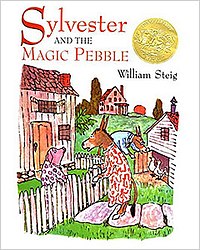
William Steig may be more well-known for a certain big green ogre, but my personal pick from his oeuvre has always been the tale of a donkey whose wish turns out to have unexpected consequences. Sylvester and the Magic Pebble was published in 1969, when Steig was in his 60s; though he came to children's books late in life, he displayed an incredible sense of how to write and illustrate books that speak to children. Sylvester won the Caldecott in 1970, and it's easy to see why - the emotional depth and range that Steig brings to his characters in the text is multiplied exponentially through his deceptively simple illustrations.
Sylvester was actually challenged in 12 states due to Steig's depiction of the police as pigs, something that surprised me a bit since it's not an aspect that jumped out at me at any point in the reading of this picture book. But books have been challenged for a lot less, after all. In Steig's Caldecott acceptance speech, he said that "(a)rt, including juvenile literature, has the power to make any spot on earth the living center of the universe; and unlike science, which often gives us the illusion of understanding things we really do not understand, it helps us to know life in a way that still keeps before us the mystery of things. It enhances the sense of wonder. And wonder is respect for life." Really, I think that's the larger point of all Steig's work, porcine law enforcement officers notwithstanding.
The plot of Sylvester is a perfect marriage of the mundane and the magical. Sylvester is a young donkey in search of pebbles for his collection. He finds an unusual one on a particularly rainy afternoon; still holding the pebble in his hoof, Sylvester thinks, "I wish it would stop raining". To his great surprise, it does, instantly. That the pebble is magic can be of no doubt. Sylvester accepts it as easily as any reader will. And he rejoices in his find, until he stumbles upon a nasty lion with a hungry look in his eyes. Panicking, Sylvester wishes he was a rock, and, being that he's holding the pebble, he of course immediately transforms. And such is Sylvester's dilemma: as a rock, he cannot possibly reach out and pick up the pebble, in order to wish himself back to donkey-dom.
I brought Sylvester home thinking it would be new for Sprout but to my great delight he said, "Oh, Sylvester! I like this one, Mama." Turns out his daycare teacher reads it often, and he knew the entire thing practically (at least the action). At the part where Sylvester turns into a rock, Sprout very gently tapped the page and said, "He's in there, Mama. It's okay," as if to reassure me. We've read it just about every night for the past week, and I can honestly say that I think Sylvester himself magic - Sprout's fallen asleep during almost every reading, preempting the nightly pleas for "one more story" and "need a drink". Gold, Mr. Steig. Pure gold.
Sylvester's on the long side, so best shared with preschoolers on up. Littler ones will enjoy the pictures but might miss out on the subtleties of the story, of which there are many. There's more than a bit of pathos here as we watch Sylvester's distraught parents come to terms with their son's disappearance. That in itself could be hard for younger children to grasp, but they will pick up on the jubilation with which his parents greet Sylvester, once he is at last transformed back into his natural state. And that's one of the best scenes in the book, in my estimation - the sun shining forth with a brilliant burst of light, as Sylvester's father dances with glee and his mother embraces her beautiful boy. It's absolutely heartwarming.
Sylvester may have been written more than 40 years ago but its lessons are just as relevant today - that when those we love are lost, we mourn them deeply. And if we are fortunate enough for them to come back to us, we should throw ourselves into celebration that is joyful and complete. That's a powerful thing for all readers to consider. Well, that and if you're ever holding a magic pebble, for God's sake don't wish you're a rock.
Wayback Wednesday Verdict? Holds up nicely
Sylvester and the Magic Pebble by William Steig, published by Simon and Schuster
Ages 3-7
Source: Library
Sample: "He imagined all the possibilities, and eventually he realized that his only chance of becoming himself again was for someone to find the red pebble and to wish that the rock next to it would be a donkey. Someone would surely find the red pebble -- it was so bright and shiny -- but what on earth would make them wish that a rock were a donkey? The chance was one in a billion at best."
Highly recommended
Bonus: William Steig's Caldecott acceptance speech (and a letter expressing his trepidation at making such a speech) from Letters of Note
Sylvester was actually challenged in 12 states due to Steig's depiction of the police as pigs, something that surprised me a bit since it's not an aspect that jumped out at me at any point in the reading of this picture book. But books have been challenged for a lot less, after all. In Steig's Caldecott acceptance speech, he said that "(a)rt, including juvenile literature, has the power to make any spot on earth the living center of the universe; and unlike science, which often gives us the illusion of understanding things we really do not understand, it helps us to know life in a way that still keeps before us the mystery of things. It enhances the sense of wonder. And wonder is respect for life." Really, I think that's the larger point of all Steig's work, porcine law enforcement officers notwithstanding.
The plot of Sylvester is a perfect marriage of the mundane and the magical. Sylvester is a young donkey in search of pebbles for his collection. He finds an unusual one on a particularly rainy afternoon; still holding the pebble in his hoof, Sylvester thinks, "I wish it would stop raining". To his great surprise, it does, instantly. That the pebble is magic can be of no doubt. Sylvester accepts it as easily as any reader will. And he rejoices in his find, until he stumbles upon a nasty lion with a hungry look in his eyes. Panicking, Sylvester wishes he was a rock, and, being that he's holding the pebble, he of course immediately transforms. And such is Sylvester's dilemma: as a rock, he cannot possibly reach out and pick up the pebble, in order to wish himself back to donkey-dom.
I brought Sylvester home thinking it would be new for Sprout but to my great delight he said, "Oh, Sylvester! I like this one, Mama." Turns out his daycare teacher reads it often, and he knew the entire thing practically (at least the action). At the part where Sylvester turns into a rock, Sprout very gently tapped the page and said, "He's in there, Mama. It's okay," as if to reassure me. We've read it just about every night for the past week, and I can honestly say that I think Sylvester himself magic - Sprout's fallen asleep during almost every reading, preempting the nightly pleas for "one more story" and "need a drink". Gold, Mr. Steig. Pure gold.
Sylvester's on the long side, so best shared with preschoolers on up. Littler ones will enjoy the pictures but might miss out on the subtleties of the story, of which there are many. There's more than a bit of pathos here as we watch Sylvester's distraught parents come to terms with their son's disappearance. That in itself could be hard for younger children to grasp, but they will pick up on the jubilation with which his parents greet Sylvester, once he is at last transformed back into his natural state. And that's one of the best scenes in the book, in my estimation - the sun shining forth with a brilliant burst of light, as Sylvester's father dances with glee and his mother embraces her beautiful boy. It's absolutely heartwarming.
Sylvester may have been written more than 40 years ago but its lessons are just as relevant today - that when those we love are lost, we mourn them deeply. And if we are fortunate enough for them to come back to us, we should throw ourselves into celebration that is joyful and complete. That's a powerful thing for all readers to consider. Well, that and if you're ever holding a magic pebble, for God's sake don't wish you're a rock.
Wayback Wednesday Verdict? Holds up nicely
Sylvester and the Magic Pebble by William Steig, published by Simon and Schuster
Ages 3-7
Source: Library
Sample: "He imagined all the possibilities, and eventually he realized that his only chance of becoming himself again was for someone to find the red pebble and to wish that the rock next to it would be a donkey. Someone would surely find the red pebble -- it was so bright and shiny -- but what on earth would make them wish that a rock were a donkey? The chance was one in a billion at best."
Highly recommended
Bonus: William Steig's Caldecott acceptance speech (and a letter expressing his trepidation at making such a speech) from Letters of Note
Sunday, June 10, 2012
48 Hour Book Challenge - Sparrow Road by Sheila O'Connor
Just under 6 hours left in my allotted timeframe for the 48 Hour Book Challenge. So far I have read/blogged for 10 hours and finished 4 books, plus am halfway through an audiobook. Husband is headed out of the house soon with the toddler to give me a little extra peace and quiet for the last leg of the challenge. I have to say, this has not been easy - even though I'd planned to read for most of the day today, a rare-for-us sunny morning could not be ignored, so we headed off for a bike ride instead. And of course any time I would sit down on the couch in Sprout's eye-view it meant he had to come over and ask "Whatcha reading?" and then bring me his own selection of books to read ("This is better book," he says solemnly).
But I have to say, what I've read has been truly outstanding. Of the four books it's hard to pick a favorite, but Sheila O'Connor's Sparrow Road is definitely a contender. I hadn't heard much about this title before I picked it up but knowing that it was set in a falling-down mansion that once held an orphanage peaked my interest. But lest you think that this is a gothic tale, it's not -- Sparrow Road is very much contemporary and deals with modern-day situations and sensibilities.
Raine O'Rourke is blindsided by her mother's sudden announcement that they are leaving their Milwaukee home and spending the summer at Sparrow Road, an artists colony held in the aforementioned creepy old home. Sparrow Road is located precisely in the middle of nowhere, and Raine's less than excited to be stuck out in the country for several months. Stranger still, her mother keeps entirely mum on just why they are there. And the rules - silence until supper, no interacting with the artists and no leaving the grounds without Mama. Raine can hardly stand it and plans to leave at the first opportunity.
But then she meets Lillian, the sweet poet whose elderly mind seems locked permanently in the past. And Josie, the energetic bohemian and Diego, the charming artist who seems enchanted with both Raine and her mama. These incredible people are more than enough to make Raine suddenly start seeing Sparrow Road in a new way. All that and a mystery too - Raine soon discovers that Sparrow Road once housed dozens of orphans, some of whom seem to still be connected to this haunting place. And then there's Mama, and her mysterious trips to town with Viktor, Sparrow Road's creepy caretaker. . . Raine hardly knows which rocks to start uncovering first.
O'Connor does a masterful job of integrating Raine's own history and struggle for identity with that of the other residents of Sparrow Road, both past and present. She deals head-on with issues related to loss and longing for parents, in the orphans that once lived in the home and in Raine's own missing father. Children who have themselves experienced a tragic loss, or who have grown up without knowing one or both of their parents will find their stories reflected in this novel, and may have some of their own feelings resolved by following Raine's journey. At the very least, they will have a touchstone to know they are not alone.
This is O'Connor's first foray into kidlit but I hope not her last - not only does she exhibit a deft hand with plot and character development, she also sets a scene that makes the reader feel compelled to turn pages. I thoroughly enjoyed Sparrow Road, and I'm incredibly glad I included it as part of my 48 Hour Book Challenge.
Sparrow Road by Sheila O'Connor, published by G.P. Putnam's Sons
Ages 9-13
Source: Library
Sample: "It was a boy's voice I imagined, a boy's voice speaking in my daydream. A story, just like Diego promised. A boy I'd never seen, but there he was. In old wool pants that hung below his knees, scuffed ankle boots, a flannel shirt rolled up at the sleeves. A boy who lived up in that attic. His skinny lower legs were nicked and scarred. His face was round, his eyes the same grassy green as Mama's. / Life just has a way, he said. I think you must know what I mean. Even parents can get lost."
Highly recommended
Saturday, June 9, 2012
48 Hour Book Challenge - Everything on a Waffle by Polly Horvath
Second book completed for my 48 Hour Book Challenge! I managed to log 2.5 hours reading last night before collapsing and sleeping like the dead (until 5:30! The child slept in!). After finishing Zachary Beaver I dived right into Polly Horvath's delightful Everything on a Waffle. I finished it today at lunch - in between I've been listening to the audiobook version of A.J. Jacobs' The Year of Living Biblically, which I may not be finished with before the challenge ends.
And you wouldn't think an adjective like "delightful" could sum up a book about a young girl whose parents are lost at sea, whose guardian is preoccupied by development deals and who loses not one but two digits in the course of the novel. Oh, and who sets a guinea pig on fire. But somehow this book is not only smart but moving, funny and charming even as it is insightful.
Primrose Squarp knows her parents aren't dead, she just knows it, and no amount of intervention on the part of nosy adults in her town of Coal Harbour will convince her otherwise. Though the snoopy Miss Honeycut and the crisp and proper Miss Perfidy try to make Primrose realize that she is an orphan, she won't believe them. Rather, Primrose continues to have various misadventures that are not at all related to her being depressed, as the two women believe. And all the while she enjoys the company of the somewhat unusual adults who do support her, including her devilishly charming Uncle Jack, her foster parents Evie and Bert (whom she compares to "kindly old hard-boiled eggs) and of course the culinarily inventive Miss Bowzer (she of the restaurant The Girl on the Red Swing, where everything is, as you've probably guessed, served on a waffle).
Primrose is an engaging character in the vein of such sparky lasses as Pippi Longstocking or Matilda Wormwood (though without a nemesis half as threatening as the Trunchbull - shudder). Primrose makes the kind of keen observations of the world around her that bely a depth far beyond her years. Nothing gets past Primrose; though the adults in her life think they are outmaneuvering her, she always ends up right where she wants to be. This is definitely an unusual novel and one that's on the surface packed with oddball sensibilities. However, dig a bit deeper and you'll find commentaries on love, loss, loneliness and the value of always being just who you are.
Everything on a Waffle by Polly Horvath, published by Farrar Straus Giroux
Ages 9-13
Source: personal collection
Sample: "Uncle Jack thought it was strange that I didn't move my sweaters into his house. I said it was because the mothballs were protecting them but really it was because I wanted to see Miss Perfidy now and then. We had a peculiar relationship. We didn't like each other much but had lived through my parents' disappearance together. It gave us a kind of melancholy bond."
Recommended
Sunday, May 27, 2012
Novel in Verse - The One and Only Ivan by Katherine Applegate
This is Ivan.
Ivan is a lowland gorilla from Zaire. For 27 years, Ivan lived in an exhibit at a circus-themed shopping center in Tacoma, Washington. He had no other gorillas for companionship, and his only exposure to the world was his view through the glass at shoppers who came to watch him. He lost his twin sister en route from Zaire, and when she died he was utterly alone. In this photo Ivan is relatively young, yet you can already see the loneliness burning behind his eyes.
Having seen Ivan in person as a kid, I always felt a connection to his story. I remember it vividly - the darkness of his enclosure, the lurid jungle-type painting on his wall, and the sad resignation in his body language. In 1994, animal advocates began campaigning for Ivan's release, and he was eventually transferred to Zoo Atlanta, where he lives today a very different life from that of his early years.
Ivan is the subject of the beautifully written new book by Katherine Applegate, The One and Only Ivan. In this novel, Applegate takes her inspiration from Ivan's story, and spins a world for Ivan that is compelling and heart-breaking, and entirely told from his point of view. Applegate populates Ivan's world with non-gorilla companions: Stella the elephant, Bob the stray dog, Julia, the daughter of the night janitor. Together this friends help Ivan survive his loneliness. Stella remembers a life before captivity, and her reminscences encourage Ivan to search the dim corners of his mind for his own memories. Bob keeps Ivan company, sneaking into Ivan's enclosure at night to sleep on Ivan's chest. Julia reaches out to Ivan, recognizing his need to create and providing him with art supplies that he uses to capture his world -- and eventually negotiate for his own new future.
Applegate tells Ivan's story as a novel-in-verse. This is a technique that can work incredibly well in the right setting -- Inside Out and Back Again, for instance -- and as a means to relate Ivan's history, it's the perfect style. In short, vivid bursts, we learn about Ivan's daily life, his loves and his heartaches. There's humor here, and pathos too, and between it all some important questions are raised about humans and what we value most. Applegate does not vilify Ivan's owner Mack, who is entirely fictional. Rather, she presents Mack as sad and confused, someone who does love Ivan but really does not know how to display his love in a way that's good for the magnificent gorilla who is under his care.
Applegate never talks down to her readers, never sugar-coats the story or implies that Ivan's situation is going to be easily resolved. The narrative brings up some incredibly important discussion points, and kids and adults alike will find themselves moved and inspired by Ivan's story. Most importantly, we learn that it's never too late for life to change for the better -- and that sometimes, when it seems impossible to hope for yourself, the hope you have for another will carry you through. The One and Only Ivan is an amazing story and a powerful addition to the canon of children's literature about animals. Read this for yourself, share it with the kiddos in your life, buy it for your library. Just don't expect to ever forget the book - or Ivan himself.
The One and Only Ivan by Katherine Applegate, published by HarperCollins
Ages 9-13
Source: Library
Sample: "I know what most humans think. They think gorillas don't have imaginations. They think gorillas don't have imaginations. They think we don't remember our pasts or ponder our futures. / Come to think of it, I suppose they have a point. Mostly I think about what is, not what could be. / I've learned not to get my hopes up."
Highly recommended
Bonus: check out The One and Only Ivan website for more information about Ivan, the book and author Katherine Applegate
Ivan is a lowland gorilla from Zaire. For 27 years, Ivan lived in an exhibit at a circus-themed shopping center in Tacoma, Washington. He had no other gorillas for companionship, and his only exposure to the world was his view through the glass at shoppers who came to watch him. He lost his twin sister en route from Zaire, and when she died he was utterly alone. In this photo Ivan is relatively young, yet you can already see the loneliness burning behind his eyes.
Having seen Ivan in person as a kid, I always felt a connection to his story. I remember it vividly - the darkness of his enclosure, the lurid jungle-type painting on his wall, and the sad resignation in his body language. In 1994, animal advocates began campaigning for Ivan's release, and he was eventually transferred to Zoo Atlanta, where he lives today a very different life from that of his early years.
Ivan is the subject of the beautifully written new book by Katherine Applegate, The One and Only Ivan. In this novel, Applegate takes her inspiration from Ivan's story, and spins a world for Ivan that is compelling and heart-breaking, and entirely told from his point of view. Applegate populates Ivan's world with non-gorilla companions: Stella the elephant, Bob the stray dog, Julia, the daughter of the night janitor. Together this friends help Ivan survive his loneliness. Stella remembers a life before captivity, and her reminscences encourage Ivan to search the dim corners of his mind for his own memories. Bob keeps Ivan company, sneaking into Ivan's enclosure at night to sleep on Ivan's chest. Julia reaches out to Ivan, recognizing his need to create and providing him with art supplies that he uses to capture his world -- and eventually negotiate for his own new future.
Applegate tells Ivan's story as a novel-in-verse. This is a technique that can work incredibly well in the right setting -- Inside Out and Back Again, for instance -- and as a means to relate Ivan's history, it's the perfect style. In short, vivid bursts, we learn about Ivan's daily life, his loves and his heartaches. There's humor here, and pathos too, and between it all some important questions are raised about humans and what we value most. Applegate does not vilify Ivan's owner Mack, who is entirely fictional. Rather, she presents Mack as sad and confused, someone who does love Ivan but really does not know how to display his love in a way that's good for the magnificent gorilla who is under his care.
Applegate never talks down to her readers, never sugar-coats the story or implies that Ivan's situation is going to be easily resolved. The narrative brings up some incredibly important discussion points, and kids and adults alike will find themselves moved and inspired by Ivan's story. Most importantly, we learn that it's never too late for life to change for the better -- and that sometimes, when it seems impossible to hope for yourself, the hope you have for another will carry you through. The One and Only Ivan is an amazing story and a powerful addition to the canon of children's literature about animals. Read this for yourself, share it with the kiddos in your life, buy it for your library. Just don't expect to ever forget the book - or Ivan himself.
The One and Only Ivan by Katherine Applegate, published by HarperCollins
Ages 9-13
Source: Library
Sample: "I know what most humans think. They think gorillas don't have imaginations. They think gorillas don't have imaginations. They think we don't remember our pasts or ponder our futures. / Come to think of it, I suppose they have a point. Mostly I think about what is, not what could be. / I've learned not to get my hopes up."
Highly recommended
Bonus: check out The One and Only Ivan website for more information about Ivan, the book and author Katherine Applegate
Monday, February 13, 2012
Happy Valentine's Day!
Who'd have thought finding a multicultural book for Valentine's Day would be such a tall order? I mean, I get that this is a holiday that's not exactly celebrated all around the globe -- and, in truth, it isn't one of my favorites. But this year Sprout's old enough to pick out valentines cards and small candies to share with his friends, and of course if we're going to recognize a holiday we need to read a book about it, too.
Oh boy, did I have my work cut out for me.
Sure, there are books about love and kisses and hugs that feature diverse casts of characters. But I wanted something that would relate the custom we follow here, of making or giving valentines to our special friends. And that presented more of a challenge.
Thank goodness for libraries, though. They have the older titles that just don't crop up on most booksellers' radar any longer. And in this case the older title was Valentine's Day by Anne Rockwell. In this book, the members of Mrs Madoff's class are making some very special valentines to send to their friend Michiko, who has moved away to Japan. Each person in the class thinks of something fun that they remember about Michiko, and uses that as their inspiration in creating a valentine. For Kate, it's flying kites together; for Eveline, it's the wonderful gift Michiko gave her for her birthday; for Nicholas, it's the way Michiko always gave him his turn on the slide. In each spread, colorfully illustrated by Lizzy Rockwell, the special memory comes to life, appearing opposite the hand-crafted valentine that inspired it.
Reading this one with Sprout provided us with the opportunity to talk about friends, and how much they mean to us. We also got to talk about what it feels like when someone you love is far away. Though it's not something that he fully understands yet, when he gets older he may begin to experience loss at times when everyone else is celebrating, because people he is intimately connected with aren't part of his daily life any longer. When that happens, it's good for us to have books like Valentine's Day in our arsenal - to show him that time and distance don't diminish the love we feel in our hearts.
Valentine's Day by Anne Rockwell, published by HarperCollins
Ages 2-7
Source: Library
Sample: "Sarah's valentine is pink. Her valentine says, 'I miss you every single day, especially when it's snack time.'"
Recommended
Wednesday, February 8, 2012
YA Review - How to Save a Life by Sara Zarr
Teen fiction is not what it used to be. There's a lot been said in recent months about the darkness of it, about how vampires and werewolves and paranormal romance are going to be the undoing of modern youth (which I highly doubt - if anything, it's getting them reading, right?). But what I think is most significant is that authors who write for teens are willing to explore new topics and themes. Yes, some of these lead to dark places, but others just examine the messy business that is real life, which so rarely comes wrapped up with a cutesy little bow. (Maureen Johnson says it better here than I possibly could.)
Take Sara Zarr, for instance. Zarr writes realistic contemporary fiction for teens - in other words, no time traveling detectives here. And what she writes are novels that peel back the layers, one by one, that construct the experience of teens in this reality, right now. These are kids who face difficult problems, many of which are brought on by forces outside their control, just like kids always have, but who do so in a culture that is often frantic and always changing. You know what I mean.
In How to Save a Life, Zarr brings us a whole slew of issues in the form of Jill, her mother Robin, and Mandy, a pregnant teenager whose baby Robin hopes to adopt. Jill's bitter, and angry, not about the baby so much as she is about the sudden death of her father in a car accident almost a year ago. She's dealt with her grief by building walls around herself, pushing away anyone and everyone who cares, and not letting anyone new inside her circle. And here comes Mandy, bursting with life and new possibilities, but with secrets and pain of her own. Mandy knows Jill doesn't like her, but she's so grateful to be in a safe place, a real home, not the cobbled-together life she's lived with her mother's rotating boyfriends. OK, so maybe Mandy has misrepresented herself a teeny bit, but it's for a good reason, right?
And then the carefully constructed facade that each character has made for herself begins to crumble. Mandy's never had someone care for her like Robin does, and she's not sure she's ready to give that up -- or her baby, for that matter. Jill thinks she knows the role everyone in her life has to play, and it's all structured. But then an unexpected encounter in the parking lot leads to a new friend that Jill just can't shake, and a growing realization that the emotions she's kept bottled up won't stay there forever. Both girls struggle to find their footing on this shaky new territory, and to reexamine what they thought they knew about themselves at the most elemental core of their being.
Zarr's writing is balanced and fluid, her gaze unflinching as she peers into the most secret corners of her characters' lives. No one is wholly good or entirely bad, and for that I applaud her -- if you're looking for stereotypes, you won't find any here. Most interesting of all, she turns adoption inside out, giving voice to the experience from all angles. As a birth mother, Mandy wrestles with the idea that her daughter will one day feel abandoned, or think that Mandy didn't love her. As a prospective adoptive parent, Robin wonders if what she's doing is enough, or if she owes a greater debt. And as a soon-to-be older sibling, Jill fluctuates from feeling betrayed to mourning the fact that her sister will never know the father that Jill so adored.
Those who say they don't read "kids books" are really missing out when it comes to authors like Sara Zarr. Honestly, I'd put How to Save a Life up against anything from an "adult" author and it would hold its own. Strong characters, skilled writing and a story that sticks with the reader long after the last page is turned. In my book, that's quality fiction, no matter where it's shelved.
How to Save a Life by Sara Zarr, published by Little, Brown
Ages: 12 up
Source: Library
Sample:
Mandy -- "My mother says that when another girl steps up to you, just smile and let her have the last word. My mother says it's usually jealousy or her wanting something you have. But I can't think of one thing I have that Jill, who has everything, could want. And I can't smile when we're talking about a tragedy."
Recommended
Subscribe to:
Posts (Atom)