Some authors become so identified with a particular work that it sometimes is difficult to remember that they've done other titles as well. Take Maurice Sendak for example - author of a slew of amazing books, illustrator of tons more, and yet to many people he's remembered for just one book. An incredible book, to be sure, but not the be-all end-all of his literary life, no way.
Ezra Jack Keats is another artist that seems to have a similar association. To most people he's probably best known as the author and illustrator of The Snowy Day. And don't get me wrong, it's gorgeous and absolutely belongs at the tippy-top of every single recommended books list. It's one of our all-time favorite reads, so much so that a good friend gave Sprout this little cutie for his third birthday. But it's by no means the outer limit of Keats's talents, and it isn't even the only adventure to feature Peter, Snowy Day's precocious wanderer.
This week's Wayback Wednesday pick is Peter's Chair, the third Peter title (after The Snowy Day and Whistle for Willie - which we also love). We first read Peter's Chair together about a year after Sprout joined our family, and for many months one or the other of these three Peter books was featured in just about every night's reading rotation. Not only are these books visually appealing - Keats did, after all, win a Caldecott for The Snowy Day - but they are full of the stuff children love: dragging sticks in the snow, building towers, exploring the neighborhood. Keats's kids are real children, not wooden creations, and you can feel their boundless energy sparking off every page.
In Peter's Chair, Keats gives our hero a dilemma to face that many kids will relate to: feeling displaced after the arrival of a younger sibling. Peter's more than a little put out to discover that all his old furniture is being painted pink for his baby sister. First the cradle, then the high chair and crib, and next up is Peter's chair. But Peter's not going to let the chair fall victim to this lunacy, so he decides to run away, taking only the important things (his dog, some cookies and his toy crocodile - and the chair, of course). Is that not just the epitome of childhood decision-making? I love Peter's prioritizing! And naturally the running-away lasts until just about lunchtime. . . .
The story of the artist behind the stories is every bit as interesting as his work. Keats grew up very poor, during the Great Depression. Though his family was proud of him, they also worried that he'd never make a living as an artist. Fortunately Keats was a beneficiary of Roosevelt's New Deal policies, working as an artist through the WPA. This gave him his start as a painter, and he turned to children's books later in his career - some of his early work was illustrating the Danny Dunn books. Keats was not himself African American (he was Jewish, and changed his name to escape anti-Semitism), and some were surprised at his choice to introduce Black characters at a time when people of color were mostly relegated to the backgrounds of children's books, if they were even present at all. He was inspired to create Peter by a series of photos he saw in a magazine; those photos, Keats has said, caused him to wonder why he had never seen a Black boy as the main character in a children's book.
Peter's Chair, like the other marvelous books by Ezra Jack Keats, epitomize multiculturalism for me in that they are thoughtful, engaging stories in which race is not a central (or even secondary) theme. Instead the focus is on the nitty-gritty of childhood life: learning to whistle, running away, finding out that a snowball won't stay forever in your jacket pocket. Sometimes these are hard lessons, but in Keats's hands the learning is joyful, not jarring.
Tonight my son fell asleep with Peter in his arms, after we yet again read Peter's Chair. That, my friends, is the mark of good literature.
Wayback Wednesday verdict? Belongs on every child's shelf
Peter's Chair by Ezra Jack Keats, published by Penguin
All ages
Source: personal collection
Sample: "He saw his crib and muttered, 'My crib. It's painted pink too.' Not far away stood his old chair. 'They didn't paint that yet!' Peter shouted. / He picked it up and ran to his room."
Showing posts with label Wayback Wednesday. Show all posts
Wednesday, August 22, 2012
Wednesday, August 1, 2012
Wayback Wednesday - From the Mixed-Up Files of Mrs. Basil E. Frankweiler (1967)
A bit of a departure for Wayback Wednesday this week, something I haven't yet read with Sprout but that I absolutely cannot wait to: From the Mixed-Up Files of Mrs. Basil E. Frankweiler by E.L. Konigsburg. When I think back on my childhood, this is one of those titles that stands well outside the pack, a shimmering bit of perfection that I think I realized, even then, was the kind of book that stood the test of time. It's most definitely the first book that I remember finishing, putting down, then picking back up almost right away to reread.
That scene is vividly imprinted on my memory - a dreary summer afternoon, a colander full of green grapes to snack on, sitting on my bedroom floor listening to the rain drum on the roof and reading about Claudia and Jamie. I had heard about the book from my older sister, who mentioned offhand once that she read it when she was about my age and really enjoyed it. That was all the convincing it took for me to seek it out during my regular visit to the bookmobile. Right from the beginning it was evident that Claudia was pretty much my literary soul mate. This sentence was all it took: "She was bored with simply being straight-A's Claudia Kincaid." I sat up straighter and began to concentrate on every word after that.
Claudia, you see, has decided that in order for her family to fully appreciate her, she must run away. But she does not want to just take off - no, Claudia is not nearly that impulsive. Instead she crafts a plan wherein she and her middle brother Jamie will run away to the most hospitable and inspiring place she can think of: the Metropolitan Museum of Art. It's a good plan, and one that Claudia and Jamie manage to carry out with a relatively small incidence of peril. But soon the siblings find that they have run right into a bit of a mystery, concerning a small statuette recently acquired from the enigmatic Mrs. Basil E. Frankweiler, which may or may not be the work of Michelangelo. Claudia and Jamie begin to investigate, and their search for the truth leads them straight to the very last place two runaway children may have expected to find themselves.
Quite simply, From the Mixed-Up Files has it all: familiar but not derivative characters, a crisply believable plot, some mystery, some humor, and a wholly original setting. It is firmly set within a specific era and yet has the whiff of timelessness about it, the kind of book that though the details may change (train fare for $1.60? hot fudge sundaes for $.40?) will still be relatable for readers for decades to come. Even to a child like me, for whom New York City was about as far away as the moon in relation to my real life, the adventures of Claudia and Jamie felt immediate and tangible. I could see myself hiding in that bathroom stall waiting for the guard to pass, or hiding my violin case in a sarcophagus (never mind that I never played a musical instrument). And that, dear reader, is what makes something a classic - the fact that though the world in which it was set may seem lightyears away from our modern age, the story still feels fresh and current, like it really could happen to you or someone you know.
E.L. Konigsburg had her first two books published in 1967, this and Jennifer, Hecate, Macbeth, William McKinley and Me, Elizabeth. Both were nominated for the Newbery in 1968, and she took the award for From the Mixed-Up Files and the Honor for Jennifer (the only person to have won both the award and the honor in the same year). Starting a career out like that had to have been more than a little daunting -- how do you follow up such huge success -- but Konigsburg has maintained a long and distinguished track record of publishing amazing literature for children. What I think has made her so successful is the fact that she never writes "down to" her audience. Konigsburg's characters, Claudia and Jamie included, tackle some very real problems, experience deep emotions and grapple with the larger stuff of life. And yet there's always humor, always lightness to cut the gravity.
If you've never read a Konigsburg novel, From the Mixed-Up Files is a great place to start. It still rings as true for me as the day I first read it, so long ago, and I hope that one day Sprout feels the same.
Wayback Wednesday verdict? Quiet adventure that still resonates
From the Mixed-Up Files of Mrs. Basil E. Frankweiler by E. L. Konisburg, published by Simon & Schuster
Ages 8-12
Source: personal collection
Sample: "What happened was: they became a team, a family of two. There had been times before they ran away when they had acted like a team, but those were very different from feeling like a team. Becoming a team didn't mean the end of their arguments. But it did mean that the arguments became a part of the adventure, became discussions not threats."
Highly recommended
That scene is vividly imprinted on my memory - a dreary summer afternoon, a colander full of green grapes to snack on, sitting on my bedroom floor listening to the rain drum on the roof and reading about Claudia and Jamie. I had heard about the book from my older sister, who mentioned offhand once that she read it when she was about my age and really enjoyed it. That was all the convincing it took for me to seek it out during my regular visit to the bookmobile. Right from the beginning it was evident that Claudia was pretty much my literary soul mate. This sentence was all it took: "She was bored with simply being straight-A's Claudia Kincaid." I sat up straighter and began to concentrate on every word after that.
Claudia, you see, has decided that in order for her family to fully appreciate her, she must run away. But she does not want to just take off - no, Claudia is not nearly that impulsive. Instead she crafts a plan wherein she and her middle brother Jamie will run away to the most hospitable and inspiring place she can think of: the Metropolitan Museum of Art. It's a good plan, and one that Claudia and Jamie manage to carry out with a relatively small incidence of peril. But soon the siblings find that they have run right into a bit of a mystery, concerning a small statuette recently acquired from the enigmatic Mrs. Basil E. Frankweiler, which may or may not be the work of Michelangelo. Claudia and Jamie begin to investigate, and their search for the truth leads them straight to the very last place two runaway children may have expected to find themselves.
Quite simply, From the Mixed-Up Files has it all: familiar but not derivative characters, a crisply believable plot, some mystery, some humor, and a wholly original setting. It is firmly set within a specific era and yet has the whiff of timelessness about it, the kind of book that though the details may change (train fare for $1.60? hot fudge sundaes for $.40?) will still be relatable for readers for decades to come. Even to a child like me, for whom New York City was about as far away as the moon in relation to my real life, the adventures of Claudia and Jamie felt immediate and tangible. I could see myself hiding in that bathroom stall waiting for the guard to pass, or hiding my violin case in a sarcophagus (never mind that I never played a musical instrument). And that, dear reader, is what makes something a classic - the fact that though the world in which it was set may seem lightyears away from our modern age, the story still feels fresh and current, like it really could happen to you or someone you know.
E.L. Konigsburg had her first two books published in 1967, this and Jennifer, Hecate, Macbeth, William McKinley and Me, Elizabeth. Both were nominated for the Newbery in 1968, and she took the award for From the Mixed-Up Files and the Honor for Jennifer (the only person to have won both the award and the honor in the same year). Starting a career out like that had to have been more than a little daunting -- how do you follow up such huge success -- but Konigsburg has maintained a long and distinguished track record of publishing amazing literature for children. What I think has made her so successful is the fact that she never writes "down to" her audience. Konigsburg's characters, Claudia and Jamie included, tackle some very real problems, experience deep emotions and grapple with the larger stuff of life. And yet there's always humor, always lightness to cut the gravity.
If you've never read a Konigsburg novel, From the Mixed-Up Files is a great place to start. It still rings as true for me as the day I first read it, so long ago, and I hope that one day Sprout feels the same.
Wayback Wednesday verdict? Quiet adventure that still resonates
From the Mixed-Up Files of Mrs. Basil E. Frankweiler by E. L. Konisburg, published by Simon & Schuster
Ages 8-12
Source: personal collection
Sample: "What happened was: they became a team, a family of two. There had been times before they ran away when they had acted like a team, but those were very different from feeling like a team. Becoming a team didn't mean the end of their arguments. But it did mean that the arguments became a part of the adventure, became discussions not threats."
Highly recommended
Wednesday, July 25, 2012
Wayback Wednesday - Harold and the Purple Crayon (1955)
The concept behind Crockett Johnson's iconic picture book Harold and the Purple Crayon is simple and yet amazingly original at the same time. Take a little boy, in the wind-down of the day into evening and bedtime, give him a very special crayon, and see what ensues. Oh, and make that aforementioned crayon purple, in a world that must undoubtedly be pretty monochromatic. Truthfully, it's not far from other classic titles that are based on flights of the character's imagination - Where the Wild Things Are, for example - but yet Johnson's book is wholly unique and his Harold not one bit derivative.
Crockett Johnson (his real name was David Johnson Leisk) was a cartoonist prior to lending his hand to children's books, first through illustrating and then through writing his own titles. You have to imagine that Purple Crayon was a bit of a breakthrough for an artist who was used to working in such closely circumscribed a format as the comic strip. Though his character "Barnaby" was much beloved and had a huge circulation, it is Harold who took flight and spawned a number of sequels. These include Harold's Fairy Tale, Harold at the North Pole, and A Picture for Harold's Room. Johnson also collaborated with his wife Ruth Krauss to produce a number of popular titles - their book The Carrot Seed is, like Purple Crayon, completely genius in its very simplicity.
Sprout went through a phase about a year ago when The Carrot Seed and Harold and the Purple Crayon were on near-constant rotation in the bedtime routine. At two years old, I think Carrot Seed was more within his realm of understanding, but he was clearly as drawn to Purple Crayon as I remember being as a kiddo. Then we kind of put them aside for a while, but lately he's taken much more interest in Harold's exploits. I think he's finally starting to get the basic premise, the magic inherent in Harold's crayon. "He made this, Mama!" he tells me, pointing at Harold's fine boat with its swelling purple sails.
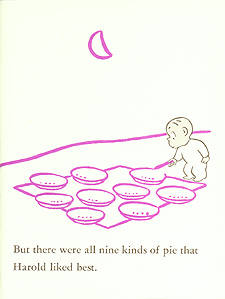
Or maybe he's just interested in those nine kinds of pie.
At any rate, it makes my heart swell to see Sprout so taken with a book that was a childhood favorite of mine. I don't remember reading any of the Harold sequels, though they were undoubtedly still in print when I was a kid. Mostly I remember Harold's moon - that not-quite crescent that guides his night-time journeys - and his apple tree. (I had quite forgotten that he draws a "terribly frightening dragon" to guard the apples on the tree. The sight of that dragon makes Sprout shiver deliciously and say, "Oooh, he scary!").
What's the lesson behind Purple Crayon? Well, it's obviously a lot about imagination, and making your own special world, but let's not forget that Harold has a good deal of unflappability about him for a somewhat chubby youngster in a sleeper suit. Hungry? Make yourself something delicious to eat. Falling off a mountain? Just draw yourself a balloon and you'll be fine. Can't find your bedroom window? Keep drawing windows until you remember just about where yours ought to be. That's self-reliance, folks - Harold's taking charge and showing kids that there's a certain brilliance to working through your own problems if you can.
And when you're home at last, don't forget to make your own bed and draw up the covers.
Wayback Wednesday verdict? Nearly as perfect as kidlit can get.
Harold and the Purple Crayon by Crockett Johnson, published by HarperCollins
All ages
Source: personal collection
Sample: "The sandy beach reminded Harold of picnics. And the thought of picnics made him hungry. / So he laid out a nice simple picnic lunch. / There was nothing but pie. / But there were all nine kinds of pie that Harold liked best."
Highly recommended
Bonus - read more about Crockett Johnson and Ruth Krauss at The Crockett Johnson Homepage. And check out Philip Nel's biography of the duo, due out later this year!
Crockett Johnson (his real name was David Johnson Leisk) was a cartoonist prior to lending his hand to children's books, first through illustrating and then through writing his own titles. You have to imagine that Purple Crayon was a bit of a breakthrough for an artist who was used to working in such closely circumscribed a format as the comic strip. Though his character "Barnaby" was much beloved and had a huge circulation, it is Harold who took flight and spawned a number of sequels. These include Harold's Fairy Tale, Harold at the North Pole, and A Picture for Harold's Room. Johnson also collaborated with his wife Ruth Krauss to produce a number of popular titles - their book The Carrot Seed is, like Purple Crayon, completely genius in its very simplicity.
Sprout went through a phase about a year ago when The Carrot Seed and Harold and the Purple Crayon were on near-constant rotation in the bedtime routine. At two years old, I think Carrot Seed was more within his realm of understanding, but he was clearly as drawn to Purple Crayon as I remember being as a kiddo. Then we kind of put them aside for a while, but lately he's taken much more interest in Harold's exploits. I think he's finally starting to get the basic premise, the magic inherent in Harold's crayon. "He made this, Mama!" he tells me, pointing at Harold's fine boat with its swelling purple sails.
Or maybe he's just interested in those nine kinds of pie.
At any rate, it makes my heart swell to see Sprout so taken with a book that was a childhood favorite of mine. I don't remember reading any of the Harold sequels, though they were undoubtedly still in print when I was a kid. Mostly I remember Harold's moon - that not-quite crescent that guides his night-time journeys - and his apple tree. (I had quite forgotten that he draws a "terribly frightening dragon" to guard the apples on the tree. The sight of that dragon makes Sprout shiver deliciously and say, "Oooh, he scary!").
What's the lesson behind Purple Crayon? Well, it's obviously a lot about imagination, and making your own special world, but let's not forget that Harold has a good deal of unflappability about him for a somewhat chubby youngster in a sleeper suit. Hungry? Make yourself something delicious to eat. Falling off a mountain? Just draw yourself a balloon and you'll be fine. Can't find your bedroom window? Keep drawing windows until you remember just about where yours ought to be. That's self-reliance, folks - Harold's taking charge and showing kids that there's a certain brilliance to working through your own problems if you can.
And when you're home at last, don't forget to make your own bed and draw up the covers.
Wayback Wednesday verdict? Nearly as perfect as kidlit can get.
Harold and the Purple Crayon by Crockett Johnson, published by HarperCollins
All ages
Source: personal collection
Sample: "The sandy beach reminded Harold of picnics. And the thought of picnics made him hungry. / So he laid out a nice simple picnic lunch. / There was nothing but pie. / But there were all nine kinds of pie that Harold liked best."
Highly recommended
Bonus - read more about Crockett Johnson and Ruth Krauss at The Crockett Johnson Homepage. And check out Philip Nel's biography of the duo, due out later this year!
Labels:
bedtime,
boys,
classics,
color,
creativity,
pie,
Wayback Wednesday
Wednesday, July 11, 2012
Wayback Wednesday - Chicka Chicka Boom Boom (1989)
Alphabet books. If there's one thing that picture book shelves are bursting with, it's books for the abecedarian set. And for good reason - print awareness and letter recognition are two of the building blocks of early literacy, so we try to get kiddos interested in written characters pretty early. In fact some of the first books published for children were alphabet books. This was a popular topic for hornbooks, which consisted of a page covered with a thin protective sheet and bound to a handle (take a look at the history of hornbooks and similar productions).
Fast-forward to modern times, when new books on the subject are being produced every season.There are all sorts of conceits employed with alphabet-themed reads. Books are populated with adorable critters, paired with high-interest topics, and feature letters that are literally turned on their heads. Some of these are excellent, modern classics that will surely be around for generations - but sadly, many of them are mediocre at best. If you don't have a great idea for an alphabet book, a truly original spin on the topic, you should just leave the subject alone, in my opinion.
And that's where Chicka Chicka Boom Boom by Bill Martin Jr. and John Archambault comes in. Far from your average ABC tome, this alphabet book made it onto School Library Journal's list of 100 Books that Shaped the Century and is #23 on Elizabeth Bird's Top 100 Picture Books List from this year. I can just imagine the pitch for this book: "all the letters of the alphabet make their way to the top of a coconut tree, and then they all fall over." Mmm-hmmm. It doesn't sound like much, and I think that's probably the appeal of it. Certainly the vivid cover art by Lois Ehlert is enough to draw most young ones toward it - those colors! that ever-so-slightly leaning tree with its jaunty palm boughs! - but the real genius is in the way Martin and Archambault's text marries itself perfectly to the graphic style. The minute you crack the book open you know this isn't just another ho-hum abecedarian treatment, but rather a lively jumble of letters and colors and action that just make you want to read it over again the second you've finished.
What I think makes Chicka Chicka Boom Boom most compelling are the quirks of personality the letters manifest. A is a trickster, daring everyone else into the climb, and D isn't much better. H is along for the ride, and L, M, N, O, and P are pretty much giving in to peer pressure. And when everybody falls out of the tree - well, poor E and F are injured, and J and K just get overwhelmed. Sounds like common occurrence with a bunch of preschoolers, right? And that's got to be a big part of why this title has such staying power.
Sprout's at the age where he's just starting to recognize letters from his name on signs and in the books we read. He was endlessly thrilled to crack open Chicka Chicka Boom Boom and see HIS letters right there, big as life, inside the front cover. It wasn't long before he was reciting the tag line just as I'm sure the authors imagined it, loud and exuberantly. Dare I hope that this cake might be in our future??
Wayback Wednesday Verdict? Tons of ABC fun!
Chicka Chicka Boom Boom by Bill Martin Jr. and John Archambault, published by Simon & Schuster
All ages
Source: Library
Sample: "A told B and B told C, 'I'll meet you at the top of the coconut tree.'"
Wednesday, June 27, 2012
Wayback Wednesday - Frog and Toad Together (1972)
Kidlit has given us a lot of duos over the years: Betsy and Tacy, Peter and Fudge, Tom and Huck, Beezus and Ramona, George and Martha, Henry and Mudge, Katniss and Peeta, Elephant and Piggie. But if you grew up in the 1970s and 1980s, chances are one particular pairing comes to mind when you consider children's literature. I'm speaking, of course, of the inimitable Frog and Toad.
Quick story: a few months back, Sprout and I were visiting a large chain bookstore and he came across a larger-than-life cutout of Frog. He was thrilled, naturally -- who wouldn't be? But then he immediately started looking for Toad, who was conspicuously absent. "Where Toad?" he asked the bookseller, completely puzzled. "Frog and Toad is friends!".
In Sprout's mind, Frog and Toad are inseparable, a duo whose presence in one another's life makes the story. And I would tend to agree with him. This is a classic pair, the staple of many an early reader's first experiences with chapter books. Arnold Lobel introduced the two friends in 1970's Frog and Toad are Friends, which won a Caldecott Honor. (Lobel went on to win a Caldecott for Fables in 1981.) The other entries in the series include Frog and Toad All Year and Days with Frog and Toad; each title contains several stories that reveal the depth of the two friends' affection for one another. Some sources quote Lobel as stating that Frog and Toad were two parts of himself. Whether or not that is true, it's obvious that the stories are personal and rendered with love by their creator.
Sprout's favorite entry in the series at the moment is 1972's Newbery Honor title Frog and Toad Together. In this volume, the two experience a number of highs and lows, from the thrill of a garden growing at last to the uncertainty of what to do when Toad's list of daily activities is lost. In each episode, the friends' individual qualities shine through, such as Toad's affinity for the spotlight and Frog's creative problem-solving. We particularly love "Cookies", in which Toad bakes an especially delicious batch of cookies and then the two friends try to figure out how to stop themselves from eating every single one (with hilarious results).
Lobel hits the mark perfectly with every one of Frog and Toad's adventures, wrapping up life lessons in funny and touching tales. The situations may be unusual, but the emotions are familiar to young children. When a bit of peril is introduced (such as the bravery-testing "Dragons and Giants"), the solution is realistic, as the two friends discover that courage may be hard on your own, but is much easier with a buddy. Through it all, Frog and Toad remain devoted companions, always matching one another's strides in order to end up right in sync.
You can't go wrong with any of the Frog and Toad tales - the only challenge comes in reading only one chapter!
Wayback Wednesday Verdict: Timeless!
Frog and Toad Together by Arnold Lobel, published by HarperCollins
Ages 3-6
Source: Library
Sample: "Toad looked at the sunshine coming through the window. 'Frog,' he said, 'I am so glad that you came over.' / 'I always do,' said Frog."
Highly recommended
Quick story: a few months back, Sprout and I were visiting a large chain bookstore and he came across a larger-than-life cutout of Frog. He was thrilled, naturally -- who wouldn't be? But then he immediately started looking for Toad, who was conspicuously absent. "Where Toad?" he asked the bookseller, completely puzzled. "Frog and Toad is friends!".
In Sprout's mind, Frog and Toad are inseparable, a duo whose presence in one another's life makes the story. And I would tend to agree with him. This is a classic pair, the staple of many an early reader's first experiences with chapter books. Arnold Lobel introduced the two friends in 1970's Frog and Toad are Friends, which won a Caldecott Honor. (Lobel went on to win a Caldecott for Fables in 1981.) The other entries in the series include Frog and Toad All Year and Days with Frog and Toad; each title contains several stories that reveal the depth of the two friends' affection for one another. Some sources quote Lobel as stating that Frog and Toad were two parts of himself. Whether or not that is true, it's obvious that the stories are personal and rendered with love by their creator.
Sprout's favorite entry in the series at the moment is 1972's Newbery Honor title Frog and Toad Together. In this volume, the two experience a number of highs and lows, from the thrill of a garden growing at last to the uncertainty of what to do when Toad's list of daily activities is lost. In each episode, the friends' individual qualities shine through, such as Toad's affinity for the spotlight and Frog's creative problem-solving. We particularly love "Cookies", in which Toad bakes an especially delicious batch of cookies and then the two friends try to figure out how to stop themselves from eating every single one (with hilarious results).
Lobel hits the mark perfectly with every one of Frog and Toad's adventures, wrapping up life lessons in funny and touching tales. The situations may be unusual, but the emotions are familiar to young children. When a bit of peril is introduced (such as the bravery-testing "Dragons and Giants"), the solution is realistic, as the two friends discover that courage may be hard on your own, but is much easier with a buddy. Through it all, Frog and Toad remain devoted companions, always matching one another's strides in order to end up right in sync.
You can't go wrong with any of the Frog and Toad tales - the only challenge comes in reading only one chapter!
Wayback Wednesday Verdict: Timeless!
Frog and Toad Together by Arnold Lobel, published by HarperCollins
Ages 3-6
Source: Library
Sample: "Toad looked at the sunshine coming through the window. 'Frog,' he said, 'I am so glad that you came over.' / 'I always do,' said Frog."
Highly recommended
Wednesday, June 20, 2012
Wayback Wednesday - Freight Train (1978)
Not quite sure how, but I entirely missed Donald Crews' books growing up. I remember seeing the cover of a few (most notably Ten Black Dots and Truck) but can't ever recall cracking them open. It's odd, because Crews received the Caldecott Honor twice in the late 70's and early 80's, so you'd think he would have been on every elementary teacher or librarian's must-read list. But then again, maybe he was, and his books were just being pored over by all the other kids in my class, as I was curling up with Bread and Jam for Frances. It's hard to say.
In any event, it wasn't until I had Sprout in my life that I came to encounter Donald Crews in a meaningful way. And that, of course, was due to this week's Wayback Wednesday read, Freight Train.
Longtime readers of this blog may remember that Sprout is a bit of a train nut. Okay, he's obsessed, really. Anything and everything trains delights him, and hardly a visit to the library goes by without us bringing home a book or two about engines of some sort. Freight Train was one of the first we read together, and he found it himself, so it has a special place in our heart.
The text is deceptively simple - just 55 words -- but each one is carefully chosen and set into its place like a jewel into a setting. And the illustrations are just as impactful. At first they appear simple, and they are, but the stylized images capture the spirit of a freight train through every single spread. Sprout loves it when the train speeds up, and I have to admit that the "Moving" images are pretty spectacular (check them out for yourself - you'll be amazed at the way Crews perfectly articulates the image of a speeding train). And there's so much more here too: colors and opposites (light/shadow), different types of cars and their placement in the train itself. The more you look at this phenomenal piece of art, the more you'll see.
In creating Freight Train, Crews has said he was inspired by his own childhood experiences riding the train from New Jersey to Cottondale, Florida. His memories no doubt helped evoke the graphic style that characterizes this work, and which makes it so visually appealing to even the youngest children. Crews went on to write other similarly themed picture books, and to collaborate with his wife, the author/illustrator Ann Jonas. His work remains vivid, bold, and relevant to children everywhere. Their daughter Nina Crews has carried on the family tradition, producing some amazing works of her own, which we love for their multiracial families and themes.
Believe me when I tell you that Sprout goes nuts for this book every single time he sees it. In fact tonight, he came in from playing outside to find me writing this blog post and insisted we had to read it right away. If that isn't high praise, I don't know what would be.
Wayback Wednesday verdict? A true classic.
Freight Train by Donald Crews, published by Greenwillow Press
All ages
Source: Library
Sample: "Moving in darkness. / Moving in daylight. Going, going...gone."
Highly recommended
In any event, it wasn't until I had Sprout in my life that I came to encounter Donald Crews in a meaningful way. And that, of course, was due to this week's Wayback Wednesday read, Freight Train.
Longtime readers of this blog may remember that Sprout is a bit of a train nut. Okay, he's obsessed, really. Anything and everything trains delights him, and hardly a visit to the library goes by without us bringing home a book or two about engines of some sort. Freight Train was one of the first we read together, and he found it himself, so it has a special place in our heart.
The text is deceptively simple - just 55 words -- but each one is carefully chosen and set into its place like a jewel into a setting. And the illustrations are just as impactful. At first they appear simple, and they are, but the stylized images capture the spirit of a freight train through every single spread. Sprout loves it when the train speeds up, and I have to admit that the "Moving" images are pretty spectacular (check them out for yourself - you'll be amazed at the way Crews perfectly articulates the image of a speeding train). And there's so much more here too: colors and opposites (light/shadow), different types of cars and their placement in the train itself. The more you look at this phenomenal piece of art, the more you'll see.
In creating Freight Train, Crews has said he was inspired by his own childhood experiences riding the train from New Jersey to Cottondale, Florida. His memories no doubt helped evoke the graphic style that characterizes this work, and which makes it so visually appealing to even the youngest children. Crews went on to write other similarly themed picture books, and to collaborate with his wife, the author/illustrator Ann Jonas. His work remains vivid, bold, and relevant to children everywhere. Their daughter Nina Crews has carried on the family tradition, producing some amazing works of her own, which we love for their multiracial families and themes.
Believe me when I tell you that Sprout goes nuts for this book every single time he sees it. In fact tonight, he came in from playing outside to find me writing this blog post and insisted we had to read it right away. If that isn't high praise, I don't know what would be.
Wayback Wednesday verdict? A true classic.
Freight Train by Donald Crews, published by Greenwillow Press
All ages
Source: Library
Sample: "Moving in darkness. / Moving in daylight. Going, going...gone."
Highly recommended
Wednesday, June 13, 2012
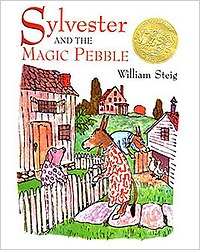
Wayback Wednesday - Sylvester and the Magic Pebble (1969)
William Steig may be more well-known for a certain big green ogre, but my personal pick from his oeuvre has always been the tale of a donkey whose wish turns out to have unexpected consequences. Sylvester and the Magic Pebble was published in 1969, when Steig was in his 60s; though he came to children's books late in life, he displayed an incredible sense of how to write and illustrate books that speak to children. Sylvester won the Caldecott in 1970, and it's easy to see why - the emotional depth and range that Steig brings to his characters in the text is multiplied exponentially through his deceptively simple illustrations.
Sylvester was actually challenged in 12 states due to Steig's depiction of the police as pigs, something that surprised me a bit since it's not an aspect that jumped out at me at any point in the reading of this picture book. But books have been challenged for a lot less, after all. In Steig's Caldecott acceptance speech, he said that "(a)rt, including juvenile literature, has the power to make any spot on earth the living center of the universe; and unlike science, which often gives us the illusion of understanding things we really do not understand, it helps us to know life in a way that still keeps before us the mystery of things. It enhances the sense of wonder. And wonder is respect for life." Really, I think that's the larger point of all Steig's work, porcine law enforcement officers notwithstanding.
The plot of Sylvester is a perfect marriage of the mundane and the magical. Sylvester is a young donkey in search of pebbles for his collection. He finds an unusual one on a particularly rainy afternoon; still holding the pebble in his hoof, Sylvester thinks, "I wish it would stop raining". To his great surprise, it does, instantly. That the pebble is magic can be of no doubt. Sylvester accepts it as easily as any reader will. And he rejoices in his find, until he stumbles upon a nasty lion with a hungry look in his eyes. Panicking, Sylvester wishes he was a rock, and, being that he's holding the pebble, he of course immediately transforms. And such is Sylvester's dilemma: as a rock, he cannot possibly reach out and pick up the pebble, in order to wish himself back to donkey-dom.
I brought Sylvester home thinking it would be new for Sprout but to my great delight he said, "Oh, Sylvester! I like this one, Mama." Turns out his daycare teacher reads it often, and he knew the entire thing practically (at least the action). At the part where Sylvester turns into a rock, Sprout very gently tapped the page and said, "He's in there, Mama. It's okay," as if to reassure me. We've read it just about every night for the past week, and I can honestly say that I think Sylvester himself magic - Sprout's fallen asleep during almost every reading, preempting the nightly pleas for "one more story" and "need a drink". Gold, Mr. Steig. Pure gold.
Sylvester's on the long side, so best shared with preschoolers on up. Littler ones will enjoy the pictures but might miss out on the subtleties of the story, of which there are many. There's more than a bit of pathos here as we watch Sylvester's distraught parents come to terms with their son's disappearance. That in itself could be hard for younger children to grasp, but they will pick up on the jubilation with which his parents greet Sylvester, once he is at last transformed back into his natural state. And that's one of the best scenes in the book, in my estimation - the sun shining forth with a brilliant burst of light, as Sylvester's father dances with glee and his mother embraces her beautiful boy. It's absolutely heartwarming.
Sylvester may have been written more than 40 years ago but its lessons are just as relevant today - that when those we love are lost, we mourn them deeply. And if we are fortunate enough for them to come back to us, we should throw ourselves into celebration that is joyful and complete. That's a powerful thing for all readers to consider. Well, that and if you're ever holding a magic pebble, for God's sake don't wish you're a rock.
Wayback Wednesday Verdict? Holds up nicely
Sylvester and the Magic Pebble by William Steig, published by Simon and Schuster
Ages 3-7
Source: Library
Sample: "He imagined all the possibilities, and eventually he realized that his only chance of becoming himself again was for someone to find the red pebble and to wish that the rock next to it would be a donkey. Someone would surely find the red pebble -- it was so bright and shiny -- but what on earth would make them wish that a rock were a donkey? The chance was one in a billion at best."
Highly recommended
Bonus: William Steig's Caldecott acceptance speech (and a letter expressing his trepidation at making such a speech) from Letters of Note
Sylvester was actually challenged in 12 states due to Steig's depiction of the police as pigs, something that surprised me a bit since it's not an aspect that jumped out at me at any point in the reading of this picture book. But books have been challenged for a lot less, after all. In Steig's Caldecott acceptance speech, he said that "(a)rt, including juvenile literature, has the power to make any spot on earth the living center of the universe; and unlike science, which often gives us the illusion of understanding things we really do not understand, it helps us to know life in a way that still keeps before us the mystery of things. It enhances the sense of wonder. And wonder is respect for life." Really, I think that's the larger point of all Steig's work, porcine law enforcement officers notwithstanding.
The plot of Sylvester is a perfect marriage of the mundane and the magical. Sylvester is a young donkey in search of pebbles for his collection. He finds an unusual one on a particularly rainy afternoon; still holding the pebble in his hoof, Sylvester thinks, "I wish it would stop raining". To his great surprise, it does, instantly. That the pebble is magic can be of no doubt. Sylvester accepts it as easily as any reader will. And he rejoices in his find, until he stumbles upon a nasty lion with a hungry look in his eyes. Panicking, Sylvester wishes he was a rock, and, being that he's holding the pebble, he of course immediately transforms. And such is Sylvester's dilemma: as a rock, he cannot possibly reach out and pick up the pebble, in order to wish himself back to donkey-dom.
I brought Sylvester home thinking it would be new for Sprout but to my great delight he said, "Oh, Sylvester! I like this one, Mama." Turns out his daycare teacher reads it often, and he knew the entire thing practically (at least the action). At the part where Sylvester turns into a rock, Sprout very gently tapped the page and said, "He's in there, Mama. It's okay," as if to reassure me. We've read it just about every night for the past week, and I can honestly say that I think Sylvester himself magic - Sprout's fallen asleep during almost every reading, preempting the nightly pleas for "one more story" and "need a drink". Gold, Mr. Steig. Pure gold.
Sylvester's on the long side, so best shared with preschoolers on up. Littler ones will enjoy the pictures but might miss out on the subtleties of the story, of which there are many. There's more than a bit of pathos here as we watch Sylvester's distraught parents come to terms with their son's disappearance. That in itself could be hard for younger children to grasp, but they will pick up on the jubilation with which his parents greet Sylvester, once he is at last transformed back into his natural state. And that's one of the best scenes in the book, in my estimation - the sun shining forth with a brilliant burst of light, as Sylvester's father dances with glee and his mother embraces her beautiful boy. It's absolutely heartwarming.
Sylvester may have been written more than 40 years ago but its lessons are just as relevant today - that when those we love are lost, we mourn them deeply. And if we are fortunate enough for them to come back to us, we should throw ourselves into celebration that is joyful and complete. That's a powerful thing for all readers to consider. Well, that and if you're ever holding a magic pebble, for God's sake don't wish you're a rock.
Wayback Wednesday Verdict? Holds up nicely
Sylvester and the Magic Pebble by William Steig, published by Simon and Schuster
Ages 3-7
Source: Library
Sample: "He imagined all the possibilities, and eventually he realized that his only chance of becoming himself again was for someone to find the red pebble and to wish that the rock next to it would be a donkey. Someone would surely find the red pebble -- it was so bright and shiny -- but what on earth would make them wish that a rock were a donkey? The chance was one in a billion at best."
Highly recommended
Bonus: William Steig's Caldecott acceptance speech (and a letter expressing his trepidation at making such a speech) from Letters of Note
Wednesday, June 6, 2012
Wayback Wednesday - Bread and Jam for Frances (1964)
It seems fitting to me that I start off my ongoing series of Wayback Wednesday posts with one of my all-time favorite picture book characters, Russell Hoban's Frances. Though in his later years Hoban became the author of a number of highly praised adult novels, he struck out into the publishing world in kidlit, and in a big way: Frances appeared almost at the outset of his literary career, with her first appearance in 1960's Bedtime for Frances, the only one of the Frances novels not illustrated by Hoban's wife Lillian. And it is saying something when you consider that while many of his other kidlit titles have almost vanished from memory, Frances lives on and is as beloved today as she was 50 years ago.
While at this point in my life I can relate most to Frances's parents (particularly in Bedtime, where her exhausted folks deal with their not-ever-sleepy-enough tot), Frances herself strikes a chord with me. She's Everykid, really. You can hardly ever fail to see the wheels turning in her mind, as she considers the world before her and how to turn circumstances to her advantage. She's got the dogged determination of a young child and the energy to match, and though her parents generally can maneuver her into their desired outcome, you just know Frances has got more tricks up her sleeves. I especially love her somewhat thinly-veiled disdain for her little sister Gloria, with whom Frances has quite the sibling rivalry (evidence the scene from A Birthday for Frances when Frances buys her sister a gift - and then somehow nearly manages to make off with all of it herself).
So: Bread and Jam for Frances. This book had been around for a good long while before I was even born, shockingly enough. I can't remember who introduced me to this specific Frances escapade, but I do know that this was the first title I ever read -- or heard, as I think I was pretty darn young. This is probably why it has stuck with me ever since, that and the sheer relatability of the plot. Frances is enamored of one food combination to the point of exclusivity. Breakfast, lunch and dinner, all Frances wants to eat is bread and jam. Hmmm, sound familiar, you parents of young kiddos? Her parents try to convince her of the worthiness of other foods (though I have to say their examples don't thrill me particularly - soft-boiled eggs, anyone?) but to no avail. Her mother even reasons, "You try new things in your school lunches. . . . Today I gave you a chicken-salad sandwich." to which Frances coyly responds, "I traded it to Albert. . . . (for) Bread and jam." Ah Frances, you sly devil.
Undaunted, Mother and Father decide to mix it up. If Frances wants only bread and jam, then bread and jam it shall be. At breakfast it's a treat. At lunch it's still delicious. By snacktime it's wearing a bit thin, and by dinner -- by dinner our darling girl is reduced to tears. In her exasperation she utters one of the best lines in kidlit, by my reckoning: "What I am / Is tired of jam." And finally Frances breaks down and decides that variety just might be the spice of life after all. Especially when it entails devouring one very complicated lunch menu.
It's safe to say that I was pretty excited to share this with Sprout, being that he's in somewhat of a picky eater phase himself at the moment. (While he takes great delight in helping me prepare different types of food, actually passing these foreign morsels through his lips is another story.) And he listened intently to Bread and Jam, though it's a bit long for a three-year-old's attention span, with the detailed descriptions of lunches and all that. He thinks Frances is "silly", and finds her jump-rope rhymes on the various merits of jam to be particularly amusing. All in all, his take on Frances is favorable, so much so that he was excited to find A Birthday for Frances on the shelf at the library last time. "Her eats bread and jam, Mama," he told me seriously. Yes, my dear, she does.
Russell Hoban passed away not long ago, leaving a legacy of fantastic storytelling for future generations. Though she was created more than a half-century ago, I think Frances has a long and happy life ahead, as she charms even more young children with her straightforward approach to life, one jammy bread-slice at a time.
Wayback Wednesday Verdict? Holds up nicely
Bread and Jam for Frances by Russell Hoban, published by HarperCollins (formerly Harper & Row)
Source: Library
Ages 3-7
Sample: " 'Well,' said Frances, 'there are many different things to eat, and they taste many different ways. But when I have bread and jam I always know what I am getting, and I am always pleased.' "
Bonus: Fuse #8 interview with Russell Hoban, from the Pageturn
While at this point in my life I can relate most to Frances's parents (particularly in Bedtime, where her exhausted folks deal with their not-ever-sleepy-enough tot), Frances herself strikes a chord with me. She's Everykid, really. You can hardly ever fail to see the wheels turning in her mind, as she considers the world before her and how to turn circumstances to her advantage. She's got the dogged determination of a young child and the energy to match, and though her parents generally can maneuver her into their desired outcome, you just know Frances has got more tricks up her sleeves. I especially love her somewhat thinly-veiled disdain for her little sister Gloria, with whom Frances has quite the sibling rivalry (evidence the scene from A Birthday for Frances when Frances buys her sister a gift - and then somehow nearly manages to make off with all of it herself).
So: Bread and Jam for Frances. This book had been around for a good long while before I was even born, shockingly enough. I can't remember who introduced me to this specific Frances escapade, but I do know that this was the first title I ever read -- or heard, as I think I was pretty darn young. This is probably why it has stuck with me ever since, that and the sheer relatability of the plot. Frances is enamored of one food combination to the point of exclusivity. Breakfast, lunch and dinner, all Frances wants to eat is bread and jam. Hmmm, sound familiar, you parents of young kiddos? Her parents try to convince her of the worthiness of other foods (though I have to say their examples don't thrill me particularly - soft-boiled eggs, anyone?) but to no avail. Her mother even reasons, "You try new things in your school lunches. . . . Today I gave you a chicken-salad sandwich." to which Frances coyly responds, "I traded it to Albert. . . . (for) Bread and jam." Ah Frances, you sly devil.
Undaunted, Mother and Father decide to mix it up. If Frances wants only bread and jam, then bread and jam it shall be. At breakfast it's a treat. At lunch it's still delicious. By snacktime it's wearing a bit thin, and by dinner -- by dinner our darling girl is reduced to tears. In her exasperation she utters one of the best lines in kidlit, by my reckoning: "What I am / Is tired of jam." And finally Frances breaks down and decides that variety just might be the spice of life after all. Especially when it entails devouring one very complicated lunch menu.
It's safe to say that I was pretty excited to share this with Sprout, being that he's in somewhat of a picky eater phase himself at the moment. (While he takes great delight in helping me prepare different types of food, actually passing these foreign morsels through his lips is another story.) And he listened intently to Bread and Jam, though it's a bit long for a three-year-old's attention span, with the detailed descriptions of lunches and all that. He thinks Frances is "silly", and finds her jump-rope rhymes on the various merits of jam to be particularly amusing. All in all, his take on Frances is favorable, so much so that he was excited to find A Birthday for Frances on the shelf at the library last time. "Her eats bread and jam, Mama," he told me seriously. Yes, my dear, she does.
Russell Hoban passed away not long ago, leaving a legacy of fantastic storytelling for future generations. Though she was created more than a half-century ago, I think Frances has a long and happy life ahead, as she charms even more young children with her straightforward approach to life, one jammy bread-slice at a time.
Wayback Wednesday Verdict? Holds up nicely
Bread and Jam for Frances by Russell Hoban, published by HarperCollins (formerly Harper & Row)
Source: Library
Ages 3-7
Sample: " 'Well,' said Frances, 'there are many different things to eat, and they taste many different ways. But when I have bread and jam I always know what I am getting, and I am always pleased.' "
Bonus: Fuse #8 interview with Russell Hoban, from the Pageturn
Tuesday, June 5, 2012
News of the World - and the 48 Hour Book Challenge!
Time, ladies and gentlemen, does not stand still. This has never been more apparent to me than in the past 2 years, when we've gone from couplehood to parenthood, and suddenly we have a three-year-old on our hands. Crazy! And crazier still, my little ol' blog here is just about to celebrate its one-year blogoversary. Yes indeed, that's a full year of sharing news and insights and lots and lots of scrumptious kidlit. Oh boy, and there's so many more books I want to share with you!
To that end, I'm starting a couple of new features on the blog. First up is "Wayback Wednesday". Every Wednesday I will share a classic favorite kidlit title. Some will be picture books, some novels, and there may even be a classic collection or two thrown in. I expect that it won't be tough for me to come up with titles for this feature, as there are so many fantastic oldies-but-goodies that I want to experience all over again with Sprout. But I'd love input from you, dear reader - if you have a classic kid's book that you'd like us to share our thoughts on, please email me (sproutsbookshelf *at* gmail *dot* com) or leave the title in the comments. I'm going to keep the definition of classic pretty loose here, but I'd say it has to be published at least 15 years ago or longer to qualify. And if you have a book blog of your own, we'd love it if you'd join in with a Wayback Wednesday choice of your own. If you do, and you send me the link, I'll share it here as well. This should be a fun one!
The next is a reboot - I'm aiming to bring back my periodic "Link Love" posts, in which I share a plethora of kidlit news from around the globe. This was one of the most popular features when I started it several months ago, but alas, it fell by the wayside with the advent of a hectic couple of semesters there. But I'm chin up and determined to give it another go. So if you come across a juicy tidbit of kidlit loveliness, please send that on to me post-haste. I promise to share with the class.
And the last bit of news is my idea of total self-indulgence - my intention to join in the fun of the 48 Hour Book Challenge. Sponsored by MotherReader, this event is in its seventh year, but this will be my first time to join in. I'm SO excited to be a part of this annual readathon, particularly since this year participants will be donating to Book People Unite, a project of Reading is Fundamental. I'm starting at the shallow end of this challenge, committing right here and now to 12-23 hours of reading and blogging in a 48 hour period this coming weekend, June 8-10. Wow, and even that is going to be a challenge of its own, with a three-year-old Sprout demanding more than a little attention. But I'm determined to get some major reading done, and am building up the TBR Pile even as we speak!
Stay tuned for more blogoversary news, and don't forget to check back tomorrow for the big reveal of our first-ever Wayback Wednesday title!
The next is a reboot - I'm aiming to bring back my periodic "Link Love" posts, in which I share a plethora of kidlit news from around the globe. This was one of the most popular features when I started it several months ago, but alas, it fell by the wayside with the advent of a hectic couple of semesters there. But I'm chin up and determined to give it another go. So if you come across a juicy tidbit of kidlit loveliness, please send that on to me post-haste. I promise to share with the class.
And the last bit of news is my idea of total self-indulgence - my intention to join in the fun of the 48 Hour Book Challenge. Sponsored by MotherReader, this event is in its seventh year, but this will be my first time to join in. I'm SO excited to be a part of this annual readathon, particularly since this year participants will be donating to Book People Unite, a project of Reading is Fundamental. I'm starting at the shallow end of this challenge, committing right here and now to 12-23 hours of reading and blogging in a 48 hour period this coming weekend, June 8-10. Wow, and even that is going to be a challenge of its own, with a three-year-old Sprout demanding more than a little attention. But I'm determined to get some major reading done, and am building up the TBR Pile even as we speak!
Stay tuned for more blogoversary news, and don't forget to check back tomorrow for the big reveal of our first-ever Wayback Wednesday title!
Subscribe to:
Posts (Atom)