Showing posts with label concepts. Show all posts

Wednesday, November 12, 2014

30 Days of Diverse Picture Books - Boom Boom by Sarvinder Naberhaus

It's Day 12 of our series of 30 Days of Diverse Picture Books! One thing I really love about the #WeNeedDiverseBooks movement is that by supporting diverse titles, you are often supporting diverse authors as well. It's fantastic when I get to read a book to Sprout and then we can talk about the author's origins - especially great when we can flip to an author photo and he sees someone who looks a lot like him!


Tonight's pick is by Sarvinder Naberhaus, who's from India, and whose debut picture book, Boom Boom, is a celebration of the seasons as seen through the eyes of a multicultural group of kids. The children are all part of a preschool class, and through a series of vignettes taking place in different seasons, readers get to experience the natural world with them.

Naberhaus's text is a terrifically simple poem with spot-on rhyme and rhythm. This would be a serious joy for storytime, with plenty of action words that kids could get up and move to, yet it's elemental enough that even very young ones will have no trouble catching on. The pictures are by Margaret Chodos-Irvine, one of my favorite artists for young children. Her illustration style is bold, energetic and textural, all things that make Boom Boom a standout for any collection.

Next time you're looking for a book on seasons, consider reaching beyond the usual suspects for a more inclusive pick. Books like Boom Boom will make you glad you did!

Boom Boom by Sarvinder Naberhaus, published by Beach Lane Books


Sunday, November 9, 2014

30 Days of Diverse Picture Books - I Know a Lot! by Stephen Krensky

It's Day 9 of our 30 Days of Diverse Picture Books. What's your favorite thing about picture books? At the top of my list has to be the closeness that they engender. When you read a picture book to a young child, you are building memories and relationships that will last a lifetime.


Tonight's pick is a board book that I absolutely love -- I Know a Lot! by Stephen Krensky. I first saw this title on a cart of new materials at work; the cover jumped right out at me, for the colors and retro feel as well as the adorable braided girl on the front cover. Sara Gillingham did the illustrations and they are terrific, the feel of classics updated for a new generation.

The other thing I really love about I Know a Lot! is the confidence-building aspect. The heroine is a preschooler, and she's proud of what she knows, sharing many facts with readers as she goes through her day with family and friends. Krensky works in opposites and other concepts quite cleverly, for an added bonus. And the diverse cast plus comforting rhythms of the text make this a winner for babies on up through preschool.

Put I Know a Lot! in a bin or on a shelf at eye level and little ones will be reaching for it every time. Look for more in Krensky and Gillingham's Empowerment Series (I Am So Brave! is another favorite of ours) for high-quality board books you and your kiddos will adore!

I Know a Lot! by Stephen Krensky, published by Abrams Appleseed

Sunday, November 2, 2014

30 Days of Diverse Picture Books - One is a Drummer by Roseanne Thong

It's Day 2 of 30 Days of Diverse Picture Books. Today's choice is an older title that for some reason hasn't made the blog until today. Not sure just why, because it's one we read and enjoyed when Sprout was quite a bit younger - but I'm making up for that now!


We really love One is a Drummer: A Book of Numbers by Roseanne Thong. The winsome illustrations by Grace Lin accompany Thong's text about activities like playing mahjong and racing dragon boats, as well as counting the days of the week and dancing in the sprinkler. I love the blending of pastimes that most kids will find familiar alongside some that may be new to them. Thong includes a glossary for further discussion points, which you'll find especially helpful for any questions that arise.

One is a Drummer works on multiple levels, making it a nice well-rounded addition to any collection since it serves several purposes. Concept book, check. Cultural introduction, check. Artistic inspiration, check. All this with rhymes that flow perfectly and a light, upbeat tone make One is a Drummer a winner!

One is a Drummer by Roseanne Thong, published by Chronicle Books

Thursday, October 2, 2014

Picture Book Review - Golden Domes and Silver Lanterns by Hena Khan

I bring books home from the library pretty much every day, and it's become part of our nightly ritual for Sprout to dig into my work bag looking for new stuff to read. A few weeks back he was doing just that and came across tonight's pick, Golden Domes and Silver Lanterns: A Muslim Book of Colors by Hena Khan. Well, it's not at all an exaggeration to say that he was completely mesmerized. He immediately wanted to stop and read the book -- like, right away, even though I was in the middle of dinner and all the weeknight craziness. And, with a cover like this, who could blame him? I did the same thing when it showed up on my hold shelf!


Golden Domes and Silver Lanterns follows one small girl as she identifies color in the world around her. It's a lovely way to honor Islamic culture and introduce it to readers who may not already be familiar with some of the various aspects and symbols. The colors become focal points for the girl to talk about the things she sees and how they relate to traditions and people she loves. So blue is her mother's hijab; brown are the dates she eats for Ramadan; red is her father's prayer rug. A final spread pulls all the colors together, and provides a glossary for all the terms used in the text - a thoughtful addition.

I'd be remiss if I didn't talk about the illustrations here, because as terrific as Hena Khan's text is, the illustrations are even more spectacular. I've seen plenty of informative books ruined by flat, lifeless images. Such is not the case here - Mehrdokht Amini pulls out all the stops for pictures that are not only vibrant and enticing, but also full of texture and shade. Some of the images seem to come right off the page at the reader, so you can practically feel the embossing on the Quran or the engraving on the dome of the mosque. It is so lovely, really -- I can't in any way do it justice, you just need to get your hands on a copy pronto. Trust me.

If you're looking to add a little depth to your story time, check out Golden Domes and Silver Lanterns. You'll not only get a glorious visual experience, you'll also get a concept book that goes far beyond the norm - one no reader is likely to forget!

Golden Domes and Silver Lanterns by Hena Khan, published by Chronicle Books
Ages 2-5
Source: Library
First line: "Red is the rug Dad kneels on to pray, facing toward Mecca, five times a day."
Highly recommended

Wednesday, April 16, 2014

Picture Book Review - Baby Bear Counts One

Kids and animals are a natural match, aren't they? Sprout's been fascinated by animals almost from the first day we met, quickly getting over his hesitations with our dog Maxie to the point that within a few days of coming home, he was imitating her behavior. Our early days as a family were cemented by trips to the zoo and watching squirrels out our dining room window. Once we started visiting the library, the animal books came home in droves - we went through obsessions with dogs, cats, sea creatures and now dinosaurs. Lately Sprout's become a collector of animal-related trivia; spend much time with him, and you're bound to learn all kinds of facts about peregrine falcons and even, as I recently found out, the African crested porcupine (yep, it's a real animal).

And I know Sprout's not alone in his love for critters, which is why I tend to share so many of them here on the blog. (Also, I really like them - and it's my blog, so there.) Today's pick is one that will be a huge hit with the youngest kiddos, because it marries a concept and adorable animals. Honestly, take a look at the cover for Ashley Wolff's Baby Bear Counts One -- can you even stand the cuteness??


This title's a follow-up to Wolff's Baby Bear Sees Blue, which as you might expect was all about colors. With this outing, Baby Bear is watching some strange things happen in the forest around him. The animals are preparing for winter, and Baby Bear is noticing what they're up to -- and counting as he goes. Squirrels drop acorns on him, prompting Baby Bear to count how many of the quick gray critters are cavorting around (two, as it happens). Turkeys are filling up on grapes before the cold weather moves in, and Baby Bear counts six of them. And the geese are flying way in search of warmer climes -- this flock is nine strong, by Baby Bear's reckoning. Fortunately, everyone accomplishes what they need to before the snowflakes fly. And of course, Baby Bear counts those too!

Wolff uses linoblock techniques for the striking images throughout Baby Bear Counts One. I'm not sure how the illustrations could be better - drenched in color, strong graphics, and plenty of little visual surprises that kids can pore over. This would absolutely work for babies and toddlers too. Best of all, there's such a lovely sense of fall running throughout. I'm fully aware that it's spring now, and we should be reading about bunnies and chicks and all things vernal, but Baby Bear is just too cute to resist. Reading this one, you'll be so drawn into the fall preparations that you'll probably want to do what we did and snuggle up in the blankets to share this book one more time through.

For creature-minded kiddos, for talking about seasons, or for just sharing a concept book that gives even more than just one-two-three, Baby Bear Counts One is a charming addition to any kid's bookshelf!

Baby Bear Counts One by Ashley Wolff, published by Beach Lane Books
Ages 1-3
Source: Library
Sample: "Deep down in the den, Baby Bear perks his furry ears. Thockthockthockthockthock! 'Mama, who woke me?' he asks. 'That is the woodpecker,' says Mama, 'hunting beetles before winter comes.' / Baby Bear counts 1."
Recommended

Wednesday, April 9, 2014

Picture Book Review - Where Do You Look? by Marthe & Nell Jocelyn

Wow! It's awesome to have had such a positive response to my last post, which was a brim-ful list of terrific diverse board books for babies and toddlers. Thanks to all who shared this list. Stay tuned for more such lists in the weeks and months to come, to help all of us color our bookshelves just a little more deeply.

Tonight's pick, while not a board book, is similarly pitched for the younger kiddos in the bunch. I've blogged before about concept books, and about how hard it can be to find unique titles in this area of kidlit. (Not to mention that it's downright impossible to find diverse concept books!) Granted, concepts by their very nature are building blocks of larger life, so right there you have a basically elemental nature. But for kids who are ready to move on beyond colors and numbers, well, it can be tough to find books that are less than didactic. Which is strange when you think of it, because there's plenty of room for humor where things like the English language are concerned.


Take homonyms, for instance -- the subject of today's pick, Where Do You Look? by Marthe & Nell Jocelyn. I mean, homonyms are arguably the biggest troublemakers of spoken word in America. Having no facility for languages at all myself, I can't imagine how much confusion these sound-alike, mean-different words cause to non-native English speakers. The mother-daughter Jocelyn team have taken a really fun approach to this topic, by posing questions: Where do you look for a tongue? for instance (Answers: In a shoe? Or in your mouth?). The dichotomies posed here are all kinds of silly, and kids who might be picturing one thing will laugh when they see the other, like Sprout, who was absolutely picturing ocean beaches rather than departing passengers for the keyword "wave".

Even better, the collage style illustrations by Nell Jocelyn add a sense of whimsy to the word pairings. I'm a big fan of collage for picture books - I love the depth that the varying textures and layers add to the pictures. I also think it encourages kids to look at materials (fabrics, papers, yarn, etc.) in their world and consider adding such items to their own artwork. The pictures in Where Do You Look? are pitch-perfect for the text, and best of all they are very inclusive. Most of the word-pairing elements are woven into the final spreads, which gives a nice sense of tying everything together. Plus, not only are there lots of people of color here, there are quite a few wearing glasses, which makes me happy. :)

Add this to the shelf in your classroom or library and prepare for some awesome discussions about sound-alikes coming your way. Then you'll have to ask yourself, Where Do You Look?!

Where Do You Look? by Marthe & Nell Jocelyn, published by Tundra Books
Ages 4-6
Source: Library
Recommended

Sunday, December 1, 2013

30 Days of Picture Books - The Tiny King by Taro Miura

It's Day 23 in our 30 Days of Picture Books. Hopefully you've found some new titles to read this past three weeks. We certainly have, and we continue to explore more authors and illustrators who are unfamiliar to us, as well as our old standbys. I'm fortunate to work at a day job that gives me near-constant exposure to picture books. But if you don't have that luxury, blogs like Pragmatic Mom, What Do We Do All Day?, Delightful Children's Books, Growing Book by Book and Jen Robinson's Book Page are all terrific sources for awesome new picture book finds, just to name a few.


Tonight's pick is one that I probably never would have noticed but for the fact that it came across my desk. I'm so glad it did, because Taro Miura's The Tiny King is a powerhouse of a concept book. It's a fantastic choice for even the littlest readers, because visually it's quite stimulating, with its primary colors and blocky bold artwork. And the simplicity of the story means it works for a wide age range, with different points to explore with readers at different stages.

The Tiny King (pictured actual size on the cover of the book) lives a very lonely life. He's got a big house, a big table and a big bed, but no one to keep him company except his army of soldiers. Then one day the Tiny King meets a Big Princess and falls in love. Marriage soon follows and suddenly the Tiny King finds his household bustling with the addition of 10 children! Now the house isn't too big, the table of food is easily consumed, and everyone sleeps better at night all snuggled up together in the big, big bed.

The use of color and shape are quite dynamic in The Tiny King. Miura contrasts the Tiny King's lonely state at the beginning of the book, marked by black backgrounds, with his blossoming as a family comes into his life. Then the color palette shifts abruptly, with brights and pastels the order of the day. Each spread is more and more joyful, to emphasize how much happier the Tiny King is now, as Sprout pointed out tonight when we read this for about the tenth time. You can't help but smile at the sight of all those adorable kiddos, numbered 1 through 10, cavorting through the previously forlorn castle.

My library has categorized The Tiny King in our concepts area, and it works beautifully there, but don't ignore the depths that the story contains, and the opportunity to talk with kids about life and relationships. This one's a winner for sure - hoping to read more from Miura soon!

The Tiny King by Taro Miura, published by Candlewick Press

Tuesday, July 9, 2013

Night Light by Nicholas Blechman

Concept books are critical, as most teachers and librarians will tell you. They present the building blocks of learning in the context of various subjects, designed to appeal to all the interests young children can dream up. But let's be honest here: most concept books are mind-numbingly boring for the adult, and sometimes even for the child. I mean, how many ways can you present the ABCs or colors or opposites and still make them engaging? Most of us grit our teeth and suffer through even the most dull concept book, because we know the subjects are important for our emerging readers.

But every once in a while you find an author who's taken a familiar concept and reimagined it in a whole new way. These are the concept books librarians dream of, due to the likelihood that they are going to stick in a young child's brain and reinforce the message more strongly than their more mundane counterparts. Think of Eric Carle's 1,2,3 to the Zoo, for example - if you read this one as a child, I'll bet the images of animals and the zoo train are etched in your memory. For my money, a book like that beats a simple count-the-flowers book any day.


And such is the new book by designer and artist Nicholas Blechman, Night Light. The premise is familiar -- seeing vehicles performing their jobs -- but here it's united with the concepts of counting and opposites to add a layer of learning to the reading experience. Overlaying each object with a completely black spread interrupted only by a few diecut holes allows the author to conduct a guessing game with kids, each answer being another vehicle. For the first spread, readers are asked, "1 light, shining bright?", and given a glimpse of the answer through one strategically placed peek-a-boo hole. The answer comes on the following page - train, which is illustrated through bold colors and the use of stylized graphics that are both vintage and fresh. Each new number gives a new opportunity to guess, and kids will love not only trying to deduce the answer, but also seeing how the peek holes are put to use in the reverse (for that first spread, the hole becomes the train tunnel - clever, no?).

Like the best concept books, Night Light is deceptively simple, and that's why I think it's effective. Kids who love things that go will be especially charmed by Blechman's work, so don't limit this one to just the youngest readers. Sprout's obviously beyond the need for counting books, but he was still quite taken by the conceit here, and loved figuring out the answers, most of which were a total surprise. And, in a nice touch, the book comes full circle at the very end, where we see that the boy reading the book is picturing himself in the driver's seat of each vehicle. Very meta!

Add this one to your library list, or pick up a copy for a baby shower or birthday gift. Because -- trust me on this -- here's a concept book even adults will enjoy looking at again and again.

Night Light by Nicholas Blechman, published by Orchard Books
Ages 1-3
Source: Library
Recommended

(For more fresh and retro concept books, check out authors like Laura Vaccaro SeegerMichael Hall and Lois Ehlert.)

Wednesday, February 27, 2013

World View - 3 Terrific Picture Books for Global Citizens

One of the best things that's happened to me since I started writing this blog is that I've become connected with a group of Multicultural Kid Bloggers. The (mostly) moms who write these blogs hail from all around the globe. They're raising their kiddos to be global citizens, by cultivating multilingualism, educating them on different cultures, traveling to faraway places, exploring societies through crafts and books, and generally making connections between their families and others around the world. I love that there are so many families who recognize the importance of giving their kids an inclusive worldview, and I'm thrilled to be a part of this community myself.

And in becoming connected with these bloggers, I've started thinking more about global citizenship in kidlit. The wonderful thing is that there are so many titles that adopt this perspective now, much more than there were when I was a child and more even then there were 10-15 years ago. It doesn't take much digging to find some excellent books on customs and cultures, food and languages, holidays and dress and the daily life of people all around the world. (Check out our Pinterest board for just a few great titles!)


Today's books are unique in sense that they literally help kids understand the interconnections between different parts of the world. The first title in our list, Willa Perlman's Good Night, World, will get kids thinking about the way night comes to each of us, in our turn, around the globe. This is a soft, quiet title, perfect for the hush of bedtime reading. Beginning with a young child heading to bed, the focus extends outward, to the other planets, to the rest of the earth, to the various aspects of nature, to people far and near. The artwork by Carolyn Fisher is breathtaking as well; kids are sure to enjoy the interplay of color and texture, light and shadow. My favorite line? "Elsewhere in the world it's light. It's morning there, but here it's night." That bit provides the perfect opportunity for us to talk with Sprout about his family in Ethiopia, and helps reinforce the idea that as he is going to sleep, they are preparing for their day.


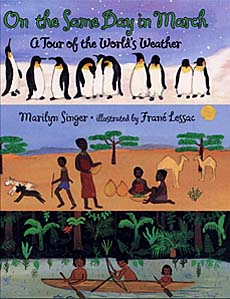
On the Same Day in March by Marilyn Singer is subtitled "A tour of the world's weather", but it's so much more than that. As the title suggests, Singer examines various areas in the world, and not only what the weather is like there, but also how people there are going about their day. Singer manages to capture in a few lines not only the spirit of a place -- Parisians sipping chocolat, for instance, or a family preparing for a storm in Australia -- but also the connections between disparate locales. While it may be raining in two different places, one is cause for celebration and one for delaying a trip, depending on the season in each location. There's a lot to look at and think about in this one, and talking about the weather leads to many more topics, like the way people live in various parts of the world. An author note at the back also does a great job of explaining how seasons come about - an added bonus for teachers.


Kids love interactive books. The lift-the-flap title While You Are Sleeping by Durga Bernhard is an excellent choice for introducing the concept of time around the world to even the youngest kiddos. With simple text, the book begins with a Native Alaskan family reading at night, while in Nigeria, when we lift the flap, we see someone else getting dressed. From Nigeria we move to Japan, and on and on, reinforcing the idea that when it's one time where you are, around the world someone else is moving through a different part of their day. Visually this is just terrific, with each new scene depicted in an inset against a larger map showing the location. Since Sprout's a map guy (he has a big world map on the wall in his room and loves to just look at it), he was especially taken with the back endpaper, a global look at timezones that is colorful and intriguing. This creative and diverse title is an excellent addition to any classroom or library shelf. Don't miss it!

What are your favorite titles for building global citizenship? And how do you help your kiddos make the connection between themselves and the world around them?

Thursday, November 15, 2012

30 Days of Picture Books - The Quiet Book and The Loud Book by Deborah Underwood

Wow, the month is halfway gone - it's Day 15 of Picture Book Month, if you can believe it! We've had such a great time sharing books with all of you. It's been the perfect excuse for us to bring home stacks and stacks of picture books from the library (not that we really need another reason. . . ). And remember, we'd LOVE to hear what your favorite picture books are - connect with us by leaving a comment here, or visiting us on Facebook or Twitter to share!


Tonight is a two-fer, because you can't really read one of these books without the other. I'm speaking of the phenomal picture books by Deborah Underwood, The Quiet Book and The Loud Book, both illustrated by Renata Liwska.  If you haven't seen these books, I highly recommend that you get your hands on both at one time. It's so much fun to compare the situations that the adorably kid-like woodland creatures get themselves into. This is how you teach opposites, with books that go beyond "up" on one page and "down" on another, and best of all don't take themselves too seriously!

Somehow "quiet" and "loud" never get a fair shake in that sort of book, but here both extremes are given their own space to be just what they are. I love that Underwood has so many ways to illustrate each state of being. She really goes far beyond the basics to help kids understand not only what is loud, but why it might be that way. For that reason, I recommend these titles for preschoolers rather than toddlers. Underwood's complex scenarios might be beyond the scope for littler ones, who aren't likely to understand "spilling your marbles in the library loud", whereas an older child will identify all too well. Really many of the jokes are ones that parents appreciate best (how about "too many bubbles quiet", featuring a bewildered bunny in an overflowing tub).


With Sprout we have fun looking at the pages and guessing why the character might be quiet or loud, as the case may be. Liwska's illustrations just tickle him, mainly because she captures the expressiveness of the characters so convincingly. And really, in these two books, there is the perfect marriage of text and illustrations - both are strong, but together, the artforms make for a pretty wonderful picture book experience.

I just asked Sprout which of these books he likes better. His response? " The Quiet Book for school, 'cause they want you to be quiet there. And The Loud Book at home, 'cause here it's great to be loud!"

The Quiet Book and The Loud Book by Deborah Underwood, published by Houghton Mifflin Books for Children 

Friday, November 9, 2012

30 Days of Picture Books - Red Sings from Treetops by Joyce Sidman

It's Day 9 of Picture Book Month. Today we're thinking about the senses. Picture books are an incredible way to teach kids about the different ways we interact with various stimuli in our environment. Seems a bit strange, though, right? How in the world can we exercise the five senses through picture books? 

It's true that unless you have a touch-and-feel, scratch-and-sniff book you're not going to have those senses engaged while you're reading. But, I would argue, using picture books as a vehicle for experiences with elements in the real world is a powerful means to not only emphasize senses like smell and touch, but also to find ways to yet again connect literacy with life. You can do this through a series of planned activities (like all those awe-inspiring Pinterest moms do), or very simply through thinking and talking about the books you read. Choose books that emphasize certain characteristics, then as you're out running errands or playing on the playground, look for elements that were represented in your storytime choice.


Today's choice is an amazing one for connecting all five senses via the written word. Joyce Sidman's Red Sings from Treetops: A Year in Colors might seem like it's all about visual stimuli, but one read-through will show you how Sidman engages all our senses through her beautiful poetry. Like this snippet, from the section about fall: "Red splashes fall trees, seeps into every vein of every five-fingered leaf. / Red swells on branches bent low. / Red: crisp, juicy, crunch!" Reading this, we can not only see the scene Sidman describes, but we can feel it, hear it, taste it. And if you want to bring this alive with your little one, follow up this reading by a trip to the apple orchard. As you pluck a juicy piece of fruit off the tree, remind your kiddo that red tastes "crisp, juicy, crunch!". Then you can talk about how red sounds, how it smells, how it feels. Suddenly colors are more than just colors, they are phenomena that engage all the senses.

I'd be remiss if I didn't talk about Pamela Zagarenski's whimsical illustrations that accompany Sidman's poems. Each segment of the book features a season, and Zagarenski adapts her mixed-media paintings to bring the color described to vivid life. She conjures up a summer breeze on the dock for yellow ("Yellow melts everything it touches. . . smells like butter, tastes like salt."). She gives us winter green in frosty evergreens ("Green darkens, shrinks, stiffens into needles."). And in spring, as colors burst forth everywhere, she shows us white highlights ("White can be quiet, too: delicate petals filled with light smell white."). Simply gorgeous imagery, words and pictures alike.

If you want reading to be the more than just a bedtime ritual, help your little one make connections with what you read and what they hear, smell, taste and touch. When we do this, we're building readers whose imagination takes them far beyond the printed words on the page, into pictures of their own devising. And who knows where that influence will stop?

Red Sings from Treetops by Joyce Sidman, published by Houghton Mifflin Books for Children

Monday, July 30, 2012

Picture Book Review - Black All Around by Patricia Hubbell

Sprout recently started a new preschool, and among other things that they did his first few weeks was color mixing. These brave souls actually took it on themselves to present a bunch of preschoolers with paint colors and allow them to try mixing different shades to see what the result was. Wow, did this ever make a BIG impression on Sprout. Though he's heard a few books about the topic (most notably The Color Kittens by Margaret Wise Brown and White Rabbit's Color Book by Alan Baker), he's never seemed too interested. But give the child a bunch of colors to mix himself and the boy was talking about it nonstop.

Lesson for mommy: more hands-on art stuff at home, in spite of the mess.

Anyway, this got us talking and thinking more about colors. One of the things Sprout mentioned frequently was that when you mix up a bunch of colors, you always got black. "Just black, Mama," was how he put it. Black's a color too, I told him, but he seemed unimpressed -- and kept telling me that his favorite color is orange. Of course I felt I needed to think of a way to convince him that black is a pretty awesome shade on its own.


Luckily, there's a book for that: namely, Patricia Hubbell's Black All Around. In this fun color story, a young girl begins looking at the world around her and noticing all the places she sees the color black. It's in animals - a horse, a cat, beetles, labradors. It's in music - piano keys and clarinets. It's in the environment - fertile dirt, tree trunks, the night sky. And it's in her family - "Daddy's arm, Momma's cheek." (Of course, that last example is arguably more brown, but it's a cultural construct.)

What she notices is that there are all kinds of shades of black, and all kinds of places to find the color. I love the sense of play that's brought to the topic. You'd think a book about the color black would have a mostly dark palette, but illustrator Don Tate (who we love from Ron's Big Mission and Summer Sun Risin') brings in gobs of spirited color. While the family plays with finger puppets (black birds, goats and bunnies), Tate sets the scene against a backdrop of light walls and colorful clothing choices. The effect is that the richness of the black objects really shines through, and little ones will see black in a whole new way. No way is it boring, black's got personality!

For kids who are just beginning to think about color, this is a good introduction to the topic. No, Hubbell never dives into the either-or skin color issue, and her purpose doesn't seem to be solely racially centered. Instead, this is more of a celebration of black, a way for young children to begin noticing the shades of black and to internalize a positive message. And in a world where villains wear black and phrases like "black sheep" or "blackmail" are common, it seems to me that turning the negative connotations around has tremendous value.

And after reading this one, you'll have a new appreciation for the way the color black enriches our world!

Black All Around by Patricia Hubbell, published by Lee & Low Books
Ages 2-6
Source: Library
Sample: "Look high, look low, look everywhere. . . . The wonderful color black is there! / Sleek and jazzy, warm and cozy. Beautiful black, black all around. . . "
Recommended

Wednesday, June 20, 2012

Wayback Wednesday - Freight Train (1978)

Not quite sure how, but I entirely missed Donald Crews' books growing up. I remember seeing the cover of a few (most notably Ten Black Dots and Truck) but can't ever recall cracking them open. It's odd, because Crews received the Caldecott Honor twice in the late 70's and early 80's, so you'd think he would have been on every elementary teacher or librarian's must-read list. But then again, maybe he was, and his books were just being pored over by all the other kids in my class, as I was curling up with Bread and Jam for Frances. It's hard to say.

In any event, it wasn't until I had Sprout in my life that I came to encounter Donald Crews in a meaningful way. And that, of course, was due to this week's Wayback Wednesday read, Freight Train.


Longtime readers of this blog may remember that Sprout is a bit of a train nut. Okay, he's obsessed, really. Anything and everything trains delights him, and hardly a visit to the library goes by without us bringing home a book or two about engines of some sort. Freight Train was one of the first we read together, and he found it himself, so it has a special place in our heart.

The text is deceptively simple - just 55 words -- but each one is carefully chosen and set into its place like a jewel into a setting. And the illustrations are just as impactful. At first they appear simple, and they are, but the stylized images capture the spirit of a freight train through every single spread. Sprout loves it when the train speeds up, and I have to admit that the "Moving" images are pretty spectacular (check them out for yourself - you'll be amazed at the way Crews perfectly articulates the image of a speeding train). And there's so much more here too: colors and opposites (light/shadow), different types of cars and their placement in the train itself. The more you look at this phenomenal piece of art, the more you'll see.

In creating Freight Train, Crews has said he was inspired by his own childhood experiences riding the train from New Jersey to Cottondale, Florida. His memories no doubt helped evoke the graphic style that characterizes this work, and which makes it so visually appealing to even the youngest children. Crews went on to write other similarly themed picture books, and to collaborate with his wife, the author/illustrator Ann Jonas. His work remains vivid, bold, and relevant to children everywhere. Their daughter Nina Crews has carried on the family tradition, producing some amazing works of her own, which we love for their multiracial families and themes.

Believe me when I tell you that Sprout goes nuts for this book every single time he sees it. In fact tonight, he came in from playing outside to find me writing this blog post and insisted we had to read it right away. If that isn't high praise, I don't know what would be.

Wayback Wednesday verdict? A true classic.

Freight Train by Donald Crews, published by Greenwillow Press
All ages
Source: Library
Sample: "Moving in darkness. / Moving in daylight. Going, going...gone."
Highly recommended