A little tip for all those folks who have emergent readers in your house -- don't box up the board books just yet. You may have felt like you could move on from these super-simple titles once your little one entered grade school, but the truth is that board books are perfect for kids just learning to read. The pictures are simple, giving lots of clues to support the interpretation of text. And the words tend to be manageable as well, with plenty of repetition and catchy phrases that inspire emergent readers. Plus your kids will be proud as punch to read some of their "baby" books on their own!
I was reminded of this as I sat down to blog about tonight's pick, Where's Lenny? by Ken Wilson-Max. Sprout wandered in, delaying his trip to the bath, and began immediately to puzzle through this cheery picture book. Though not a board book per se, the paper style and trim size definitely lend themselves to the youngest set. But Sprout was lured to it by the bright colors and that cover photo of Lenny, which made him want to read the book for himself. And really, who wouldn't want to read about this adorable chap?
Where's Lenny? features a game of hide-and-seek between the title character and his dad. The game takes the pair all over the house, encountering the dog, the goldfish and even Mummy. Lenny is clearly delighted to be leading his father on a wild goose chase, and the more Daddy guesses wrong, the more fun the sturdy toddler is having. At long last, Daddy and Mummy join forces and find their boy hiding under a blanket. And the escapade ends with a good bunch of cuddles, and some tickling for good measure. So fun!
Where's Lenny? is just one of several Lenny adventures by Wilson-Max. I love these titles because they include a multiracial family - it's always great to find books with parents of two different races, especially when the titles are as fun and upbeat as the Lenny books. Colorful and happy, these titles are a pure joy to read. Once you've read one, you'll be on the lookout for the rest!
Where's Lenny? by Ken Wilson-Max, published by Frances Lincoln Children's Books
Ages 2-5
Source: Library
Look for Lenny Has Lunch, Lenny in the Garden, and Lenny Goes to Nursery School too!
Showing posts with label board book. Show all posts
Thursday, January 15, 2015
Tuesday, November 25, 2014
30 Days of Diverse Picture Books - Snug by Carol Thompson
It's Day 24 of our 30 Days of Diverse Picture Books. I'm struggling today, in the wake of the Ferguson grand jury non-indictment. My heart is heavy for my son and for all the sons and daughters of Black America. But we press on, working for justice, inclusion, representation, equality. So, diverse books - because that's where my hope lies, for the next generation to change this world.
Tonight's pick is a gentle one, because that's what my spirit needs right now. Snug by Carol Thompson is a board book, one that seems the kind of book that a toddler would seize on and need to have read over and over. It makes me a little sad that Sprout's outgrown these types of books - time was, he would have obsessed over Snug, I'm pretty sure. But it's definitely something I'll be giving to friends for their little ones, because it's not only sweet but very inclusive.
With Snug, Thompson describes the snugness of various things in nature, starting of course with the bug in the rug, but then branching out to include a bulb deep in the earth, a mouse in a house, even a slug in the mud (why not?). Thompson juxtaposes the images of nature with adorable chubby-cheeked kiddos exploring the world, whether that's burrowing under a quilt or digging in the soil. And the pictures show a range of ethnicities and genders, plus even abilities, with one girl in a wheelchair. Love!
Check out Snug if you want a simple and sweet title for bedtime with your kiddo. And hold them close as you read it, just as I'll be holding my kiddo tonight.
Snug by Carol Thompson, published by Child's Play
Sunday, November 9, 2014
30 Days of Diverse Picture Books - I Know a Lot! by Stephen Krensky
It's Day 9 of our 30 Days of Diverse Picture Books. What's your favorite thing about picture books? At the top of my list has to be the closeness that they engender. When you read a picture book to a young child, you are building memories and relationships that will last a lifetime.
Tonight's pick is a board book that I absolutely love -- I Know a Lot! by Stephen Krensky. I first saw this title on a cart of new materials at work; the cover jumped right out at me, for the colors and retro feel as well as the adorable braided girl on the front cover. Sara Gillingham did the illustrations and they are terrific, the feel of classics updated for a new generation.
The other thing I really love about I Know a Lot! is the confidence-building aspect. The heroine is a preschooler, and she's proud of what she knows, sharing many facts with readers as she goes through her day with family and friends. Krensky works in opposites and other concepts quite cleverly, for an added bonus. And the diverse cast plus comforting rhythms of the text make this a winner for babies on up through preschool.
Put I Know a Lot! in a bin or on a shelf at eye level and little ones will be reaching for it every time. Look for more in Krensky and Gillingham's Empowerment Series (I Am So Brave! is another favorite of ours) for high-quality board books you and your kiddos will adore!
I Know a Lot! by Stephen Krensky, published by Abrams Appleseed
Tuesday, November 4, 2014
30 Days of Diverse Picture Books - Good Morning World by Paul Windsor
It's Day 4 of our 30 Days of Diverse Picture Books. It's been quite blustery here in Northwest Washington, and a lot darker thanks to the time change this past weekend. Which means we are all quite content to settle in with a good book in the evenings -- the best part of late fall!
Tonight's pick is Paul Windsor's Good Morning World, a knockout title that celebrates the Native cultures of the Pacific Northwest, specifically Native Canadians. And it's a board book, so perfect for sharing with the littles!
Windsor writes that his book was created to share good energy and help kids (and adults) with a positive attitude, connected to the world around them. The artwork is stunning, really breathtaking. Windsor is tribally enrolled in the Haisla and Heiltsuk tribes, and his illustrations honor his ancestors with images that are vibrant and alive.
There's a playful spirit to Good Morning World that young readers will pick up right away. From the beaver building his dam to the frogs leaping in the pond, all creatures have a smiling sun looking down on them. This is a terrific pick to emphasize our relationship to the earth and to one another. Good Morning World is a small-press title, so may be a little tougher to find - but definitely worth looking for to bring diversity to even the youngest readers.
Good Morning World by Paul Windsor, published by Native Northwest
Thursday, April 3, 2014
Color Your Bookshelf: 39 Diverse Board Books to Give a Baby or Toddler
I'm of the strong opinion that books are some of the best gifts to give families adding a new member. Onesies and diaper bags are all fine, of course, but books lay the foundation of early learning that rewards a child for his or her entire life. Also, books are a great choice if the child isn't a newborn. Sprout came into our family at 12 months old, and so it was hard to judge just what he needed, but the board books we got as gifts still occupy a prominent place on his bookshelf.
Generally I just do single-title reviews here on the Bookshelf, because I think each title is a gem and should shine all on its own. But I'm breaking with tradition to come up with this list of titles that make a perfect gift for anyone adding a baby or toddler to their family. Please note: these are NOT book recommendations solely for children of color. White kids need these books too. I cannot stress this enough. If we're going to raise global citizens, if we're going to foster inclusion and tolerance, we've got to start diversifying every single child's bookshelf. And we need to do that from day one.
So - on to the list!
First up is one Sprout adored as a baby himself, and which we've given to several families -- Global Babies by the Global Fund for Children. Babies love to look at other babies, so this is a sure-fire hit. We received two copies of this when Sprout came home, and it's a good thing because we've worn both out! Also look for other Global Fund for Children titles: Global Baby Girls and American Babies.

Another pair of titles Sprout read a lot as a toddler are the board books Whose Knees Are These? and Whose Toes Are Those? by Jabari Asim. Bright and cheerful, with colorful graphics, these simple titles speak directly to a young child's interest in his/her own person. And, they are super fun to boot. I can still quote chunks of this: "knees like these don't grow on trees!" Also fun are Asim's Girl of Mine and Boy of Mine -- all are illustrated by the incomparable LeUyen Pham.
We recently read Anna McQuinn's new book Leo Loves Baby Time, the companion to her series featuring African American toddler Lola and her little brother Leo. (It isn't a board book, but does have reinforced pages for small kiddos.) Though he's a little old for it now, Sprout loved revisiting these favorite characters and seeing Leo in the starring role in McQuinn's comforting and happy title. Lola at the Library is available in board book form, and we read it nearly every week, either before or after our Friday visit to stock up on books.
Cheryl Willis Hudson did a few terrific board books several years ago, and I'm glad to see they are still in print for families and libraries to add to their collections. Good Morning, Baby and Good Night, Baby deal with routines familiar to any little one, and it's nice to see African American kids in the main roles here. These are solid stories likely to earn a central place in your read-aloud routine. Also look for Let's Count, Baby and Animal Sounds for Baby, in the same series but maybe a little harder to find.
Two new books that are widely available, and which we just adore, are both written by Mary Brigid Barrett. Pat-A-Cake and All Fall Down sound like they are based on the familiar rhymes, and while there are some similarities, Barrett has put an entirely new spin on things. These are breezy, easy reads, bound to capture -- and keep -- the attention of a toddler. Oh, and if those illustrations look familiar, it's because the artist probably is: LeUyen Pham, whose work I was just raving about a little bit ago.
Another recent title that is a real visual treat is Julie Morstad's take on the poem The Swing by Robert Louis Stevenson. I have a soft spot for this poem, it being my particular childhood favorite from Stevenson's A Child's Garden of Verses. Morstad has reimagined this verse and set it in a classic format, depicting a gaggle of children experiencing the swing in various venues. I love that the diversity is woven so seamlessly into this quietly striking title, never feeling forced or premeditated, just natural, as all kinds of kids do love to swing!
Free Spirit Publishing has produced the "Happy Healthy Baby" series of board books by Elizabeth Verdick and Marjorie Lisovskis. Each one works well on its own, but giving the whole series to a family would be so much fun. Sprout and I read Reach, all about babies engaging with the world by reaching out. He liked seeing the pictures, which are striking black-and-white photos of babies of various ethnicities. The series also contains Eat, Move, and Cuddle, and every entry looks even cuter than the one before.
Little Scholastic did a line of board books a few years ago that are nicely diverse. We bought Welcome Fall for our bookshelf before Sprout joined our family, and he was pretty much obsessed with it for quite a long while. The series includes books for each season (Welcome Spring is a nice one too), books on manners like Please and Thank You and Uh-Oh! I'm Sorry and informative titles like My Body. There are interactive components in most of these titles, which really adds to the enjoyment for babies and toddlers.

A colleague recommended Karen Baicker's books to me, and they were among the first we checked out of the library, before Sprout was totally ready to handle books with paper pages. I Can Do It Too! and You Can Do It Too! stand alone just fine, but work quite nicely together. The illustrations by Ken Wilson-Max bring these titles to life, and the gentle reassurance of the message is a nice identity boost for all children.

Roberta Grobel Intrater wrote a series of board books called Baby Faces, and they are just about as cute as can be. The photos are gorgeous, clear and bold to draw the attention of little ones and keep it. Most libraries have these (or should - suggest if your library doesn't!) and I've seen them in many bookstores as well. We've read and loved several, including Splash!, Smile!, and Peek-A-Boo!, and there are quite a few more. A couple of these books, plus some small toys and a onesie, would make a terrific basket for a new baby.

Rachel Fuller is another author/illustrator who has done several board books with diversity. Each title is bright and colorful, just the thing for stimulating a young child's curiosity in books. The stories are simple enough that kiddos won't get lost, which is a nice feature of books like these that truly are written to be board books. Most of the titles are geared around the addition of a new sibling, so they can work for kids of varying ages, something not all board books do well. Among the titles: Look at Me!, Waiting for Baby (multiracial family in this one!), and You and Me.

We were fortunate to get some really terrific board books as shower gifts, some of which we still read together almost four years later. Among these was Susan Meyers' Everywhere Babies, illustrated by Marla Frazee. (This is available in a hardcover edition or board book - you can't go wrong either way, I promise you.) I adore the way Frazee incorporates diversity seamlessly into almost every one of her books, and this is no exception. Little ones will love looking at all the babies, and the sweetly sentimental text will appeal to their grownups as well.
No diverse bookshelf is complete without books by Helen Oxenbury. Her delightfully chubby babies and toddlers make the perfect complement to her simple phrases and plots. We loved so many of her board books when Sprout was younger, and even now I can quote large swatches of text from some of them. Ten Little Fingers and Ten Little Toes was a gift from a sweet friend, a total classic that we read every night during bathtime. Say Goodnight, Clap Hands, Tickle Tickle, All Fall Down-- all of these are fabulous and bound to become part of a baby's daily book time.
You can't go wrong with any of the titles we've compiled above, so add these and other diverse titles to your gift list for new families. What are your favorite multicultural books to read with a baby or toddler?
Tuesday, March 11, 2014
I Am Latino: The Beauty in Me by Sandra L. & Myles C. Pinkney
Well hello again! Seems I took a bit of a blogging break the last couple of weeks, however unintentional. I've had a few other projects that have been taking up my attention. But no matter what, we're still reading, so I've got plenty of books to share.
Increasingly we're finding chapter books really capture Sprout's attention -- and yet, we still manage to check out the same huge load of picture books from the library, which thrills me no end. I honestly don't want to be one of those parents who pushes their child toward "serious" reading or toward one format of books over another. As I've shared before, Hubs grew up being not much of a reader, until he discovered graphic novels, and those have been his "gateway drug" into other forms of literature. So I happily check out whatever random pile of books catches Sprout's fancy on any given day, being sure to include a few of my own picks, however surreptitiously.
One thing I always try to do with our library selections is inject a good mix of diversity into our choices. No surprise there, right? But it does take work to make your bookshelves reflective of the world we live in -- because of course the titles that get the most press are those that make up the prevailing bulk of mainstream publishing, and that means white, white, white. So we all have to dig a little deeper and see what we can find to add some color to our reading selections. Fortunately, if you do look, it's possible to be rewarded with some excellent diverse kidlit without much effort.
One tip I like to share with parents and teachers is to find an author you like and then explore his/her catalog -- often writers who choose diverse subject matter or who populate their books with characters of color do so intentionally and thoughtfully, and their body of work usually demonstrates that. Today's book is one I came across because we've loved the previous collaborations by Sandra and Myles Pinkney. I Am Latino: The Beauty in Me doesn't disappoint, either -- it's every bit as stunning as their book Shades of Black, which is one of our all-time favorite titles.
In I Am Latino, the Pinkneys again turn their attention to a specific part of the population with a joyful celebration of the uniqueness of Latino people and culture. Framed around the concept of the senses, Sandra's poetic verse calls out ways to "sense the beauty", from the melody of language to the rhythm of music to the richness of foods. Myles again illustrates this title with his evocative photography, showing a diverse section of Latino boys and girls in situations that accent the story. Sprout's favorite photo is toward the end, where a young boy is smelling a plate of empanadas. "I bet those taste so so good, Mom!" he exclaimed the first time we read this (Hubs and I assured him he was right on the money there!).
I love I Am Latino not only because it introduces kids who aren't familiar with Latino culture to some basic traditions, but also because it's an affirmation for kids who see themselves in these pages. Maybe they see the food their grandmother makes or have a family photo that resembles one in the book. Maybe they've never thought about what makes their heritage special, or maybe they've grown up with family members who keep them closely tied to their roots. It doesn't matter, really, because this title works on many levels for whoever is reading it. Ultimately, the Pinkneys' message through I Am Latino and their other books is that there's pride in heritage and being connected to your history. And also, that there's power in affirming the beauty we see around us.
You may not find I Am Latino readily available on your bookstore or library shelves. But take a little extra time to look for this one, regardless of your family background -- it's simple, strong and a great celebration of Latino heritage. This is a terrific title for even the youngest readers.
I Am Latino: The Beauty in Me by Sandra L. & Myles C. Pinkney, published by Little, Brown
All ages
Source: Library
Sample: "Use your senses. / You will see Beauty -- Magnificently / I am Latino. I am the Beauty!!!"
Recommended
Labels:
board book,
boys,
diversity,
family,
food,
girls,
Latino/a,
nonfiction,
picture book,
poetry
Friday, November 15, 2013
30 Days of Picture Books - Whistle for Willie by Ezra Jack Keats
Welcome to Day 8 of our 30 Days of Picture Books! It's a cold, wet November evening here in the Pacific Northwest, which to us just means a chance to curl up with a blanket, a kitty and a great book. We hope you have a chance to do the same!
Tonight's pick is an oldie-but-goodie that we've been reading since Sprout was a wee -- well, sprout. In fact, Ezra Jack Keats' books The Snowy Day, Peter's Chair and today's pick Whistle for Willie were some of the first books we added to our home library, when we knew we would be bringing home an Ethiopian boy. We felt then that it was important to surround our son with literary heroes and heroines of diverse backgrounds. And today, nearly 3 1/2 years later, we feel even more strongly about the subject, which you probably know if you've been following along here on the blog.
Whistle for Willie follows Keats' recurring character Peter in another urban adventure. In this outing, Peter is wishing he was able to whistle for his dog, Willie, like he sees another boy doing. While Peter's working on his whistling skills, he explores the neighborhood, then heads home for a little pretending. He decides it would be funny to surprise Willie by hiding and whistling - and after a couple of tries, he really does it! But of course Willie doesn't know Peter from a whistle, and he's plenty surprised at Peter's new skills, as are Peter's mom and dad. And in the final spread, on a trip to the store, Peter "whistled all the way there, and he whistled all the way home."
Keats absolutely nails the character of Peter here - rarely will you see a young boy so faithfully depicted, in his absolute randomness. I love the randomness of what Peter does when he's trying to learn to whistle, and I especially adore the scene with Peter and his mom, when Peter's trying on his dad's hat (no spoilers - you have to read the book to get it!). The collage technique Keats used for the illustration is just as fresh and exuberant today as it was when the book was published first in 1964. And best of all, there's a board book version available so even the youngest readers can have access to this bit of yummy way-back kidlit. (The set makes a great baby shower gift for boys or girls!)
Make your way to the library or bookstore and add this lesser-known Peter adventure to your kiddo's picture book stack ASAP. You'll be whistling too, in no time flat!
Whistle for Willie by Ezra Jack Keats, published by Viking
Monday, September 24, 2012
Library Find - Can You Hear the Sea?
The other day, I was headed back to my work area when something on a cart caught my eye. I should mention, in case you don't already know it, that I am privileged to work at the administrative center for a regional library system. The building I work in houses not only all the staff who support our system, but also shelves containing older titles and materials that are in transit to one of our library branches. Books are coming in and going out literally all day long. It is a bibliophile's dream and nightmare all at the same time. Small wonder my library card gets such a workout.
The story is set in an unnamed country in West Africa but the author's bio notes that she grew up in Ghana so it's not too much of a leap to think it was set there. The narrative explores the relationship between Sarah and her beloved grandfather. On a Saturday before he leaves, Grandpa gives Sarah a beautiful seashell; he tells her to hold it to her ear and listen closely, for she will hear the sea. Though Sarah knows that Grandpa would never lie to her, she can't hear the sound, no matter how hard she tries. Instead, each day of the week, Sarah only hears the sounds of the everyday world around her - the drums in church on Sunday, the monkeys in the trees on Wednesday, the honking taxis on Friday. But then Grandpa returns and shows Sarah just how to listen. And suddenly there it is, the sound of the waves on the shore and the roaring, rushing power of the ocean.
What I love about this simple story is all the layers it incorporates. There are the building blocks of learning, like the progression of the week which teaches about sequences and the passing of time. There are the vivid colors and multilayered illustrations, which stimulate young readers' senses. And then there is the emotional component, in which Sarah knows she should trust her grandfather but then begins to doubt his word. In the end, Sarah's trust is restored as she learns to listen, just as her Grandpa has instructed her. This reaffirms the bond between the two, and provides a gently reassuring ending to this sweet story.
Though I wish there were a few more cultural details - a further development of the setting and the use of culturally correct names or language terms - this is a solidly written and gorgeously illustrated story that will engage any child. Use with other West African stories like Jane Kurtz's In the Small, Small Night or Penda Diakite's I Lost My Tooth in Africa to build a unit about this diverse region of Africa.
Can You Hear the Sea? by Judy Cumberbatch, published by Bloomsbury
Ages 2-6
Source: Library
Sample: "On Monday, Sarah listened to her shell by the river as she and Grandma did the washing. But what she heard was. . . water splashing, Grandma beating out the sheets, and the clothes flip-flapping in the wind."
Recommended
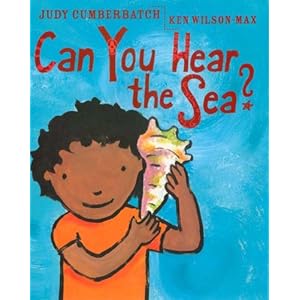
Anyway, right off I recognized the book in question as being illustrated by Ken Wilson-Max. Eons ago, before Sprout came into our family, our children's librarian recommended some titles she thought we might like (and she was spot on, by the way). Among them were Karen Baicker's I Can Do It Too! and You Can Do It Too!, both illustrated by Wilson-Max. Sprout loved both of these books from the first time we read them and they have been frequent revisits since. This new title, Can You Hear the Sea?, written by Judy Cumberbatch, appealed to me right off (don't let anyone tell you we don't judge books by the cover, we all do it). I was pretty sure Sprout would like it, and -- no surprise here -- he firmly declared it "really just good, Mama!"
The story is set in an unnamed country in West Africa but the author's bio notes that she grew up in Ghana so it's not too much of a leap to think it was set there. The narrative explores the relationship between Sarah and her beloved grandfather. On a Saturday before he leaves, Grandpa gives Sarah a beautiful seashell; he tells her to hold it to her ear and listen closely, for she will hear the sea. Though Sarah knows that Grandpa would never lie to her, she can't hear the sound, no matter how hard she tries. Instead, each day of the week, Sarah only hears the sounds of the everyday world around her - the drums in church on Sunday, the monkeys in the trees on Wednesday, the honking taxis on Friday. But then Grandpa returns and shows Sarah just how to listen. And suddenly there it is, the sound of the waves on the shore and the roaring, rushing power of the ocean.
What I love about this simple story is all the layers it incorporates. There are the building blocks of learning, like the progression of the week which teaches about sequences and the passing of time. There are the vivid colors and multilayered illustrations, which stimulate young readers' senses. And then there is the emotional component, in which Sarah knows she should trust her grandfather but then begins to doubt his word. In the end, Sarah's trust is restored as she learns to listen, just as her Grandpa has instructed her. This reaffirms the bond between the two, and provides a gently reassuring ending to this sweet story.
Though I wish there were a few more cultural details - a further development of the setting and the use of culturally correct names or language terms - this is a solidly written and gorgeously illustrated story that will engage any child. Use with other West African stories like Jane Kurtz's In the Small, Small Night or Penda Diakite's I Lost My Tooth in Africa to build a unit about this diverse region of Africa.
Can You Hear the Sea? by Judy Cumberbatch, published by Bloomsbury
Ages 2-6
Source: Library
Sample: "On Monday, Sarah listened to her shell by the river as she and Grandma did the washing. But what she heard was. . . water splashing, Grandma beating out the sheets, and the clothes flip-flapping in the wind."
Recommended
Wednesday, August 22, 2012
Wayback Wednesday - Peter's Chair (1967)
Some authors become so identified with a particular work that it sometimes is difficult to remember that they've done other titles as well. Take Maurice Sendak for example - author of a slew of amazing books, illustrator of tons more, and yet to many people he's remembered for just one book. An incredible book, to be sure, but not the be-all end-all of his literary life, no way.
Ezra Jack Keats is another artist that seems to have a similar association. To most people he's probably best known as the author and illustrator of The Snowy Day. And don't get me wrong, it's gorgeous and absolutely belongs at the tippy-top of every single recommended books list. It's one of our all-time favorite reads, so much so that a good friend gave Sprout this little cutie for his third birthday. But it's by no means the outer limit of Keats's talents, and it isn't even the only adventure to feature Peter, Snowy Day's precocious wanderer.
This week's Wayback Wednesday pick is Peter's Chair, the third Peter title (after The Snowy Day and Whistle for Willie - which we also love). We first read Peter's Chair together about a year after Sprout joined our family, and for many months one or the other of these three Peter books was featured in just about every night's reading rotation. Not only are these books visually appealing - Keats did, after all, win a Caldecott for The Snowy Day - but they are full of the stuff children love: dragging sticks in the snow, building towers, exploring the neighborhood. Keats's kids are real children, not wooden creations, and you can feel their boundless energy sparking off every page.
In Peter's Chair, Keats gives our hero a dilemma to face that many kids will relate to: feeling displaced after the arrival of a younger sibling. Peter's more than a little put out to discover that all his old furniture is being painted pink for his baby sister. First the cradle, then the high chair and crib, and next up is Peter's chair. But Peter's not going to let the chair fall victim to this lunacy, so he decides to run away, taking only the important things (his dog, some cookies and his toy crocodile - and the chair, of course). Is that not just the epitome of childhood decision-making? I love Peter's prioritizing! And naturally the running-away lasts until just about lunchtime. . . .
The story of the artist behind the stories is every bit as interesting as his work. Keats grew up very poor, during the Great Depression. Though his family was proud of him, they also worried that he'd never make a living as an artist. Fortunately Keats was a beneficiary of Roosevelt's New Deal policies, working as an artist through the WPA. This gave him his start as a painter, and he turned to children's books later in his career - some of his early work was illustrating the Danny Dunn books. Keats was not himself African American (he was Jewish, and changed his name to escape anti-Semitism), and some were surprised at his choice to introduce Black characters at a time when people of color were mostly relegated to the backgrounds of children's books, if they were even present at all. He was inspired to create Peter by a series of photos he saw in a magazine; those photos, Keats has said, caused him to wonder why he had never seen a Black boy as the main character in a children's book.
Peter's Chair, like the other marvelous books by Ezra Jack Keats, epitomize multiculturalism for me in that they are thoughtful, engaging stories in which race is not a central (or even secondary) theme. Instead the focus is on the nitty-gritty of childhood life: learning to whistle, running away, finding out that a snowball won't stay forever in your jacket pocket. Sometimes these are hard lessons, but in Keats's hands the learning is joyful, not jarring.
Tonight my son fell asleep with Peter in his arms, after we yet again read Peter's Chair. That, my friends, is the mark of good literature.
Wayback Wednesday verdict? Belongs on every child's shelf
Peter's Chair by Ezra Jack Keats, published by Penguin
All ages
Source: personal collection
Sample: "He saw his crib and muttered, 'My crib. It's painted pink too.' Not far away stood his old chair. 'They didn't paint that yet!' Peter shouted. / He picked it up and ran to his room."
Wednesday, June 20, 2012
Wayback Wednesday - Freight Train (1978)
Not quite sure how, but I entirely missed Donald Crews' books growing up. I remember seeing the cover of a few (most notably Ten Black Dots and Truck) but can't ever recall cracking them open. It's odd, because Crews received the Caldecott Honor twice in the late 70's and early 80's, so you'd think he would have been on every elementary teacher or librarian's must-read list. But then again, maybe he was, and his books were just being pored over by all the other kids in my class, as I was curling up with Bread and Jam for Frances. It's hard to say.
In any event, it wasn't until I had Sprout in my life that I came to encounter Donald Crews in a meaningful way. And that, of course, was due to this week's Wayback Wednesday read, Freight Train.
Longtime readers of this blog may remember that Sprout is a bit of a train nut. Okay, he's obsessed, really. Anything and everything trains delights him, and hardly a visit to the library goes by without us bringing home a book or two about engines of some sort. Freight Train was one of the first we read together, and he found it himself, so it has a special place in our heart.
The text is deceptively simple - just 55 words -- but each one is carefully chosen and set into its place like a jewel into a setting. And the illustrations are just as impactful. At first they appear simple, and they are, but the stylized images capture the spirit of a freight train through every single spread. Sprout loves it when the train speeds up, and I have to admit that the "Moving" images are pretty spectacular (check them out for yourself - you'll be amazed at the way Crews perfectly articulates the image of a speeding train). And there's so much more here too: colors and opposites (light/shadow), different types of cars and their placement in the train itself. The more you look at this phenomenal piece of art, the more you'll see.
In creating Freight Train, Crews has said he was inspired by his own childhood experiences riding the train from New Jersey to Cottondale, Florida. His memories no doubt helped evoke the graphic style that characterizes this work, and which makes it so visually appealing to even the youngest children. Crews went on to write other similarly themed picture books, and to collaborate with his wife, the author/illustrator Ann Jonas. His work remains vivid, bold, and relevant to children everywhere. Their daughter Nina Crews has carried on the family tradition, producing some amazing works of her own, which we love for their multiracial families and themes.
Believe me when I tell you that Sprout goes nuts for this book every single time he sees it. In fact tonight, he came in from playing outside to find me writing this blog post and insisted we had to read it right away. If that isn't high praise, I don't know what would be.
Wayback Wednesday verdict? A true classic.
Freight Train by Donald Crews, published by Greenwillow Press
All ages
Source: Library
Sample: "Moving in darkness. / Moving in daylight. Going, going...gone."
Highly recommended
Tuesday, June 28, 2011
Raised by Readers
Few things make a better gift for a child than a book, in my mind. Toys wear out, clothes are outgrown, gadgets wane in popularity. But a book is forever, in the sense that it opens the mind and the heart to new ideas, and for a young child provides an excellent opportunity for one-on-one time with an adult. The one gift my niece and nephews could always count on was a book, like it or not!
One friend in particular seems to have an innate knack for finding fun, engaging titles that also happen to celebrate diversity. We always get excited when a package comes from Miss Mary, because it is guaranteed to have great books inside! Even as I type this, Sprout and Daddy are reading our very favorite, Ten Little Fingers, Ten Little Toes by Mem Fox and Helen Oxenbury. We love this one for lots of reasons -- it's fun to act out (wiggling fingers and toes), it features illustrations of babies who are all kinds of cute, and it has the big finale, where Mama's baby gets "three little kisses on the end of its nose". Of course, we always plant three kisses on Sprout at the end, and he giggles in anticipation all through the book. What could be more fun? Such a great read-aloud!
Another gift from Miss Mary was, appropriately, Mary Had a Little Lamb by Jonas Sickler. This title is in the Indestructibles line of books, which are, as promised, darn near impossible for a baby to ruin. Seriously! Skip the fragile pop-ups and lift-the-flaps, or at least postpone them until your kiddo is read. T
For Christmas, Miss Mary sent us Whose Knees Are These? by Jabari Asim. Not only is this fun to read aloud, with its rhythmic text and creative premise, but it's also a true pleasure to look at. The chubby-legged boy in question is depicted legs-only in various poses, from lounging on a boat to marching up a stair, and everything in between. In the last spread the oh-so-adorable boy is revealed, grinning devilishly like he's really pulled one over on you. Sprout likes to point at it and say "Me!", and it actually does look a lot like him, especially that gleeful smile. I really love this one, and will be on the lookout for more titles by Asim as well as by illustrator LeUyen Pham (and check out Pham's website, if you want to see something really fun).
Sprout is fortunate to have several adults in his life who give books as gifts (this is what happens when your mom and dad are avid readers, and their friends are too). To my delight he is as thrilled by a new book as he is by a Thomas engine, and that's saying a lot. And we always welcome an addition to the reading rotation, as it usually comes just when we think we can't read Goodnight Moon one more time without losing our marbles.
One friend in particular seems to have an innate knack for finding fun, engaging titles that also happen to celebrate diversity. We always get excited when a package comes from Miss Mary, because it is guaranteed to have great books inside! Even as I type this, Sprout and Daddy are reading our very favorite, Ten Little Fingers, Ten Little Toes by Mem Fox and Helen Oxenbury. We love this one for lots of reasons -- it's fun to act out (wiggling fingers and toes), it features illustrations of babies who are all kinds of cute, and it has the big finale, where Mama's baby gets "three little kisses on the end of its nose". Of course, we always plant three kisses on Sprout at the end, and he giggles in anticipation all through the book. What could be more fun? Such a great read-aloud!
hese books can be bent, squashed, chewed, pulled, wadded up and drooled on (and don't think they won't be). I've found ours folded up at the bottom of the train bin and stuffed into the couch cushion, and you'd never know it. Oh, and did I mention? In this version Mary and her woolly little friend live in Africa! We like to point out to Sprout that the hut in the pictures is similar to those in the village where he lived. This is a great way to bring two cultures together. Also look for their version of Old MacDonald, whose farm is in Bolivia. Love it!
Every kid should be as lucky as we are, to have family and friends who value books and want to share them. If, as they say, it takes a village to raise a child, then a village full of booklovers is just who we want for Sprout. And we'll do the same for others.
Sunday, June 19, 2011
A Reading Dad
From my point of view, there's no more important way to encourage literacy in your kiddos than to model that behavior yourself. Kidlit blogger Jen Robinson of Jen Robinson's Book Page writes frequently and persuasively about the ways we can bolster literacy and the love of reading in little ones. In this post from 2008, she mentions modeling that behavior ourselves, and the importance of doing so especially for fathers. Jen says, "If the only people boys ever see reading are their mothers and their female teachers, it's very easy for those boys to absorb the message that reading is a feminine activity. But if even some of the time your son sees his father reading instead of watching television, that message goes a long way."
Another blog I love, Read Aloud Dad, not only hails the benefits of reading aloud, but also encourages dads to find ways to encourage their boys to read, especially. Not to slight girls, but let's be honest here: there does appear to be a cultural bias toward reading as a somehow "girlie" pastime (about which I strenuously object). Read Aloud Dad did a great interview with Pam Allyn (read the whole thing here) where she makes the case for meeting boys where they are, and reading what they want to read -- and especially reading it with them. So, not only do kids need to see us read, they need to hear it and be surrounded by it, in an environment that establishes the importance of reading in everyday life, not just for school or because we have to.
In Sprout's early days home, a major component of the bonding between father and son came about at bedtime, when Jake would hold him with a bottle and read to him. Mr. Brown Can Moo, Mike Mulligan and His Steam Shovel, Harry the Dirty Dog, Pajama Time. Some classics, some newer titles, most of which likely made zero sense to a one-year-old who'd never heard English before. But now those books stand out as some of Sprout's favorites, and the ones he goes back to again and again. And although both Mama and Daddy read to Sprout whenever he wants us to -- seriously, it's a drop-everything-and-do-it-now activity -- there are some titles that no one does just like Daddy. I mean, Mama tries her best, but she can't top Daddy's exuberance and suspenseful build-up for A Monster At the End of This Book. Not even close.
On this Father's Day, we'll be celebrating with family and spending time riding bikes and playing trains. But when bedtime rolls around, you know just where to find us -- all together, in one place, with our books.
As a mom I feel particularly blessed to have a husband who values literacy just as much as I do. But for his love of comic books, we may never have met in the first place, and so that common ground has formed a basis on which our relationship has been built. And before Sprout joined our family, we talked a whole lot about reading, and how important it is to both of us that our little man be exposed to concepts, ideas, thoughts, mindsets far beyond the reaches of our little burg -- realms he can only find between the covers of books.
Subscribe to:
Posts (Atom)