Showing posts with label Caldecott winner. Show all posts

Friday, November 22, 2013

30 Days of Picture Books - Joseph Had a Little Overcoat by Simms Taback

Welcome to Day 15 of our 30 Days of Picture Books! If you need to catch up, click the link to check out the whole list on Pinterest - and while you're there, you may find one or two other boards that seem timely, help you build a booklist or just make you smile!


Tonight's pick is one that I first read a couple of years ago when I was taking a children's literature class for my degree. I was ridiculously excited to take that class, for lots of reasons, but one of the big things that tickled my fancy was a HUGE assignment I'd heard about. My prof had us gather the Caldecott winners from each year the award was given (or Honor titles, if need be) and then analyze the developments in art and style from the first to the last. Holy cooooow, was that ever a lot of work! And you should have seen the stacks of books on our kitchen table! But it was also very informative and made me examine not only picture book art but the relationship between art and text in a more synergistic fashion. (Hmmm, I think I might have ripped that sentence right out of my paper. . . )

Anyway, Simms Taback's Joseph Had a Little Overcoat was one of the titles that stood out to me for the way the creator married innovation and plot. The book uses a technique of die-cut holes that overlay a page - the view changes depending on if you're looking through the die-cut from the front or the back. I know that probably doesn't make a whole lot of sense, but trust me, it's pretty ingenious. Kids will be flipping the pages back and forth to see the trick (heck, that's what I do every time I read it!).

That little bit of inventiveness works just perfectly with the story Taback is telling. Joseph has an overcoat, but it's riddled with holes. So, rather than waste the fabric, Joseph uses his tailoring skills to turn it into a jacket. When the jacket wears out, it becomes a vest. On and on it goes, until at last, Joseph has nothing left - but our creative hero is even able to make something out of that. At the end, Taback explains in an author's note that the story is based on a Yiddish folk song he enjoyed as a child, which is a nice nod to culture and adds some depth to the work as a whole.

This is a great example of a cumulative tale, and it makes a great read-aloud, as listeners try to guess what it is Joseph's going to create next. The lessons are pretty terrific too -- do with what you have, celebrate life, enjoy your family -- all values we're interested in passing on to Sprout, wrapped up in an interesting, visually bountiful package. Taback knows how to work with the tools of his trade, mixing color, texture and perspective to present a world that's lively and inviting. I can see this used in a classroom or library as a springboard to a child's own creative adventure.

Head out to your library or bookstore and pick this one up as soon as possible. Taback's created a modern classic here, one that's sure to survive not just because of the gold seal on the cover, but because of the jewels wrapped within.

Joseph Had a Little Overcoat by Simms Taback, published by Viking

Tuesday, November 6, 2012

30 Days of Picture Books - A Sick Day for Amos McGee by Philip C. Stead

It's Day 6 of Picture Book Month, and I must be in an emotional frame of mind because when I reread today's choice in preparation for this post, the first word that popped into my head was love. Love and books are kind of inextricably entwined for me personally - not only do I adore books, as you all know, but the experience of reading has long been linked with love. It's the love of a small child curling up with a beloved adult and listening to a story, or the quiet contemplation of a lazy day reading with a sweetheart. Love and books, love of books: call it what you will, it's magic.

As a mom, I think one of the important vehicles I have to show love to Sprout is by making time for special connections with him. We connect in lots of ways, of course, but I especially adore the end of the night. He's freshly bathed, snuggly in pajamas with his favorite stuffies and blankets. I'm winding down from a manic day and taking a quiet breath to be with my kid. We share news of the day, read stories, and then I sing him to sleep. It's my way of saying, with words and with actions, how much I love him.


You'll probably pick up on the thread of love in this book too -- it's A Sick Day for Amos McGee by Philip C. Stead. Amos McGee is a zookeeper, and he's a man of predictability. Same breakfast every day, same route to work, same ways to gently connect with his friends at the zoo (which include a chess-playing elephant and an owl who's scared of the dark). All is right with everyone's world because you can count on Amos. But one day Amos doesn't show up. His animal friends are worried, naturally, so they set out to find out what's wrong. And they end up doing for Amos all the things he does for them, making his day just as perfect as a sick day can be.

I promised myself at the outset of this project that I'd try to emphasize hidden gems. Amos McGee certainly isn't one of these, since illustrator Erin E. Stead won the Caldecott for it. But oh my stars, is it ever a fantastic book! The story is pitch-perfect, not a word wasted or out of place. And the illustrations are impeccably, achingly skillful. Every line of the rhino's brow shows us his character, every fold in Amos's uniform speaks of his dedication. If you love illustrations, you'll want to seek this one out and add it to your home library. It's the kind of volume you never get tired of. (Look for more of Erin Stead's amazing art work in Julie Fogliano's And Then It's Spring.)

Contrary to the sappy homily, if you love something, you don't set it free. You hold it close and nurture it, as do the characters in this elegant tale, and it'll make everyone all the richer.

A Sick Day for Amos McGee by Philip C. Stead, published by Roaring Brook Press

Saturday, November 3, 2012

30 Days of Picture Books - The Lion and the Mouse by Jerry Pinkney

It's Day 3 of Picture Book Month, and what's on my mind today is story. Sure, picture books are all about illustrations, but the story's pretty important too, right? Word choice had better be spot on in a picture book, nothing out of place because you're communicating a narrative all in the scantest of lines. I don't know about you, but if there are more than a few paragraphs on each page, I'm sure to have a restless little one on my hands, and then we're off to find another choice. So the first credo of picture book writers would seem to be choose your words carefully.

But what if you decide not to choose your words at all? I'm speaking, of course, about wordless picture books, something that might not immediately seem strong in narrative, but which have a hidden strength that goes beyond the written word. You see what's so great about wordless books is that you get to tell the story any way you want to. Kids love this - it's what they do, after all, as pre-readers when they sit down to "read" a book to their stuffies. And with the wordless picture book, adults get to experience that phenomenon too. The book's creator gives us the framework within which we can emphasize whatever aspects and nuance seem most significant to us.


In our home library, one wordless book in particular stands out, and for good reason - it's easily one of the best examples of the genre out there. I'm speaking of Jerry Pinkney's The Lion & the Mouse, a Caldecott Award Winner and all-around gorgeous piece of graphic storytelling.

The plot is of course based on the fable by Aesop, wherein a tiny mouse is captured by a lion who then, for whatever reason, lets the mouse go. And soon the lion finds himself in trouble, as he is ensnared by hunters - but the little mouse and his friends come to the rescue, chewing through the net that holds the lion and setting the mighty king of the jungle free. As in all fables, we have a lesson to take away: always perform an act of kindness when you have the opportunity, for you never know when you will need kindness in return.

In Pinkney's skilled control, the narrative becomes so much more. Honestly, if you're looking for visual splendor you couldn't do better. Even the end pages are a feast for the eyes, as we're taken immediately into the landscape of Eastern Africa, where Pinkney's version is set. Young readers will love poring over the detail of each page, noticing the curls in the lion's mane or the spiderweb clinging to a strand of grass. And they'll revel in the chance to tell you a story, if you let them - one time through is all most kids are likely to need before they want to relate the tale in their own words, a recounting that's never the same twice.

Linger over the experience of The Lion & the Mouse together, for it really is the kind of book you want to visit again and again.

The Lion & the Mouse by Jerry Pinkney, published by Little, Brown

Wednesday, August 22, 2012

Wayback Wednesday - Peter's Chair (1967)

Some authors become so identified with a particular work that it sometimes is difficult to remember that they've done other titles as well. Take Maurice Sendak for example - author of a slew of amazing books, illustrator of tons more, and yet to many people he's remembered for just one book. An incredible book, to be sure, but not the be-all end-all of his literary life, no way.

Ezra Jack Keats is another artist that seems to have a similar association. To most people he's probably best known as the author and illustrator of The Snowy Day. And don't get me wrong, it's gorgeous and absolutely belongs at the tippy-top of every single recommended books list. It's one of our all-time favorite reads, so much so that a good friend gave Sprout this little cutie for his third birthday. But it's by no means the outer limit of Keats's talents, and it isn't even the only adventure to feature Peter, Snowy Day's precocious wanderer.

This week's Wayback Wednesday pick is Peter's Chair, the third Peter title (after The Snowy Day and Whistle for Willie - which we also love). We first read Peter's Chair together about a year after Sprout joined our family, and for many months one or the other of these three Peter books was featured in just about every night's reading rotation. Not only are these books visually appealing - Keats did, after all, win a Caldecott for The Snowy Day - but they are full of the stuff children love: dragging sticks in the snow, building towers, exploring the neighborhood. Keats's kids are real children, not wooden creations, and you can feel their boundless energy sparking off every page.


In Peter's Chair, Keats gives our hero a dilemma to face that many kids will relate to: feeling displaced after the arrival of a younger sibling. Peter's more than a little put out to discover that all his old furniture is being painted pink for his baby sister. First the cradle, then the high chair and crib, and next up is Peter's chair. But Peter's not going to let the chair fall victim to this lunacy, so he decides to run away, taking only the important things (his dog, some cookies and his toy crocodile - and the chair, of course). Is that not just the epitome of childhood decision-making? I love Peter's prioritizing! And naturally the running-away lasts until just about lunchtime. . . .

The story of the artist behind the stories is every bit as interesting as his work. Keats grew up very poor, during the Great Depression. Though his family was proud of him, they also worried that he'd never make a living as an artist. Fortunately Keats was a beneficiary of Roosevelt's New Deal policies, working as an artist through the WPA. This gave him his start as a painter, and he turned to children's books later in his career - some of his early work was illustrating the Danny Dunn books. Keats was not himself African American (he was Jewish, and changed his name to escape anti-Semitism), and some were surprised at his choice to introduce Black characters at a time when people of color were mostly relegated to the backgrounds of children's books, if they were even present at all. He was inspired to create Peter by a series of photos he saw in a magazine; those photos, Keats has said, caused him to wonder why he had never seen a Black boy as the main character in a children's book.

Peter's Chair, like the other marvelous books by Ezra Jack Keats, epitomize multiculturalism for me in that they are thoughtful, engaging stories in which race is not a central (or even secondary) theme. Instead the focus is on the nitty-gritty of childhood life: learning to whistle, running away, finding out that a snowball won't stay forever in your jacket pocket. Sometimes these are hard lessons, but in Keats's hands the learning is joyful, not jarring.

Tonight my son fell asleep with Peter in his arms, after we yet again read Peter's Chair. That, my friends, is the mark of good literature.

Wayback Wednesday verdict? Belongs on every child's shelf

Peter's Chair by Ezra Jack Keats, published by Penguin
All ages
Source: personal collection
Sample: "He saw his crib and muttered, 'My crib. It's painted pink too.' Not far away stood his old chair. 'They didn't paint that yet!' Peter shouted. / He picked it up and ran to his room."

Wednesday, June 13, 2012

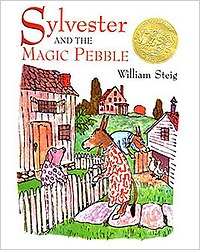
Wayback Wednesday - Sylvester and the Magic Pebble (1969)

William Steig may be more well-known for a certain big green ogre, but my personal pick from his oeuvre has always been the tale of a donkey whose wish turns out to have unexpected consequences. Sylvester and the Magic Pebble was published in 1969, when Steig was in his 60s; though he came to children's books late in life, he displayed an incredible sense of how to write and illustrate books that speak to children. Sylvester won the Caldecott in 1970, and it's easy to see why - the emotional depth and range that Steig brings to his characters in the text is multiplied exponentially through his deceptively simple illustrations.


Sylvester was actually challenged in 12 states due to Steig's depiction of the police as pigs, something that surprised me a bit since it's not an aspect that jumped out at me at any point in the reading of this picture book. But books have been challenged for a lot less, after all. In Steig's Caldecott acceptance speech, he said that "(a)rt, including juvenile literature, has the power to make any spot on earth the living center of the universe; and unlike science, which often gives us the illusion of understanding things we really do not understand, it helps us to know life in a way that still keeps before us the mystery of things. It enhances the sense of wonder. And wonder is respect for life." Really, I think that's the larger point of all Steig's work, porcine law enforcement officers notwithstanding.

The plot of Sylvester is a perfect marriage of the mundane and the magical. Sylvester is a young donkey in search of pebbles for his collection. He finds an unusual one on a particularly rainy afternoon; still holding the pebble in his hoof, Sylvester thinks, "I wish it would stop raining". To his great surprise, it does, instantly. That the pebble is magic can be of no doubt. Sylvester accepts it as easily as any reader will. And he rejoices in his find, until he stumbles upon a nasty lion with a hungry look in his eyes. Panicking, Sylvester wishes he was a rock, and, being that he's holding the pebble, he of course immediately transforms. And such is Sylvester's dilemma: as a rock, he cannot possibly reach out and pick up the pebble, in order to wish himself back to donkey-dom.

I brought Sylvester home thinking it would be new for Sprout but to my great delight he said, "Oh, Sylvester! I like this one, Mama." Turns out his daycare teacher reads it often, and he knew the entire thing practically (at least the action). At the part where Sylvester turns into a rock, Sprout very gently tapped the page and said, "He's in there, Mama. It's okay," as if to reassure me. We've read it just about every night for the past week, and I can honestly say that I think Sylvester himself magic - Sprout's fallen asleep during almost every reading, preempting the nightly pleas for "one more story" and "need a drink". Gold, Mr. Steig. Pure gold.

Sylvester's on the long side, so best shared with preschoolers on up. Littler ones will enjoy the pictures but might miss out on the subtleties of the story, of which there are many. There's more than a bit of pathos here as we watch Sylvester's distraught parents come to terms with their son's disappearance. That in itself could be hard for younger children to grasp, but they will pick up on the jubilation with which his parents greet Sylvester, once he is at last transformed back into his natural state. And that's one of the best scenes in the book, in my estimation - the sun shining forth with a brilliant burst of light, as Sylvester's father dances with glee and his mother embraces her beautiful boy. It's absolutely heartwarming.

Sylvester may have been written more than 40 years ago but its lessons are just as relevant today - that when those we love are lost, we mourn them deeply. And if we are fortunate enough for them to come back to us, we should throw ourselves into celebration that is joyful and complete. That's a powerful thing for all readers to consider. Well, that and if you're ever holding a magic pebble, for God's sake don't wish you're a rock.

Wayback Wednesday Verdict? Holds up nicely
Sylvester and the Magic Pebble by William Steig, published by Simon and Schuster
Ages 3-7
Source: Library
Sample: "He imagined all the possibilities, and eventually he realized that his only chance of becoming himself again was for someone to find the red pebble and to wish that the rock next to it would be a donkey. Someone would surely find the red pebble -- it was so bright and shiny -- but what on earth would make them wish that a rock were a donkey? The chance was one in a billion at best."
Highly recommended

Bonus: William Steig's Caldecott acceptance speech (and a letter expressing his trepidation at making such a speech) from Letters of Note