Showing posts with label award winners. Show all posts

Thursday, November 20, 2014

30 Days of Diverse Picture Books - Ruby's Wish by Shirin Yim Bridges

It's Day 20 of our 30 Days of Diverse Picture Books. The National Book Awards were presented last night, and I was thrilled to see Jacqueline Woodson take home the honor for her spectacular memoir Brown Girl Dreaming. It is seriously magnificent, people - review coming when Picture Book Month is at an end.


Tonight's pick is one that often ends up on best-of lists, and for good reason - Ruby's Wish by Shirin Yim Bridges, like Woodson's Brown Girl Dreaming, honors a connection to the past and all those who've paved the way for future generations. Bridges tells the story of her grandmother, Ruby, a little girl growing up in China during a time when education was the province of boys, not girls. Ruby loves the color red, and she loves to learn, even putting in extra hours doing her domestic tasks just so she doesn't have to give up her studies when all the other girls do. And her grandfather sees Ruby's dedication and rewards it in a way that's most unusual for girls of that time period.

Ruby's Wish shines with the pride and love a granddaughter has for her grandmother, a message that young readers will no doubt find inspiring. Sophie Blackall rendered the exquisite watercolors for the book, and her art captures the time and place beautifully, as well as providing a gentle backdrop for the relationship between grandfather and granddaughter. (That cover - just amazing, no?) Modern readers may be surprised to learn of the restrictions on education - it's a great way to talk about how those limits continue in many countries, and discuss what we as global citizens can do to help broaden education worldwide.

Ruby's Wish is a stand-out addition to any home or classroom library. Read it for inspiration and history, in equal measures.

Ruby's Wish by Shirin Yim Bridges, published by Chronicle Books

Tuesday, September 2, 2014

Talking with Kids about Ferguson: Recommended Titles on Race & Equality


It's been a heck of a few weeks, has it not? In addition to Sprout starting kindergarten today (wha???), which has taken up most of my free brain space, there's the situation surrounding the death of Michael Brown in Ferguson, Missouri. Events are continuing to unfold, but one thing is pretty clear to all involved - this was about far more than the death of one young man, tragic as that death may have been.

I have my opinions on this issue, and I'm betting many of you can guess where my sympathies lie. I'm not going to be debating the events in this space, however. It's a discussion that needs to happen, and I'm fully invested in that, but in other arenas. Instead, what I want to do today is share some resources for initiating a conversation about race and justice with the children in your life. That's where I feel change can begin - with talking openly about the history of our country, honestly looking at events that have transpired, and considering where we can go from here, as a nation and as individuals.

So, without further ado - my picks surrounding African Americans' struggle for civil rights, to help provide some context to discussing Ferguson in the classroom, library or at home:


1. Let's Talk about Race by Julius Lester - (Ages 4-8) Possibly my favorite book ever to discuss race and difference between people. Lester acknowledges that race is important, and an element in everyone's story, and explores why difference can divide, or bring us together. Critical for every classroom or library.


2. We March by Shane W. Evans (Ages 4-6) - a family participates in the March on Washington, showing the power of individuals joining together to make their voices heard. Great introductory piece for young children, with a nice afterword for further discussion.


3. Ron's Big Mission by Rose Blue and Corinne J. Naden (Ages 3-6) - a young boy is denied a library card because he is black - but Ron doesn't let it go, and stages a protest for the right to access the books he loves. Based on the true story of astronaut Ron McNair, this is one of the first books about race we read with Sprout, and he still remembers it.


4. Belle, the Last Mule at Gee's Bend by Calvin Alexander Ramsey and Bettye Stroud (Ages 5-8) - a fictionalized account of true events surrounding the drive to register to vote, and the fallout that happened when Dr. Martin Luther King Jr. was assassinated. This vivid title doesn't shy away from relating hard truths, but is beautifully done.

5. Sit-In: How Four Friends Stood Up by Sitting Down by Andrea Davis Pinkney (Ages 7-10) - At the core of the Civil Rights Movement is nonviolent protest, and the Pinkneys demonstrate that in action with their account of the 1960 protest at the Woolworth lunch counter. A tremendous example of the small acts of injustice that wore away at African Americans daily, and how they stood up to gain basic freedoms.


6. Through My Eyes by Ruby Bridges (Ages 8-12) - the firsthand account of a young black girl at the forefront of the movement to integrate public schools in 1960. The power of this first-person narrative draws readers in and provides plenty to think and talk about.


7. Freedom Walkers: The Story of the Montgomery Bus Boycott by Russell Freedman (Ages 8-12) - a nonfiction piece that explores the entire history of this pivotal moment in the Civil Rights Movement, giving context for the boycott and explaining how organized resistance brought about change. Illustrated with powerful photos, full of citations and additional reading suggestions.


8. Heart and Soul: The Story of America and African Americans by Kadir Nelson (Ages 9 up) - a stunning portrait of black history in the United States, covering the entirety of the stuggle for equality and acceptance. This should be required reading for all Americans, in my opinion - much of the history Nelson provides is often glossed over in regular history classes. Simply the finest title out there.


9. One Crazy Summer by Rita Williams-Garcia (Ages 9 up) - Set a little later than many of the other choices here, this novel brings to life the late 60's and the rise of the Black Panthers. By setting her story against that of three sisters reconnecting with their absentee mother, Williams-Garcia personalizes the events and helps readers see a different view of the much-maligned organization. (Even better on audio.)


10. Revolution by Deborah Wiles (Ages 10 up) - this novel, the second in Wiles's Sixties Trilogy, is densely populated with facts that underscore the fiction. Students of history will appreciate the many small threads that Wiles weaves into this story, set in Mississippi during Freedom Summer; the shifting perspective of white and black characters adds power to the narrative.


11. Claudette Colvin: Twice Toward Justice by Philip Hoose (Age 12 up) - Hoose's award-winning title recounts the true story of Claudette Colvin, a teenager whose refusal to move to the back of the bus preceded Rosa Parks's by several months. Colvin's actions were instrumental in the beginnings of the Montgomery Bus Boycott, but her story was mostly forgotten; Hoose corrects this wrong with a striking story of one girl at the epicenter of a vast political movement.


12. They Called Themselves the KKK by Susan Campbell Bartoletti (Age 13 up) - I've often wondered how an organization based on hate could get its start, and this book pulls back the curtain. This is a difficult title, so best for older readers - Bartoletti is unflinching in her examination of the cruelty and bloodshed that spawned this group, and I think this is an important read to understand not only Jim Crow and segregation, but also the roots of the Civil Rights Movement.


13. When Thunder Comes by J. Patrick Lewis (Age 12 up) - the struggle for civil rights is of course not confined to the United States. Here, with a powerful collection of poetry, Lewis brings voice to the leaders of civil rights struggles the world over, including many who are familiar and some that will be entirely new. An intensely personal volume, and one that will linger in the heart and mind of the reader.

In addition, here are some more resources for discussing civil rights, protest, inequality and the events both past and current:


Friday, July 18, 2014

Picture Book Review - Niño Wrestles the World by Yuyi Morales

A few weeks ago, I had the privilege of sharing a presentation on diversity in kidlit with a class of Early Childhood Education students. It was a serious honor to be asked to present, and warmed my heart to see all these future educators so excited about children's lit with diverse characters. The problem, though, was in choosing what books to share with them -- so many great choices, so little space (and time).


So I enlisted Sprout to help me pick, asking him what books we've read that he really liked. And among those he described was today's feature, the absolutely amazing Niño Wrestles the World by Yuyi Morales. I wasn't surprised that he mentioned this one, since we've had it checked out more or less nonstop since it debuted last summer. But I was a bit shocked that I hadn't blogged about it yet. Seriously, I had to check through the archives just to be sure!

Lo and behold, this one slipped through the cracks for us, I guess. Time to right that imbalance pronto. Because, my friends, Niño is one fantastically fun read-aloud and it deserves as wide an audience as it can possibly get. I mean, I dare you to read this one aloud and not collapse in a fit of giggles, just due to the sound effects alone.

The story follows our hero, Niño, who we right away discover is a pretty formidable wrestler in the lucha libre style of wrestling. Don't worry if you're not familiar with the concept - Morales has a very nice author note at the end that will answer your kiddos' questions about this type of wrestling. Suffice to say that lucha libre is pretty over the top, and that's exactly what our hero loves about it. Niño fights against all matter of crazy opponents and defeats them all handily, with plenty of awesome comic-inspired "whunks" and "zzwaps". But in the final measure, there is one pair of foes not even a fearless undie-clad hero can defeat -- his baby sisters!

I asked Sprout what he likes best about this one and he said "everything". I tend to agree. From the fast pace, to the zany opponents, to the colorful backdrops and sprinkling of Spanish phrases throughout, Niño is a total winner. . . even if he can't hold out against two little charmers (but who ever could?).

Niño Wrestles the World by Yuyi Morales, published by Roaring Brook Press
Ages 4-6
Source: Library
Highly recommended

Tuesday, June 24, 2014

YA Review - Yaqui Delgado Wants to Kick Your Ass by Meg Medina

I'm finally getting around to writing reviews of some of those incredible books I read during the 48 Hour Book Challenge a few weeks ago! (It takes me a while, sometimes.) Part of the reason is that I needed to process what I read - my goal during this year's challenge was to maximize my reading time, so I pretty much read straight through, with only a few stopovers on social media and other participants' blogs. And so it was one big happy blur of diverse titles, all of which I needed to digest a bit before I sat down and put fingers to keyboard.

But I definitely don't want to forget about these books, so on with the reviews. First up is a teen pick, Yaqui Delgado Wants to Kick Your Ass by Meg Medina. This one caught my attention when it won the Pura Belpre award last year, and kept my attention when it started being challenged for various reasons. (I kind of secretly love when a great book is challenged, because what is a more sure-fire way to guarantee that teenagers read something, than to tell them not to?). So of course I knew this was going to be a 48 Hour Book Challenge title for me, and I'm so glad I included it with my list.


The story begins when Piddy Sanchez finds out that "Yaqui Delgado wants to kick your ass," from some other girl she doesn't even know. Piddy doesn't know Yaqui either -- she's new at the school, hardly knows anyone -- and is equally mystified as to why this unknown stranger would want to beat her up. She's sure she doesn't want trouble, though, so she decides to avoid Yaqui at all costs. And for a while that works, as Piddy focuses on her job, school and the mystery of who her father is and why her mother never speaks of him. But then things with Yaqui start to heat up, in a serious fashion, and suddenly Piddy finds herself doing whatever she can to avoid confrontation and to find a little peace - even if that means acting out in ways she's never thought of before. What will Piddy do to cope, and can she stay out of Yaqui's way without hurting her other relationships?

OK, first of all, let's get out of the way the fact that this title has the word "ass" in it.

Yep, a swear.

If that's a stumbling block for you, well, just stop reading now.

Because if it is, I guarantee you won't want to read the honest, soul-baring novel that carries this name. Yaqui Delgado is a tough book at times, not because of language or situations but because of the real human pain that bleeds through on the pages. Piddy is a character that many kids can relate to, and her struggles are so familiar that I'd venture to guess few high schools don't have a host of Piddys walking their halls. So for me, tough as it might be, this is a book that needs to be shared because I believe it can save the lives of kids who are experiencing Piddy's problems right now.

At its core, Yaqui Delgado is a novel about bullying that stands apart from the pack, because it shows how bullying is a problem that can't be easily solved like the movie-of-the-week wants us to think. Medina doesn't shrink from demonstrating how the conflict with Yaqui, undeserved as it turns out to be, changes Piddy's life in ways large and small. That's the real tragedy, that adults in Piddy's life turn out not to recognize the issue or aren't able to help in any meaningful way. The scary thing is all the little cracks that the bullying creates in Piddy's life, causing her to make choices like pulling away from some people and drawing close to others, all in an attempt to make some sense of this relentless, controlling force. I was moved to tears at some points by Piddy's desperation, and haunted by the idea that this conflict is shaping Piddy's life in ways she will forever feel.

Medina is a powerhouse of an author, one who's not afraid to show the hard truth and pose the difficult questions. There's a complexity here that belies the simple characterization of this as a bullying book - which it is, but so much more also. Though Piddy and Yaqui are both female, both Latina, they are very different, and the conflict between them speaks to concepts of race and gender that run deep within our society. This isn't a simple story and it isn't one that wraps up tidily. But it is a truthful one, a provocative one, and a story that teens and adults need to read and share.

Yaqui Delgado Wants to Kick Your Ass by Meg Medina, published by Candlewick
Age 12+
Source: Library
First lines: "'Yaqui Delgado wants to kick your ass.' / A kid named Vanesa tells me this in the morning before school. She springs out with no warning and blocks my way, her textbook held at her chest like a shield. She's tall like me and caramel. I've seen her in the lunchroom, I think. Or maybe just in the halls. It's hard to remember. / Then, just like that, Vanesa disappears into the swell of bodies all around."
Highly recommended

Sunday, June 30, 2013

Building Our House by Jonathan Bean

Creative people fascinate me, for lots of reasons. I don't consider myself to be especially creative in any real sense - certainly not with arts and crafts, and rarely with leftovers even -- so I guess that's why the creative process seems so mystifying. The events and objects that inspire authors and illustrators are so varied, and it's always interesting to see what these folks mine for their work. Of course life events are high on that list, and I'd bet that more than a few books were generated from the creators' own childhoods.


In the case of Jonathan Bean's Building Our House, that's especially true, as Bean used his own family's experience of building their home as fodder for this new book. In the author's note at the end, Bean explains the process that his parents used, and includes photos from their experiences. Sprout loved this part of the book. Honestly he was thrilled by the thought that the events in the book really happened to someone who grew up and wrote a book about it. (I think it's important to connect the dots for kids, so any time we can talk about something we know about the author, it's a huge bonus.)

And the personal aspect of this story definitely comes through in the way Bean has lovingly presented his topic. First of all the illustrations are just delightful; from the cover and endpapers right on in, kids will be absorbed by the level of detail and depth Bean includes in each spread. The story opens as the family moves from their home in the city to a plot of land in the country, where they plan to build their new home. Every aspect of the construction process is discussed, from the plans and tools, to the pouring of the foundation, to the raising of the frame. The family lives in a trailer as the house is going up, and the process of readying their temporary homestead is mentioned as well.

The house itself is quite obviously a member of the family, around which the entire story turns. Even the weather becomes a secondary character - for instance, Bean depicts the kids playing in a pool as Dad downs lemonade, and describes the hurry to get work done before the winter weather sets in. And the extended family comes into play, participating in the frame raising and helping out with the move. But through it all the little family works together, mother and father and children, each to their own talents and abilities, diligently laboring to build their home.

It's a love story Bean has told, and marvelously so, with simple prose and illustrations kids will pore over. For those who are enthralled by construction work and tools, this is a surefire hit, and adults likewise will find themselves studying each page closely. It's no wonder Bean won a Horn Book/Boston Globe Award this year for Building Our House. In the manner of classic kidlit, this book is timeless and one no library should be without.

Building Our House by Jonathan Bean, published by Farrar Straus Giroux
Ages 3-8
Source: Library
Sample: "My family makes up a strong crew of four and we have a truck named Willys. My brother helps Dad carry the tools. 'The right tools for the right job,' says Dad. / I help Mom carry the plans. 'A good plan for a good house,' says Mom. Willys carries everything else."
Highly recommended

Tuesday, March 12, 2013

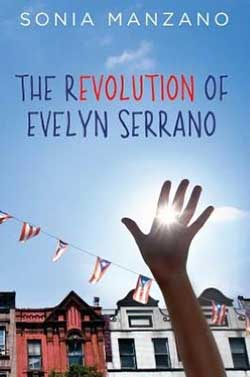
Teen Review - The Revolution of Evelyn Serrano by Sonia Manzano

For my teen literature class last semester, I compiled a list of historical fiction titles as my end-of-term project. It was a fun list to put together, and I was shocked at how many historicals I'd read in recent memory. But what struck me about the list was how many books about certain eras there are. Take World War II, for instance -- one of the most fascinating periods in world history, for lots of reasons, and as you might expect there are tons of books on the subject. But look for teen books on other eras and you might be hard pressed to find anything at all, much less anything worth reading.

The 60's are one of those eras that tend to be somewhat untapped when it comes to teen lit. I can't figure out why -- maybe it's not long past enough to be truly historical for some? Not really sure, but it seems to me that I've read some really extraordinary books set during this turbulent timeframe. And it's a natural match to the turmoil of adolescence, with all the uncertainty and the shades of black and white fading into gray in so many areas of life. Seems like gold to a novelist, I would think.


And that's certainly true of the debut novel by Sonia Manzano, The Revolution of Evelyn Serrano. Manzano's name probably sounds familiar -- she's best known as the actress who plays Maria on Sesame Street. I'm not ashamed to admit that Sesame Street made a huge impact on me, as it did to so many of us babies of the 1970s. The second I read about Manzano's book, it went on my reading list, because, hello? It's Maria! And I'm so glad I jumped at it, because this affecting, emotional novel is truly a gem that deserves a spot on every reading list.

Evelyn Serrano used to be known as Rosa Maria, but when she turned 14 she decided a name change was in order. Besides, there are entirely two many Rosas and Marias in her Spanish Harlem neighborhood, and Evelyn doesn't want to blend in. She also doesn't want to be like her Mami, clinging to the ways things were in Puerto Rico, fashions and decorating and all of that. So she's breaking out on her own a bit, and things are going pretty well -- until her abuela turns up, Mami's mother from Puerto Rico. Abuela's not like any of the other grandmothers - she's sassy and brash and she knows things, political things, that Mami never wants to talk about. Evelyn's drawn to Abuela and her politics, and before long all three of the Serrano women are embroiled in activism, as the Young Lords, a protest group, make a stand in Evelyn's Spanish Harlem neighborhood.

Manzano may be on her first outing as a novelist here, but her talents for characterization are clearly well-honed. Evelyn is a believable and interesting narrator, one modern readers will identify with as she struggles to find her footing in a world of upheaval and uncertainty. The issues Evelyn faces -- issues of family, politics, love, and identity -- are universal, which makes their placement amidst this historical setting all the more powerful. Personally I didn't know much at all about the Young Lords, and I found Manzano's account not only stirring but informative. Much like Rita Williams-Garcia's stellar novel One Crazy Summer, and its depiction of the Black Panthers, Manzano's novel gives us a side of the conflict in Spanish Harlem that most of us may not fully understand. All this while keeping the action moving, an impressive feat for a debut novelist.

More than just a book about politics, though, Revolution is ultimately a book about a young girl, and the transformation she undergoes not only with how she sees herself but how she understands her friends and family. The relationship between Evelyn and her mother is a thorny one (much like that between Mami and Abuela), and Manzano shows us the whole thing, unstintingly. These are real people, which makes them all the more complex and interesting - and ultimately, believable.

I can't wait to read more from Manzano, and I'm thrilled that her recent Pura Belpre honor for this title will take her book to that much wider an audience.

The Revolution of Evelyn Serrano by Sonia Manzano, published by Scholastic
Ages 12 up
Source: Library
Sample: "At the kitchen table sat a woman whose eyebrows were drawn on with a black makeup pencil. On her eyelids was a thick spread of eye shadow the same blue as my snow cone. The woman's lips were as pink as the inside of a seashell. And, oh, her hair -- it was as orange as Bozo's, puffed up and piled on top of her head like a wad of cotton candy. Mami was serving this strange lady a cup of coffee. / Mami spoke in a very tired way. 'Mija, this is your abuela.'"
Recommended

Saturday, January 19, 2013

Picture Book Review - Unspoken by Henry Cole

Next week I'll be attending the ALA Midwinter convention, and I'm pretty much thrilled. Not only is it my first trade show as an almost-librarian, it's also the one where the ALA Youth Media Awards are announced. You probably know these awards more by their individual names: Caldecott, Newbery, Printz, Coretta Scott King, Sibert, etc. This is a big deal for us kidlit folks - think the Oscars for children's book geeks. Swoon!

The Awards will be announced on Monday, and the kidlitosphere is all abuzz in predictions. (Pragmatic Mom has a nice rundown of the frontrunners compiled from some heavy hitters in kidlit.) Usually I don't dip my toe into those waters, preferring to watch from the sidelines and root for my own favorites to take the top prize, or at least an Honor. But this year I'm putting it out there in the form of my own pick for the Caldecott, the prize for illustration: Unspoken by Henry Cole.


Unspoken, according to the author's note, arose out of his history of living in Loudoun County, Virginia, an area steeped in connections to the Civil War. Cole reports growing up hearing stories from elderly relatives, themselves connected in some way to people who had lived during the war. And so, Cole recounts, "It's not so suprising that I wanted to create a picture book that was evocative of that era. . . . I wanted to tell -- or show -- the courage of everyday people who were brave in quiet ways."

And that's exactly what Cole has done. In this evocative book, we are transported to a homestead during the Civil War, when a young girl living on the farm discovers a runaway slave hiding in the family's barn. She knows what she's expected to do, to raise the alarm, and yet the look in the stranger's eyes convinces her otherwise. She begins to sneak out food, day by day, bit by bit. Then one day slavers come looking, asking questions. The girl watches, hidden, and fearful for her friend's life. Later, she sneaks to the barn, underneath the night sky with the North Star shining bright overhead. And there she finds her friend has gone, but left behind a gift: a smiling doll, fashioned from the cornstalks behind which the slave found refuge.

Unspoken is a bit of an unusual choice for an award winner: it features a black-and-white palette AND it's wordless. The two characteristics themselves aren't that uncommon - Chris Van Allsburg won the prize for his black-and-white Jumanji, for instance, and Jerry Pinkney for the wordless The Lion and the Mouse. But the two together? That's a bit of a stretch for some. And then let's not forget that this is a historical title to boot.

But quite honestly I don't think any of these factors, taken singly or together, should stand in the way of Cole receiving the top honor this year. Because this, my friends, is a simply extraordinary picture book. There's so much we don't know -- who the slave is, why he or she found this place, where he/she is headed next -- but none of that alters one bit of the power of this story. Cole's use of pencil brings the stark contrast of light and dark to the forefront, where it belongs in a book about slavery and the Underground Railroad. The expressiveness of the features on the characters, in particular our heroine, communicates so much beyond the thread of narrative - it tells of the emotions that surround the difficult choice one girl must make, the connection she feels to someone she knows not at all, and the fear she experiences when it seems her bravery may be uncovered. Cole goes far beyond technical skill here, to tell a story of courage in the face of danger, of hope in the midst of unspeakable fear.

Unspoken, for me, elevates the picture book format to art form in a way that I think might cause even non-picture book fans to stop and take note. And, whether or not the committee agrees, that's the mark of a winner in my eyes.

Unspoken by Henry Cole, published by Scholastic Press
Ages 4 and up
Source: Library
Highly recommended

Bonus: a review of Unspoken from Kirkus Reviewer Julie Danielson

Friday, January 11, 2013

Nonfiction Review - They Called Themselves the KKK by Susan Campbell Bartoletti

This past semester I was fortunate to take a class on teen literature. We read some amazing stuff over the course of the 16 weeks in the class, and my professor really made every attempt to introduce us to a diverse cross-section of books for teens. One unfortunate side effect, however, was that my already formidable TBR list grew by leaps and bounds (sadly, my available reading time did not grow with it, so who knows when I'll get to all these wonderful books, but that's another problem).

One of the titles we read that really blew me away was Susan Campbell Bartoletti's nonfiction selection  Hitler Youth: Growing Up in Hitler's Shadow. Not only was the subject matter fascinating -- the effect of Nazism on tweens and teens who became part of the movement -- but Bartoletti's writing is top-notch. While never sensationalizing events, she has the ability to pull you into the story and absolutely compel you to keep reading, to find out how life turned out for the young men and women Bartoletti focuses on. The book was recognized with a number of awards, including a Newbery Honor and a Sibert Honor, and for good reason, because it's simply incredible.


Reading Hitler Youth left me wanting more from this talented author, so I turned to her more recent book They Called Themselves the KKK, published in 2010. This is another fascinating historical account, this time centering on the formation of the Ku Klux Klan in the period of post-Civil War Reconstruction. I knew little to nothing about the KKK's history, so I went into this one entirely fresh, and was amazed at the depth of historical detail Bartoletti was able to uncover.

Her story takes up right after the Civil War concludes, when the Southern states were still reeling from their devastation and defeat at the hands of the Union soldiers. Tennessee was particularly hard hit, and the residents of Pulaski, TN worried about their future in a country that intended to see the South punished for their rebellion. Six Pulaski men took up meeting in the evenings to reminsce about "the good old days" before war ravaged their region; it was at one of these meetings that the Ku Klux Klan was formed, as a club for men who shared the six friends' ethos.

To say the Klan took off like wildfire is an understatement. Bartoletti traces the rapid spread of the KKK through the South and also the tactics that caused its membership to swell, even if many of the new recruits joined against their will. To oppose the Klan was to risk reprisal, and few young men were willing to risk it. And very soon the Klan began to take steps to protect its members and other white Southerners from what it felt were overly punitive and biased laws and mandates.

Of course, we all know of the violence and bloodshed that was left in the wake of the KKK, but it is here that Bartoletti's book becomes most moving. She traces first-hand accounts from former slaves and others who stood up to the Klan and were severely punished for their trouble. Stories like that of disabled preacher Elias Hill, whose sermons caused the Klan to target him for inciting black-on-white violence, provide an essentially personal element to this period of history. Throughout the book, reproductions of photographs, illustrations and historical documents add depth and bring out the poignant moments of human suffering described in Bartoletti's text. Much of it is horrifying, and yet critical to understand events that followed, most notably the Civil Rights Movement.

With excellent resources like this well-researched and riveting book, history truly comes alive for students, in a way no dry textbook can do. It's easy to condemn the actions that were carried out by the KKK -- far harder to analyze what events brought the Klan to power and how its effects lingered for years afterward, even to this day. I so admire the balance, sensitivity and accuracy Bartoletti employs in this account, which should be required reading for every student of American history.

They Called Themselves the KKK by Susan Campbell Bartoletti, published by Houghton Mifflin
Ages 13+
Source: Library
Sample: "Despite the Klan's terror tactics, freedmen turned out to vote in extraordinary numbers. In Spartanburgh County, South Carolina, for instance, freedmen swam rivers, waded streams, and walked miles to reach the polls. 'A man can kill me,' explained Henry Lipscomb, 'but he can't scare me.'"
Recommended

Bonus: Susan Campbell Bartoletti's visit to a KKK rally as background research

Wednesday, November 21, 2012

30 Days of Picture Books - Balloons Over Broadway by Melissa Sweet

It's Day 21 of Picture Book Month and today I'm thinking about tradition. Picture books are a great way to bolster traditions and help celebrate new ones. As far as Thanksgiving goes, the Macy's Thanksgiving Day Parade makes the holiday for a lot of people, myself among them. I remember sitting with my dad on the sofa watching the parade on TV, with the smell of turkey wafting through from the kitchen and the promise of family coming later in the day. Those Thanksgiving mornings are indelibly etched on my memory, and I know I'm not the only one who feels that way.

Sprout's never seen the Macy's Parade -- we don't have cable -- and so I wasn't sure if the pick for today would really speak to him. But I needn't have worried, because he loves parades. Who doesn't, really? The festivity, the color and music and pageantry of it all. When I took Melissa Sweet's Balloons over Broadway: The True Story of the Puppeteer of Macy's Parade off the stack tonight, and told him it was about parades and balloons, that was all it took to pique his interest.


Sweet's book, which she wrote and illustrated and which has garnered a number of awards (including the Sibert Award, given for nonfiction), is many things. It's history and memoir, telling the story of puppeteer Tony Sarg and his quest to bring puppets to the Macy's Parade. It's inspiration, as we follow Tony's efforts, culminating in the unveiling of the amazing balloons that graced the Parade in 1928, and made balloons a centerpiece even of today's parades. And it's art, filled with incredible mixed-media illustrations that tell Tony's story and give even the most faraway readers a hint of the magic of the Macy's Thanksgiving Day Parade.

Balloons Over Broadway is a great example of some of the wonderful nonfiction available for kids, books that are impeccably researched and bursting with life. Teachers and parents who want to use this title to inspire art projects will find ample fodder for discussing invention and creation with kids; I can absolutely see this as a take-off for making puppets inspired by Tony's outstanding artwork (check out the author's website for loads of links related to this and her other titles).

For his part, Sprout was very intrigued by the notion of marionettes, which I realized that he'd never seen either, so we'll be hunting down an opportunity to watch some in action. And I wish I'd had a camera at the ready as we were reading the book the first time -- when I flipped to the page where Tony's first balloon takes flight over the street below, his jaw dropped wide open in complete amazement.

So as you watch the parade tomorrow, give a thought to Tony Sarg, whose vision and talented team of assistants brought the balloons to Broadway. Rest in peace, Mr. Sarg; our holidays are all the more magical because you were here.

Balloons Over Broadway: The True Story of the Puppeteer of Macy's Parade by Melissa Sweet, published by Houghton Mifflin

Saturday, November 3, 2012

30 Days of Picture Books - The Lion and the Mouse by Jerry Pinkney

It's Day 3 of Picture Book Month, and what's on my mind today is story. Sure, picture books are all about illustrations, but the story's pretty important too, right? Word choice had better be spot on in a picture book, nothing out of place because you're communicating a narrative all in the scantest of lines. I don't know about you, but if there are more than a few paragraphs on each page, I'm sure to have a restless little one on my hands, and then we're off to find another choice. So the first credo of picture book writers would seem to be choose your words carefully.

But what if you decide not to choose your words at all? I'm speaking, of course, about wordless picture books, something that might not immediately seem strong in narrative, but which have a hidden strength that goes beyond the written word. You see what's so great about wordless books is that you get to tell the story any way you want to. Kids love this - it's what they do, after all, as pre-readers when they sit down to "read" a book to their stuffies. And with the wordless picture book, adults get to experience that phenomenon too. The book's creator gives us the framework within which we can emphasize whatever aspects and nuance seem most significant to us.


In our home library, one wordless book in particular stands out, and for good reason - it's easily one of the best examples of the genre out there. I'm speaking of Jerry Pinkney's The Lion & the Mouse, a Caldecott Award Winner and all-around gorgeous piece of graphic storytelling.

The plot is of course based on the fable by Aesop, wherein a tiny mouse is captured by a lion who then, for whatever reason, lets the mouse go. And soon the lion finds himself in trouble, as he is ensnared by hunters - but the little mouse and his friends come to the rescue, chewing through the net that holds the lion and setting the mighty king of the jungle free. As in all fables, we have a lesson to take away: always perform an act of kindness when you have the opportunity, for you never know when you will need kindness in return.

In Pinkney's skilled control, the narrative becomes so much more. Honestly, if you're looking for visual splendor you couldn't do better. Even the end pages are a feast for the eyes, as we're taken immediately into the landscape of Eastern Africa, where Pinkney's version is set. Young readers will love poring over the detail of each page, noticing the curls in the lion's mane or the spiderweb clinging to a strand of grass. And they'll revel in the chance to tell you a story, if you let them - one time through is all most kids are likely to need before they want to relate the tale in their own words, a recounting that's never the same twice.

Linger over the experience of The Lion & the Mouse together, for it really is the kind of book you want to visit again and again.

The Lion & the Mouse by Jerry Pinkney, published by Little, Brown

Monday, September 3, 2012

Chapter Book Review - Liar & Spy by Rebecca Stead

For some authors, I would imagine the news that they've won a major award like the Newbery is followed almost immediately by a sense of panic at how they're going to follow that up. I mean, you know that the eyes of the kidlit world are going to be trained on your next effort, that the inevitable comparisons are going to be made and that a critical few aren't going to be satisfied no matter what you produce. This kind of pressure, I'd think, might just be paralyzing. No doubt that's why some folks decide to go in an entirely different direction for their next work.

And at first glance that's what Rebecca Stead did with her new book Liar & Spy, the realistic fiction novel that follows her 2010 Newbery win for When You Reach Me. I thoroughly enjoyed Stead's last book, even though -- true confession time here -- I just never liked A Wrinkle in Time, Madeleine L'Engle's classic work that forms the center around which When You Reach Me is built. But Stead is an assured storyteller, a meticulous writer whose characterization always builds the plot and remains authentic to the people she has created. And those engaging characters where what drew me through the novel, and caused me to go back and reread large chunks of it once I got to the end (which I will not spoil for you, dear reader, but suffice to say it's a doozy).


In Liar & Spy, Stead gives us the story of Georges -- yes, as in Seurat, the painter he's named for -- and his struggle to survive daily life and middle school. School's definitely the worst part, as Georges deals with the "typical bully crap" dished out by the odious Dallas Llewellyn on a regular basis. But home's been a little rough too, since his dad lost his job and the family had to move to an apartment building. Oh, and his mom, a nurse in the ICU, seems to be gone all the time too, and Georges misses her intensely. His main consolation seems to be his friendship with the intensely strange Safer, a boy Georges' age whose "bohemian" parents also take Georges under their wings. Safer drinks coffee, walks dogs for money and doesn't go to school. And then there's the little matter of Safer's spy career, and the project he ropes Georges in on: spying on the neighbor Safer calls Mr. X, whose strange comings and goings Safer is determined to puzzle out. Harriet M. Welsch should watch herself with Safer around.

Georges is the kind of kid most people can relate to - slightly oddball but not really kooky, someone who wants more than just to survive but who also wants to be himself. The thing is, though, middle school isn't really a time when uniqueness is celebrated, and so Georges is torn. At home, he's hanging out with Safer, who in absolutely no uncertain terms is hell-bent on being his own person. But at school, Georges wants to fit in. And he's afraid, terribly afraid, that he's about to be marked as "a big phlegmy wad of geek", as Dallas puts it, thanks to the taste test that all kids take in the 7th grade (a pretty nifty bit of narrative on Stead's part - she's really tapped in to the kinds of tools that bullies can use against others). So Georges is stuck with one foot in both worlds, as all the while he's trying to sort out just where he belongs.

Liar & Spy is a slim little book, just 180 pages, but don't be fooled: every page packs a punch. Stead says more in this novel than many adult books four times its length, and I found myself constantly flipping back and forth to pick up a thread I'd missed along the way. While strong readers will find this enjoyable, and love watching how she ties everything together at the end, kids who are less confident readers may struggle with this aspect. But this would be a great novel to read together with your child, as it opens up lots of opportunities to discuss what life in middle school's really like, what they might be going through that mirrors Georges' experience or that reminds them of someone they know.

Liar & Spy is a puzzle much like life, one that seems impossible close-up but from a distance will dazzle you with its brilliance. Above all, this novel will resonate with anyone who found this period of their life to be particularly trying, who felt they were trying on personas like new shoes with none seeming to quite fit. It says a whole lot about bravery: not the kind of grand gestures and heroics, but the smaller sort, that helps you get through every day when you're not sure just how you can. And that, it seems to me, is the most difficult kind.

Liar & Spy by Rebecca Stead, published by Random House Children's Books
Ages 9-12
Source: Library
Sample: "Dallas Llewellyn passes me on the way to his seat, saying 'You're it, Gorgeous,' and flicking the top of my ear with his finger. I ignore him. Dallas is always on the lookout for other people's weak spots so that he knows exactly where to poke them. And if you don't have a weak spot, he'll invent one and poke you anyway."
Recommended

Wednesday, July 4, 2012

Independence Day!

Happy Fourth of July everyone! It's early here still, and our plans for the day aren't really firmed up (much depends on the temperament of the little guy who woke up at 5 a.m.). But the sun is out, the birds are chirping and it's a lovely day for family and fun.

And books, of course - what's a holiday without books? Although we spend a lot of time celebrating Sprout's Ethiopian heritage through literature, it's also important for us that we teach him about his new homeland and its history. We want him to understand that our country was made great by hundreds of Americans who came here as immigrants, just as he did when we adopted him. This is truly a land of possibility!


This year I made it a point to seek out some titles with multicultural emphasis for Sprout. In Jan Spivey Gilchrist's My America, poetic verses laud not only the natural beauty of our country, but also the diversity found in our population. Each pages contains only a few words or phrases, made more impactful by the colorful, emotive illustrations done by Gilchrist and Coretta Scott King Honor winner Ashley Bryan. The pictures range from triumphant -- a bevy of multicolored birds soaring in the sky -- to contemplative -- a young girl in profile, braids fluttering in the breeze. On the last spread, Americans from a variety of ethnic backgrounds display their cultural heritage but are united by their entertwined hands, emphasizing that our greatest strength is in our diversity. A beautiful, simple book perfect for even the youngest children.


National Ambassador for Young People's Literature Walter Dean Myers offers "a tribute from the heart" in his book We Are America, illustrated by his son Christopher Myers. In his author's note, Myers explained how he was moved to write the book in the wake of September 11, when he felt he needed to make a deeper connection with the history of his country. "No words here have been penned lightly, no flag waved mindlessly." Myers writes. "This is simply my truest feelings for my country, my tribute to America." And it is a gorgeous tribute, comprised of Myers' free verse poems and Christopher Myers' stunning paintings. The entire range of the American experience is spoken to here, from that of immigrants coming to our shores to wars fought and freedoms gained. Though he doesn't gloss over the difficult points in our history, Myers finds much to celebrate in the hope, the possibility, that is America.


I've written about this before, but it bears repeating. Perhaps the most striking and emotional book I've read in years is Kadir Nelson's Heart and Soul: The Story of America and African Americans. Nelson's goal in writing this book was to tie the history of African Americans -- a history of injustice, suffering and division -- to the history of our nation, to explain how the experience of African Americans is truly the "heart and soul" of our country. This is an unflinching examination of our history, the struggle for equality and acceptance for all Americans. Nelson's was no easy task: finding a way to condense hundreds of years of experience into a cohesive and relatable narrative. But he accomplishes it amazingly well, presenting a book that does not shy from the difficult points yet also stresses the hope that imbued so many to fight for themselves and their children. You will be moved to tears at many points, whether from the poignancy of Nelson's first-person narrative or from his deeply beautiful portraits. This is a book that belongs on the shelf of every American, regardless of your culture or ethnicity.

As you celebrate our nation today, remember that it is a country made up of immigrants from all corners of the globe. Our diversity makes us not a melting pot but a patchwork, more beautiful for the unique contributions of each person who calls this land home. Happy Independence Day!

Saturday, June 9, 2012

48 Hour Book Challenge - Everything on a Waffle by Polly Horvath


Second book completed for my 48 Hour Book Challenge! I managed to log 2.5 hours reading last night before collapsing and sleeping like the dead (until 5:30! The child slept in!). After finishing Zachary Beaver I dived right into Polly Horvath's delightful Everything on a Waffle. I finished it today at lunch - in between I've been listening to the audiobook version of A.J. Jacobs' The Year of Living Biblically, which I may not be finished with before the challenge ends.

And you wouldn't think an adjective like "delightful" could sum up a book about a young girl whose parents are lost at sea, whose guardian is preoccupied by development deals and who loses not one but two digits in the course of the novel. Oh, and who sets a guinea pig on fire. But somehow this book is not only smart but moving, funny and charming even as it is insightful.

Primrose Squarp knows her parents aren't dead, she just knows it, and no amount of intervention on the part of nosy adults in her town of Coal Harbour will convince her otherwise. Though the snoopy Miss Honeycut and the crisp and proper Miss Perfidy try to make Primrose realize that she is an orphan, she won't believe them. Rather, Primrose continues to have various misadventures that are not at all related to her being depressed, as the two women believe. And all the while she enjoys the company of the somewhat unusual adults who do support her, including her devilishly charming Uncle Jack, her foster parents Evie and Bert (whom she compares to "kindly old hard-boiled eggs) and of course the culinarily inventive Miss Bowzer (she of the restaurant The Girl on the Red Swing, where everything is, as you've probably guessed, served on a waffle).

Primrose is an engaging character in the vein of such sparky lasses as Pippi Longstocking or Matilda Wormwood (though without a nemesis half as threatening as the Trunchbull - shudder). Primrose makes the kind of keen observations of the world around her that bely a depth far beyond her years. Nothing gets past Primrose; though the adults in her life think they are outmaneuvering her, she always ends up right where she wants to be. This is definitely an unusual novel and one that's on the surface packed with oddball sensibilities. However, dig a bit deeper and you'll find commentaries on love, loss, loneliness and the value of always being just who you are.

Everything on a Waffle by Polly Horvath, published by Farrar Straus Giroux
Ages 9-13
Source: personal collection
Sample: "Uncle Jack thought it was strange that I didn't move my sweaters into his house. I said it was because the mothballs were protecting them but really it was because I wanted to see Miss Perfidy now and then. We had a peculiar relationship. We didn't like each other much but had lived through my parents' disappearance together. It gave us a kind of melancholy bond."
Recommended

Friday, June 8, 2012

48 Hour Book Challenge - When Zachary Beaver Came to Town by Kimberly Willis Holt


One of my goals for the 48 Hour Book Challenge was to catch up on some older kidlit that I'd previously overlooked. I also want to get some more award-winners under my belt. Kimberly Willis Holt's When Zachary Beaver Came to Town fit both categories nicely, as an older title (1999) that won the National Book Award plus ALA Notable status. And I'd read Holt's novel The Water Seeker last year and really enjoyed that, so I've been looking forward to this one.

Zachary Beaver did not disappoint. Despite being a quick read, it was a surprisingly emotional and impactful one, with lots of heavy themes that are carried out with the lightest of touches. Holt's depiction of small-town Texas life is realistic, and her characters are personalities but never charicatures. Zachary Beaver breezes into town as a sideshow attraction, "the fattest boy in the world," and like everyone else in town, Toby and his best buddy Cal can't miss out on the show. But when Zachary's guardian leaves him behind, Toby discovers a sudden kinship with this boy, unexpected since Toby himself never realized how much his own life parallels Zachary's. Left behind by his mother who's gone seeking fame and fortune, Toby struggles to reconcile his feelings about his mom with his newfound friendship with Zachary, worry about Cal's older brother Wayne in Vietnam, and his attempts to woo the beautiful Scarlett Stallings. In the end, Toby sees that though external appearances may differ, people are all the same deep within, and loss touches us all in ways we could never imagine.

Holt's not shy about facing difficult situations, and about putting her characters in places that other authors might think twice about. But the result is a well-developed plot that is peopled with the kind of folks we all know, and that we're sure to recognize in our own friends, family and selves. This is a well-rounded and highly readable award winner that belongs in every classroom and library - lots to discuss here, in a story that will keep young readers turning pages.

When Zachary Beaver Came to Town by Kimberly Willis Holt, published by Henry Holt
Ages 9-13
Source: Library
Sample: "Cars and pickups pull into the Dairy Maid parking lot. Some people make no bones about it. They just get in line to see him. Ohters try to act like they don't know anything about the buzz. They enter the Dairy Maid, place their orders, and exit with Coke floats, chocolate-dipped cones, or curlicue fries, then wander to the back of the line. They don't fool me."
Recommended

Tuesday, January 17, 2012

Library Find - Jazz Baby by Lisa Wheeler

I love my kid. I really do. But at the moment he's in a stage that frustrates the life out of me. If you have toddlers or have spent much (any) time around them, you'll recognize it -- it's the "no way will I tolerate anything new" phase. Basically this means that his daily selections (food, clothes, books, DVDs) are from a very limited list of personally-approved items. Any deviation from said list is bound to meet up with a pronounced "no, I don't want to" or "no, I don't like it". Or, you know, just "no".

Well, okay, I can play along with this to a limited extent. But since my husband and I happen to believe that trying new things is good, we can't entirely let our dear son dictate everything. So that means that alongside his beloved dinner of noodles and cheese, Sprout is apt to find a taste of asparagus. Paired up with his favorite Cars pajama bottoms, he's likely to have a different t-shirt choice. And in with his tried-and-true library selections, there is bound to be something he thinks he just won't like.


Such was the case for Jazz Baby by Lisa Wheeler, illustrated by R. Gregory Christie. I picked this one up at the library because I was drawn to the energetic cover art, which features a multiracial cast. (The fact that it was sporting a Theodor Seuss Geisel Honor seal didn't hurt either.) A quick read through suggested that it might be a bedtime favorite - lots of fun upbeat rhymes, characters swinging and swaying to a jazzy beat, and skin in all shades of pinks and browns. What's not to love, I thought?

Unfortunately Sprout was a harder sell. He pitched a fit the first time I pulled it out, but I persisted. And lo and behold, it has become one of the most-requested titles in the bedtime rotation. Well, how could it not be - seriously, this is a fun one to read together! The premise is simple: a lively family celebration of music, with singing and dancing and beboppin' galore. Wheeler's words put the song in motion, and Christie's vibrant characters look ready to dance right off the page. In each spread, our jazzy baby is dancing with someone new, as the whole family, plus neighbors and friends, get into the act. And the singing and dancing is infectious -- if you can read this one through without wanting to get up and dance yourself, I'd be surprised!

Sprout loves the recurring refrain sung by the main character: "Go, man, go!" My husband taught him to say it in a really jazzy way, which makes him laugh like nobody's business. All in all, this is a fun and funny title that's great for bedtime reading but would make an excellent addition to any storytime program as well. Pair with This Jazz Man for another title that will get kids up and on their feet!

Jazz Baby by Lisa Wheeler, illustrated by R. Gregory Christie, published by Harcourt
Ages 2-7
Source: Library
Sample: "Auntie toe-taps. / Uncle soft-shoes. / Fancy-dancin' Baby sings 'Doo-Wop-Doo!'"
Recommended

Friday, January 6, 2012

Novel in Verse - Inside Out and Back Again by Thanhha Lai

Rarely am I at a loss to describe a book, or even to write a review of it.

Rarely does an author so take my breath away that upon finishing her work, I am immediately moved to reread it.

Rarely does a book like Thanhha Lai's come along.


If you haven't read a novel-in-verse, you may be put off by the format. I was, for a very long time, until reading Karen Hesse's Out of the Dust. In a word, that book was stunning - it captures the experience of living in Dust Bowl Oklahoma in a voice that is spare and beautiful. Since then I've read a few others, but none quite comes close to Lai's Inside Out and Back Again.

Lai's debut novel (winner of the National Book Award) is a story based on her own experience, that of ten-year-old Ha, who with her family escapes Saigon in the wake of the Vietnam War. Ha's life is marked by loss - her father went missing in action before Ha's first birthday, her mother has drawn gradually away with the stress of supporting the whole family. And now the war - Ha's best friend flees with her family, and the loss continues. At last it becomes clear that Ha's family also must go, but with no clear idea exactly where they will end up. The escape, the boat journey, the terror of floating aimlessly with no rescue in sight - this is all part of Ha's story, as is her arrival in a strange land called Alabama, where not even a taste of her favorite fruit can bring back the feeling of her homeland.

Lai tells Ha's story with a fierce tenderness that speaks to the personal nature of the tale. Her decision to write the novel in verse is, in my estimation, a brilliant one, as it allows for the kind of stark imagery that brings the entire experience to vivid life. Bursts of humor break the tension, but never do we forget that this is a journey not only of physicality, but also of identity and of learning to find one's place in a strange land.

Like Lai's prose, Ha herself instantly captures you. She's sneakily brilliant: on the first morning of the new year, Ha tells us, male feet should touch the floor first, for luck -- but Ha wants to be the first, so she creeps her toe out of the covers to tap the ground. She's determined: her strength shines through every line, every thought, every vignette. Though the world she knew gradually slips away from her, Ha clings to her faith in herself and her family. Never does her beautiful, bright determination waver, never does her spirit become worn away.

I read this in one quick burst -- I couldn't help it -- but then went back and read shorter portions, savoring the language, the imagery, the sense of place and time and personality. This is a gorgeously written portrait of a girl whose experience echoes over and over in refugees the world over. Absolutely compelling - one of my new favorites.

Inside Out and Back Again by Thanhha Lai, published by HarperCollins
Ages 9 up
Source: Library
Sample: "Water, water, water / everywhere / making me think / land is just something / I once knew / like / napping on a hammock / bathing without salt / watching Mother write / laughing for no reason / kicking up powdery dirt / and / wearing clean nightclothes / smelling of the sun."
Highly recommended

Bonus: Thanhha Lai's interview with Publisher's Weekly

Friday, December 9, 2011

Audio Review - Strings Attached by Judy Blundell

Atmosphere -- as a character in one of her books might say, Judy Blundell's got it in spades. Her books are like a step back in time, literally. You are so transported to the place and time she's writing about that it will likely be a shock for you to look up from the book and realize you're not in a smoky 1940's nightclub. If you want to be totally swept away from your life for a bit, Judy Blundell can do that for you.

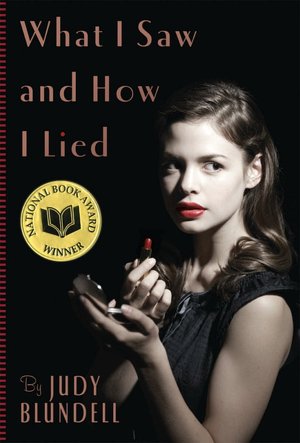
I've listened to both of Blundell's books on CD now, and both are simply amazing. What I Saw and How I Lied won the National Book Award, and it's easy to see why -- though I didn't review that one because honestly? I wasn't sure I could say much other than "read it, read it, read it now". It's that good.

And Strings Attached is a very, very close second. It's 1950, the war years are over, and Kit Corrigan has left her hometown of Providence, Rhode Island with no looking back. Kit's going to make it on Broadway, though when we meet her, she's dancing in the chorus of "That Girl from Scranton" and not making much of anything doing it. But then she runs into her ex-boyfriend Billy's father, who makes her an extraordinary offer. Nate Benedict is connected, and he's willing to use those connections to help Kit open some doors. Almost before she knows it, Kit's installed in a swank new apartment and working as one of the "Lido Dolls" at the most famous nightclub in New York. But the glamorous life comes at a price, as Kit quickly discovers -- and suddenly Kit's realizing that behind the velvet curtains is a world she's not sure she's ready for.

Oh, but this is good, historical fiction at its very best. In fact, I'm hesitant to even use the term "historical" because it might scare some readers away. And even though Kit's life and her struggles are very much couched in the issues and mores of the day, these are familiar themes even today. Kit's the kind of person who jumps in first and thinks it out later, and as a result she soon finds herself down a road she never intended to follow. Blundell is unsparing in her depiction of Kit, and of the other characters -- though you may at times want to scream at them, they are always true to their own motives and their own perceptions of the world as they know it. This is what makes for great fiction, and for the kind of story that lingers in readers' minds well after the story's end.

I loved having the audio version of this -- Emma Galvin's voice captures Kit's youth as well as a bit of world-weariness that comes from having lived life absent of softness. The other characters are shaded just as well -- Billy's edgy distrustfulness, Nate's smooth veneer, Delia's commanding righteousness. We are bound up with these characters for the entire course of the narrative, and soon we, like Kit, can hardly tell what's real and what's just what we want to believe.

Blundell's definitely not for the younger set (though not graphic, these are novels with teens in adult situations) but she's got a whip-crack sense of timing and the environment couldn't be richer. Be forewarned though -- once you crack the spine, you're not likely to put it down until you turn the last page.

Strings Attached by Judy Blundell (audio narrated by Emma Galvin), published by Scholastic
Ages 12 and up
Source: Library
Sample quote: "Nate hung up with a soft click. No chance for me to say no. It was like he knew whatever I'd say would be a waste of his time. He knew I wouldn't turn this down. He knew I'd be crazy to say no. I didn't like him knowing all that. I didn't like how staying here suddenly made me available to him whenever he felt like calling. I hadn't counted on that."
Highly recommended

Sunday, September 25, 2011

Link Love - Reading Rainbow, Award Predictions, & Kadir Nelson

Wow, links aplenty this time! Jumping right in --

~ First, since I'm in a scholarly mood (writing papers will do that to you), here's a study that shows that reading fiction makes you a better person! OK, maybe not a better person, but possibly a more empathetic one, and therefore better at getting along with others. So novels can, theoretically, make the world a better place -- as I always suspected.

~ Remember Reading Rainbow? So many excellent picture books gained attention via this PBS show. In an effort to transfer this success to another platform, LeVar Burton is launching RRKidz, a digital library that is subscription-based and will feature plenty of opportunities for interaction. Great news for backlist titles that might just reach a whole new audience!
~ Early literacy is crucial, which is why shows like Reading Rainbow are important. This piece from School Library Journal takes a look at another early intervention program, Raising a Reader, and the amazing effect their bright red bags have had. And from the Seattle Times, a piece about the tireless work of all the dedicated folks at Reading is Fundamental. In the face of insurmountable challenges, the staff of this organizations soldier on. Heroes, every one.

~ I can't figure out what I think about this essay. On the one hand, anything to get kids reading, right? On the other -- and maybe this is just me -- doesn't that backlit display kind of suck all the romance out of curling up with a book??

~ Shifting gears a bit, the last couple of weeks have seen announcements of big names releasing kids books. Here's one that I'm kind of surprised didn't happen sooner. And here's one that makes me kind of sad -- when will publishers decide to leave well enough alone? Which brings up another question: can celebrities write good children's books?

~ It's no secret that I completely love Kadir Nelson, and just the cover of his new book, Heart and Soul, has me drooling. Add this one to your library queue now, and plan some time to share it with the kiddos in your life. It's guaranteed to be a must-see.

~ Taunting me from my TBR stack is the new Jack Gantos novel, Dead End in Norvelt. I'm pouncing on that one just as soon as I get a handle on all this reading for school, trust me. And it looks like I'm not the only one who considers Gantos a rock star -- check out this homage to Jack from Seven Impossible Things.

~ National Hispanic Heritage month runs from September 15 to October 15. If you're in search of titles for your classroom, library, or just want to get in the spirit of things, Diversity in YA has a terrific list. I especially love that this is a mix of titles old and new. Thanks to

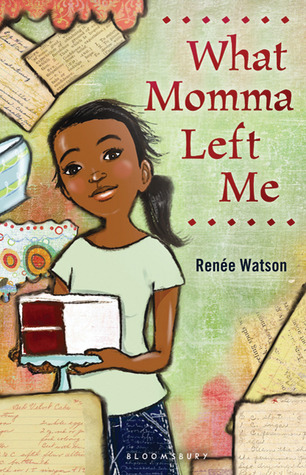
~ Kinda late with this one, but the 2011 winner of Nerds Heart YA has been announced. Here's more about the verdict and the book that won, What Momma Left Me by Renee Watson. Such fun to watch the tournament results unfold -- and I can't wait to read the winner, too!

~ Speaking of awards season, it's heating up. Here's Fuse #8 on her 2012 predictions. Some great titles here -- yay for Okay for Now! And, for another take, the PW Shelftalker blog considers illustrators that have been overlooked by the Caldecott. You may just be surprised (I was!).

~ And finally, let's close with a perfect match -- Read Aloud Dad on Winnie the Pooh. It's already a struggle to wait until I can share the silly old bear with Sprout. This review has me thinking I might just have to break down and reread them myself first. For research purposes, of course (wink).