Oh my word, such a stack of books to blog about! I've been reading and loving so many books lately - it seems like a great season for multicultural and diverse titles, at long last. Lots of these titles are by authors or illustrators whose work I've previously enjoyed, but every once in a while a new artist sneaks in and captures my heart. I *love* when that happens!
Today's pick is just such a title - one that I saw the cover for and instantly knew I had to read it. Take a look at this image and tell me Imani's Moon isn't going on your TBR list for that picture alone:
I'm quite happy to say that the book delivers nicely on the promise of that cover. Author JaNay Brown-Wood based Imani's Moon on the legends and culture of the Maasai people, who can be found in Kenya and Tanzania. Sprinkling in a bit of Maasai tribal dancing and a good dose of traditional Maasai storytelling, Brown-Wood created the story of Imani, a tiny girl who is mocked by others for her small stature. Imani is captivated by her mother's stories of Olapa, the moon goddess, and longs to touch the moon in honor of her heroine. But the task seems impossible, and Imani's initial efforts fail, garnering more jeers from the children in her village. Should Imani give up her unachievable dream?
Brown-Wood does an excellent job of blending mystical and realistic in Imani's Moon. Talking animals and feats of the fantastic are key components of her story. While kids aren't likely to believe that (spoiler alert) Imani really touches the moon, they will internalize the message that Imani's mama tells her: "(a) challenge is only impossible until someone accomplishes it." Those are powerful words, just the kind of thing I want Sprout to have implanted firmly in his head as he goes forth in the world.
I can't close out this review without mentioning the illustrations by Hazel Mitchell, because they really tremendous. Brown-Wood's text pays honor to the Maasai, as do Mitchell's illustrations, showing them as a joyous and soulful people who live close to the land and revere their traditions. Sprout especially enjoyed the spread showing the Maasai warriors dancing - it's an arresting image that evokes the spirit of this gathering, a celebration and a ritual that is deeply embedded in Maasai culture. Mitchell uses color to evoke emotions as well, keeping the moon a focal point as it is for Imani herself.
Don't miss Imani's Moon, a great addition to collections for its focus on bravery, honoring oneself and never giving up. Let the magic sweep you up, as it does Imani, to touch the moon.
Imani's Moon by JaNay Brown-Wood, published by Mackinac Island Press
Ages 4-6
Source: Library
Recommended
Bonus: read more about author JaNay Brown-Wood in the Multicultural Children's Book Day Spotlight
Showing posts with label Kenya. Show all posts
Sunday, January 11, 2015
Sunday, May 26, 2013
The Matatu by Eric Walters {The Children's Bookshelf}
Note: The Children's Bookshelf is going on vacation! We're taking the summer off with this linky, so we can all read even more terrific kidlit titles to share with you in the fall. Enjoy today's posts and remember you can always read any of our past posts for The Children's Bookshelf here.
Why read multicultural books to your kids? There are lots of reasons, many of which I've talked about here in the past. First and foremost, it opens up a child's mind to the notion that there are many people the world over who live in ways both different and the same. It helps connect them to their heritage, which is especially important for families who share multiple ethnicities. Multicultural literature develops tolerance and understanding, making kids mindful that we are all global citizens. And it's fun - young readers can travel around the world through litearture, all the while learning about traditions, customs and backgrounds from various countries.
Today's pick is a perfect example of a book that can accomplish all of the above, and that's got a good dose of humor besides. A brief note at the beginning explains that Eric Walters has been accepted as an elder of the Kamba people in Kenya; as such he is a cultural insider with the authority to relate one of the Kamba's stories in the form of his picture book The Matatu. What I love about this book is that Walters just tells the story - he doesn't exoticize the matatus, the buses that carry passengers and goods from village to village. And the traditional Kamba tale is tucked nicely into a story about young Kioko and his grandfather.
Kioko is excited to be celebrating his fifth birthday with a ride on a matatu! He rushes to get on board, then waits impatiently for his Babu, who seems to be taking forever. When the pair is finally settled in their seats, Kioko notices the dogs chasing the bus and asks his grandfather about them. Babu instructs Kioko to first look for sheep and goats, and see how they react when the matatu comes past. Then Babu tells Kioko the story of Dog, Goat, and Sheep, and how these animals took a ride on the matatu together. When it came time to pay, each animal had a different experience - and these encounters are why the various species run from or toward an approaching matatu. (No spoilers here - but if you've ever driven in Africa, you'll know the animal behaviors are spot on!).
An author's note explains the details of matatus and their role in Kenyan daily life, which adds even more authenticity to the tale. Eva Campbell did the illustrations and they are as colorful and lively as an African village. There's no shortage of excitement when a matatu rumbles through, and Campbell captures that spirit perfectly. Though the story of the dogs, goats and sheep forms the center of this story, the real heart of the book is Kioko's relationship with his Babu. It's terrific to see the the esteem with which the other villagers treat Babu, and this and his wonderful stories add to Kioko's appreciation of all his grandfather is for him.
The Matatu is a text-heavy title, which makes it a perfect choice for older preschoolers. Its sly humor is also best received by a slightly older audience (or really, their parents). This is a great addition to any unit about Africa. The genuine respect Walters feels for the Kamba people is evident throughout, and Campbell's illustrations bolster that feeling, which will translate to readers as well. Just don't be surprised if your kiddos want to jump on a matatu themselves!
The Matatu by Eric Walters, published by Orca Book Publishers
Ages 4-8
Source: Library
Sample: "Kioko raced toward the market. He passed huts, houses and stalls, not even glancing at the sweet mandazi for sale. / He ran past people, pushcarts and bicycles. Then he saw it - the matatu. A crowd of passengers waited to board. The roof was heavy with bags of maize, bundles of grass, a bed frame, a mattress and three chairs."
Recommended
Bonus: check out this clip of a matatu from Eric Walters' website
----------------------------------------------------------------------------
This post is part of The Children’s Bookshelf, a weekly linky party with the goal of connecting parents with great books for their kids. Do you have a book review, literacy or book-related post that you think will be helpful for parents? If so, please add your link below.
NOTE: By linking up you are giving permission for any of the co-hosts to pin and/or feature a your photo on a future The Children’s Bookshelf post. Kindly link up to an individual post, not your blog’s homepage. The hosts reserve the right to delete any links to homepages, commercial links, repeat links or otherwise inappropriate links. Thank you for your understanding.
You can also follow The Children’s Bookshelf on Pinterest or visit TCB’s co-hosts: Sprout’s Bookshelf, What Do We Do All Day?, No Twiddle Twaddle, Smiling Like Sunshine, My Little Bookcase, The Picture Book Review, MemeTales and Mouse Grows, Mouse Learns. You can find more details here.
Why read multicultural books to your kids? There are lots of reasons, many of which I've talked about here in the past. First and foremost, it opens up a child's mind to the notion that there are many people the world over who live in ways both different and the same. It helps connect them to their heritage, which is especially important for families who share multiple ethnicities. Multicultural literature develops tolerance and understanding, making kids mindful that we are all global citizens. And it's fun - young readers can travel around the world through litearture, all the while learning about traditions, customs and backgrounds from various countries.
Today's pick is a perfect example of a book that can accomplish all of the above, and that's got a good dose of humor besides. A brief note at the beginning explains that Eric Walters has been accepted as an elder of the Kamba people in Kenya; as such he is a cultural insider with the authority to relate one of the Kamba's stories in the form of his picture book The Matatu. What I love about this book is that Walters just tells the story - he doesn't exoticize the matatus, the buses that carry passengers and goods from village to village. And the traditional Kamba tale is tucked nicely into a story about young Kioko and his grandfather.
Kioko is excited to be celebrating his fifth birthday with a ride on a matatu! He rushes to get on board, then waits impatiently for his Babu, who seems to be taking forever. When the pair is finally settled in their seats, Kioko notices the dogs chasing the bus and asks his grandfather about them. Babu instructs Kioko to first look for sheep and goats, and see how they react when the matatu comes past. Then Babu tells Kioko the story of Dog, Goat, and Sheep, and how these animals took a ride on the matatu together. When it came time to pay, each animal had a different experience - and these encounters are why the various species run from or toward an approaching matatu. (No spoilers here - but if you've ever driven in Africa, you'll know the animal behaviors are spot on!).
An author's note explains the details of matatus and their role in Kenyan daily life, which adds even more authenticity to the tale. Eva Campbell did the illustrations and they are as colorful and lively as an African village. There's no shortage of excitement when a matatu rumbles through, and Campbell captures that spirit perfectly. Though the story of the dogs, goats and sheep forms the center of this story, the real heart of the book is Kioko's relationship with his Babu. It's terrific to see the the esteem with which the other villagers treat Babu, and this and his wonderful stories add to Kioko's appreciation of all his grandfather is for him.
The Matatu is a text-heavy title, which makes it a perfect choice for older preschoolers. Its sly humor is also best received by a slightly older audience (or really, their parents). This is a great addition to any unit about Africa. The genuine respect Walters feels for the Kamba people is evident throughout, and Campbell's illustrations bolster that feeling, which will translate to readers as well. Just don't be surprised if your kiddos want to jump on a matatu themselves!
The Matatu by Eric Walters, published by Orca Book Publishers
Ages 4-8
Source: Library
Sample: "Kioko raced toward the market. He passed huts, houses and stalls, not even glancing at the sweet mandazi for sale. / He ran past people, pushcarts and bicycles. Then he saw it - the matatu. A crowd of passengers waited to board. The roof was heavy with bags of maize, bundles of grass, a bed frame, a mattress and three chairs."
Recommended
Bonus: check out this clip of a matatu from Eric Walters' website
----------------------------------------------------------------------------
This post is part of The Children’s Bookshelf, a weekly linky party with the goal of connecting parents with great books for their kids. Do you have a book review, literacy or book-related post that you think will be helpful for parents? If so, please add your link below.
NOTE: By linking up you are giving permission for any of the co-hosts to pin and/or feature a your photo on a future The Children’s Bookshelf post. Kindly link up to an individual post, not your blog’s homepage. The hosts reserve the right to delete any links to homepages, commercial links, repeat links or otherwise inappropriate links. Thank you for your understanding.
You can also follow The Children’s Bookshelf on Pinterest or visit TCB’s co-hosts: Sprout’s Bookshelf, What Do We Do All Day?, No Twiddle Twaddle, Smiling Like Sunshine, My Little Bookcase, The Picture Book Review, MemeTales and Mouse Grows, Mouse Learns. You can find more details here.
Wednesday, April 3, 2013
Spring Ahead! Four Picture Books to Plant Some New Ideas
It's spring! Lovely, glorious spring! We had a terrific time over Easter weekend, playing outside, going for bike rides, and just generally enjoying the feeling of not being bundled up in raincoats and boots. While we're not silly enough to think that the rain is gone yet -- after all, we do live in the Pacific Northwest -- it was wonderful to have a bit of spring idyll.
And of course that spring weather means that we're in the mood to read about all things growing. Spring provides a host of excellent topics for children's books, providing an introduction into the growth cycle and the rhythm of the seasons. All the aspects of spring are so much fun, aren't they? Planting, watching flowers bloom, seeing butterflies and birds, getting outside and becoming more connected to the earth. Can't wait to do more of that this year with Sprout, now that he's getting old enough to do more than just eat handfuls of dirt. :)
We brought home a ton of great spring-themed reads from the library, and sorting through to find the best was no mean feat. I took my cue from Sprout on this one, as he once again has some very definite preferences among the titles we read together. His most favorite was a title that I added as an afterthought, and I'm glad I did: City Green by DyAnne DiSalvo-Ryan. This book has an urban setting, so it's perfect for kids who maybe won't be sowing seeds in their own backyards. When an old building is knocked down in Marcy's neighborhood, all the neighbors work together to turn the patch of land into something beautiful -- all but Old Man Hammer, who is nothing but unpleasant about the whole thing. But Marcy stumbles on Old Man Hammer's secret, and soon discovers that, just like with the earth, when you scratch the surface of someone, there are hidden places underneath. This is a lovely story of community involvement and intergenerational relationships, and the diversity included is definitely an added bonus.
A friendship between young and old also forms the basis for George Shannon's Seeds. Illustrated by Steve Björkman, the pictures capture the spirit of Shannon's story perfectly, lending a slightly impressionist feel that's energetic at the same time. Warren and Bill are friends -- Warren helps Bill in his yard, and the older man draws or plays games with Warren. But then Warren's family moves away, and he misses his friend terribly. So Warren writes Bill a letter, and Bill writes back, with a surprise that makes Warren's loneliness -- and his yard -- much brighter. Not only does this book touch on the themes of loss and connection, it also provides a great example of the notion that friendship, like a beautiful garden, blooms in unexpected places. (Check your library or used bookstore for this older title.)
One of my favorite things about spring is the blossoming of the flowering cherry trees. Sprout knows this, and so every time we see one when we're out and about, he yells, "There's your pink trees again, Mama!". And so the fact that Diane Muldrow's We Planted a Tree features a spread with pink cherry blossoms just delighted him, enough that we read this one several times together. This is definitely an eye-popper, with retro-vibed illustrations by the delightfully quirky Bob Staake. Honestly, I could look at his work forever, it's that fun and full of life, as is Muldrow's poem about the growth of trees and their connection to humans. The book shows people from all corners of the globe experiencing the joy of trees - from their leaves to their shade, from fruit and flower to maple syrup and beyond. The message, that as trees grow and thrive, so do we, is timely and spot-on. Best of all, there's a reference to the Green Belt Movement of Kenya's Dr. Wangari Maathai, a connection to East Africa that seals this one as a winner in our book.
Last but not least is Butterflies for Kiri, a book about art and perseverance, that wraps its message in the beauty of a spring day. Cathryn Falwell's previous books have been favorites of ours, and this one's no exception, both intriguing to the mind and to the eye. When Kiri's Auntie Lu sends her a book of origami for her birthday, Kiri sets out at once to make a beautiful origami butterfly. But the paper folding is much harder than Kiri bargains for, and she soon gets frustrated. Still, she's determined, so every day she practices making a butterfly with scrap paper. And then one day, inspired by the gorgeous spring weather, Kiri decides to capture her feelings with an art project. At first things don't turn out how she intended them to, but this time Kiri's not giving up -- and all that practice pays off as she completes her piece with a perfectly folded butterfly. I love the message here, that difficult things take practice and patience, and I especially love the smile on Kiri's face as she shows off her completed masterpiece.
As the days get longer, there's more light for reading just one more bedtime pick. If you're squeezing in one of these springtime favorites, you may want to leave time for a reread (or two!).
And of course that spring weather means that we're in the mood to read about all things growing. Spring provides a host of excellent topics for children's books, providing an introduction into the growth cycle and the rhythm of the seasons. All the aspects of spring are so much fun, aren't they? Planting, watching flowers bloom, seeing butterflies and birds, getting outside and becoming more connected to the earth. Can't wait to do more of that this year with Sprout, now that he's getting old enough to do more than just eat handfuls of dirt. :)
We brought home a ton of great spring-themed reads from the library, and sorting through to find the best was no mean feat. I took my cue from Sprout on this one, as he once again has some very definite preferences among the titles we read together. His most favorite was a title that I added as an afterthought, and I'm glad I did: City Green by DyAnne DiSalvo-Ryan. This book has an urban setting, so it's perfect for kids who maybe won't be sowing seeds in their own backyards. When an old building is knocked down in Marcy's neighborhood, all the neighbors work together to turn the patch of land into something beautiful -- all but Old Man Hammer, who is nothing but unpleasant about the whole thing. But Marcy stumbles on Old Man Hammer's secret, and soon discovers that, just like with the earth, when you scratch the surface of someone, there are hidden places underneath. This is a lovely story of community involvement and intergenerational relationships, and the diversity included is definitely an added bonus.
A friendship between young and old also forms the basis for George Shannon's Seeds. Illustrated by Steve Björkman, the pictures capture the spirit of Shannon's story perfectly, lending a slightly impressionist feel that's energetic at the same time. Warren and Bill are friends -- Warren helps Bill in his yard, and the older man draws or plays games with Warren. But then Warren's family moves away, and he misses his friend terribly. So Warren writes Bill a letter, and Bill writes back, with a surprise that makes Warren's loneliness -- and his yard -- much brighter. Not only does this book touch on the themes of loss and connection, it also provides a great example of the notion that friendship, like a beautiful garden, blooms in unexpected places. (Check your library or used bookstore for this older title.)
One of my favorite things about spring is the blossoming of the flowering cherry trees. Sprout knows this, and so every time we see one when we're out and about, he yells, "There's your pink trees again, Mama!". And so the fact that Diane Muldrow's We Planted a Tree features a spread with pink cherry blossoms just delighted him, enough that we read this one several times together. This is definitely an eye-popper, with retro-vibed illustrations by the delightfully quirky Bob Staake. Honestly, I could look at his work forever, it's that fun and full of life, as is Muldrow's poem about the growth of trees and their connection to humans. The book shows people from all corners of the globe experiencing the joy of trees - from their leaves to their shade, from fruit and flower to maple syrup and beyond. The message, that as trees grow and thrive, so do we, is timely and spot-on. Best of all, there's a reference to the Green Belt Movement of Kenya's Dr. Wangari Maathai, a connection to East Africa that seals this one as a winner in our book.
Last but not least is Butterflies for Kiri, a book about art and perseverance, that wraps its message in the beauty of a spring day. Cathryn Falwell's previous books have been favorites of ours, and this one's no exception, both intriguing to the mind and to the eye. When Kiri's Auntie Lu sends her a book of origami for her birthday, Kiri sets out at once to make a beautiful origami butterfly. But the paper folding is much harder than Kiri bargains for, and she soon gets frustrated. Still, she's determined, so every day she practices making a butterfly with scrap paper. And then one day, inspired by the gorgeous spring weather, Kiri decides to capture her feelings with an art project. At first things don't turn out how she intended them to, but this time Kiri's not giving up -- and all that practice pays off as she completes her piece with a perfectly folded butterfly. I love the message here, that difficult things take practice and patience, and I especially love the smile on Kiri's face as she shows off her completed masterpiece.
As the days get longer, there's more light for reading just one more bedtime pick. If you're squeezing in one of these springtime favorites, you may want to leave time for a reread (or two!).
Saturday, November 3, 2012
30 Days of Picture Books - The Lion and the Mouse by Jerry Pinkney
It's Day 3 of Picture Book Month, and what's on my mind today is story. Sure, picture books are all about illustrations, but the story's pretty important too, right? Word choice had better be spot on in a picture book, nothing out of place because you're communicating a narrative all in the scantest of lines. I don't know about you, but if there are more than a few paragraphs on each page, I'm sure to have a restless little one on my hands, and then we're off to find another choice. So the first credo of picture book writers would seem to be choose your words carefully.
But what if you decide not to choose your words at all? I'm speaking, of course, about wordless picture books, something that might not immediately seem strong in narrative, but which have a hidden strength that goes beyond the written word. You see what's so great about wordless books is that you get to tell the story any way you want to. Kids love this - it's what they do, after all, as pre-readers when they sit down to "read" a book to their stuffies. And with the wordless picture book, adults get to experience that phenomenon too. The book's creator gives us the framework within which we can emphasize whatever aspects and nuance seem most significant to us.
In our home library, one wordless book in particular stands out, and for good reason - it's easily one of the best examples of the genre out there. I'm speaking of Jerry Pinkney's The Lion & the Mouse, a Caldecott Award Winner and all-around gorgeous piece of graphic storytelling.
The plot is of course based on the fable by Aesop, wherein a tiny mouse is captured by a lion who then, for whatever reason, lets the mouse go. And soon the lion finds himself in trouble, as he is ensnared by hunters - but the little mouse and his friends come to the rescue, chewing through the net that holds the lion and setting the mighty king of the jungle free. As in all fables, we have a lesson to take away: always perform an act of kindness when you have the opportunity, for you never know when you will need kindness in return.
In Pinkney's skilled control, the narrative becomes so much more. Honestly, if you're looking for visual splendor you couldn't do better. Even the end pages are a feast for the eyes, as we're taken immediately into the landscape of Eastern Africa, where Pinkney's version is set. Young readers will love poring over the detail of each page, noticing the curls in the lion's mane or the spiderweb clinging to a strand of grass. And they'll revel in the chance to tell you a story, if you let them - one time through is all most kids are likely to need before they want to relate the tale in their own words, a recounting that's never the same twice.
Linger over the experience of The Lion & the Mouse together, for it really is the kind of book you want to visit again and again.
The Lion & the Mouse by Jerry Pinkney, published by Little, Brown
But what if you decide not to choose your words at all? I'm speaking, of course, about wordless picture books, something that might not immediately seem strong in narrative, but which have a hidden strength that goes beyond the written word. You see what's so great about wordless books is that you get to tell the story any way you want to. Kids love this - it's what they do, after all, as pre-readers when they sit down to "read" a book to their stuffies. And with the wordless picture book, adults get to experience that phenomenon too. The book's creator gives us the framework within which we can emphasize whatever aspects and nuance seem most significant to us.
In our home library, one wordless book in particular stands out, and for good reason - it's easily one of the best examples of the genre out there. I'm speaking of Jerry Pinkney's The Lion & the Mouse, a Caldecott Award Winner and all-around gorgeous piece of graphic storytelling.
The plot is of course based on the fable by Aesop, wherein a tiny mouse is captured by a lion who then, for whatever reason, lets the mouse go. And soon the lion finds himself in trouble, as he is ensnared by hunters - but the little mouse and his friends come to the rescue, chewing through the net that holds the lion and setting the mighty king of the jungle free. As in all fables, we have a lesson to take away: always perform an act of kindness when you have the opportunity, for you never know when you will need kindness in return.
In Pinkney's skilled control, the narrative becomes so much more. Honestly, if you're looking for visual splendor you couldn't do better. Even the end pages are a feast for the eyes, as we're taken immediately into the landscape of Eastern Africa, where Pinkney's version is set. Young readers will love poring over the detail of each page, noticing the curls in the lion's mane or the spiderweb clinging to a strand of grass. And they'll revel in the chance to tell you a story, if you let them - one time through is all most kids are likely to need before they want to relate the tale in their own words, a recounting that's never the same twice.
Linger over the experience of The Lion & the Mouse together, for it really is the kind of book you want to visit again and again.
The Lion & the Mouse by Jerry Pinkney, published by Little, Brown
Wednesday, July 20, 2011
Picture Book Review - Mama Panya's Pancakes by Mary and Rich Chamberlin
When we embarked on the process of adopting from Ethiopia, I immediately began scouring the shelves of every library and bookstore for fun picture books about East Africa. There are several Ethiopian ones, and I'll share many of them in the weeks and months to come (if you can't wait, a good place to start is anything by the fabulous Jane Kurtz. Really, you can't go wrong.) But I didn't want to limit myself to just books about Sprout's birth country, so I cast a wider net and found some great titles about other nations on the Horn of Africa.
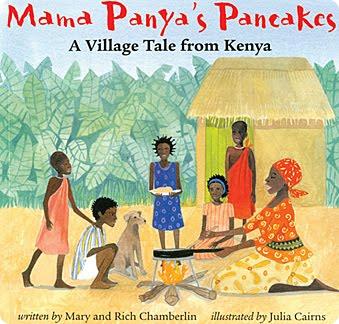
One such title is Mama Panya's Pancakes: A Village Tale from Kenya by Mary and Rich Chamberlin. Right from the start, you know you have a fun choice here, with its vibrant and colorful artwork that captures the look of village life. The characters are joyful and it shows, both through Julia Cairns' illustrations and through the spunky, lively text of the story itself. Mama Panya and little Adika are on their way to market to buy ingredients for pancakes. Along the way they run into a lot of friends and neighbors, and Adika just can't help inviting each and every one along for pancakes. Mama Panya is worried: will her flour stretch to make pancakes for everyone? Yet somehow "a little bit and a little bit more" becomes just enough! (Think "stone soup" and you'll get the drift.)
Mama Panya's Pancakes by Mary and Rich Chamberlin, published by Barefoot Books
Ages 4-8
Source: Library
Sample quote: "Mama tucked the package into her bag. 'Ai-Yi-Yi! You and I will be lucky to share half a pancake.'
'But Mama, we have a little bit and a little bit more.'"
Recommended
One such title is Mama Panya's Pancakes: A Village Tale from Kenya by Mary and Rich Chamberlin. Right from the start, you know you have a fun choice here, with its vibrant and colorful artwork that captures the look of village life. The characters are joyful and it shows, both through Julia Cairns' illustrations and through the spunky, lively text of the story itself. Mama Panya and little Adika are on their way to market to buy ingredients for pancakes. Along the way they run into a lot of friends and neighbors, and Adika just can't help inviting each and every one along for pancakes. Mama Panya is worried: will her flour stretch to make pancakes for everyone? Yet somehow "a little bit and a little bit more" becomes just enough! (Think "stone soup" and you'll get the drift.)
The authors have taken pains to add in aspects of Kenyan life and culture; especially thoughtful is the inclusion of various wildlife common to the Kenyan countryside. The post-story pages include quite a bit of information about language, geography and environment, and even feature a recipe for the titular pancakes (although they sound less like pancakes and more like flatbread similar to Ethiopian injera, but the target audience won't care about the semantics there).
I'm in no way an expert on Kenya, so I can't say for sure how culturally sound this tale is as a whole. Still, if you take it at face value, as a light and playful story about the importance of sharing and making room for others, there's a whole lot to like. The representations of the village and the process of walking to market give texture to the tale. Kids can see traditional homes and garb, from head scarfs to the robes worn by the cattle herders. It's quite nice too that the relationship between Mama Panya and Adika is never fully spelled out -- Mama Panya may in fact be Adika's birth parent, or a relative or neighbor who is caring for the young boy. The distinction isn't important, and that makes this a nice choice to read to an adopted child who may have been raised by a grandmother, aunt or other relative.
Sprout's a little young yet to sit still for this one, though he did have fun looking at the pictures and picking out the doggie who appears on nearly every page. Mama Panya would be a nice choice for storytime and a good jumping-off place to learn more about Kenya's history, culture and daily life.
Mama Panya's Pancakes by Mary and Rich Chamberlin, published by Barefoot Books
Ages 4-8
Source: Library
Sample quote: "Mama tucked the package into her bag. 'Ai-Yi-Yi! You and I will be lucky to share half a pancake.'
'But Mama, we have a little bit and a little bit more.'"
Recommended
Subscribe to:
Posts (Atom)