It's Day 15 of 30 Days of Diverse Picture Books. We're halfway through the series, can you believe it? What's your favorite title so far? I hope you've seen some old favorites as well as some new titles to add to your wish list!
Tonight's pick is one by the amazing author Jane Kurtz - one of her older titles, Faraway Home. We've read many of Jane's picture books and look forward to reading more, but I recently realized that somehow I've never reviewed any of her titles on the blog. (What the what?!? Fixing that now!) We feel a special connection to Jane because she grew up in Ethiopia, and is a fierce advocate for the country and its people. I especially admire her work for Ethiopia Reads.
Faraway Home is about Desta, an American-born girl whose father must return for a visit to Ethiopia because her grandmother is ill. Desta doesn't know Ethiopia and it makes her a little sad to hear the longing her father has for his homeland -- she's afraid her daddy won't return to America. But the more her father talks about the beautiful country, the more Desta is reassured, and the more she feels connected to the Ethiopia that lives in her too. Jane tells the story beautifully, thoughtfully and tenderly, and the breathtaking illustrations by E.B. Lewis evoke the spirit of the tale. This one always makes Sprout thoughtful as well, and I love to read it to reinforce his own ties to the land of his birth, which will always be in his heart.
Include Faraway Home in your collection for many reasons - its gentle reassurance, its exploration of the lives of immigrants, its celebration of family and connection. It's tough to get (come on, let's see this one back in print!) but well worth looking for!
Faraway Home by Jane Kurtz, published by Gulliver Books
Showing posts with label immigrants. Show all posts
Saturday, November 15, 2014
Sunday, November 24, 2013
30 Days of Picture Books - The Thanksgiving Door by Debby Atwell
It's Day 17 in our 30 Days of Picture Books. Today I'd like to share a Thanksgiving title that's new to us this year. I often see -- and pin -- fantastic lists of holiday books, the kinds of lists that are overflowing with awesome choices. I rarely create lists like that, though, because I'm always trying to find holiday titles that are diverse or multicultural in nature. And if you've been reading my blog long, you know books like that are few and far between. So generally when we do a holiday feature, it has some diversity included - makes for a smaller but more impactful list, I think.
Today's book is one I've heard about for a couple of years now but hadn't had a chance to read. I'm so glad we made the effort to seek it out this Thanksgiving though, because it was simply charming. Debby Atwell's The Thanksgiving Door is unique in that the action starts on the front cover of the book - you really need to focus on what's happening there in order to have context for later events, but that's all the spoiler I'm giving you. :)
The story focuses on Ed and Ann, an elderly couple who are all alone for Thanksgiving. Ann accidentally burns their dinner, and it looks like the holiday is going to be ruined. But then Ed decides the couple is going out to eat (taking a page from The Christmas Story, our favorite holiday movie!). They decide to try a new restaurant in the neighborhood - at first they aren't sure the place is serving, but the door was open, so they venture in. Well, actually the family that runs the place was having their own dinner, and some members are a bit dismayed to see guests. But Grandmother believes that hospitality is essential, especially on the family's first holiday in America, so the family welcomes Ed and Ann. And it's a wonderful, if unexpected, Thanksgiving for all!
This is such a heartwarming story of acceptance and inclusion, just right for Thanksgiving. The folk art-infused illustrations definitely add to the classic feel of the story, which would be a good choice to share with preschoolers on up. I love that both parties -- Ed and Ann, and the family -- were uncertain about accepting the other, but overcame their fears and uncertainties and let down their guard. Ed and Ann experience aspects of the family's culture (Atwell never specifies where they are from, just "the old country", but I'm guessing Ukranian?). And the family learns new things too, such as when Ann teaches everyone the conga. Now that's what a holiday should be.
Make the time to seek out The Thanksgiving Door -- it's a colorful and upbeat title that captures the true spirit of giving that is central to this winter holiday!
The Thanksgiving Door by Debby Atwell, published by Houghton Mifflin
Today's book is one I've heard about for a couple of years now but hadn't had a chance to read. I'm so glad we made the effort to seek it out this Thanksgiving though, because it was simply charming. Debby Atwell's The Thanksgiving Door is unique in that the action starts on the front cover of the book - you really need to focus on what's happening there in order to have context for later events, but that's all the spoiler I'm giving you. :)
The story focuses on Ed and Ann, an elderly couple who are all alone for Thanksgiving. Ann accidentally burns their dinner, and it looks like the holiday is going to be ruined. But then Ed decides the couple is going out to eat (taking a page from The Christmas Story, our favorite holiday movie!). They decide to try a new restaurant in the neighborhood - at first they aren't sure the place is serving, but the door was open, so they venture in. Well, actually the family that runs the place was having their own dinner, and some members are a bit dismayed to see guests. But Grandmother believes that hospitality is essential, especially on the family's first holiday in America, so the family welcomes Ed and Ann. And it's a wonderful, if unexpected, Thanksgiving for all!
This is such a heartwarming story of acceptance and inclusion, just right for Thanksgiving. The folk art-infused illustrations definitely add to the classic feel of the story, which would be a good choice to share with preschoolers on up. I love that both parties -- Ed and Ann, and the family -- were uncertain about accepting the other, but overcame their fears and uncertainties and let down their guard. Ed and Ann experience aspects of the family's culture (Atwell never specifies where they are from, just "the old country", but I'm guessing Ukranian?). And the family learns new things too, such as when Ann teaches everyone the conga. Now that's what a holiday should be.
Make the time to seek out The Thanksgiving Door -- it's a colorful and upbeat title that captures the true spirit of giving that is central to this winter holiday!
The Thanksgiving Door by Debby Atwell, published by Houghton Mifflin
Friday, March 29, 2013
Picture Book Review - The Quiet Place by Sarah Stewart
Once in a while you find a book that hits on all the right notes: gorgeous to look at, spectacularly written, sensitive, thoughtful and one your kiddo wants to hear over and over. It's rare, this type of book, I'm not going to kid you. It's especially rare to find one that fits the last criterion. Sprout tends to focus on books that are really energetic and lively, which is great of course, but doesn't always make for the most impactful choice.
And so it surprised me when he became especially taken with a book by one of my favorite author-illustrator duos, Sarah Stewart and David Small. Both have received numerous accolades for their work, together and separately. David Small's graphic memoir Stitches was a selection we read in my teen lit class last semester and it is probably the one that I found most haunting and memorable. And I've adored Sarah Stewart's body of work for a long time, so a new picture book from her was definitely going on my TBR list. But when I brought it home, Sprout seized it out of my read-and-review pile and appropriated it for bedtime reading almost immediately.
The Quiet Place is a story of immigration, of change and finding oneself in a world that's far from the familiar. Told through letters from Isabel to her Auntie Lupita back home in Mexico, the story begins with the illustrations - the opening endpapers show the family preparing to leave and then driving away from their village home. The first letter just after Isabel's family has crossed the border, and it's her first letter using the English words she's learned from Aunt Lupita. As we follow Isabel's story, we learn more of the things she misses, and of the new things she's discovering in this foreign life -- snow, for instance, a bright spot in the otherwise colorless world that seems to be Isabel's now.
Isabel yearns for a place that is her own, a quiet place, and her resourceful nature helps her come up with the perfect solution to make a retreat when she needs one. And gradually, bit by bit, Isabel finds that there is value not only in quiet, but in laughter and music and dancing and noise and life, the bursting new life that seems to be flowering all around her, almost without her notice. Though she misses Aunt Lupita fiercely, by the end of the book we know that Isabel will make her own way in America, and that the lives of those she meets will be all the richer for it.
I love this book, not only because of its theme but because of the perfect symbiosis between picture and story. In the best picture books, you cannot separate the two forms of art without a loss to the tale they are telling, and that's certainly the case here. What Stewart's perfectly chosen words hint at, Small's nuanced illustrations embody, and vice versa. Isabel as a character comes alive through the missives she pens to her aunt, but what she doesn't write down is ours to peek into anyway -- her reticence to join in a birthday part, her wistfulness while watching Fourth of July fireworks. Though her heart is always partly home in Mexico, Isabel's joy slowly comes alive in her new home, which is a thrill to witness.
Though I'm sure most of the deeper themes about immigration and identity went right past my almost-four-year-old, Sprout displayed a real sensitivity toward this book. And therein lies a lesson, my friends -- don't hold back the good stuff from your little ones just because you think they aren't ready. They are often old souls, our children, and fine books like The Quiet Place may touch them deeply in a place even their parents cannot entirely understand.
The Quiet Place by Sarah Stewart, published by Farrar Straus Giroux
Ages 4-10
Source: Library
Sample: "The spots on this letter are from my tears. A big storm blew across Lake Michigan yesterday. I had left my box outside and the rain ruined it. So many new things are in my life, not just new words but new people and new places. I loved how safe I felt in that box! Mother is letting me write this letter under the kitchen table. It isn't the same."
Recommended
Bonus: interview with Sarah Stewart and David Small about the inspiration for The Quiet Place
And so it surprised me when he became especially taken with a book by one of my favorite author-illustrator duos, Sarah Stewart and David Small. Both have received numerous accolades for their work, together and separately. David Small's graphic memoir Stitches was a selection we read in my teen lit class last semester and it is probably the one that I found most haunting and memorable. And I've adored Sarah Stewart's body of work for a long time, so a new picture book from her was definitely going on my TBR list. But when I brought it home, Sprout seized it out of my read-and-review pile and appropriated it for bedtime reading almost immediately.
Isabel yearns for a place that is her own, a quiet place, and her resourceful nature helps her come up with the perfect solution to make a retreat when she needs one. And gradually, bit by bit, Isabel finds that there is value not only in quiet, but in laughter and music and dancing and noise and life, the bursting new life that seems to be flowering all around her, almost without her notice. Though she misses Aunt Lupita fiercely, by the end of the book we know that Isabel will make her own way in America, and that the lives of those she meets will be all the richer for it.
I love this book, not only because of its theme but because of the perfect symbiosis between picture and story. In the best picture books, you cannot separate the two forms of art without a loss to the tale they are telling, and that's certainly the case here. What Stewart's perfectly chosen words hint at, Small's nuanced illustrations embody, and vice versa. Isabel as a character comes alive through the missives she pens to her aunt, but what she doesn't write down is ours to peek into anyway -- her reticence to join in a birthday part, her wistfulness while watching Fourth of July fireworks. Though her heart is always partly home in Mexico, Isabel's joy slowly comes alive in her new home, which is a thrill to witness.
Though I'm sure most of the deeper themes about immigration and identity went right past my almost-four-year-old, Sprout displayed a real sensitivity toward this book. And therein lies a lesson, my friends -- don't hold back the good stuff from your little ones just because you think they aren't ready. They are often old souls, our children, and fine books like The Quiet Place may touch them deeply in a place even their parents cannot entirely understand.
The Quiet Place by Sarah Stewart, published by Farrar Straus Giroux
Ages 4-10
Source: Library
Sample: "The spots on this letter are from my tears. A big storm blew across Lake Michigan yesterday. I had left my box outside and the rain ruined it. So many new things are in my life, not just new words but new people and new places. I loved how safe I felt in that box! Mother is letting me write this letter under the kitchen table. It isn't the same."
Recommended
Bonus: interview with Sarah Stewart and David Small about the inspiration for The Quiet Place
Labels:
family,
friendship,
girls,
identity,
immigrants,
loss,
Mexico,
picture book
Friday, February 8, 2013
3 Terrific Chapter Books for Chinese New Year!
It's almost Chinese New Year! Sprout has a sort of horrified fascination with snakes at the moment, and when I told him this coming year was the Year of the Snake he wasn't sure whether to be thrilled or freaked out (Mama is definitely in the latter camp).
Last year we shared some great picture books for Chinese New Year, so this year I thought it would be fun to feature books for slightly older readers. Because let's remember that these sorts of celebrations aren't just for the youngest set - there's all kinds of celebratory fun to be had for older kids, teens and adults too. And as I pointed out last year, it's really important to choose selections that have cultural accuracy, in order to share with our kiddos the most authentic view of the holiday and the cultures that celebrate the Lunar New Year.
First up is Laurence Yep's The Star Maker. Yep is a prolific author with many award-winning books to his credit, including historical fiction and fantasy titles as well. In The Star Maker, Yep gives us the story of Artie, whose desire to fit in with his obnoxious cousin Petey leads him to make a rather rash promise - that he'll supply firecrackers for Chinese New Year for all the cousins. Now Artie has to figure out how to come up with all the money to pay for it. And he thinks he has the solution in his Uncle Chester; now if only Uncle Chester will come through. Set in 1953 in Chinatown, The Star Maker is a slice of life that kids will thoroughly enjoy. Even better, the fast pace and realistic conflicts makes it a perfect choice for those just transitioning into more advanced chapters.
Up next is Grace Lin, one of my favorite authors, and her novel The Year of the Dog. Pacy is excited because this is supposed to be the year she finds her special talent. What will it be? She has no idea, but she does know this is going to be a lucky year when she makes friends with Melody, who is Taiwanese just like Pacy. As the two girls get into trouble, have adventures, and work hard to find Pacy's talent, they learn about friendship, family, and the process of finding yourself when you have a foot in two cultures. This is a great book for readers who love stories about bright, determined heroines - and look for more of Pacy's adventures in The Year of the Rat and Dumpling Days.
Lensey Namioka has written a series of chapter books about the Yang family; while none of them focus specifically on Chinese New Year, they all provide an excellent perspective, that of a family of Chinese immigrants navigating life in America. In the first novel in the series, Yang the Youngest and His Terrible Ear, we hear the story of Yingtao, the only untalented member in a family of brilliant musicians. Yingtao is struggling to fit in not only at home but also in this strange new American life, where even his name is hard for Americans to understand. But Yingtao soon makes a friend and finds an activity he's truly passionate about -- only it isn't the violin. This is a well-written story of identity and individuation, and kids will understand Yingtao's twin desires to be himself without disappointing his family.
What are your favorite novels for Chinese New Year? We'd love to hear how you celebrate the holiday, and what traditions are most important to you and your family. We hope books are part of the fun!
Last year we shared some great picture books for Chinese New Year, so this year I thought it would be fun to feature books for slightly older readers. Because let's remember that these sorts of celebrations aren't just for the youngest set - there's all kinds of celebratory fun to be had for older kids, teens and adults too. And as I pointed out last year, it's really important to choose selections that have cultural accuracy, in order to share with our kiddos the most authentic view of the holiday and the cultures that celebrate the Lunar New Year.
First up is Laurence Yep's The Star Maker. Yep is a prolific author with many award-winning books to his credit, including historical fiction and fantasy titles as well. In The Star Maker, Yep gives us the story of Artie, whose desire to fit in with his obnoxious cousin Petey leads him to make a rather rash promise - that he'll supply firecrackers for Chinese New Year for all the cousins. Now Artie has to figure out how to come up with all the money to pay for it. And he thinks he has the solution in his Uncle Chester; now if only Uncle Chester will come through. Set in 1953 in Chinatown, The Star Maker is a slice of life that kids will thoroughly enjoy. Even better, the fast pace and realistic conflicts makes it a perfect choice for those just transitioning into more advanced chapters.
Up next is Grace Lin, one of my favorite authors, and her novel The Year of the Dog. Pacy is excited because this is supposed to be the year she finds her special talent. What will it be? She has no idea, but she does know this is going to be a lucky year when she makes friends with Melody, who is Taiwanese just like Pacy. As the two girls get into trouble, have adventures, and work hard to find Pacy's talent, they learn about friendship, family, and the process of finding yourself when you have a foot in two cultures. This is a great book for readers who love stories about bright, determined heroines - and look for more of Pacy's adventures in The Year of the Rat and Dumpling Days.
Lensey Namioka has written a series of chapter books about the Yang family; while none of them focus specifically on Chinese New Year, they all provide an excellent perspective, that of a family of Chinese immigrants navigating life in America. In the first novel in the series, Yang the Youngest and His Terrible Ear, we hear the story of Yingtao, the only untalented member in a family of brilliant musicians. Yingtao is struggling to fit in not only at home but also in this strange new American life, where even his name is hard for Americans to understand. But Yingtao soon makes a friend and finds an activity he's truly passionate about -- only it isn't the violin. This is a well-written story of identity and individuation, and kids will understand Yingtao's twin desires to be himself without disappointing his family.
What are your favorite novels for Chinese New Year? We'd love to hear how you celebrate the holiday, and what traditions are most important to you and your family. We hope books are part of the fun!
Friday, December 7, 2012
Chapter Book Review - A Long Walk to Water by Linda Sue Park
It's the holiday season, and at this time of year thoughts naturally turn to all we have to do. Gifts to make or buy (and wrap), rooms to clean, meals to prepare, cards to send -- it can get a little bit overwhelming and crazy. I myself am very far behind this year. Though we have our Christmas tree up, I've yet to even order cards and still have quite a bit to do on holiday gifts. And like most Americans, these are things that seem important to me.
Until I stop to consider the daily reality of most people around the globe. To them, priorities like trimming the Christmas tree or baking cookies aren't even on the radar. Instead, they're laboring every day for food, for shelter, for clean water and for safety for their children. And that thought humbles me, as it does every time I open my cupboards and find them full of food, or look through my closet and consider all I have to wear. It humbles me, and it makes me mindful of all I have that others do not.
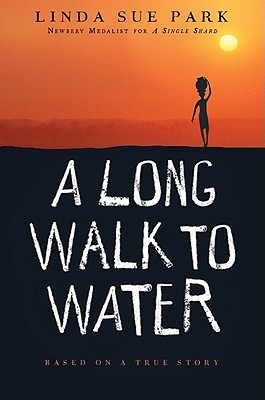
That thought was ever-present in my mind as I read Linda Sue Park's short but powerful novel A Long Walk to Water. Park based her book on the real-life experiences of Sudanese-born Salva Dut. The novel opens in 1985, when Salva is eleven, on a regular school day. Suddenly rebel forces open fire and the students are forced to flee into the bush, leaving their families behind. In the ensuing scuffle, Salva ends up being left behind by the group of survivors. Alone, he struggles to find safety, looking for news of his family and village as he walks to who-knows-where. Along the way he encounters many who are kind and helpful, some who mean him harm, and much tragedy. Even when Salva finds shelter in a refugee camp, the trouble isn't over, and it is many, many years before Salva will know what became of his loved ones on that terrible day.
Park intersperses Salva's story with that of modern-day Nya. Nya's tale is much shorter, but no less moving. We learn of the girl that much of her life revolves around water. The process of getting clean water for her family takes up an enormous amount of Nya's time, as she must travel many miles on foot each day, carrying a large plastic container on her head. Though at certain times Nya's family lives near a lake, the fighting between neighboring tribes means that it's only really possible to stay there during the dry season, when the warring factions are preoccupied with survival. The rest of the year, Nya must walk to water, and doing so is consuming her life and that of her friends as well.
The stories of Salva and Nya are different but parallel, and when Park draws the two disparate threads together it is with a satisfying sense of rightness. Though sparely written, A Long Walk to Water is emotionally charged, and readers will feel a connection to both main characters from the first page on. Park's voice throughout this novel is respectful but never patronizing. While we empathize with the situation, Park never makes either character an object of pity but instead helps readers to recognize the extraordinary dignity and strength that both Nya and Salva display. You cannot help but be moved by this story -- as I envison Nya walking miles each day to gather water that is very likely contaminated, my heart simply breaks.
In reading Salva's story, kids will be inspired to action, to find out how they can help provide clean water for those in Sudan and so many other nations around the world. Salva Dut's organization Water for South Sudan is doing amazing work providing safe drinking water and changing lives. This holiday season, as you make your gift list, consider adding the gift of clean water for someone you've never met -- I guarantee it will be a gift that is never forgotten.
A Long Walk to Water by Linda Sue Park, published by Clarion Books
Ages 8-12
Source: Library
Sample: "The water that filled the hole was filthy, more mud than liquid. It seeped in so slowly that it took a long time to collect even a few gourdsful. Nya would crouch by the hole, waiting. / Waiting for water. Here, for hours at a time. And every day for five long months, until the rains came and she and her family could return home."
Recommended
Bonus: Linda Sue Park and Salva Dut discuss the book and the mission of Water for South Sudan
Until I stop to consider the daily reality of most people around the globe. To them, priorities like trimming the Christmas tree or baking cookies aren't even on the radar. Instead, they're laboring every day for food, for shelter, for clean water and for safety for their children. And that thought humbles me, as it does every time I open my cupboards and find them full of food, or look through my closet and consider all I have to wear. It humbles me, and it makes me mindful of all I have that others do not.
That thought was ever-present in my mind as I read Linda Sue Park's short but powerful novel A Long Walk to Water. Park based her book on the real-life experiences of Sudanese-born Salva Dut. The novel opens in 1985, when Salva is eleven, on a regular school day. Suddenly rebel forces open fire and the students are forced to flee into the bush, leaving their families behind. In the ensuing scuffle, Salva ends up being left behind by the group of survivors. Alone, he struggles to find safety, looking for news of his family and village as he walks to who-knows-where. Along the way he encounters many who are kind and helpful, some who mean him harm, and much tragedy. Even when Salva finds shelter in a refugee camp, the trouble isn't over, and it is many, many years before Salva will know what became of his loved ones on that terrible day.
Park intersperses Salva's story with that of modern-day Nya. Nya's tale is much shorter, but no less moving. We learn of the girl that much of her life revolves around water. The process of getting clean water for her family takes up an enormous amount of Nya's time, as she must travel many miles on foot each day, carrying a large plastic container on her head. Though at certain times Nya's family lives near a lake, the fighting between neighboring tribes means that it's only really possible to stay there during the dry season, when the warring factions are preoccupied with survival. The rest of the year, Nya must walk to water, and doing so is consuming her life and that of her friends as well.
The stories of Salva and Nya are different but parallel, and when Park draws the two disparate threads together it is with a satisfying sense of rightness. Though sparely written, A Long Walk to Water is emotionally charged, and readers will feel a connection to both main characters from the first page on. Park's voice throughout this novel is respectful but never patronizing. While we empathize with the situation, Park never makes either character an object of pity but instead helps readers to recognize the extraordinary dignity and strength that both Nya and Salva display. You cannot help but be moved by this story -- as I envison Nya walking miles each day to gather water that is very likely contaminated, my heart simply breaks.
In reading Salva's story, kids will be inspired to action, to find out how they can help provide clean water for those in Sudan and so many other nations around the world. Salva Dut's organization Water for South Sudan is doing amazing work providing safe drinking water and changing lives. This holiday season, as you make your gift list, consider adding the gift of clean water for someone you've never met -- I guarantee it will be a gift that is never forgotten.
A Long Walk to Water by Linda Sue Park, published by Clarion Books
Ages 8-12
Source: Library
Sample: "The water that filled the hole was filthy, more mud than liquid. It seeped in so slowly that it took a long time to collect even a few gourdsful. Nya would crouch by the hole, waiting. / Waiting for water. Here, for hours at a time. And every day for five long months, until the rains came and she and her family could return home."
Recommended
Bonus: Linda Sue Park and Salva Dut discuss the book and the mission of Water for South Sudan
Labels:
Africa,
boys,
family,
immigrants,
middle grade,
novel,
refugee,
Sudan,
water
Wednesday, November 21, 2012
30 Days of Picture Books - Balloons Over Broadway by Melissa Sweet
It's Day 21 of Picture Book Month and today I'm thinking about tradition. Picture books are a great way to bolster traditions and help celebrate new ones. As far as Thanksgiving goes, the Macy's Thanksgiving Day Parade makes the holiday for a lot of people, myself among them. I remember sitting with my dad on the sofa watching the parade on TV, with the smell of turkey wafting through from the kitchen and the promise of family coming later in the day. Those Thanksgiving mornings are indelibly etched on my memory, and I know I'm not the only one who feels that way.
Sprout's never seen the Macy's Parade -- we don't have cable -- and so I wasn't sure if the pick for today would really speak to him. But I needn't have worried, because he loves parades. Who doesn't, really? The festivity, the color and music and pageantry of it all. When I took Melissa Sweet's Balloons over Broadway: The True Story of the Puppeteer of Macy's Parade off the stack tonight, and told him it was about parades and balloons, that was all it took to pique his interest.
Sweet's book, which she wrote and illustrated and which has garnered a number of awards (including the Sibert Award, given for nonfiction), is many things. It's history and memoir, telling the story of puppeteer Tony Sarg and his quest to bring puppets to the Macy's Parade. It's inspiration, as we follow Tony's efforts, culminating in the unveiling of the amazing balloons that graced the Parade in 1928, and made balloons a centerpiece even of today's parades. And it's art, filled with incredible mixed-media illustrations that tell Tony's story and give even the most faraway readers a hint of the magic of the Macy's Thanksgiving Day Parade.
Balloons Over Broadway is a great example of some of the wonderful nonfiction available for kids, books that are impeccably researched and bursting with life. Teachers and parents who want to use this title to inspire art projects will find ample fodder for discussing invention and creation with kids; I can absolutely see this as a take-off for making puppets inspired by Tony's outstanding artwork (check out the author's website for loads of links related to this and her other titles).
For his part, Sprout was very intrigued by the notion of marionettes, which I realized that he'd never seen either, so we'll be hunting down an opportunity to watch some in action. And I wish I'd had a camera at the ready as we were reading the book the first time -- when I flipped to the page where Tony's first balloon takes flight over the street below, his jaw dropped wide open in complete amazement.
So as you watch the parade tomorrow, give a thought to Tony Sarg, whose vision and talented team of assistants brought the balloons to Broadway. Rest in peace, Mr. Sarg; our holidays are all the more magical because you were here.
Balloons Over Broadway: The True Story of the Puppeteer of Macy's Parade by Melissa Sweet, published by Houghton Mifflin
Sprout's never seen the Macy's Parade -- we don't have cable -- and so I wasn't sure if the pick for today would really speak to him. But I needn't have worried, because he loves parades. Who doesn't, really? The festivity, the color and music and pageantry of it all. When I took Melissa Sweet's Balloons over Broadway: The True Story of the Puppeteer of Macy's Parade off the stack tonight, and told him it was about parades and balloons, that was all it took to pique his interest.
Sweet's book, which she wrote and illustrated and which has garnered a number of awards (including the Sibert Award, given for nonfiction), is many things. It's history and memoir, telling the story of puppeteer Tony Sarg and his quest to bring puppets to the Macy's Parade. It's inspiration, as we follow Tony's efforts, culminating in the unveiling of the amazing balloons that graced the Parade in 1928, and made balloons a centerpiece even of today's parades. And it's art, filled with incredible mixed-media illustrations that tell Tony's story and give even the most faraway readers a hint of the magic of the Macy's Thanksgiving Day Parade.
Balloons Over Broadway is a great example of some of the wonderful nonfiction available for kids, books that are impeccably researched and bursting with life. Teachers and parents who want to use this title to inspire art projects will find ample fodder for discussing invention and creation with kids; I can absolutely see this as a take-off for making puppets inspired by Tony's outstanding artwork (check out the author's website for loads of links related to this and her other titles).
For his part, Sprout was very intrigued by the notion of marionettes, which I realized that he'd never seen either, so we'll be hunting down an opportunity to watch some in action. And I wish I'd had a camera at the ready as we were reading the book the first time -- when I flipped to the page where Tony's first balloon takes flight over the street below, his jaw dropped wide open in complete amazement.
So as you watch the parade tomorrow, give a thought to Tony Sarg, whose vision and talented team of assistants brought the balloons to Broadway. Rest in peace, Mr. Sarg; our holidays are all the more magical because you were here.
Balloons Over Broadway: The True Story of the Puppeteer of Macy's Parade by Melissa Sweet, published by Houghton Mifflin
Monday, November 12, 2012
30 Days of Picture Books - Thanksgiving Titles
Today is Day 12 of Picture Book Month, and since we're heading into the holiday season, it seems like a good time to share some titles to get you in the festive mood. But I can't quite bring myself to jump right over Thanksgiving, no matter how much the retailers seem to want us to. Thanksgiving is a great time to talk and think about everything we have in our lives that so richly blesses us.
And what could be a better way to be thankful than with some tremendous picture books? As is the case with so many holidays, it's not easy to find multicultural titles for Thanksgiving -- but we managed to find a few that round out the experience by helping us look at the holiday with a fresh perspective.
First up is Gracias the Thanksgiving Turkey by Joy Cowley. I love this book for its humor and heart as well as the colorful illustrations by Joe Cepeda. In the story, Miguel's Papa, a long-haul trucker, sends home a live turkey for the family to fatten up for Thanksgiving dinner. Miguel names the turkey Gracias, and as you might expect, he's reluctant to make her a meal when the time comes around. Still, Miguel's grandfather's all for putting Gracias on the turkey platter - but an unexpected intervention from the parish priest saves Gracias at the last minute. There are lots of great lessons here, including the importance of friendship and responsibility, and plenty to talk and think about.
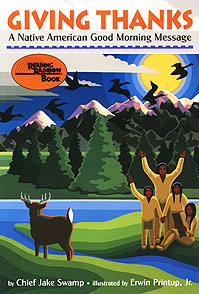
Next is Giving Thanks by Chief Jake Swamp, illustrated by Erwin Printup Jr. Subtitled A Native American Good Morning Message, this isn't a title that should be restricted to Thanksgiving, but with the spirit of gratitude we all have in our hearts at this time of year, it seems a good fit. The text is clear and simple, filled with appreciation for all the beauty and bounty in the natural world around us. And the illustrations are just breathtaking - vibrant and warm, simple and yet full of emotional depth. Best of all, this title is free of some of the most persistent stereotypical images we find in so many Thanksgiving books, and it reinforces the idea that we all have much to be thankful for.
If pilgrims are on your mind, why not check out Molly's Pilgrim? This is an older title, written by Barbara Cohen and most recently illustrated by Daniel Mark Duffy. Though its cover is somewhat subdued (albeit beautiful), the message behind it is a fantastic one. Molly and her parents are from Russia, having come to America for freedom after the Cossacks sacked their village and burned out many other Jewish families. When Molly is assigned a project to make a pilgrim woman for the school Thanksgiving display, Molly's mama makes one that looks just like her. But it doesn't look like the pilgrims in Molly's textbooks. Will the other girls make fun of Molly for this, like they do for so many other things? A tale of inclusion and acceptance, this story speaks volumes, especially to those new to the tradition of American Thanksgiving.
Tradition is what you make it, wouldn't you agree? Still, it's hard when your family doesn't go along with what everyone else does. That's the conflict at the center of Duck for Turkey Day by Jacqueline Jules, illustrated by Kathryn Mitter. Tuyet is excited to be celebrating Thanksgiving with her family, especially her cousins and her grandmother from Viet Nam. But she's a little upset that the family will be having duck for dinner, not turkey, as she's sure everyone else will be having. Tuyet tries to talk the problem over with her mother and grandmother, but they are sticking to their guns - and Tuyet has to admit that the duck with its spicy sauce is pretty tasty. But what will happen when she tells her friends at school that her family didn't have turkey? An unexpected ending to this tale not only reassures but also confirms that there's no one right way to celebrate!
This year, add a little extra flavor to your celebration with one of these great multicultural titles -- and make it a truly American Thanksgiving!
And what could be a better way to be thankful than with some tremendous picture books? As is the case with so many holidays, it's not easy to find multicultural titles for Thanksgiving -- but we managed to find a few that round out the experience by helping us look at the holiday with a fresh perspective.
First up is Gracias the Thanksgiving Turkey by Joy Cowley. I love this book for its humor and heart as well as the colorful illustrations by Joe Cepeda. In the story, Miguel's Papa, a long-haul trucker, sends home a live turkey for the family to fatten up for Thanksgiving dinner. Miguel names the turkey Gracias, and as you might expect, he's reluctant to make her a meal when the time comes around. Still, Miguel's grandfather's all for putting Gracias on the turkey platter - but an unexpected intervention from the parish priest saves Gracias at the last minute. There are lots of great lessons here, including the importance of friendship and responsibility, and plenty to talk and think about.
Next is Giving Thanks by Chief Jake Swamp, illustrated by Erwin Printup Jr. Subtitled A Native American Good Morning Message, this isn't a title that should be restricted to Thanksgiving, but with the spirit of gratitude we all have in our hearts at this time of year, it seems a good fit. The text is clear and simple, filled with appreciation for all the beauty and bounty in the natural world around us. And the illustrations are just breathtaking - vibrant and warm, simple and yet full of emotional depth. Best of all, this title is free of some of the most persistent stereotypical images we find in so many Thanksgiving books, and it reinforces the idea that we all have much to be thankful for.
If pilgrims are on your mind, why not check out Molly's Pilgrim? This is an older title, written by Barbara Cohen and most recently illustrated by Daniel Mark Duffy. Though its cover is somewhat subdued (albeit beautiful), the message behind it is a fantastic one. Molly and her parents are from Russia, having come to America for freedom after the Cossacks sacked their village and burned out many other Jewish families. When Molly is assigned a project to make a pilgrim woman for the school Thanksgiving display, Molly's mama makes one that looks just like her. But it doesn't look like the pilgrims in Molly's textbooks. Will the other girls make fun of Molly for this, like they do for so many other things? A tale of inclusion and acceptance, this story speaks volumes, especially to those new to the tradition of American Thanksgiving.
Tradition is what you make it, wouldn't you agree? Still, it's hard when your family doesn't go along with what everyone else does. That's the conflict at the center of Duck for Turkey Day by Jacqueline Jules, illustrated by Kathryn Mitter. Tuyet is excited to be celebrating Thanksgiving with her family, especially her cousins and her grandmother from Viet Nam. But she's a little upset that the family will be having duck for dinner, not turkey, as she's sure everyone else will be having. Tuyet tries to talk the problem over with her mother and grandmother, but they are sticking to their guns - and Tuyet has to admit that the duck with its spicy sauce is pretty tasty. But what will happen when she tells her friends at school that her family didn't have turkey? An unexpected ending to this tale not only reassures but also confirms that there's no one right way to celebrate!
This year, add a little extra flavor to your celebration with one of these great multicultural titles -- and make it a truly American Thanksgiving!
Monday, October 29, 2012
Picture Book Review - A Picnic in October by Eve Bunting
As I'm typing this, we're hearing about Hurricane Sandy hammering the East Coast, specifically the Northeast. So far it appears that all our friends and loved ones are safe, hunkered down somewhere and riding out the storm. It seems a little surreal to be writing about a book set in New York, knowing that so many are experiencing a day that's far outside the norms for October weather. Here's hoping everyone is doing well and reading books by candlelight!
And what's better to share as a family than a picture book by the always magnificent Eve Bunting? I've written before about how much I love her sensitive, thoughtful titles, and A Picnic in October is no exception. In this intergenerational story, we meet a family who is headed out to Liberty Island for a very special birthday picnic. Tony's not too thrilled about it, though it's a yearly tradition - he thinks it would be much better to do something else for Grandma's birthday, or maybe to have a picnic in the summertime. But "this is the way Grandma wants it," Tony's mom says, and so that's what the family does.
Gathering all their picnic gear, including chairs, blankets and loads of food, the family makes their way to catch the ferry to the Statue of Liberty's home grounds. Tony's cousins think this is a silly tradition too, especially since Grandma and Grandpa act so sappy in the ferry line. But all the way out to the island Tony can't stop thinking about his encounter with a lady and her family who were also waiting - with not much English, she didn't understand how the boat routes worked - and he's relieved when he sees that they made it on to the island as well, and are staring up at Lady Liberty. "The way they stand, so still, so respectful, so. . . so peaceful, makes me choke up." And suddenly Tony can see what his grandmother must feel, and why coming to this place is the only way she'll celebrate her birthday.
Once again, Bunting delivers a touching and heartfelt portrait of a family touched by immigration and their connection to their heritage. This is a realistic take on a family story -- it makes sense that the youngest generation wouldn't be as connected to the grandmother's feelings, but the representation of Tony seeing his grandmother's emotions personified in another family, from another place, is thoughtfully handled. The illustrations by Nancy Carpenter mirror the tone of the tale perfectly, as the soft brush strokes of the paintings reveal the emotions on every family member's face. Some spreads feel especially powerful - as we look down on the family picnicking in the sun at the statue's base, we get a sense of the enormity of this symbol in the lives of Tony's loved ones, and so many others.
This is an older title, as you'll note when you glimpse the NYC skyline, with the twin towers still very much in evidence. But the themes of family, patriotism and memory are perennial, and the story reads just as relevantly today as it did when it was first published, thirteen years ago. Share this with your kids for a discussion about immigration and identity - pair with books like Dan Yaccarino's All the Way to America or Jane Yolen's Naming Liberty for more stories about families coming to America but keeping ties to their past.
A Picnic in October by Eve Bunting, published by Harcourt Brace & Company
Ages 5-9
Source: Library
Sample: "The next ferry comes and we manage to squeeze on. I watch for the woman and her family, but they don't make it onto this boat. I hope they don't give up."
Recommended
Bonus: a video interview with Eve Bunting from Reading Rockets
And what's better to share as a family than a picture book by the always magnificent Eve Bunting? I've written before about how much I love her sensitive, thoughtful titles, and A Picnic in October is no exception. In this intergenerational story, we meet a family who is headed out to Liberty Island for a very special birthday picnic. Tony's not too thrilled about it, though it's a yearly tradition - he thinks it would be much better to do something else for Grandma's birthday, or maybe to have a picnic in the summertime. But "this is the way Grandma wants it," Tony's mom says, and so that's what the family does.
Gathering all their picnic gear, including chairs, blankets and loads of food, the family makes their way to catch the ferry to the Statue of Liberty's home grounds. Tony's cousins think this is a silly tradition too, especially since Grandma and Grandpa act so sappy in the ferry line. But all the way out to the island Tony can't stop thinking about his encounter with a lady and her family who were also waiting - with not much English, she didn't understand how the boat routes worked - and he's relieved when he sees that they made it on to the island as well, and are staring up at Lady Liberty. "The way they stand, so still, so respectful, so. . . so peaceful, makes me choke up." And suddenly Tony can see what his grandmother must feel, and why coming to this place is the only way she'll celebrate her birthday.
Once again, Bunting delivers a touching and heartfelt portrait of a family touched by immigration and their connection to their heritage. This is a realistic take on a family story -- it makes sense that the youngest generation wouldn't be as connected to the grandmother's feelings, but the representation of Tony seeing his grandmother's emotions personified in another family, from another place, is thoughtfully handled. The illustrations by Nancy Carpenter mirror the tone of the tale perfectly, as the soft brush strokes of the paintings reveal the emotions on every family member's face. Some spreads feel especially powerful - as we look down on the family picnicking in the sun at the statue's base, we get a sense of the enormity of this symbol in the lives of Tony's loved ones, and so many others.
This is an older title, as you'll note when you glimpse the NYC skyline, with the twin towers still very much in evidence. But the themes of family, patriotism and memory are perennial, and the story reads just as relevantly today as it did when it was first published, thirteen years ago. Share this with your kids for a discussion about immigration and identity - pair with books like Dan Yaccarino's All the Way to America or Jane Yolen's Naming Liberty for more stories about families coming to America but keeping ties to their past.
A Picnic in October by Eve Bunting, published by Harcourt Brace & Company
Ages 5-9
Source: Library
Sample: "The next ferry comes and we manage to squeeze on. I watch for the woman and her family, but they don't make it onto this boat. I hope they don't give up."
Recommended
Bonus: a video interview with Eve Bunting from Reading Rockets
Wednesday, July 4, 2012
Independence Day!
Happy Fourth of July everyone! It's early here still, and our plans for the day aren't really firmed up (much depends on the temperament of the little guy who woke up at 5 a.m.). But the sun is out, the birds are chirping and it's a lovely day for family and fun.
And books, of course - what's a holiday without books? Although we spend a lot of time celebrating Sprout's Ethiopian heritage through literature, it's also important for us that we teach him about his new homeland and its history. We want him to understand that our country was made great by hundreds of Americans who came here as immigrants, just as he did when we adopted him. This is truly a land of possibility!
This year I made it a point to seek out some titles with multicultural emphasis for Sprout. In Jan Spivey Gilchrist's My America, poetic verses laud not only the natural beauty of our country, but also the diversity found in our population. Each pages contains only a few words or phrases, made more impactful by the colorful, emotive illustrations done by Gilchrist and Coretta Scott King Honor winner Ashley Bryan. The pictures range from triumphant -- a bevy of multicolored birds soaring in the sky -- to contemplative -- a young girl in profile, braids fluttering in the breeze. On the last spread, Americans from a variety of ethnic backgrounds display their cultural heritage but are united by their entertwined hands, emphasizing that our greatest strength is in our diversity. A beautiful, simple book perfect for even the youngest children.
National Ambassador for Young People's Literature Walter Dean Myers offers "a tribute from the heart" in his book We Are America, illustrated by his son Christopher Myers. In his author's note, Myers explained how he was moved to write the book in the wake of September 11, when he felt he needed to make a deeper connection with the history of his country. "No words here have been penned lightly, no flag waved mindlessly." Myers writes. "This is simply my truest feelings for my country, my tribute to America." And it is a gorgeous tribute, comprised of Myers' free verse poems and Christopher Myers' stunning paintings. The entire range of the American experience is spoken to here, from that of immigrants coming to our shores to wars fought and freedoms gained. Though he doesn't gloss over the difficult points in our history, Myers finds much to celebrate in the hope, the possibility, that is America.
I've written about this before, but it bears repeating. Perhaps the most striking and emotional book I've read in years is Kadir Nelson's Heart and Soul: The Story of America and African Americans. Nelson's goal in writing this book was to tie the history of African Americans -- a history of injustice, suffering and division -- to the history of our nation, to explain how the experience of African Americans is truly the "heart and soul" of our country. This is an unflinching examination of our history, the struggle for equality and acceptance for all Americans. Nelson's was no easy task: finding a way to condense hundreds of years of experience into a cohesive and relatable narrative. But he accomplishes it amazingly well, presenting a book that does not shy from the difficult points yet also stresses the hope that imbued so many to fight for themselves and their children. You will be moved to tears at many points, whether from the poignancy of Nelson's first-person narrative or from his deeply beautiful portraits. This is a book that belongs on the shelf of every American, regardless of your culture or ethnicity.
As you celebrate our nation today, remember that it is a country made up of immigrants from all corners of the globe. Our diversity makes us not a melting pot but a patchwork, more beautiful for the unique contributions of each person who calls this land home. Happy Independence Day!
And books, of course - what's a holiday without books? Although we spend a lot of time celebrating Sprout's Ethiopian heritage through literature, it's also important for us that we teach him about his new homeland and its history. We want him to understand that our country was made great by hundreds of Americans who came here as immigrants, just as he did when we adopted him. This is truly a land of possibility!
This year I made it a point to seek out some titles with multicultural emphasis for Sprout. In Jan Spivey Gilchrist's My America, poetic verses laud not only the natural beauty of our country, but also the diversity found in our population. Each pages contains only a few words or phrases, made more impactful by the colorful, emotive illustrations done by Gilchrist and Coretta Scott King Honor winner Ashley Bryan. The pictures range from triumphant -- a bevy of multicolored birds soaring in the sky -- to contemplative -- a young girl in profile, braids fluttering in the breeze. On the last spread, Americans from a variety of ethnic backgrounds display their cultural heritage but are united by their entertwined hands, emphasizing that our greatest strength is in our diversity. A beautiful, simple book perfect for even the youngest children.
National Ambassador for Young People's Literature Walter Dean Myers offers "a tribute from the heart" in his book We Are America, illustrated by his son Christopher Myers. In his author's note, Myers explained how he was moved to write the book in the wake of September 11, when he felt he needed to make a deeper connection with the history of his country. "No words here have been penned lightly, no flag waved mindlessly." Myers writes. "This is simply my truest feelings for my country, my tribute to America." And it is a gorgeous tribute, comprised of Myers' free verse poems and Christopher Myers' stunning paintings. The entire range of the American experience is spoken to here, from that of immigrants coming to our shores to wars fought and freedoms gained. Though he doesn't gloss over the difficult points in our history, Myers finds much to celebrate in the hope, the possibility, that is America.
I've written about this before, but it bears repeating. Perhaps the most striking and emotional book I've read in years is Kadir Nelson's Heart and Soul: The Story of America and African Americans. Nelson's goal in writing this book was to tie the history of African Americans -- a history of injustice, suffering and division -- to the history of our nation, to explain how the experience of African Americans is truly the "heart and soul" of our country. This is an unflinching examination of our history, the struggle for equality and acceptance for all Americans. Nelson's was no easy task: finding a way to condense hundreds of years of experience into a cohesive and relatable narrative. But he accomplishes it amazingly well, presenting a book that does not shy from the difficult points yet also stresses the hope that imbued so many to fight for themselves and their children. You will be moved to tears at many points, whether from the poignancy of Nelson's first-person narrative or from his deeply beautiful portraits. This is a book that belongs on the shelf of every American, regardless of your culture or ethnicity.
As you celebrate our nation today, remember that it is a country made up of immigrants from all corners of the globe. Our diversity makes us not a melting pot but a patchwork, more beautiful for the unique contributions of each person who calls this land home. Happy Independence Day!
Friday, May 11, 2012
Nonfiction Picture Book - All the Way to America by Dan Yaccarino
Books come into our lives in lots of ways. Some speak to us through their cover art or we notice them because we're familiar with their creators. Others are the result of personal recommendations or reviews we read. And some just keep pushing their way into our consciousness - an author interview here, a prepub notice there, a prominent placement at the library.
Dan Yaccarino's All the Way to America was one of those insistent titles that kept cropping up in my travels through the kidlitosphere. I read a couple of reviews about the book and saw a book trailer. Then I read an interview Yaccarino did with Publisher's Weekly. Some of my favorite book bloggers started buzzing about the book. And then it kind of dropped off my radar, until I started reading best of the year lists. Lo and behold, that little story of a family that I'd heard about was gently edging its way onto those lists.
And for good reason.
Yaccarino calls this "the story of a big Italian family and a little shovel", and promises that "some parts have been condensed a bit, but it's all true. And all Italian." The story opens with Dan's great-grandfather Michele Iaccarino, growing up in Sorrento, Italy. Michele has a little shovel that he uses to till the earth, and he brings the shovel with him when he travels to America. He uses it at his job as a baker, then as a pushcart peddler. The shovel passes through the generations of the Iaccarino (now Yaccarino) family - Dan's grandfather Aniello, who owns a market and then a restaurant; his father Mike, who opens a barbershop; and on to Dan, who uses it even now to garden with his own children.
The story may be a familiar one but that just means that it resonates all the more with readers. I appreciate the fact that Yaccarino ties the shovel in to the work that each member of the family does, emphasizing not only the diversity of opportunities that was available to each generation of the Yaccarinos, but also the thread of family that ties each member together. The illustrations are vivid and interesting, fleshing out the story of the family with small details like the ever-present bowl of spaghetti with Mama Iaccarino's tomato sauce. Each spread is inviting, with lots of action and depth to the backgrounds that tell a tale all their own.
This is the kind of tale that makes it easy for kids to draw parallels with their own family history and introduce curiosity about how their own families got to the United States. It will also make them think about their own lives, and what pieces of their heritage might have been passed on from previous generations. While not every family has a little shovel (too bad, I think - what a great detail!), there are other inheritances, like red hair and freckles, or an aptitude for music, or a long-held secret recipe.
All the Way to America is one family's story, a variation on a theme that has occurred countless times in many places. And that, in a way, is its greatest strength - the quietly compelling thread of a narrative that makes one family unique. It's a journey you'll truly enjoy taking.
All the Way to America by Dan Yaccarino, published by Alfred A. Knopf
Ages 5-12
Source: Library
Sample; "Friends from home helped each other in this new country. Michael found work in a bakery owned by a man who had also come from Sorrento. Michael polished his little shovel till it shined and used it to measure out flour and sugar."
Recommended
Bonus: Dan Yaccarino's post on why picture books are important
Dan Yaccarino's All the Way to America was one of those insistent titles that kept cropping up in my travels through the kidlitosphere. I read a couple of reviews about the book and saw a book trailer. Then I read an interview Yaccarino did with Publisher's Weekly. Some of my favorite book bloggers started buzzing about the book. And then it kind of dropped off my radar, until I started reading best of the year lists. Lo and behold, that little story of a family that I'd heard about was gently edging its way onto those lists.
And for good reason.
Yaccarino calls this "the story of a big Italian family and a little shovel", and promises that "some parts have been condensed a bit, but it's all true. And all Italian." The story opens with Dan's great-grandfather Michele Iaccarino, growing up in Sorrento, Italy. Michele has a little shovel that he uses to till the earth, and he brings the shovel with him when he travels to America. He uses it at his job as a baker, then as a pushcart peddler. The shovel passes through the generations of the Iaccarino (now Yaccarino) family - Dan's grandfather Aniello, who owns a market and then a restaurant; his father Mike, who opens a barbershop; and on to Dan, who uses it even now to garden with his own children.
The story may be a familiar one but that just means that it resonates all the more with readers. I appreciate the fact that Yaccarino ties the shovel in to the work that each member of the family does, emphasizing not only the diversity of opportunities that was available to each generation of the Yaccarinos, but also the thread of family that ties each member together. The illustrations are vivid and interesting, fleshing out the story of the family with small details like the ever-present bowl of spaghetti with Mama Iaccarino's tomato sauce. Each spread is inviting, with lots of action and depth to the backgrounds that tell a tale all their own.
This is the kind of tale that makes it easy for kids to draw parallels with their own family history and introduce curiosity about how their own families got to the United States. It will also make them think about their own lives, and what pieces of their heritage might have been passed on from previous generations. While not every family has a little shovel (too bad, I think - what a great detail!), there are other inheritances, like red hair and freckles, or an aptitude for music, or a long-held secret recipe.
All the Way to America is one family's story, a variation on a theme that has occurred countless times in many places. And that, in a way, is its greatest strength - the quietly compelling thread of a narrative that makes one family unique. It's a journey you'll truly enjoy taking.
All the Way to America by Dan Yaccarino, published by Alfred A. Knopf
Ages 5-12
Source: Library
Sample; "Friends from home helped each other in this new country. Michael found work in a bakery owned by a man who had also come from Sorrento. Michael polished his little shovel till it shined and used it to measure out flour and sugar."
Recommended
Bonus: Dan Yaccarino's post on why picture books are important
Friday, March 30, 2012
Picture Book Review - Going Home by Eve Bunting
Picture books truly are a format that can work with any and all ages. For those who think they're only for the youngest child, I would counter that there are books that encompass the complexity and nuance of certain subjects every bit as well as chapter books or nonfiction. Of course, these selections need to be used with the right audience, but when chosen carefully, picture books shed new light on a topic or open up opportunities for critical thinking for children and adults alike.
A perfect example of this is the work by Eve Bunting and David Diaz. Never ones to shy away from a tough subject, Bunting and Diaz have produced some stunningly beautiful literary works. Their collaboration Smoky Night, written in response to the LA riots, won a Caldecott for its unique and dazzling illustrations, which underscore the tense, emotional plotline. One glimpse through this title and you'll see why it draws strong responses from its readers.
Going Home, their next book together, is a similar melding of thought-provoking text and complex, evocative illustrations. In the book, Carlos and his family are on their way home to Mexico for Christmas. The family hasn't been back since Mama and Papa left years before; though the parents are looking forward to going back, Carlos and his sisters really don't know what to expect. After all, California is home to them. It may not be perfect -- Papa and Mama must do backbreaking labor in the fields, and Carlos never seems to see the opportunities that immigration promised them -- but it's what the children know.
But now the world of their homeland begins to open up to the children. As they drive they see the land that their parents left behind, and it isn't what they expected. There is beauty here, lots of it: in the flowers and trees, in the buildings and little villages, in the faces of relatives and those who knew their parents, once upon a time. And most of all there is beauty in Mama and Papa, who come alive in this place in a way that Carlos and his sisters have never seen.
What Bunting and Diaz have created here is a masterful opening to any conversation about immigration and the experience of people who leave their home for another. We can approach this topic from a variety of ideologies, but one common root remains: the notion that finding oneself far from home is hard, no matter what the reasons are for leaving. For older children, pair this with a title like Return to Sender by Julia Alvarez; younger readers might be ready for Grandfather's Journey by Allan Say or La Mariposa by Francisco Jimenez, for a look at the immigrant experience.
Going Home by Eve Bunting and David Diaz, published by HarperCollins
Ages 6-10
Source: Library
Sample: "There is a wooden plow outside Grandfather's house. I remember when Mama and Papa saved the money for it. Later they also sent money for two oxen. I wonder where the oxen are and if we will be friends."
Recommended
Bonus: Video interview with Eve Bunting from Reading Rockets
A perfect example of this is the work by Eve Bunting and David Diaz. Never ones to shy away from a tough subject, Bunting and Diaz have produced some stunningly beautiful literary works. Their collaboration Smoky Night, written in response to the LA riots, won a Caldecott for its unique and dazzling illustrations, which underscore the tense, emotional plotline. One glimpse through this title and you'll see why it draws strong responses from its readers.
Going Home, their next book together, is a similar melding of thought-provoking text and complex, evocative illustrations. In the book, Carlos and his family are on their way home to Mexico for Christmas. The family hasn't been back since Mama and Papa left years before; though the parents are looking forward to going back, Carlos and his sisters really don't know what to expect. After all, California is home to them. It may not be perfect -- Papa and Mama must do backbreaking labor in the fields, and Carlos never seems to see the opportunities that immigration promised them -- but it's what the children know.
But now the world of their homeland begins to open up to the children. As they drive they see the land that their parents left behind, and it isn't what they expected. There is beauty here, lots of it: in the flowers and trees, in the buildings and little villages, in the faces of relatives and those who knew their parents, once upon a time. And most of all there is beauty in Mama and Papa, who come alive in this place in a way that Carlos and his sisters have never seen.
What Bunting and Diaz have created here is a masterful opening to any conversation about immigration and the experience of people who leave their home for another. We can approach this topic from a variety of ideologies, but one common root remains: the notion that finding oneself far from home is hard, no matter what the reasons are for leaving. For older children, pair this with a title like Return to Sender by Julia Alvarez; younger readers might be ready for Grandfather's Journey by Allan Say or La Mariposa by Francisco Jimenez, for a look at the immigrant experience.
Going Home by Eve Bunting and David Diaz, published by HarperCollins
Ages 6-10
Source: Library
Sample: "There is a wooden plow outside Grandfather's house. I remember when Mama and Papa saved the money for it. Later they also sent money for two oxen. I wonder where the oxen are and if we will be friends."
Recommended
Bonus: Video interview with Eve Bunting from Reading Rockets
Friday, March 16, 2012
Picture Book Review - Big Red Lollipop by Rukhsana Khan
Ah, birthday parties. Whether you lived through it yourself or via your own children (or both), most of us are familiar with the dynamic of birthday parties in elementary school. Who's coming and who's not, which of your friends are invited, what it feels like when you're included (elation!) and what it feels like when you're not (depression). For girls especially, this whole birthday party thing can take on a life of its own, and make or break you -- or so it seems.
In Big Red Lollipop, author Rukhsana Khan presents us with Rubina's dilemma: she's invited to her first-ever birthday party, but her mother insists she bring her little sister Sana along. Rubina protests, sure that her new friends won't understand, but Ami stands firm. Of course Rubina's friend says it's all right, but Sana doesn't know how to act at the party. Rubina's only consolation is the huge red lollipop that Sally's mom gives out as party favors. While Sana gobbles hers down right away, Rubina saves it for the next morning, dreaming all night about her sweet treat. But Sana manages to spoil that as well.
Rubina is so mad at Sana - about the lollipop, yes, but also for ruining Rubina's chances at being invited to more parties. Until Sana receives her own invitation to a party. . .
Lollipop is amazing on so many levels, and it is one of those rare titles that works for just about any child. In one sense, you have the sibling relationship: older sister plus pesky younger sister. The way Khan resolves the conflict is surprising, but completely perfect, and it speaks volumes about how we really should treat others. On another level, this is a story about fitting in: the cultural norms that Rubina's family is familiar with don't fit with the society they are living in. Rubina is caught between what the kids at school think is normal and what her mother wants her to do. And on yet another plane, this is a story about right and wrong - when doing what you want to do is not the best solution.
Wrap all that up in a multicultural package and you have a charming yet deep picture book. The illustrations by Sophie Blackall are beguiling in her signature fashion - colorful and energetic, simple and expressive, perfectly suited to Rukhsana Khan's story. I love the hidden depths that are hinted at in this one, something that the pictures really carry forth. There's a lot to think about here; this would be a perfect classroom pick as the possibilities for discussion are numerous.
Big Red Lollipop is the kind of book you need to read through more than once, for each time another aspect of the story reveals itself to you. Khan has given us a sensitive and thoughtful story that will make you laugh, and think, in equal measures. Don't miss this one!
Big Red Lollipop by Rukhsana Khan, illustrated by Sophie Blackall. Published by Viking
Ages 3-7
Source: Library
Sample: "I beg and plead, but Ami won't listen. I have no choice. I have to call. Sally says "All right." But it doesn't sound all right. I know she thinks I'm weird."
Bonus: check out this interview with Rukhsana Khan at Paper Tigers
In Big Red Lollipop, author Rukhsana Khan presents us with Rubina's dilemma: she's invited to her first-ever birthday party, but her mother insists she bring her little sister Sana along. Rubina protests, sure that her new friends won't understand, but Ami stands firm. Of course Rubina's friend says it's all right, but Sana doesn't know how to act at the party. Rubina's only consolation is the huge red lollipop that Sally's mom gives out as party favors. While Sana gobbles hers down right away, Rubina saves it for the next morning, dreaming all night about her sweet treat. But Sana manages to spoil that as well.
Rubina is so mad at Sana - about the lollipop, yes, but also for ruining Rubina's chances at being invited to more parties. Until Sana receives her own invitation to a party. . .
Lollipop is amazing on so many levels, and it is one of those rare titles that works for just about any child. In one sense, you have the sibling relationship: older sister plus pesky younger sister. The way Khan resolves the conflict is surprising, but completely perfect, and it speaks volumes about how we really should treat others. On another level, this is a story about fitting in: the cultural norms that Rubina's family is familiar with don't fit with the society they are living in. Rubina is caught between what the kids at school think is normal and what her mother wants her to do. And on yet another plane, this is a story about right and wrong - when doing what you want to do is not the best solution.
Wrap all that up in a multicultural package and you have a charming yet deep picture book. The illustrations by Sophie Blackall are beguiling in her signature fashion - colorful and energetic, simple and expressive, perfectly suited to Rukhsana Khan's story. I love the hidden depths that are hinted at in this one, something that the pictures really carry forth. There's a lot to think about here; this would be a perfect classroom pick as the possibilities for discussion are numerous.
Big Red Lollipop is the kind of book you need to read through more than once, for each time another aspect of the story reveals itself to you. Khan has given us a sensitive and thoughtful story that will make you laugh, and think, in equal measures. Don't miss this one!
Big Red Lollipop by Rukhsana Khan, illustrated by Sophie Blackall. Published by Viking
Ages 3-7
Source: Library
Sample: "I beg and plead, but Ami won't listen. I have no choice. I have to call. Sally says "All right." But it doesn't sound all right. I know she thinks I'm weird."
Bonus: check out this interview with Rukhsana Khan at Paper Tigers
Labels:
acceptance,
girls,
immigrants,
Muslim,
picture book,
siblings
Friday, January 6, 2012
Novel in Verse - Inside Out and Back Again by Thanhha Lai
Rarely am I at a loss to describe a book, or even to write a review of it.
Rarely does an author so take my breath away that upon finishing her work, I am immediately moved to reread it.
Rarely does a book like Thanhha Lai's come along.
If you haven't read a novel-in-verse, you may be put off by the format. I was, for a very long time, until reading Karen Hesse's Out of the Dust. In a word, that book was stunning - it captures the experience of living in Dust Bowl Oklahoma in a voice that is spare and beautiful. Since then I've read a few others, but none quite comes close to Lai's Inside Out and Back Again.
Lai's debut novel (winner of the National Book Award) is a story based on her own experience, that of ten-year-old Ha, who with her family escapes Saigon in the wake of the Vietnam War. Ha's life is marked by loss - her father went missing in action before Ha's first birthday, her mother has drawn gradually away with the stress of supporting the whole family. And now the war - Ha's best friend flees with her family, and the loss continues. At last it becomes clear that Ha's family also must go, but with no clear idea exactly where they will end up. The escape, the boat journey, the terror of floating aimlessly with no rescue in sight - this is all part of Ha's story, as is her arrival in a strange land called Alabama, where not even a taste of her favorite fruit can bring back the feeling of her homeland.
Lai tells Ha's story with a fierce tenderness that speaks to the personal nature of the tale. Her decision to write the novel in verse is, in my estimation, a brilliant one, as it allows for the kind of stark imagery that brings the entire experience to vivid life. Bursts of humor break the tension, but never do we forget that this is a journey not only of physicality, but also of identity and of learning to find one's place in a strange land.
Like Lai's prose, Ha herself instantly captures you. She's sneakily brilliant: on the first morning of the new year, Ha tells us, male feet should touch the floor first, for luck -- but Ha wants to be the first, so she creeps her toe out of the covers to tap the ground. She's determined: her strength shines through every line, every thought, every vignette. Though the world she knew gradually slips away from her, Ha clings to her faith in herself and her family. Never does her beautiful, bright determination waver, never does her spirit become worn away.
I read this in one quick burst -- I couldn't help it -- but then went back and read shorter portions, savoring the language, the imagery, the sense of place and time and personality. This is a gorgeously written portrait of a girl whose experience echoes over and over in refugees the world over. Absolutely compelling - one of my new favorites.
Inside Out and Back Again by Thanhha Lai, published by HarperCollins
Ages 9 up
Source: Library
Sample: "Water, water, water / everywhere / making me think / land is just something / I once knew / like / napping on a hammock / bathing without salt / watching Mother write / laughing for no reason / kicking up powdery dirt / and / wearing clean nightclothes / smelling of the sun."
Highly recommended
Bonus: Thanhha Lai's interview with Publisher's Weekly
Rarely does an author so take my breath away that upon finishing her work, I am immediately moved to reread it.
Rarely does a book like Thanhha Lai's come along.
If you haven't read a novel-in-verse, you may be put off by the format. I was, for a very long time, until reading Karen Hesse's Out of the Dust. In a word, that book was stunning - it captures the experience of living in Dust Bowl Oklahoma in a voice that is spare and beautiful. Since then I've read a few others, but none quite comes close to Lai's Inside Out and Back Again.
Lai's debut novel (winner of the National Book Award) is a story based on her own experience, that of ten-year-old Ha, who with her family escapes Saigon in the wake of the Vietnam War. Ha's life is marked by loss - her father went missing in action before Ha's first birthday, her mother has drawn gradually away with the stress of supporting the whole family. And now the war - Ha's best friend flees with her family, and the loss continues. At last it becomes clear that Ha's family also must go, but with no clear idea exactly where they will end up. The escape, the boat journey, the terror of floating aimlessly with no rescue in sight - this is all part of Ha's story, as is her arrival in a strange land called Alabama, where not even a taste of her favorite fruit can bring back the feeling of her homeland.
Lai tells Ha's story with a fierce tenderness that speaks to the personal nature of the tale. Her decision to write the novel in verse is, in my estimation, a brilliant one, as it allows for the kind of stark imagery that brings the entire experience to vivid life. Bursts of humor break the tension, but never do we forget that this is a journey not only of physicality, but also of identity and of learning to find one's place in a strange land.
Like Lai's prose, Ha herself instantly captures you. She's sneakily brilliant: on the first morning of the new year, Ha tells us, male feet should touch the floor first, for luck -- but Ha wants to be the first, so she creeps her toe out of the covers to tap the ground. She's determined: her strength shines through every line, every thought, every vignette. Though the world she knew gradually slips away from her, Ha clings to her faith in herself and her family. Never does her beautiful, bright determination waver, never does her spirit become worn away.
I read this in one quick burst -- I couldn't help it -- but then went back and read shorter portions, savoring the language, the imagery, the sense of place and time and personality. This is a gorgeously written portrait of a girl whose experience echoes over and over in refugees the world over. Absolutely compelling - one of my new favorites.
Inside Out and Back Again by Thanhha Lai, published by HarperCollins
Ages 9 up
Source: Library
Sample: "Water, water, water / everywhere / making me think / land is just something / I once knew / like / napping on a hammock / bathing without salt / watching Mother write / laughing for no reason / kicking up powdery dirt / and / wearing clean nightclothes / smelling of the sun."
Highly recommended
Bonus: Thanhha Lai's interview with Publisher's Weekly
Friday, December 23, 2011
12 Days of Christmas Picture Books - Yoon and the Christmas Mitten
Blending cultures is always a tricky thing. It's tough to know what customs to keep from one, which to add from another, and which to let go of. You want to honor everything, but sometimes it feels like our worlds are so full already, it can be hard to add more. This is especially true for holidays, I think, when another set of observances can make the celebration richer but at the same time more complex.
In Yoon and the Christmas Mitten by Helen Recorvits, Yoon's family is struggling with this very thing. Recent immigrants to the US from Korea, Yoon's parents are reluctant to embrace American traditions like Christmas, with its strange customs. Stockings by the chimney? Colored lights? Santa Claus? Yoon's father puts his foot down. "We are not a Christmas family," he tells her. But Yoon longs to experience all the things her classmates speak of, like decorating a tree and getting presents in her sock. On Christmas Eve Yoon decides to take action, hanging up her mitten so that Mr. Santa Claus can leave her a gift. And what a surprise Yoon gets, when somehow Santa finds her house even without the twinkling lights!
This book is simply beautiful, with breathtaking illustrations by Gabi Swiatkowska. Really, nothing I can say will do these pictures justice - you just have to see them for yourself. And the way Recorvits tells Yoon's story is something special indeed. While never devaluing the way Yoon's parents feel, she still captures Yoon's desire to have an American Christmas just like all the other kids do. The resulting compromise - the family still celebrates New Year, which is much more in line with their Korean traditions - shows that joining a new culture doesn't have to mean abandoning familiar customs.
When we brought our son into our family, we also gained a whole new culture. Now we love having two Christmases, two New Year's, and a host of other holidays along the way. Even if you don't have a direct link to another culture, it's fun to add in different observations, and a great reminder that we all come together in the joy of sharing celebrations.
In Yoon and the Christmas Mitten by Helen Recorvits, Yoon's family is struggling with this very thing. Recent immigrants to the US from Korea, Yoon's parents are reluctant to embrace American traditions like Christmas, with its strange customs. Stockings by the chimney? Colored lights? Santa Claus? Yoon's father puts his foot down. "We are not a Christmas family," he tells her. But Yoon longs to experience all the things her classmates speak of, like decorating a tree and getting presents in her sock. On Christmas Eve Yoon decides to take action, hanging up her mitten so that Mr. Santa Claus can leave her a gift. And what a surprise Yoon gets, when somehow Santa finds her house even without the twinkling lights!
This book is simply beautiful, with breathtaking illustrations by Gabi Swiatkowska. Really, nothing I can say will do these pictures justice - you just have to see them for yourself. And the way Recorvits tells Yoon's story is something special indeed. While never devaluing the way Yoon's parents feel, she still captures Yoon's desire to have an American Christmas just like all the other kids do. The resulting compromise - the family still celebrates New Year, which is much more in line with their Korean traditions - shows that joining a new culture doesn't have to mean abandoning familiar customs.
When we brought our son into our family, we also gained a whole new culture. Now we love having two Christmases, two New Year's, and a host of other holidays along the way. Even if you don't have a direct link to another culture, it's fun to add in different observations, and a great reminder that we all come together in the joy of sharing celebrations.
Monday, July 18, 2011
YA Review - The Day of the Pelican by Katherine Paterson
"Being deeply loved by someone gives you strength, while loving someone deeply gives you courage." (Lao Tzu)
Katherine Paterson's slim but affecting novel The Day of the Pelican embodies the very nature of Lao Tzu's words. In what seems somewhat of a departure for Paterson, this novel is set in Kosovo in 1998, during the conflict between Serbian and Albanian Kosovars. The story centers around almost twelve-year-old Meli Lleshi, an Albanian Kosovar who, with her family, is plunged into unexpected conflict when her brother Mehmet is captured by Serbian soldiers. Almost without warning the Lleshis are forced to flee their home, leaving behind everything they know and love. As the family struggles to survive, moving from one harrowing situation to another, their first priority is to keep everyone together at all costs. And then out of the blue everything changes again for the Lleshis as they immigrate to the US and face a whole new set of challenges, trying to reestablish themselves in a place both welcoming and frightening.
Meli's story is a harrowing yet uplifting one. It's difficult to read about the fallout from ethnic cleansing; in the hands of a lesser author, this could come across as a much different type of tale. But Paterson handles her subject matter deftly, always emphasizing the personal while not underplaying or misrepresenting the horrors ever present in this time and place. Paterson puts faces and names on the tragedies, helping readers to understand the reality that refugees face, whether in the Kosovar region or in other places, and the difficult if not impossible choices that must be made.
For me the most affecting part of the narrative came towards the end, when Meli and her family are living in the US and trying to adjust to their new reality. There are so many parallels between the struggles Meli and the other children face, and those of children newly adopted into American families. Cultural differences and uncertain mastery of a new language are only the tip of the iceberg. The Lleshi children also have to come to terms with the atrocities that they witnessed. This is especially true for Meli's brother Mehmet, whose experiences mark him as unusual in the eyes of his soccer teammates and other boys. Mehmet is angry, very angry, and Meli worries for him that he will never find peace within himself. Children born into countries where war and hunger and strife are the reality may identify with Mehmet especially, and understand how difficult it is for him to resolve his old life with this strange new American one.
If we are to change the world, we must first open our eyes to it, all of it. If we are to reach out to others, we must first know their heartache. The Day of the Pelican is a novel imbued with both heartache and hope, one that will speak to adults and children alike.
The Day of the Pelican by Katherine Paterson, published by Clarion Books
Ages 11 up
Source: Library
Sample quote: "'Once you've been in jail, you're not a kid anymore,' he replied, the words sending a chill up his sister's spine. He was no longer the brother she thought she knew. He didn't speak about that terrible time, but it had changed him. . . . Despite his squawky voice and smooth cheeks, Meli knew that he was becoming a man -- not the sort of kind, loving man that Baba was, but a secretive man with the sharp and watchful eyes of a blackbird."
Recommended
Meli's story is a harrowing yet uplifting one. It's difficult to read about the fallout from ethnic cleansing; in the hands of a lesser author, this could come across as a much different type of tale. But Paterson handles her subject matter deftly, always emphasizing the personal while not underplaying or misrepresenting the horrors ever present in this time and place. Paterson puts faces and names on the tragedies, helping readers to understand the reality that refugees face, whether in the Kosovar region or in other places, and the difficult if not impossible choices that must be made.
For me the most affecting part of the narrative came towards the end, when Meli and her family are living in the US and trying to adjust to their new reality. There are so many parallels between the struggles Meli and the other children face, and those of children newly adopted into American families. Cultural differences and uncertain mastery of a new language are only the tip of the iceberg. The Lleshi children also have to come to terms with the atrocities that they witnessed. This is especially true for Meli's brother Mehmet, whose experiences mark him as unusual in the eyes of his soccer teammates and other boys. Mehmet is angry, very angry, and Meli worries for him that he will never find peace within himself. Children born into countries where war and hunger and strife are the reality may identify with Mehmet especially, and understand how difficult it is for him to resolve his old life with this strange new American one.
If we are to change the world, we must first open our eyes to it, all of it. If we are to reach out to others, we must first know their heartache. The Day of the Pelican is a novel imbued with both heartache and hope, one that will speak to adults and children alike.
The Day of the Pelican by Katherine Paterson, published by Clarion Books
Ages 11 up
Source: Library
Sample quote: "'Once you've been in jail, you're not a kid anymore,' he replied, the words sending a chill up his sister's spine. He was no longer the brother she thought she knew. He didn't speak about that terrible time, but it had changed him. . . . Despite his squawky voice and smooth cheeks, Meli knew that he was becoming a man -- not the sort of kind, loving man that Baba was, but a secretive man with the sharp and watchful eyes of a blackbird."
Recommended
Subscribe to:
Posts (Atom)