Showing posts with label food. Show all posts

Wednesday, December 17, 2014

Picture Book Review - 'Twas Nochebuena by Roseanne Greenfield Thong

Christmas is a week away, can you believe it?? I'm in total shock. It feels like the past few weeks have just flown by, with a flurry of shopping, decorating and readying for all the events we've had going on. Last night was the Nativity play at Sprout's school, an absolutely terrific event that was full of just what you'd expect - a bit of confusion, some dropped lines, but lots of shining faces and kids singing enthusiastically with joy in their hearts. Such a special moment for us and for Sprout.


Tonight's pick is for all those who celebrate Christmas and want to add a bit of diversity into the mix. Roseanne Greenfield Thong is fast becoming one of my go-to authors for high-quality multicultural titles (in fact, I have two titles of her titles sitting on my desk at the moment!). And her new book 'Twas Nochebuena is just spectacular - a winner for Spanish-speakers as well as those who are still learning the language.

The story in 'Twas Nochebuena mirrors Clement C. Moore's poem 'Twas the Night Before Christmas, but puts an entirely fresh storyline in place. Gone are the nightcaps and that bowl full of jelly, to be replaced by farols and tamales. The heroine relates her family's Christmas tradition, making food together, decorating, visiting house to house, attending mass. The night culminates with fireworks, a midnight feast and lots of gifts. It's a joyous, exuberant celebration that readers will want to jump right into!

The festivities are captured by Thong's skillful rhymes, which integrate Spanish phrases into the text, allowing readers to discern meaning from context. That's a strategy I much prefer to the repetition that some books employ - I think this method makes books more accessible to all audiences. Sara Palacios did the illustrations for 'Twas Nochebuena and I *love* them. The tone is absolutely on-point: festive, fun, full of life and spirit, just like the holidays should be. Love the colors, the touches of collage, and the inclusion of multiracial families as well.

Add 'Twas Nochebuena to your holiday bookshelf and think about reading it as part of your Christmas Eve celebrations. Fair warning, though - you'll want to have champurrado (hot chocolate) close at hand!

'Twas Nochebuena by Roseanne Greenfield Thong, published by Viking
Ages 4-6
Source: Library
Recommended

Sunday, November 16, 2014

30 Days of Diverse Picture Books - What's So Yummy? by Robie H. Harris

Today's Day 16 of our 30 Days of Diverse Picture Books. Nope, we haven't run out of picks yet - in fact, as always with this series, I'm starting to wonder if I'll get everything included! 


Tonight's pick is nonfiction, and I chose this one specifically because I think it's important to remember that nonfiction choices should also be inclusive. It's really easy to focus on the topic and worry less about diversity when choosing informative titles, but in my opinion, we need to be just as mindful there, if not more so. Fortunately there are plenty of good choices, such as What's So Yummy? by Robie H. Harris. The latest entry in the Let's Talk About You and Me series by Harris and Nadine Bernard Westcott, this title focuses on healthy eating and exercise, so it's a great choice to share with preschoolers on up!

Harris writes What's So Yummy? with an informative yet never boring tone - including plenty of facts that kids will find intriguing. There's even a discussion of allergies, something Sprout found relevant as two of his best school friends have significant allergies. But for me the icing on the cake with this title is the pictures - the main characters are a transracial family, a huge bonus for us. And the background is populated with folks of different ages, races, genders, and abilities. It's really a lovely recognition of the fact that our world is diverse and books for children should acknowledge that, no matter what their topic.

Teachers, librarians and parents: you can't go wrong with any of the titles by Harris and Westcott, but What's So Yummy? is especially delightful. Hats off to quality, inclusive nonfiction!

What's So Yummy? by Robie H. Harris, published by Candlewick Press


Tuesday, March 11, 2014

I Am Latino: The Beauty in Me by Sandra L. & Myles C. Pinkney

Well hello again! Seems I took a bit of a blogging break the last couple of weeks, however unintentional. I've had a few other projects that have been taking up my attention. But no matter what, we're still reading, so I've got plenty of books to share.

Increasingly we're finding chapter books really capture Sprout's attention -- and yet, we still manage to check out the same huge load of picture books from the library, which thrills me no end. I honestly don't want to be one of those parents who pushes their child toward "serious" reading or toward one format of books over another. As I've shared before, Hubs grew up being not much of a reader, until he discovered graphic novels, and those have been his "gateway drug" into other forms of literature. So I happily check out whatever random pile of books catches Sprout's fancy on any given day, being sure to include a few of my own picks, however surreptitiously.

One thing I always try to do with our library selections is inject a good mix of diversity into our choices. No surprise there, right? But it does take work to make your bookshelves reflective of the world we live in -- because of course the titles that get the most press are those that make up the prevailing bulk of mainstream publishing, and that means white, white, white. So we all have to dig a little deeper and see what we can find to add some color to our reading selections. Fortunately, if you do look, it's possible to be rewarded with some excellent diverse kidlit without much effort.


One tip I like to share with parents and teachers is to find an author you like and then explore his/her catalog -- often writers who choose diverse subject matter or who populate their books with characters of color do so intentionally and thoughtfully, and their body of work usually demonstrates that. Today's book is one I came across because we've loved the previous collaborations by Sandra and Myles Pinkney. I Am Latino: The Beauty in Me doesn't disappoint, either -- it's every bit as stunning as their book Shades of Black, which is one of our all-time favorite titles.

In I Am Latino, the Pinkneys again turn their attention to a specific part of the population with a joyful celebration of the uniqueness of Latino people and culture. Framed around the concept of the senses, Sandra's poetic verse calls out ways to "sense the beauty", from the melody of language to the rhythm of music to the richness of foods. Myles again illustrates this title with his evocative photography, showing a diverse section of Latino boys and girls in situations that accent the story. Sprout's favorite photo is toward the end, where a young boy is smelling a plate of empanadas. "I bet those taste so so good, Mom!" he exclaimed the first time we read this (Hubs and I assured him he was right on the money there!).

I love I Am Latino not only because it introduces kids who aren't familiar with Latino culture to some basic traditions, but also because it's an affirmation for kids who see themselves in these pages.  Maybe they see the food their grandmother makes or have a family photo that resembles one in the book. Maybe they've never thought about what makes their heritage special, or maybe they've grown up with family members who keep them closely tied to their roots. It doesn't matter, really, because this title works on many levels for whoever is reading it. Ultimately, the Pinkneys' message through I Am Latino and their other books is that there's pride in heritage and being connected to your history. And also, that there's power in affirming the beauty we see around us.

You may not find I Am Latino readily available on your bookstore or library shelves. But take a little extra time to look for this one, regardless of your family background -- it's simple, strong and a great celebration of Latino heritage. This is a terrific title for even the youngest readers.

I Am Latino: The Beauty in Me by Sandra L. & Myles C. Pinkney, published by Little, Brown
All ages
Source: Library
Sample: "Use your senses. / You will see Beauty -- Magnificently / I am Latino. I am the Beauty!!!"
Recommended

Tuesday, November 12, 2013

30 Days of Picture Books - Creepy Carrots! by Aaron Reynolds

It's Day 5 of our 30 Days of Picture Books. We hope you've been enjoying the titles we've shared so far, and that you're as excited to see more as we are thrilled to be sharing them!


Today's pick could arguably be considered a Halloween book, and certainly is good for the times when you want to add a little thrill to storytime. I'm very glad we happened upon this title, because honestly it's not one that I probably would have picked out for us to read. Sprout tends to be a little hesitant with anything spooky or scary, so I would likely have passed this by. But when Aaron Reynolds' Creepy Carrots arrived in a box of other bookish goodies, Sprout seized on it. I read it to him, not really sure what to expect, and he ADORED it, right from the get-go. Lesson learned: offer more varied reading selections, you never know what the kiddo will like.

The story of Creepy Carrots touches on themes that run throughout kidlit, like being the only one to see a phenomenon and having to take things into your own hands to solve a problem. Jasper Rabbit is a carrot-loving guy, as you might expect from a bunny. His favorite carrots are the ones growing wild in Crackenhopper Field, and Jasper just can't get enough, hitting the place up for treats morning, noon and night. But then one day Jasper experiences something unusual: he thinks he sees a trio of creepy carrots following him. Try as he might, Jasper can't catch the carrots in the act, and no one believes him of course. Finally at the end of his rope, Jasper takes some extreme measures. But who's really taking care of who?

Oh my word, this book is fantastic. The sly humor Reynolds employs grows on you the more you read it, the the pictures are knock-down amazing. (It won a Caldecott Honor for Peter Brown's illustrations.) My husband especially loves the way the spreads are a nod to cinema classics, with a Vertigo feel to one picture that is just terrific. The way Brown chooses to have his carrots stand out as the lone bursts of color against the black-and-white landscape is genius. Kids may not be able to put their fingers on what this makes this such a tasty visual tidbit, but adults will appreciate every bit. And the humor's a winner with all ages -- just don't be surprised if you start looking behind yourself to catch some creepy carrots!

Creepy Carrots by Aaron Reynolds, published by Simon and Schuster

Friday, October 18, 2013

Who Put the Cookies in the Cookie Jar? by George Shannon

**Hey friends! We're off on a family vacation and unplugging for a couple of weeks. In the meantime, here's a recent pick that we really loved, all about the importance of community and working together. See you in November!**

Food, I think, is a true universal. Everyone in every culture has food that is important to them, food that means celebration or comfort or peace or home. What it is varies from nation to nation, but it's critical in so many ways to all of us. Food can help bridge the gap between cultures; sharing a meal together helps diverse groups put aside their differences for a moment and find common ground.

For those of us who've adopted children from other countries, food is one of the first things we find to bond over. In the early days with Sprout, before he knew he could trust us and far before he understood that we were his now, forever, food was central to our bond. He was eating some soft food at the time, and I'll never forget the first time he tasted chocolate pudding -- the look on his face was shock at first, and then simple sheer joy (and a worldess "more, please!"). Those first days and weeks, food was critical to trust and helping him feel safe and comfortable, and while we fumbled our way as parents, it was the one thing that was easy to provide.


Food is at the center of a new book by George Shannon that I love for its deep perspective on global citizenship. Who Put the Cookies in the Cookie Jar? takes a spin on the familiar "Who Stole the Cookies from the Cookie Jar?" song, by examining how the treats got in there in the first place. The premise is obvious right from the get-go: Shannon's looking at all the contributors, the world over, whose work facilitates the creation of these yummy treats. So we have workers making cookie sheets and farmers plowing fields, a young boy gathering eggs and a crew stocking store shelves. All of these folks, and many more, share pieces of the work that ends in delicious cookies of all kinds.

Julie Paschkis did the illustrations for this culinary journey, and their stylized, folk-art-infused nature really makes Shannon's ideas come alive. It's important to note that this isn't really meant to be a linear tale - we aren't following one batch of cookies from beginning to end, but rather looking at the process that makes many kinds of cookies, in many places, possible for all. So there are families grinding wheat by hand and others loading trucks, and both processes exist side-by-side in Paschkis' winsome and  clever illustrations. And that's perfectly reasonable.

What I really appreciate about this book, and what I think Shannon and Paschkis are trying to get across, is the very global nature of sharing treats together. We see it in all cultures, as Paschkis shows us on the final threat, where characters of all ages, colors and creeds are enjoying little bits of sugary goodness. This book, perfect to share with the youngest of readers, brings up some great opportunities to talk about the way food comes to our table, but also how food is shared by people the world over. Because after all, who doesn't love a delicious cookie of one sort or another?

Be prepared to read this one more than once - it's a slow build, and the message definitely grew on Sprout the more we read this title. In the end, he was thrilled to see people from all walks of life sharing cookies with each other. And of course, it prompted the oh-so-familiar question: "Can we bake some cookies, Mom?"

Ages 2-5
Source: Library
First lines: "One hand in the cookie jar takes a cookie out. / How many hands put the cookie in is what the world's about."
Recommended

Thursday, September 19, 2013

Thanking the Moon by Grace Lin

Today's a pretty awesome day - the Mid-Autumn Festival, also known as the Moon Festival. I didn't know a whole lot about this festival before I read today's selection, but it's a very cool holiday. The specific date day varies from year to year, but generally it is the 15th day of the 8th lunar month, means it can fall during either September or October. The holiday is generally observed by Chinese families, but some other Asian peoples also take part, and the observation of this day began as a way to honor the completion of the harvest and the preparation for a new season. And the moon is a very central part of the whole holiday, since it is celebrated after the moon rises in the evening.


Sprout and I learned about this holiday by reading today's selection, Thanking the Moon by Grace Lin. We first read this book a couple of years ago, stumbling on it at the library and checking it out because, well, it's Grace Lin, and I'd read the phone book if she wrote (and illustrated) it. Sprout was quite taken, then and now, with the illustrations, which isn't a surprise if you've seen any of Lin's books. Her characters have an openness and an honesty about them that draws young children in. There's plenty of depth in her deceptively simple scenes, most of which center on some aspect of family life, making them a great choice for sharing with toddlers and preschoolers.

I love that Lin always honors domesticity and tradition in her books, and Thanking the Moon is similar in that regard. Being that it follows one family's observation of the Moon Festival, we learn a lot about how they prepare for the celebration - driving to the park at night, setting up a picnic of special food (mooncakes and pears, yum!), mounting the lanterns, pouring the tea. Oh, how much Sprout wants to climb into that picnic illustration where the family is gathered around eating mooncakes in the soft light of the golden lanterns. We both love the way the family thanks the moon for all its blessings, tangible and intangible alike. Lin's author note explains that the moon's fullness during the festival symbolizes wholeness and harmony - she drives that point home with a lovely spread at the end showing all the families who have come to observe the festival in the same fashion.

The central elements of Thanking the Moon are the kind I wish to deeply imbed in my son - peacefulness and harmony, gratefulness and calm. Reading this book together again this year reemphasized for me what a great thing it can be to introduce new cultural traditions into our lives, to make them that much richer. Tonight, with the blessing of clear skies, I think we'll be letting Sprout stay up just a little longer, that we might gaze up at the clear brightness of the moon together and rejoice in all the goodness we've been given, and all that's yet to come.

Thanking the Moon by Grace Lin, published by Alfred A. Knopf
Ages 3-6
Source: Library
Sample: "The mid-autumn moon glows in the sky. We go into the night to admire it."
Recommended

Thursday, September 12, 2013

Rainbow Stew by Cathryn Falwell

Two posts in one week?!? Could it be that I'm getting my blogging mojo back?? I hope so. It's been an odd summer, mostly because having finally finished grad school, I had a real sense of wanting to step away from (most) non-work, non-family commitments. I wish I could say that I read a ton of novels during that time, or that I organized my kitchen cabinets. Not so much, though - mostly there was just playing with Sprout, spending time with my husband, getting a few household projects done and even catching up on TV watching (gasp!).

So now there's a backlog of AWESOME titles that we read together as a family, which I've got to somehow translate into blog posts -- since, after all, you cannot peek into my oh-so-cluttered brain and discern which were the best of all the many books we checked out this summer. Hope you've got your library list at the ready, dear reader, 'cause there's some good stuff coming your way!


First up is a new title by one of Sprout's favorite author/illustrators. We've reviewed a couple of Cathryn Falwell's books here on the blog -- Christmas for 10 is one, Butterflies for Kiri another. We were waiting for her newest title, Rainbow Stew, very anxiously, and I'm pleased to say it's just as excellent as the other books by her that we've read and loved. Most fun of all, it takes place on a rainy summer day, something we as Northwesterners definitely have our fair share of, so Sprout could totally relate. :)

The story follows three kiddos who are visiting their Grandpa, and who are more than a little disappointed to discover the aforementioned showery weather when they make their plans for the day. But Grandpa has another suggestion: suit up in rain gear and venture out to his garden, where they pick all the ingredients for a tummy-warming bowl of rainbow stew. The kids have a great time harvesting -- and playing -- in the rain, getting all kinds of muddy and loving every second. (Side note: this is *exactly* what Sprout would do, given the same opportunity. Falwell completely gets little ones.) Then it's inside to dry off (newspapers on the floor = Grandpa's one smart cookie), change clothes, and prep the veggies. While the stew cooks, there's time for a little reading and resting, and then everyone gets to enjoy the fruits of their labor -- just in time for a rainbow to peek through!

Where to start with all the things I love about this cheerful, vibrant book? Falwell's illustrations are of course terrific, featuring just the right balance of details to make each scene come to life. Of course I love that there's teamwork going on here. Everyone helps out in harvesting, prep work and eating the delicious lunch, which naturally means the whole process is that much more fun. (If you want to make your own rainbow stew, the recipe's helpfully included right at the end.) I also really dig that we have Grandpa in the main role here, performing many tasks usually left up to moms or grandmas. It's so nice to see a male figure given domestic duties, from making breakfast to helping the kids tidy up after playing in the mud. In the day and age of so much pink- and blue-gender specificity, having Grandpa be the main caregiver was a very nice touch.

Make it a point to seek out Rainbow Stew on your next trip to the library or bookstore. And if your chosen branch doesn't have it, this would be a great purchase suggestion to make to the manager or children's librarian. A colorful book about food and fun, written with a catchy rhyme? It's every bit as yummy as Grandpa's Rainbow Stew!

Rainbow Stew by Cathryn Falwell, published by Lee & Low Books
Ages 2-5
Source: Library
Sample: "We jump around like grasshoppers and buzz about like bees. / We creep along like ladybugs, and all get muddy knees."
Highly recommended

Monday, January 7, 2013

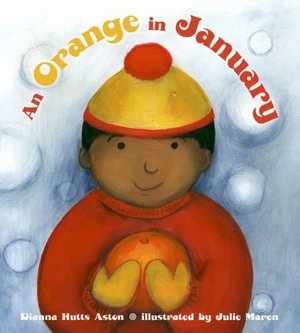
An Orange in January by Dianna Hutts Aston {The Children's Bookshelf}

Boy oh boy, does my kid love fruit. Really, I think it's his favorite thing to eat. He'd much rather have a slice of melon or an apple than a cookie any day. Every night we prepare his dinner plate plus a bowl of one of his favorites like grapes or pineapple on the side. And woe to us if we forget - to Sprout, a meal isn't a meal unless there's fruit involved.

Which is what made this particular library find all the sweeter, because not only does it focus on one of his all time most-preferred fruits, oranges, but also because it explains the cycle of how that orange comes to the table.


In An Orange in January, Dianna Hutts Aston starts by centering the story on one tiny blossom, glowing in the light of spring. From there, we follow the progress of the bees pollinating the blossom, to the orange itself beginning to manifest itself. Eventually the fruit is ripe, and it is picked by "a hand, brown with seasons of sun," then it is on its way to a grocery store. There it is selected by an adorable brown-skinned boy, who cradles his find carefully home, then takes it to school where he distributes pieces of the juicy treat to his friends. Yum!

Julie Maren illustrated this colorful title, and her pictures definitely add an air of realistic whimsy to the story Hutts Aston has to tell. In one fanciful spread, the boy pictures himself using his orange in various ways: as something to juggle, as a ball to pitch, as a globe to help him see the future. Sprout loves this part - he likes to laugh at the idea of doing anything with an orange but eating it, which he simply cannot imagine doing. He also likes the pictures at the end, when the hero has shared his orange with his friends on the playground. "They are sharing!" he says, delightedly. Another fantastic message to take away from this well-written book.

A big part of healthy eating is awareness, getting kids to understand the natural element in the food that they are consuming. With lyrical precision, Hutts Aston carries readers along for the journey of the food cycle. (That she made the main character a person of color is particularly wonderful - this is a message that all kids need to understand.) Helping to connect the dots between what's on our plates and where it came from, An Orange in January is a great way to make kids aware of agriculture and how food is sourced. No longer will they think of supermarket produce as springing only from boxes and bags - rather, they'll look at the trees and vines around them as a source of nutrition and deliciousness. And that's a treat that's everyone can appreciate!

An Orange in January by Dianna Hutts Aston, published by Dial Books for Young Readers
Ages 2-7
Source: library
Sample: "When morning came, the orange reached the end of its journey, bursting with the seasons inside it. / And two hands, pink with cold, shared its segments, so that everyone could taste the sweetness of an orange in January."
Recommended

----------------------------------------

This post is part of The Children’s Bookshelf, a weekly linky party with the goal of connecting parents with great books for their kids. Do you have a book review, literacy or book-related post that you think will be helpful for parents? If so, please add your link below.

NOTE: By linking up you are giving permission for any of the co-hosts to pin and/or feature a your photo on a future The Children’s Bookshelf post. Kindly link up to an individual post, not your blog’s homepage. The hosts reserve the right to delete any links to homepages, commercial links, repeat links or otherwise inappropriate links. Thank you for your understanding.

You can also follow The Children’s Bookshelf on Pinterest or visit TCB’s co-hosts: Sprout’s Bookshelf, What Do We Do All Day?, No Twiddle Twaddle, Smiling Like Sunshine, My Little Bookcase, The Picture Book Review, MemeTales and Mouse Grows, Mouse Learns. You can find more details here.


Wednesday, December 12, 2012

Picture Book Review - Lemonade in Winter by Emily Jenkins

Ooooh boy, does it seem like winter around here! In the Northwest that's more about rain and gray days than it is about snow, though Sprout is convinced it's going to snow ON CHRISTMAS and he will be super disappointed if (when?) it doesn't. And since he's been a little snow-obsessed these past few weeks we've been reading a bunch of books about wintry climes. Think penguins, polar bears, sledding, snowmen and of course our favorite Ezra Jack Keats classic (which honestly we just read all year round).

The other thing that's a running theme in the Kinser household these days is counting. Sprout is counting everything of late, with relish, and can actually get up to thirty, more or less accurately. Watching him learn these building blocks of knowledge is so exciting for us -- it's like having a front row seat to a pretty amazing discovery. The thrill for him in understanding how the numbers come together, and recognizing a pattern, is just palpable, and I love seeing this.


So with these two obsessions in mind, I was pretty thrilled to bring home today's pick, Lemonade in Winter: A Book About Two Kids Counting Money. This quirky picture book is written by Emily Jenkins, who happens to be the author of one of our big favorites from earlier this year, What Happens on Wednesdays. And it's illustrated by G. Brian Karas, who we also adore -- so, win-win right from the get-go.

Beyond that, how can you not be charmed by a book whose premise is siblings who, bored one very cold and snowy day, decide to have a lemonade stand. Yup, a for-real, on-the-corner, ice-cubes-and-all lemonade stand. Though Mom and Dad try to dissuade Pauline and John-John, the kids are determined. And so they count out money for supplies, mix up their product and hit the streets -- in parkas and earmuffs, no less -- chanting their slogan: "Lemon lemon lime, lemon LIMEade! / Lemon lemon lime, lemon LEMONade!" (Catchy, no?)

This tale of young entrepreneurship is not only fun, it's a great learning experience to boot. (Just skip over the subtitle when you read it to your kiddos -- without it the "learning part" will just sneak right up on them!) At every turn, Pauline is educating her young brother about counting money, how many coins make up a dollar and how they can make back their initial supply investment. You don't see that kind of thing too often in a book that is this accessible to the younger crowd, so kudos to Jenkins for including it. And then there's the perserverance both kiddos show. When business is slow, as you might expet it to be when you're selling cold drinks in wintertime, the siblings come up with creative ways to boost their sales. Plus -- huge bonus in my book -- there's a truly multicultural cast of characters here, which we see as we meet the various members of Pauline and John-John's neighborhood. Love that!

In the end, is Pauline and John-John's project a success? Well, you'll have to be the judge of that. But what I can tell you, with certainty, is that this is a picture book that's not only whimsical and bursting with community, but that's solidly based in math and counting skills as well. And in whatever season you read this amusing story, you're bound to get your money's worth!

Lemonade in Winter by Emily Jenkins, published by Schwartz and Wade
Ages: 3-6
Source: Library
Sample: "'Maybe nobody is on the street,' says Pauline, after a bit. 'Maybe nobody will want cold drinks.' / 'I'm on the street,' says John-John. 'I want them.' He grabs a cup of limeade. / 'Don't drink too much,' Pauline warns. 'It's fifty cents a cup.'"
Recommended

Monday, November 12, 2012

30 Days of Picture Books - Thanksgiving Titles

Today is Day 12 of Picture Book Month, and since we're heading into the holiday season, it seems like a good time to share some titles to get you in the festive mood. But I can't quite bring myself to jump right over Thanksgiving, no matter how much the retailers seem to want us to. Thanksgiving is a great time to talk and think about everything we have in our lives that so richly blesses us.

And what could be a better way to be thankful than with some tremendous picture books? As is the case with so many holidays, it's not easy to find multicultural titles for Thanksgiving -- but we managed to find a few that round out the experience by helping us look at the holiday with a fresh perspective.


First up is Gracias the Thanksgiving Turkey by Joy Cowley. I love this book for its humor and heart as well as the colorful illustrations by Joe Cepeda. In the story, Miguel's Papa, a long-haul trucker, sends home a live turkey for the family to fatten up for Thanksgiving dinner. Miguel names the turkey Gracias, and as you might expect, he's reluctant to make her a meal when the time comes around. Still, Miguel's grandfather's all for putting Gracias on the turkey platter - but an unexpected intervention from the parish priest saves Gracias at the last minute. There are lots of great lessons here, including the importance of friendship and responsibility, and plenty to talk and think about.


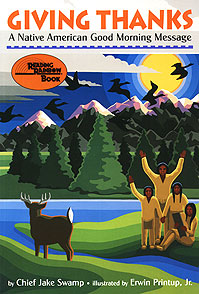
Next is Giving Thanks by Chief Jake Swamp, illustrated by Erwin Printup Jr. Subtitled A Native American Good Morning Message, this isn't a title that should be restricted to Thanksgiving, but with the spirit of gratitude we all have in our hearts at this time of year, it seems a good fit. The text is clear and simple, filled with appreciation for all the beauty and bounty in the natural world around us. And the illustrations are just breathtaking - vibrant and warm, simple and yet full of emotional depth. Best of all, this title is free of some of the most persistent stereotypical images we find in so many Thanksgiving books, and it reinforces the idea that we all have much to be thankful for.


If pilgrims are on your mind, why not check out Molly's Pilgrim? This is an older title, written by Barbara Cohen and most recently illustrated by Daniel Mark Duffy. Though its cover is somewhat subdued (albeit beautiful), the message behind it is a fantastic one. Molly and her parents are from Russia, having come to America for freedom after the Cossacks sacked their village and burned out many other Jewish families. When Molly is assigned a project to make a pilgrim woman for the school Thanksgiving display, Molly's mama makes one that looks just like her. But it doesn't look like the pilgrims in Molly's textbooks. Will the other girls make fun of Molly for this, like they do for so many other things? A tale of inclusion and acceptance, this story speaks volumes, especially to those new to the tradition of American Thanksgiving.


Tradition is what you make it, wouldn't you agree? Still, it's hard when your family doesn't go along with what everyone else does. That's the conflict at the center of Duck for Turkey Day by Jacqueline Jules, illustrated by Kathryn Mitter. Tuyet is excited to be celebrating Thanksgiving with her family, especially her cousins and her grandmother from Viet Nam. But she's a little upset that the family will be having duck for dinner, not turkey, as she's sure everyone else will be having. Tuyet tries to talk the problem over with her mother and grandmother, but they are sticking to their guns - and Tuyet has to admit that the duck with its spicy sauce is pretty tasty. But what will happen when she tells her friends at school that her family didn't have turkey? An unexpected ending to this tale not only reassures but also confirms that there's no one right way to celebrate!

This year, add a little extra flavor to your celebration with one of these great multicultural titles -- and make it a truly American Thanksgiving!

Thursday, November 8, 2012

30 Days of Picture Books - Cora Cooks Pancit by Dorina K. Lazo Gilmore

It's Day 8 of Picture Book Month. Today we're thinking about relationships. There's nothing like the act of sharing a book with someone to cement your relationship. Common stories unite all of us, as a people and as smaller units of family and friends. When I read an incredible book, the first thing I want to do is share it with everyone I know -- well, you know that, because that's why you're reading this! And I think it's important to use picture books to build that shared bond with our little ones.

But picture books can also illustrate important aspects about relationships, such as the connections between the generations. Family history is more than just having the same last name. It's a heritage and shared language that is passed down from one generation to another. This is how the knowledge of our families is kept alive, the traditions and ties that link us to our past and to our future.


Food is, for most families, a crucial part of the shared experience. Think back to your childhood and I'll bet you find that there's something like grandma's pies or uncle's barbecue that still makes your mouth water, even as a memory. And that's the case in Cora Cooks Pancit, a picture book by Dorina K. Lazo Gilmore that celebrates one family's culinary legacy.

In the book, Cora feels left out when the family cooks because as the youngest, she only gets the little-kid jobs. Then one day her siblings are out of the house and Cora's mama suggests they cook together. As they make a favorite family dish, Mama tells Cora about her Lolo, or grandfather, who cooked for the Filipino farmworkers and shared stories of his youth in the Philippines as he did. Cora loves hearing about Lolo and learning how to make pancit, one of her favorite dishes. Best of all, when her brothers and sisters come home, Cora gets to tell them that she did all the "grown-up" jobs this time around!

This lovingly told story of a Filipino family sparkles with pictures by illustrator Kristi Valiant. I love the way Valiant takes us right into Cora's perspective, as she looks down on a steaming pot of scrumptious-looking noodles and veggies (don't worry, the recipe's included). And Cora's expressive eyes shine with pride as her whole family settles down to a meal cooked by the youngest, but with ties to generations past.

Gather your kiddos for a reading of this delicious tale of food and family, reminiscent of another favorite, Linda Sue Park's Bee Bim Bop. Gilmore evokes a mood of togetherness and connection in a story that everyone can enjoy.

Cora Cooks Pancit by Dorina K. Lazo Gilmore, published by Shen's Books

Wednesday, August 15, 2012

Nonfiction Picture Book - Minette's Feast by Susanna Reich

So normally this would be Wayback Wednesday, but since today is Julia Child's 100th birthday, this seemed like a more appropriate post.

An especially fantastic trend in picture books of late are the fictionalized biographies of real-life individuals. Technically, since the stories are usually told from an alternate perspective and some details are invented, they aren't strictly nonfiction. And yet, because they have a basis in reality, these accounts can make an excellent bridge for young children from the fiction section to the nonfiction section, or vice versa. Kids who only want "true stories" could be induced by a whiff of whimsy to try something else, or those whose fare leans toward the imaginary might be convinced that real life can be just as engaging.


One of my favorite recent examples of this trend is Robbin Gourley's Bring Me Some Apples and I'll Make You A Pie. In a similar vein comes Susanna Reich's Minette's Feast, a peek into the life of Julia Child via her cat, Minette Mimosa McWilliams Child. Told through the perspective of this very blessed feline, Julia Child's early life in Paris and the beginnings of her culinary career are lovingly rendered and beautifully illustrated. Minette does in fact lead a charmed life, and she knows it - she came into the household thanks to Julia's belief that "(a) house without a cat is like life without sunshine!". Minette is famously finicky, and though she won't eat food out of a can, she's not entirely convinced by her mistress's delicious dishes either. Much better is a fresh bird, or maybe a mouse she's caught herself - now that's delightful. Still, Minette is Julia's constant companion as she undertakes the process of improving her cooking, first through self-study and then by enrolling at Le Cordon Bleu. (Minette polishes her own hunting skills in a similar fashion.)

This is a simply charming book, one that presents the story of Julia Child in a format that appeals to young chefs and cat lovers alike. The illustrations by Amy Bates are beyond fantastic, the kind of homey warmth you just want to linger over. For one thing, she captures the capriciousness of Minette perfectly - one minute resting quietly, then suddenly pounce! But Bates goes far beyond Minette's own actions to bring Julia's story to life as well. Her depictions of a younger Julia stirring, tasting, whisking, chopping fairly burst from the page, as the famous woman's boundless energy come through on every spread. A picture of a dinner party at the Child home is particularly spot-on: the all-but-salivating guests, including Child's husband Paul; the beaming Julia, bearing a fragrant turkey still steaming from the oven; and the ever-proud Minette, taking her place in the hostess's spot (it's only the way things should be, after all). Delectable!

Whether you're a fan of food or felines, Minette's Feast is a sure-fire hit. I'll be rooting for this one come award season - it's a gem that truly stands out on every bookshelf!

Minette's Feast by Susanna Reich, published by Abrams
Ages 7-12
Source: Library
Sample: "Sometimes the 'nice old fish lady' at the marketplace gave Julia luscious fish heads for Minette. Julia would cook them up in a pot. Perhaps she'd add a dollop of scrumptious 'chicken liver custard.' / Minette might even take a nibble. / But it seemed that mouse and bird were really much preferred."
Highly recommended

Bonus: an outstanding interview with illustrator Amy Bates from the blog Seven Impossible Things Before Breakfast

Friday, July 13, 2012

Nonfiction Picture Book - Bring Me Some Apples and I'll Make You a Pie by Robbin Gourley

Sun-ripened peaches. Juicy blackberries straight off the vine. Crunchy pecans and walnuts. Succulent tomatoes fresh out of the garden.


If your mouth is watering at the sound of this delectable fresh produce, then this is the book for you. Bring Me Some Apples and I'll Make You a Pie by Robbin Gourley is a fictionalized account of the childhood of famed chef Edna Lewis. A master of her craft, cooking delicious Southern food in some of the most popular restaurants in the country, Lewis believed strongly in using the freshest ingredients possible. She maintained the traditional methods of preparing food, always using the finest produce she could find, as that, she believed, made the dishes sing. In writing Apples, Robbin Gourley researched Lewis's life extensively, and created a tale that was inspired by Lewis's upbringing in Freetown, Virginia (a community founded by freed slaves, including Lewis's grandfather).

Apples is a perfect introduction for kids to the notion of eating seasonally. As each new crop comes in, Edna and her siblings take part in the harvest. From picking bucketsful of ripe cherries to gathering all sorts of beans from the garden, Edna can always think of something delicious to make with the fruits of her labor. The first crop is wild strawberries, and though her sister plans to eat as many as she picks, Edna's going to turn hers into strawberry shortcake. On it goes, up through the fall harvests of apples and of nuts, and at last Edna surveys the pantry, bursting full of preserved goods ready to get the family through winter with a little bit of summer for them to taste every day.

There's a lot to like about this title, from the gorgeous watercolor illustrations (the peaches look like you could pluck them right off the page) to the dynamic of family togetherness throughout. Gourley emphasizes the role that ever family member plays in putting food on the table; while things may be different now since many families don't gather their foodstuffs from the garden, the lessons in responsibility and participation carry over. And oh, the food - if the illustrations don't make you want to rush out to the farmer's market, then the children's plans for their bounty surely will. It's a summertime treat to read this when so many of these goodies are either in season or nearly there.

Reading this one with Sprout, he was especially taken by the illustration of plump tomatoes heavy on the vine. Though we didn't plant tomatoes this year (just too wet here in Northwest Washington), he remembers picking them from the vines himself last year. "I like these tomatoes, Mama," he tells me seriously. And in fact he did eat the ones we grew last summer, though he won't touch tomatoes from the grocery store. Smart kid that boy is!

Bring Me Some Apples and I'll Make You a Pie is a great book to share with young chefs and foodies, but don't expect to get off lightly when you read it. I'm already expecting to be baking pies with Sprout just as soon as those berries are ripe!

Bring Me Some Apples and I'll Make You A Pie by Robbin Gourley, published by Clarion Books
Ages 4-9
Source: Library
Sample: "Spring turns into summer, and Edna leads Daddy to a beehive she's found deep in the fragrant honeysuckle woods. He breaks the comb and gathers all the delicious dark-amber nectar. / Edna dips her finger in the bucket. 'Honey on hot biscuits sweetens the morning,' she says, smacking her lips."
Recommended

Wednesday, June 6, 2012

Wayback Wednesday - Bread and Jam for Frances (1964)

It seems fitting to me that I start off my ongoing series of Wayback Wednesday posts with one of my all-time favorite picture book characters, Russell Hoban's Frances. Though in his later years Hoban became the author of a number of highly praised adult novels, he struck out into the publishing world in kidlit, and in a big way: Frances appeared almost at the outset of his literary career, with her first appearance in 1960's Bedtime for Frances, the only one of the Frances novels not illustrated by Hoban's wife Lillian. And it is saying something when you consider that while many of his other kidlit titles have almost vanished from memory, Frances lives on and is as beloved today as she was 50 years ago.

While at this point in my life I can relate most to Frances's parents (particularly in Bedtime, where her exhausted folks deal with their not-ever-sleepy-enough tot), Frances herself strikes a chord with me. She's Everykid, really. You can hardly ever fail to see the wheels turning in her mind, as she considers the world before her and how to turn circumstances to her advantage. She's got the dogged determination of a young child and the energy to match, and though her parents generally can maneuver her into their desired outcome, you just know Frances has got more tricks up her sleeves. I especially love her somewhat thinly-veiled disdain for her little sister Gloria, with whom Frances has quite the sibling rivalry (evidence the scene from A Birthday for Frances when Frances buys her sister a gift - and then somehow nearly manages to make off with all of it herself).


So: Bread and Jam for Frances. This book had been around for a good long while before I was even born, shockingly enough. I can't remember who introduced me to this specific Frances escapade, but I do know that this was the first title I ever read -- or heard, as I think I was pretty darn young. This is probably why it has stuck with me ever since, that and the sheer relatability of the plot. Frances is enamored of one food combination to the point of exclusivity. Breakfast, lunch and dinner, all Frances wants to eat is bread and jam. Hmmm, sound familiar, you parents of young kiddos? Her parents try to convince her of the worthiness of other foods (though I have to say their examples don't thrill me particularly - soft-boiled eggs, anyone?) but to no avail. Her mother even reasons, "You try new things in your school lunches. . . . Today I gave you a chicken-salad sandwich." to which Frances coyly responds, "I traded it to Albert. . . . (for) Bread and jam." Ah Frances, you sly devil.

Undaunted, Mother and Father decide to mix it up. If Frances wants only bread and jam, then bread and jam it shall be. At breakfast it's a treat. At lunch it's still delicious. By snacktime it's wearing a bit thin, and by dinner -- by dinner our darling girl is reduced to tears. In her exasperation she utters one of the best lines in kidlit, by my reckoning: "What I am / Is tired of jam." And finally Frances breaks down and decides that variety just might be the spice of life after all. Especially when it entails devouring one very complicated lunch menu.

It's safe to say that I was pretty excited to share this with Sprout, being that he's in somewhat of a picky eater phase himself at the moment. (While he takes great delight in helping me prepare different types of food, actually passing these foreign morsels through his lips is another story.) And he listened intently to Bread and Jam, though it's a bit long for a three-year-old's attention span, with the detailed descriptions of lunches and all that. He thinks Frances is "silly", and finds her jump-rope rhymes on the various merits of jam to be particularly amusing. All in all, his take on Frances is favorable, so much so that he was excited to find A Birthday for Frances on the shelf at the library last time. "Her eats bread and jam, Mama," he told me seriously. Yes, my dear, she does.

Russell Hoban passed away not long ago, leaving a legacy of fantastic storytelling for future generations. Though she was created more than a half-century ago, I think Frances has a long and happy life ahead, as she charms even more young children with her straightforward approach to life, one jammy bread-slice at a time.

Wayback Wednesday Verdict? Holds up nicely

Bread and Jam for Frances by Russell Hoban, published by HarperCollins (formerly Harper & Row)
Source: Library
Ages 3-7
Sample: " 'Well,' said Frances, 'there are many different things to eat, and they taste many different ways. But when I have bread and jam I always know what I am getting, and I am always pleased.' "

Bonus: Fuse #8 interview with Russell Hoban, from the Pageturn

Thursday, May 31, 2012

Library Find - Bee-bim Bop! by Linda Sue Park

One of the best ways to experience a culture, I think, is through its food. Food tells you a lot about people, and it's a language everyone speaks. The base flavors, the types of elements that go into traditional dishes, and the way the meal is served - all of these elements give you a glimpse into how people from a particular ethnic background experience daily life.

And of course, for little ones, reading about food is the gateway to trying a new cuisine. It's worked for us with Indian food (cue Hot, Hot Roti for Dada-ji) and Japanese (see Dumpling Soup). Now, thanks to Sprout's recent library find, we even have an introduction to Korean food -- bee-bim bop!

The picture book Bee-bim Bop! by Linda Sue Park is just about the perfect way to get kids intrigued enough to try an unfamiliar dish. The story's pretty straightforward: a young girl helps her mother make bee-bim bop for family dinner, first shopping for ingredients together, then rushing home to assemble the various components just in time for everyone to arrive and pull up a chair.


Our heroine is more than a little excited about this delicious meal, urging her mother to "hurry, Mama, hurry" at nearly every juncture. But she's helping, too, by peeling onions, setting the table, and pouring the water for the veggies (and cleaning up when that last task goes a bit awry!). Each part of the process is narrated with a bouncy, rollicking rhyme that ends with the name of the dish. Sprout loves to shout this part out -- "BEE-BIM BOP!" -- and why wouldn't he, it's loads of fun to say!

Ho Baek Lee's illustrations match perfectly with Park's text. Here's an illustrator who knows how to capture the exuberance and vivacity of toddlerhood, and does so as adeptly as he depicts the simple pleasures of family life. Lee's pictures tell us that this meal is an event, but it is so precisely because of its familiarity and the rhythm that the family knows so well. Lee also adds some humor with the family dog, who's right along with the heroine sniffing at the rice pot and begging for just a bite.

Possibly the best part of the book for parents comes at the end, when Park shares her recipe for bee-bim bop. She also includes a description of how the dish is eaten ("mix everything together like crazy") as well as a picture of herself and her niece and nephew cooking together. Of course by the time you get to the author's notes, you're probably already salivating at the thought of this delicious dish. We haven't tried making bee-bim bop yet, but it's on our list of things to try this summer for sure. And when we do, I can almost guarantee that we'll be shouting out "BEE-BIM BOP!" all through the meal!

Bee-bim Bop! by Linda Sue Park, published by Clarion Books
Ages 2-6
Source: Library
Sample: "Hurry, Mama, hurry / Gotta shop shop shop! / Hungry hungry hungry / for some BEE-BIM BOP!"
Recommended

Bonus: watch this interview with Linda Sue Park from Reading Rockets

Thursday, February 23, 2012

Picture Book Review - Hot, Hot Roti for Dada-ji by F. Zia

Hitting the right balance with a culturally specific tale is no easy feat. You want the book to appeal to insiders, by being authentic and a true representation of their cultural experience. At the same time you need it to be something that cultural outsiders can appreciate, even if they have no knowledge of traditions or even language. Tough stuff indeed.

The same is true for intergenerational stories - the plot needs to be believable and realistic. Why is this young kid interested in what an oldster has to say, anyway? What's his/her motivation to listen? We've all read historical fiction in which the often-used trope of "come little child, let me tell you a tale" is trotted out, and most of the time it's thin at best. We just aren't given a good rationale for keeps the kiddies enthralled.


And so, since it is both culturally specific and intergenerational, you might think Hot, Hot Roti for Dada-ji has the deck stacked against it. But you'd be wrong, because this is a story that works on many levels: specific enough to speak to cultural insiders, broad enough to appeal to outsiders, and held together by the truly believable bond between grandfather and grandson.

The book begins with Aneel's grandparents coming from India. Aneel relishes his time with them, especially Dada-ji's wonderful stories. He loves to hear the tales of Dada-ji's amazing strength as a young lad - wrestling elephants and tying cobras in a knot. And what was the young boy's secret? Eating lots of his mother's fluffy-puffy roti, hot from the grill and topped with spicy mango pickle. Mmmmm! Dada-ji can almost taste the roti now! So Aneel asks everyone to make some, but all the members of the family are busy. It's up to Aneel, and he gets to work, making a huge stack of delicious roti for Dada-ji. When the last scrap of roti has been gobbled up, Dada-ji has his famous strength -- and the two go off to the yard to have some new adventures together.

It's interesting to note that this is the first picture book for both author F. Zia and illustrator Ken Min. The quality of this effort certainly speaks to a pair of artists who know how to craft a work that appeals to a broad audience. Sprinkling culturally specific elements throughout the text, Zia lets us in on what life was like for Dada-ji as a young boy. I especially appreciate that she doesn't interrupt the flow of the story to define the Hindi words, but rather includes a glossary in the back for those of us who may be unfamiliar with the terms. And Min's illustrations are spot-on: you can feel the power welling up in Dada-ji as he gulps down the huge stack of roti, and the shifting perspectives he uses (watching from inside the bowl as Aneel dumps the flour down) add a playful element that's just right. I love the energy that bursts from each of the characters, especially Aneel, who is excited to be doing something for his grandfather.

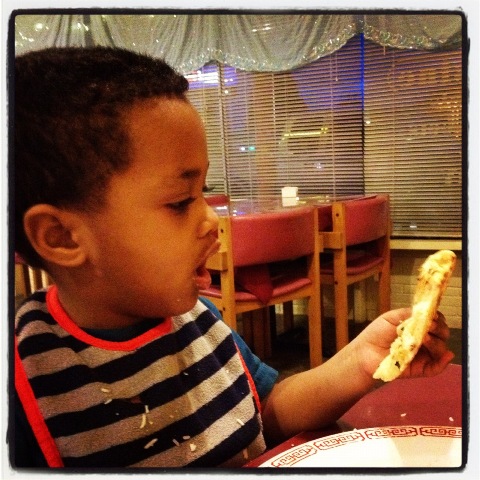
Sprout LOVED this book, which surprised me because it's a bit on the long side and more introspective than some of his favorites. But he asked for it over and over again, and was thrilled when my husband offered to take us all out for Indian food the other night. (Here he is, enjoying his own hot, hot roti - ok, naan bread, but it was hot and delicious too!)


Hot, Hot Roti for Dada-ji by F. Zia, published by Lee & Low
Ages 2-6
Source: Library
Sample: "What made the lad so strong? It was the hot, hot roti that sizzled and wizzled on Badi-ma's wood hearth. You see, baba, Badi-ma made the best roti around! Hungry villagers trampled tall fields and swam angry rivers to sniff the fluffy-puffy roti that bubbled and wobbled in ghee on the hot, hot tavva pan."
Recommended

Bonus: interview with F. Zia at The Happy Nappy Bookseller

Sunday, February 5, 2012

Veggies Rock!

My name is Mary, and I'm raising a veggie-phobe.

It didn't start out that way. When Sprout first joined our family he would eat anything and everything. We were so proud of our non-picky child! But as he got older, things changed, and his aversion to meat has spread to veggies. While he adores fruit and would eat nothing but that at every meal, veggies (with the exception of "dippy" carrots) are firmly on the "no, not like it" list.

It's more than a little frustrating.


In an effort to move through this phase a little quicker, I decided recently that a little bibliotherapy was in order. First up was Lois Ehlert's Eating the Alphabet. We've read and enjoyed a few of Ehlert's other books, and this is similarly engaging. The illustrations are what Eating the Alphabet is all about: huge, vivid, graphic representations of a variety of fruits and vegetables. Sprout enjoyed pointing out the ones he knew (pumpkin, broccoli, oranges) and trying out new words like rhubarb or kumquat. He was a little confused by some things, though - for instance, gooseberry, about which he says "dat not goose, Mama."


Next we tried Rah, Rah Radishes by April Pulley Sayre. This was a HUGE hit, more so than I could have anticipated . It's not too hard to see why. For starters, Sayre's included some gorgeous color photos of veggies in all their glory, and the pictures really make the vegetables look succulent. Sprout's always excited to act out taking a bite of the carrots, and they look mighty delicious, I must say. Plus, the rhymes in this book are absolutely infectious. After we'd read it a couple of nights in a row (it has become one of the most-requested titles in our rotation), Sprout could quote chunks of the veggie-centric chants verbatim. You should have seen the looks we got in the grocery store produce section when he yelled "Broccoli, cauliflower, give a cheer!".


Then we decided to bring the topic full circle with Soup Day by Melissa Iwai. Just looking at the cover of this book, you know you're in for a treat. I love this gentle title, not only because it shows off veggies like celery and zucchini, but also because it's all about a cozy afternoon at home making soup. Sprout loves the part where the narrator, a little girl with straight black hair, shows off the pasta shapes she picks to go with her veggies. And he never fails to say "Yum!" when she displays her finished soup, steaming hot and delicious. The illustrations here are engaging and soothing, a perfect match to the rhythm of the story and of the little girl's day. We even made our own pot of soup (there's a recipe included, though we used a different one), and Sprout pronounced it "Yum" too.

Best of all, when we sat down to dinner the other night, suddenly Sprout was far less averse to the veggie portion of the plate. He even discovered one new veggie that he likes - cucumbers! It may be a baby step, but we're headed in the right direction. And it's all thanks to picture books, naturally.