Showing posts with label inclusion. Show all posts

Wednesday, April 30, 2014

#WeNeedDiverseBooks - For My Family and Yours

This is my family.


We don't look like every other family on the block. We don't look like any family on the block, or any family that we know. We are okay with that - we are who we are, we love each other, and we are very happy.

But we do feel, on many occasions, that it would be nice to see ourselves reflected in the pages of the books we read.

And I know we're not alone in that. While there are some fantastic diverse books out there, it does take work to find them. It should not be that hard for a child to open a book and see all kinds of people represented - especially people who look like them, and like their family.

Enter the We Need Diverse Books Campaign. Conceived as a reaction to coming events at BookCon, the We Need Diverse Books project aims to communicate to publishers and decision makers the demand for books that represent ALL readers.  By coordinating activities via social media, the hope is to demonstrate how critical it is for kids to see themselves in the pages of the books they read.

The best part is - YOU can participate in this initiative as well. Over the next three days, May 1-3, let your voice be heard on this subject. Buy books to Diversify Your Shelves. Donate diverse books to your classroom or library. Take a photo of your family with a sign that tells why diverse books are necessary. Write a blog post, tweet, post a photo on Instagram or Facebook - find a way to shout to the world how important it is to have more books that mirror our world. No matter what you do, use the hashtag #WeNeedDiverseBooks to add your voice to the conversation!

The team of brilliant authors, publishers and industry peeps behind this initiative, spearheaded by Ellen Oh, is listed here. Go check out these folks - follow them, read their blogs, buy their books and tell them how important this issue is to you! I'll be sharing as much as I can, through posts on Twitter and Facebook. And of course, we will continue to feature reviews on diverse books here on the blog.

My hope? That there will grow to be so many diverse titles on the shelves at my library and bookstore that we'll open a book purely by chance and read about a family that looks like ours. Not today - but maybe, if we keep the message going, someday soon.

Friday, October 18, 2013

Who Put the Cookies in the Cookie Jar? by George Shannon

**Hey friends! We're off on a family vacation and unplugging for a couple of weeks. In the meantime, here's a recent pick that we really loved, all about the importance of community and working together. See you in November!**

Food, I think, is a true universal. Everyone in every culture has food that is important to them, food that means celebration or comfort or peace or home. What it is varies from nation to nation, but it's critical in so many ways to all of us. Food can help bridge the gap between cultures; sharing a meal together helps diverse groups put aside their differences for a moment and find common ground.

For those of us who've adopted children from other countries, food is one of the first things we find to bond over. In the early days with Sprout, before he knew he could trust us and far before he understood that we were his now, forever, food was central to our bond. He was eating some soft food at the time, and I'll never forget the first time he tasted chocolate pudding -- the look on his face was shock at first, and then simple sheer joy (and a worldess "more, please!"). Those first days and weeks, food was critical to trust and helping him feel safe and comfortable, and while we fumbled our way as parents, it was the one thing that was easy to provide.


Food is at the center of a new book by George Shannon that I love for its deep perspective on global citizenship. Who Put the Cookies in the Cookie Jar? takes a spin on the familiar "Who Stole the Cookies from the Cookie Jar?" song, by examining how the treats got in there in the first place. The premise is obvious right from the get-go: Shannon's looking at all the contributors, the world over, whose work facilitates the creation of these yummy treats. So we have workers making cookie sheets and farmers plowing fields, a young boy gathering eggs and a crew stocking store shelves. All of these folks, and many more, share pieces of the work that ends in delicious cookies of all kinds.

Julie Paschkis did the illustrations for this culinary journey, and their stylized, folk-art-infused nature really makes Shannon's ideas come alive. It's important to note that this isn't really meant to be a linear tale - we aren't following one batch of cookies from beginning to end, but rather looking at the process that makes many kinds of cookies, in many places, possible for all. So there are families grinding wheat by hand and others loading trucks, and both processes exist side-by-side in Paschkis' winsome and  clever illustrations. And that's perfectly reasonable.

What I really appreciate about this book, and what I think Shannon and Paschkis are trying to get across, is the very global nature of sharing treats together. We see it in all cultures, as Paschkis shows us on the final threat, where characters of all ages, colors and creeds are enjoying little bits of sugary goodness. This book, perfect to share with the youngest of readers, brings up some great opportunities to talk about the way food comes to our table, but also how food is shared by people the world over. Because after all, who doesn't love a delicious cookie of one sort or another?

Be prepared to read this one more than once - it's a slow build, and the message definitely grew on Sprout the more we read this title. In the end, he was thrilled to see people from all walks of life sharing cookies with each other. And of course, it prompted the oh-so-familiar question: "Can we bake some cookies, Mom?"

Ages 2-5
Source: Library
First lines: "One hand in the cookie jar takes a cookie out. / How many hands put the cookie in is what the world's about."
Recommended

Thursday, March 7, 2013

Of Missed Opportunities

Do you ever feel slightly let down by a book? Like maybe what you hoped it would be was just not completely realized? This is a feeling I recognize in myself more and more frequently. Maybe it's that I'm getting older (big birthday this year - keeping it in perspective). Or maybe it's just that I've reached the point where I've read so many knockout titles that when a book doesn't go deliver as much as it could, I feel a bit cheated.

I find this happening a lot now that I'm reading kidlit pretty much exclusively (with the exception of textbooks, of course). There are a ton of fantastic kid's books on the shelves in libraries and bookstores these days. Overall the quality really rivals anything I remember from my own childhood. That's especially true of multicultural kidlit, where phenomenal authors like Rita Williams Garcia and Grace Lin and Christopher Paul Curtis and Pam Munoz Ryan turn out consistently top-notch books where diversity is interwoven seamlessly into the storyline. And so when I find a book that just doesn't go quite far enough, I feel a little like it's been a wasted opportunity.


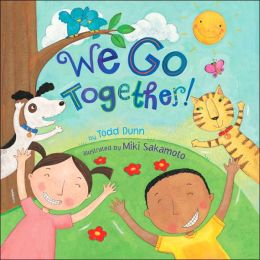
I found this to be the case with one book in particular lately. I really hesitated writing about this book, because I wanted to like it, but just couldn't 100% embrace it, and I couldn't figure out why. The book in question is We Go Together by Todd Dunn, illustrated by Miki Sakamoto. Sprout nabbed this one on a recent library visit and I suspect that's mostly because of the cover - bright sunshine, animals and birds, a white-skinned girl and brown-skinned boy with huge smiles. What's not to like?

The text and illustrations are perfectly suited, as Sakamoto's cheerful figures and palette match Dunn's bounce rhymes very well. There's no real narrative here, just a depiction of things that go very well together - like moon and night, for instance, or string and kite. Each spread has a sly joke or whimsical touch that works quite nicely. Sometimes there's a double meaning included, like "We go together like elephant and trunk", which shows a chipper purple elephant bearing a small chest on his back. Cute, in all, and upbeat, which always makes for a nice addition to any reading session.

So what was it that bothered me? It took a while to figure out, but I finally narrowed it down to the last spread. Throughout the book we have a reasonable attempt to depict diversity - most of the spreads with more than one human character has multiple ethnicities represented. But on the last page, the text reads: "We go together, that's what we do. We go together because you love me and I love you!". Sweet, but here's where the missed opportunity comes in for me: the mother and daughter depicted on the page look almost exactly identical: white skin, rosy cheeks, brown hair turned up at the ends.

For me this is a misstep - the whole book is about things that go together, so why not use this spread as a chance to emphasize that things don't have to look alike to go together? This would have been a great opportunity to depict a transracial family, or at the very least two people who looked dissimilar. Maybe mom could have red curly hair and be hugging a boy with straight black hair? Would that be too much to ask? Couldn't the creators of the book have used this as a way to drive home the point to kids that belonging isn't about looking just exactly the same, but rather belonging has to do with the feelings mentioned in the page text?

Don't get me wrong, I have nothing against this particular book, and it's not one that I would prevent Sprout from reading. It's cute enough, the illustrations are well-done, and it's something the author and illustrator should be very proud of creating. I also don't think that every single kids' book should cater to transracial families -- because come on, where's the reality in that? But I couldn't help but wonder how much stronger this little slice of kidlit could have been with just a tweak in the approach.

And here's where the missed opportunity comes in: because changing our environment and embracing more diversity is as simple as the decision to show the world families don't all have to match. The message of the title could have been that much more impactful, for my mind, with just a shift in this one editorial choice. These are the kinds of things that don't escape my notice, now that I'm parenting transracially. And you can be sure that if I'm noticing it, Sprout and all the other kids his age aren't letting these messages, however slight, pass them by. This kind of small choice strengthens the argument for kids on the playground who ask us questions like, "Are you his mom? Why don't you look like him?"

Listen, there are a host of reasons that parents and kids don't resemble one another, and adoption certainly isn't the only one. So let's be brave, kidlit creators: let's teach our kids that matching is more than just having the same hair color or wearing the same outfit. Let's throw them a curve and show them a daddy in a wheelchair or a mama and baby with different skin tones. Let's trust that kids can handle the challenge of seeing a parent and child for what they are, even when they don't look the same. Because that's an opportunity -- for thought, discussion, inclusion -- that no one should miss.

Tuesday, February 19, 2013

Religion Around the World - Books to Share Faith with Kids

Kids are a curious bunch, aren't they? Just when you think you've heard it all from your little one, they'll suddenly take up with a topic seemingly out of nowhere. The questions will begin to fly fast and furious. I know as a parent this has already happened with me, and as Sprout grows the topics will get even more complex - and controversial. Not looking forward to some of those conversations, believe you me!

For many parents, the topic of religion may be a tough one to discuss with their kids. Faith is a tricky thing, even harder to explain than it is to hold on to. And while it may be hard to describe one's own beliefs, defining those of another religion or group can be much more difficult. After all, religions are founded on deeply personal tenets and incorporate traditions from many cultural systems and communities. Those beliefs inspire passion and honor, making them seem like subjects that are vast and hard to define.

Still, many of us want our children to grow up understanding and respecting the belief systems of people around the world. A keystone of tolerance is an appreciation of the ways others live their lives, the beliefs that guide them and the ideologies they hold dear. And as parents raising global citizens, learning about religion is a first step in understanding cultures and people around the world.

Two terrific books to help parents begin the discussion about world religion are available from noted children's publisher DK. If you're familiar with the DK list, you know they produce quality offerings. Lavishly illustrated with inviting photographs and written in clear, straightforward fashion, the books on DK's publishing roster are the cornerstone of every well-rounded nonfiction collection, home or classroom.


A great place to start learning about faith is with DK's A Faith Like Mine, written by Laura Buller. This title is of course filled with intriguing photographs of people from all walks of life, engaging in the various traditions and ceremonies of their faith. Through the perspective of children just like them, kids can learn about what members of religious traditions believe and how they practice those beliefs on a daily basis. In the pages of Buller's book we meet 10-year-old Hasini, a Buddhist from Sri Lanka; 13-year-old Erin, a Jewish girl from the U.S.; and 9-year-old Leena, a Muslim from Jordan, just to name a few. Even very young children will enjoy flipping through this title and looking at all the amazing photos, which is a great way for discussions to begin naturally; parents and children will learn a lot from this well-researched and well-rounded title.


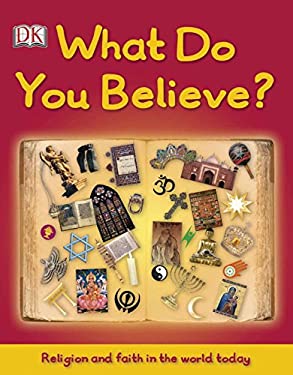
For kids who are ready to begin thinking and talking about the philosophical aspects of various religions, DK's book What Do You Believe? is a natural next step. Beginning with a discussion of why religions exist in the first place, this title examines the major faiths as well as many alternate views. I love that this book considers multiple perspectives on the same issue, and talks about how the practicalities of our lives -- how we dress, what we eat, how we celebrate -- are influenced by our belief systems. Even the origins of religious traditions are discussed, and native religions are also part of the conversation. Tolerance, peace, and the collision of conflicting beliefs is included here too, as well as a nicely rounded glossary to help define some of the basic terms. Visually, this title is incredibly impactful, and raises the same questions you might find in a comparative religion course, so it's a great educational tool.

Look for these titles, and others like them, to spark some lively debate and help you consider your own philosophies more deeply, as you examine the spectrum of belief with your children. You can use these books as a way to begin introducing complex topics with your kids, to see what they believe and to help them begin to comprehend the world around them. Yes, religion is complicated -- but never more so than when we try not to understand.

What books about belief does your family read? Have you thought about how broadening your bookshelf could strengthen your own faith?

Thursday, November 29, 2012

30 Days of Picture Books - A Bus Called Heaven by Bob Graham

It's Day 29 of Picture Book Month, and the theme of our choice for today is community. Books in general, and picture books in particular, are a major means of teaching cultural norms, which is a critical part of socialization. Young children learn how to work together, how to share, how to be part of society not only through the behaviors they see modeled, but also through more passive channels.

And so armed with that knowledge, I think it's vital to read books that show what we want our kiddos to become. For us, it's important that Sprout become the kind of kid who cares about others and is inspired to contribute as a citizen of the world as well as of his community. So we read books that build social consciousness, books about amazing people like Wangari Maathai and Pura Belpre, and then we read books about communities coming together.


The most amazing community-themed book I've read in recent months, and one that Sprout has asked for again and again, is Bob Graham's A Bus Called Heaven. I've written about Bob Graham's books before, but I must say again that I find his work so very incredible. He hits the nail right on the head when it comes to books that kids will love but which carry deeper messages - about love and acceptance, and in this case about working together. His illustrations are spot on for his target audience, with plenty of small details that kids love to pore over and realism and idealism melded together. Simply fantastic, every one.

In A Bus Called Heaven, Graham gives us another neighborhood story, this time of a group of people who turn an abandoned bus into a de facto community center. Nobody's sure where the bus, labelled with a sign that reads "Heaven", came from. But acting on an idea from shy little Stella, the neighbors rally and convert it into their own place. It's not just for the kids, but for everyone, with movie nights, foosball, a lending library, a gathering spot. Sooner or later, though, the bureaucrats get involved and the bus has to move -- unless quiet Stella's plan to save their bus can somehow be successful.

Here you have the most inclusive backgrounds I've seen in picture books, as Graham peoples his books with elderly and infants, tattooed biker types and glasses-wearing rabbis, moms and dads, multiracial families, and people of all colors and creeds. (Nothing annoys me more than books set in urban areas where there's zero diversity.) Graham gets it right in his message too: that some things are bigger than just one person, that we all need "third places" to connect and involved and be together. The last spread shows the whole point best - at the center of the gray city night is the bus called Heaven -- alive with color and light, festive and drawing together a community, with grass "danced flat".

The bus may be called Heaven - but this book, for us, is too.

A Bus Called Heaven by Bob Graham, published by Candlewick Press

Sunday, November 4, 2012

30 Days of Picture Books - Duck, Duck, Goose by Tad Hills

It's Day 4 of Picture Book Month and it seems like time to think about lessons. We all learn about the world in a variety of ways, most of which are firsthand experiences but some of which are based on what we glean through other channels. We learn by watching others, by listening to our parents (or not, as the case may be), and of course by reading. Picture books teach us about the sphere we live in as well as those far away or even those of imagination. And when we visit those imaginary realms, we often bring back knowledge that helps us when we face a similar situation in "real life".

For the youngest readers picture books provide the building blocks of things like color and shape. For slightly older kiddos, life lessons are coming into play. Suddenly the focus becomes not basic concepts like opposites and ABCs, but basic relationship skills like getting along with others and taking your turn. By modeling situations your kids will encounter at school or with friends, picture books provide opportunities to role play and think through difficult scenarios.


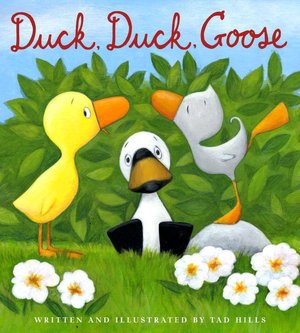
Duck, Duck, Goose by Tad Hills is a title that's great for talking about the friendship dynamic. We're fans of Duck and Goose around these parts. I think we got through the board book Duck and Goose Find a Pumpkin approximately 6,000 times in the first autumn and winter Sprout was in our family (luckily it's a pretty fun read).

In this episode of their ongoing adventures, a new face enters the picture: a small grayish duck aptly named Thistle. She's a prickly sort, too, the best at everything -- if you don't believe it, just ask her. Goose very quickly feels left out of Duck and Thistle's adventures, especially since Thistle just wants to best Goose in every contest she can think of. Disheartened, Goose heads off for some quiet time, and Duck realizes just how much he misses his very best friend. Soon the two are reconciled, and they find a way to let Thistle have her way -- even while they do the things they two like best.

Tad Hills just gets kids, which you quickly discover by reading one of his excellent titles. Kids and adults alike will be charmed by his perfectly adorable characters, and then they'll discover how much Hills has to teach readers, about the nature of friendship, about getting along with others, about the simple pleasure of kicking a ball around a meadow.

And those are the kinds of lessons we could all use, couldn't we?

Duck, Duck, Goose by Tad Hills, published by Schwartz & Wade Books

Friday, August 24, 2012

Why Books Can Be Windows, Not Walls

Recently I stumbled across this article that spotlights the continued dearth of multicultural titles in the world of children's literature. As I said when I posted a link on Facebook, I wish this was a surprise to me, but it sadly is not. I'm sure that others who spend their time immersed in books for children probably aren't shocked either. Groups like the Cooperative Children's Book Center at UW-Madison, mentioned in the article, scour the record of titles published each year, tracking the number of books by and about people of color that are released. (If you want some fascinating reading, check out the CCBC's archives, where director KT Horning and her incredible staff post their yearly essays on the state of publishing.) What's really startling about the CCBC research is that the rate of kid's books by people of color published has never exceeded 5%.

Let that sink in a moment.

Of all the books published in any given year, 95% are by white authors.


True, there are books about multicultural characters being written by white authors - after all, I'm a white mama writing about race. But still, the rate of multicultural titles is very, very low. What's so sad about that is that it flies in the face of what's really happening in our country. Our society is becoming increasingly diverse; if you don't believe me on that fact, take a look at this detailed analysis of census data and the implications it carries for diversity in the population of US children. In researching a paper I wrote last fall on children's literature for multiracial families, I found multiple sources indicating that the lack of representation of their own reality can have a major impact on the identity formation of young children.

And really, is it any wonder? If you never saw yourself reflected in the world around you, wouldn't you grow to be a little self-doubting?


So if the world is becoming more diverse, then why aren't books reflecting that diversity? The short answer is white privilege; the long answer, as with so many things related to race, is more complicated. Publishers often argue that multicultural books don't sell. Booksellers and librarians may use the same argument. "We buy them and they don't circulate," as a school librarian in one of my classes put it. And in the days of ever-shrinking budgets, who can afford to buy what people don't want to read?

But if fewer titles are published, then fewer titles are reviewed by critics and even fewer are purchased by bookstores and libraries. The smaller the pool to draw from the more "other" these books seem. And in a world where everyone gravitates toward what they believe is HOT HOT HOT, quiet titles are going to be overlooked. I mean, I think The Hunger Games is just fantastically written, but is that really why everyone and their brother has read it? Or was it more about the drive to not be left out of the loop?


And then there's the fact that so many of the multicultural titles that make it into print are "issues" books. You know what I mean here, the ones that are about accepting others no matter how different, or are about standing up in the face of discrimination. Don't get me wrong, I think those titles are hugely important, and all our kids need to hear these messages, regardless of their skin tone. But honestly, kids get sick of being lectured to, and if they feel that a title is going to hit them over the head with a big ol' lesson, well, they're going to tune out. Trust me. What is immensely more effective are what I call "inclusion" titles, where the diversity of the characters is secondary to the plot or theme of the story. You know, the book that is such a great read that you're not constantly sidelined by the heavy-handed message the author is trying to get through.

So what's a parent or industry professional to do here? First off I think we all need to quit hiding behind excuses or being timid about this issue. Booksellers and librarians, take some time to examine your motives. I know we all think of ourselves as impartial, but the truth is we carry plenty of biases. Maybe you don't buy a certain author's new release because his/her older titles never circulated. Fair enough - but what's the buzz behind the new book? Check out the kidlitosphere, read some review journals, talk to other professionals. More importantly, read it yourself - and if you love it, sell the hell out of it. I'm just going to say it: multicultural books may require a bigger boost than other titles. I mean, you know the new Mo Willems is going to fly out the door, but something like Big Red Lollipop might require more of a boost from you. Integrate these titles into booktalks, feature them in displays, handsell them to customers or patrons, include them on booklists. The more you talk the more your message will get out there, and I promise you that the checkouts or purchases will follow. Make it your mission to get that title into the hands of a child who needs it, and don't give up!


Parents, if you feel as strongly as I do about having your kids represented in the literature they read, make your voice heard. You don't have to be obnoxious about it, but take some time to talk to your bookstore buyer or youth services librarian about what's on the shelves. Maybe they never realized that there are interested parties out there, and they'll make more of an effort to look for quality titles if they know you want them. If you are frequent library users like us, or are lucky enough to shop at an indie bookstore, I guarantee that your needs are hugely important to the powers that be. If you're buying at a chain, take some time to email their corporate office about your concerns. Above all, vote with your dollars and your checkouts. Libraries and bookstores are strapped for cash, and they can't stock books that don't show turnaround. It does very little good to entreat a store to stock more diverse selections if you're not going to follow through by buying them. So when you see more color popping up on the shelves, support the efforts of that store or library. Tell your friends, other parents, teachers or babysitters. And please try to track down the person who made that diversity possible, and thank them for their efforts. We all want to feel appreciated, and this will go a long, long way to continuing the process.

Look, this is something I'm passionate about because I feel we owe it to our children to give them books that are mirrors AND windows, that show them not only the reality they already know but one they may not otherwise see. In a world where image is everything, we really can make a difference in the lives of our young people. Start a movement that doesn't end until every child recognizes themselves in a book they read - can you imagine how different that might make our world??

Friday, March 2, 2012

Nonfiction Review - The Great Big Book of Families by Mary Hoffman

Lately, Sprout's been kind of obsessed with the notion of family. He likes to talk about our family: who's in it ("Daddy, Mama, Maxie, me!"), our common traits, what we like to do, where we are going to go together. It's fun watching his understanding of family change. He knows that he has family he lives with, family he sees only sometimes, and family he doesn't get to see. And he's gradually learning that not every family looks like ours.


In The Great Big Book of Families, Mary Hoffman takes a good long look at what makes families different, and the same. Beginning with an acknowledgement that "in real life, families come in all sorts of shapes and sizes", Hoffman explores all the ways families can be unique. She starts by looking at who children might live with, and how those families may have come together. Small drawings along the edges of the page emphasize that everyone's family looks just a bit different from everyone else's.

She also looks at all the characteristics that set one family apart from another, beyond just who makes up the family. Homes, for instance: some people live in small houses, some in apartments, some in large houses. Some have no homes at all. Holidays are another point. Some families celebrate in big ways, some in small, and not everybody observes the same days. The list of categories goes on and on -- clothes, transportation, school,  even feelings -- and each category contains a wealth of rich detail in the illustrations by Ros Asquith.

It may take a bit of hunting to find The Great Big Book of Families in your local library. Ours is shelved in nonfiction, so you might try there, or with the picture books (it's kind of two things at once). Sprout and I read this together and he pored over each page; kids who like to study a lot of small illustrations, a la Richard Scarry, will find this worth a look. Best of all, for me, was the way that Hoffman and Asquith combine and recombine family structures, mixing skin colors, genders, ages, ability, and everything in between. The subtitle of this visually appealing book could well be "a joyful celebration of all kinds of families", because it surely is. We love it!

The Great Big Book of Families by Mary Hoffman, published by Dial Books for Young Readers
Ages 2-10
Source: Library
Sample: "Some people have lots of brothers and sisters. . . and uncles and aunties. . . and cousins. . . and grandmas and grandpas. And even great-grandmas and great-grandpas. But some people have really small families. You can be a family with just two people."
Recommended

Thursday, December 22, 2011

12 Days of Christmas Picture Books - An Angel Just Like Me

See this guy?

This is one of the new Santa pieces we bought this year. My husband found him at a department store in downtown Seattle, after driving two hours to take Sprout to see the only African American Santa we were able to locate anywhere in the vicinity. We felt it was important for him to understand Christmas as a holiday for everyone, not just people whose skin looks like most Santas. After all, a snowman has to be white, but a Santa? Not so much.


And that's the thesis behind Mary Hoffman's book An Angel Just Like Me, which is gorgeously illustrated by Cornelius Van Wright and Ying-Hwa Hu. In this moving story, Tyler asks his family why all the Christmas angels they have are "pink" and "look like girls". Tyler decides then and there to find an angel that looks just like him, with brown skin and curly hair. And he scours every store in his town for such an angel, even talking to Santa about it. Finally Tyler decides to get a star instead, because "a star's the same for everyone". But Tyler soon finds out that angels (and Santas) do come in all shapes and sizes, and that Christmas joy really is for everyone.

I am so grateful for authors like Hoffman, who tackle the tough questions and do it in such an approachable, even humorous way. And those pictures -- could the cover illustration be more alluring? Sprout nabbed this one off the kitchen table as I began writing this, poring over the pictures and exclaiming "Santa!" with pure joy.

If the people in your family come in different colors (like ours do!), chances are some little one is going to pose Tyler's question. And even if you all "match", your kids just might wonder why there isn't an angel or Santa that looks like their best friend. Adding some color to your holiday scheme doesn't have to mean lights and tinsel - think how much more interesting your mantel would look with a Santa just like ours!

UPDATE - No sooner had I added this blog post than the doorbell rang with a package from a wonderful friend of ours. Mary always sends our sweet Sprout the most amazing books, and this time there was something for Mom and Dad too - a gorgeous angel that, as you can see, matches our boy exactly. Now Sprout can point to the mantel and his very own "angel just like me"!


Thanks Mary! And Merry Christmas!

Wednesday, October 19, 2011

How White is Your World?

I'm taking a study break from reading about diversity to write a blog post about diversity.

Hmm, can you tell where my heart is these days?

One of my classes this semester is Multicultural Children's Literature. It is nearly the toughest class I've ever taken (save an undergrad linguistics class that was INSANELY hard, but interesting). My reading level for the class is beyond what any reasonable person could handle. My papers and class discussions are challenging. And just when I think I have a handle on it all, something else comes along to upset the apple cart, like the massive paper I need to get cracking on but for which I still haven't chosen a topic.

But really, I think anyone parenting transracially should take a class like this. Because so much of what our children learn about race is formed through how we live our lives, and the materials we choose to bring into them. Through this class I've read and talked a lot about how racial identity is formed -- and it is formed a whole lot sooner than most people think it is. In fact, in this interview Professor Erin Winkler discusses studies that now show children as young as 3-5 years old may begin to use race to identify and exclude. Yikes! And, bias comes as part of the larger process of enculturation, which means kids learn bias from society, not just from the adults in their lives.

Did you get that?

Let me reiterate: kids learn bias from society -- and as most of us know, society does not offer equality of opportunity for everyone.
So it's up to us as parents to educate our kids as much as possible about diversity, particularly where it concerns race. Because studies also show that kids notice race beginning at a very, very young age (see this article - a bit long but worth reading - for more). So ignoring it, or putting off conversations until our kids are older might just result in some serious misconceptions for our children. This is especially crucial for those of us who are parenting transracially, but don't think that just because everyone in your household "matches" that these aren't important issues. Because really, we live in a diverse world, where people look differently and live differently and believe differently. And tolerance is a keystone of the kind of society I want to live in, and where I want to raise my son.

How does this come back to literature? Easy -- look at the books on your shelves, and the DVDs in your cupboard, and the toys your children play with. Does everyone look alike? Are all your bedtime reads "classics" that might harbor hidden stereotypes? Could all the dolls be sisters? Maybe it's time to mix things up a bit. Add in some multicultural family sets. Read a story set in India, or one set in Nigeria. Choose a Thanksgiving title that honors Native Americans. Watch a movie about how families live around the world. Pick out a new friend whose skin is a little darker.

Above all, talk. Talk about skin color, talk about religion, talk about difference. Talk about ability, talk about gender, talk about acceptance. When your kids ask "why is that guy in a wheelchair?", don't shush them. Talk to them about it, and if possible, let them talk to the person in question -- if it's my husband, believe me, he WANTS to talk to your kids about disability. Above all, be open about the things that make us different as people, and the things that draw us together. Because if your kids see that you are uncomfortable talking about how someone is different, what message will they take away from that encounter?

Not too long ago I was at the park with Sprout and a little guy he was playing with asked if I was Sprout's mommy. I said yes, and the boy said, "But you don't look the same." I told him no, we didn't, because Sprout was born in Africa. "Oh, okay," said the boy. "Can he come swing with me?". And that was that. Simple. Honest question, honest answer.

If diversity is a "life lesson" you try to teach your kids, it's going to come off awkward and be hard to approach. If diversity is a walk that you live every day, where your kids see that people come in all shapes, sizes, colors and varieties, then accepting difference will be a natural thing for them. And isn't that what we all want, just to be accepted for who we are, recognized for our unique gifts and personalities?

Be accepting. Be inclusive. And first and foremost, be open -- with yourself, with your children, and most importantly, with others. The richness your world will take on may just surprise you.