Showing posts with label skin color. Show all posts

Tuesday, September 3, 2013

Nelson Mandela by Kadir Nelson {Picture Book of the Day}

I'm thrilled to be participating in the Picture Book of the Day project with a host of other awesome kidlit bloggers! This is a very cool meme that is great for building your library list -- each day a different blogger posts his/her picture book choice, which is shared via Facebook (you can also follow the picks on Pinterest). I've shared many of these in the past, and have found some terrific books for Sprout from the daily meme, so I'm especially excited to be part of the project this year!

For my first daily pick, I'm pulling out the big guns: Kadir Nelson's new picture book, Nelson Mandela.


It's hard to imagine how any reader could not just fall in love with Kadir Nelson's work after reading any of his books, but this one in particular seems to prove the benchmark of his talents. Naturally his breathtaking paintings are on full display here -- Sprout's favorite is the cover image, which honestly I could stare at myself for hours as well. But his narrative skills also come into the forefront again, as we read of the background and history of Mandela, from his early days as a barefoot boy playing at fighting, to his years imprisoned for the cause he could not abandon. Each image and its accompanying prose shows a facet of Mandela's life that will build in readers the admiration Kadir Nelson so clearly holds, for a man whose tireless fight at last culminated in a free South Africa.

Explaining to Sprout just what Mandela was fighting for was a little tricky; while he knows that people come in all different colors (and shapes, sizes, ages, abilities, etc.), it was hard for him to understand that some people are benefited by the hue of their skin while others suffer for it. Honestly I didn't force the issue too much, but neither do we sugarcoat these things with Sprout. It will be a feature of his life in this country, where he is bound to bear the weighty history of African Americans and their struggle for equality. So for him, the two spreads that most hit home were the first image of a "whites only" beach, followed by one later in the book where families of all colors enjoy the sand and surf. He lingered on the integrated image, and I can only guess at the message Sprout internalized from that.

My hope is that parents and teachers (and librarians too) will share Nelson Mandela with young readers not just as history lesson or a snippet about a great man. Though Mandela is without question the latter, I believe that the message of his life's work is larger than that - it's one that we need to carry forward into all our interactions of everyday life. Because open or hidden, racism is about fear, and only light will drive out that kind of darkness.

Slip this title into your book basket for bedtime, or for your kiddos to browse in the car. Let your middle schoolers read it, and share it aloud with your preschoolers as well. And read it yourself, for history and memory and celebration of one man, one extraordinary ordinary man, who saw a wrong in his society and never gave up the dream to change it.

Ages 4-8 (and up)
Source: Library
Sample: "Rolihlala played barefooted on the grassy hills of Qunu. He fought boys with sticks and shot birds with slingshots. The smartest Madiba child of thirteen, he was the only one chosen for school. His new teacher would not say his Xhosa name. She called him Nelson instead."
Highly recommended

Friday, August 24, 2012

Why Books Can Be Windows, Not Walls

Recently I stumbled across this article that spotlights the continued dearth of multicultural titles in the world of children's literature. As I said when I posted a link on Facebook, I wish this was a surprise to me, but it sadly is not. I'm sure that others who spend their time immersed in books for children probably aren't shocked either. Groups like the Cooperative Children's Book Center at UW-Madison, mentioned in the article, scour the record of titles published each year, tracking the number of books by and about people of color that are released. (If you want some fascinating reading, check out the CCBC's archives, where director KT Horning and her incredible staff post their yearly essays on the state of publishing.) What's really startling about the CCBC research is that the rate of kid's books by people of color published has never exceeded 5%.

Let that sink in a moment.

Of all the books published in any given year, 95% are by white authors.


True, there are books about multicultural characters being written by white authors - after all, I'm a white mama writing about race. But still, the rate of multicultural titles is very, very low. What's so sad about that is that it flies in the face of what's really happening in our country. Our society is becoming increasingly diverse; if you don't believe me on that fact, take a look at this detailed analysis of census data and the implications it carries for diversity in the population of US children. In researching a paper I wrote last fall on children's literature for multiracial families, I found multiple sources indicating that the lack of representation of their own reality can have a major impact on the identity formation of young children.

And really, is it any wonder? If you never saw yourself reflected in the world around you, wouldn't you grow to be a little self-doubting?


So if the world is becoming more diverse, then why aren't books reflecting that diversity? The short answer is white privilege; the long answer, as with so many things related to race, is more complicated. Publishers often argue that multicultural books don't sell. Booksellers and librarians may use the same argument. "We buy them and they don't circulate," as a school librarian in one of my classes put it. And in the days of ever-shrinking budgets, who can afford to buy what people don't want to read?

But if fewer titles are published, then fewer titles are reviewed by critics and even fewer are purchased by bookstores and libraries. The smaller the pool to draw from the more "other" these books seem. And in a world where everyone gravitates toward what they believe is HOT HOT HOT, quiet titles are going to be overlooked. I mean, I think The Hunger Games is just fantastically written, but is that really why everyone and their brother has read it? Or was it more about the drive to not be left out of the loop?


And then there's the fact that so many of the multicultural titles that make it into print are "issues" books. You know what I mean here, the ones that are about accepting others no matter how different, or are about standing up in the face of discrimination. Don't get me wrong, I think those titles are hugely important, and all our kids need to hear these messages, regardless of their skin tone. But honestly, kids get sick of being lectured to, and if they feel that a title is going to hit them over the head with a big ol' lesson, well, they're going to tune out. Trust me. What is immensely more effective are what I call "inclusion" titles, where the diversity of the characters is secondary to the plot or theme of the story. You know, the book that is such a great read that you're not constantly sidelined by the heavy-handed message the author is trying to get through.

So what's a parent or industry professional to do here? First off I think we all need to quit hiding behind excuses or being timid about this issue. Booksellers and librarians, take some time to examine your motives. I know we all think of ourselves as impartial, but the truth is we carry plenty of biases. Maybe you don't buy a certain author's new release because his/her older titles never circulated. Fair enough - but what's the buzz behind the new book? Check out the kidlitosphere, read some review journals, talk to other professionals. More importantly, read it yourself - and if you love it, sell the hell out of it. I'm just going to say it: multicultural books may require a bigger boost than other titles. I mean, you know the new Mo Willems is going to fly out the door, but something like Big Red Lollipop might require more of a boost from you. Integrate these titles into booktalks, feature them in displays, handsell them to customers or patrons, include them on booklists. The more you talk the more your message will get out there, and I promise you that the checkouts or purchases will follow. Make it your mission to get that title into the hands of a child who needs it, and don't give up!


Parents, if you feel as strongly as I do about having your kids represented in the literature they read, make your voice heard. You don't have to be obnoxious about it, but take some time to talk to your bookstore buyer or youth services librarian about what's on the shelves. Maybe they never realized that there are interested parties out there, and they'll make more of an effort to look for quality titles if they know you want them. If you are frequent library users like us, or are lucky enough to shop at an indie bookstore, I guarantee that your needs are hugely important to the powers that be. If you're buying at a chain, take some time to email their corporate office about your concerns. Above all, vote with your dollars and your checkouts. Libraries and bookstores are strapped for cash, and they can't stock books that don't show turnaround. It does very little good to entreat a store to stock more diverse selections if you're not going to follow through by buying them. So when you see more color popping up on the shelves, support the efforts of that store or library. Tell your friends, other parents, teachers or babysitters. And please try to track down the person who made that diversity possible, and thank them for their efforts. We all want to feel appreciated, and this will go a long, long way to continuing the process.

Look, this is something I'm passionate about because I feel we owe it to our children to give them books that are mirrors AND windows, that show them not only the reality they already know but one they may not otherwise see. In a world where image is everything, we really can make a difference in the lives of our young people. Start a movement that doesn't end until every child recognizes themselves in a book they read - can you imagine how different that might make our world??

Friday, September 30, 2011

Library Find - Ron's Big Mission by Rose Blue and Corinne J. Naden

One thing I especially appreciate about our local libraries is that the staff members take the time to incorporate diversity into their displays. Although I work for the library system, I don't work in a branch, so I don't know how much extra time this takes, but we're grateful. Every time we go into the library, Sprout can see characters on the covers of books who have skin and hair like his, or like his friends. This is such a huge step forward in making everyone feel welcome -- kudos to all librarians, pages, booksellers and other staffers who take the time to do this!

The other day Sprout ran right over to the shelf and pulled down Ron's Big Mission by Rose Blue and Corinne J. Naden. No surprise why -- the cover features a gorgeous African American boy with a plane overhead (win win for Sprout!). The illustration style looked familiar, with a rich color palate, careful use of shading and simple details that nevertheless add complexity. As soon as I flipped to the back I saw why, as illustrator Don Tate also did one of our favorite recent reads, Summer Sun Risin'.

The book relates an incident in the life of Ron McNair, a little boy from South Carolina who grew up to be an astronaut. As a boy, Ron loved the library, but as an African American child in the 1950's, he was not allowed to check out any books. Several of the white patrons would take out books on their cards for Ron. But one day Ron decided he had had enough, and he refused to leave the library until he was allowed to check out his books. The desk clerk refused to give him a card, and soon Ron's mother and even the police were called. But nothing could make Ron budge -- until, at last, the head librarian did the right thing and gave Ron his own library card.

If I thought the story wouldn't hold Sprout's interest, I was wrong. He was riveted through the whole thing. This is the first book we've read where racism was openly discussed, but it won't be the last -- we know that our child will encounter hatred in his life, and we intend to prepare him the best we can for that, with tools like these. And I couldn't help comparing Ron's experience at the library with ours today, fifty years later, when Sprout can go into a library and see books that represent diversity in all its forms. No, we're not a perfect society yet, and we have a long way to go until equality is realized for all our citizens. But on this day, it warmed my heart to see my beautiful Ethiopian son carry Ron's Big Mission up to the counter, hand the librarian our library card, and walk away with a smile on his face.

Ron's Big Mission by Rose Blue and Corinne J. Naden, published by Dutton Children's Books
All ages
Source: Library
Sample quote: "At last Ron found some books on airplanes. He took the books and started to walk to the front desk. Ron felt nervous and his hands felt a little sweaty, but he knew what he wanted to do."
Highly recommended

Friday, September 16, 2011

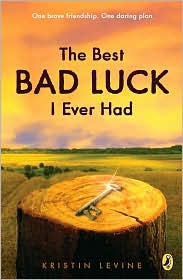
Chapter Book Review - The Best Bad Luck I Ever Had by Kristin Levine

Historical fiction is somewhat of a mixed bag. Successful historicals allow you to inhabit an alternate reality, just as you would in a fantasy novel, so that the reader comes away with knowledge that you would get if you had lived it. Less inviting are novels that are little more than recitations of fact, or those who overlay modern values and feelings into historical settings. Much better are books where it's apparent that a novelist has done his or her homework, and the details of daily life are woven seamlessly into the narrative.

In The Best Bad Luck I Ever Had, author Kristin Levine builds on the life of her grandfather to create a compelling and engrossing novel for middle graders. It's 1917 and life in Moundville, Alabama has a predictable rhythm for twelve-year-old Dit Sims. When a new family moves into town, Dit's hoping for a boy his own age, and he's too busy being mad that the postmaster has a daughter to care about the fact that the Walkers are Black. Emma seems just like nobody Dit could ever possibly be friends with, and he's only nice to her because his mama says he has to be. Spending time with Emma starts Dit thinking, though, and he realizes that not everything in Moundville is exactly the same for everyone. Before long Dit and Emma are pulled into events that are way beyond their control, where life and death literally hang in the balance.

What Levine does in this book is very subtle, slowly revealing the actual themes of her novel to the reader at the same pace that the conflicts arise for Dit. She introduces Moundville as a town much like any other. It is only once the characters begin to examine their own town in closer detail that the reader begins to see the prejudice and racism that bubble just beneath the surface. Dit has grown up here, he knows the people as well as he knows the heft of his slingshot or just how to catch the fattest perch. But seeing things through Emma's eyes, Dit is troubled by the inequality that exists there for people of color like Doc Haley and his son Elbert. Like Dit, readers may begin to look around and wonder what life is really like for people who might be on the outside of society, whether that is due to skin color, religion, income, ability or other factors.

The other thing that impresses me about Levine's debut is the way she deftly threads historical detail into the plot. Kids aren't immediately hit with the idea that this is a historical -- though you know it, by virtue of elements like the excitement of an arriving train, or Dit's mama boiling wash in the front yard -- you're never hammered over the head by the foreignness of these elements. This is the type of book that works well for kids who think they don't like history. Because Levine's story is so character-driven and emotionally charged, readers are pulled along with the plot without stopping to think about time and place.

The Best Bad Luck I Ever Had raises thought-provoking questions about acceptance and equality, about those who are part of the inner circle and those who are forever kept on the outside. This is a finely nuanced novel that raises the level of tension almost imperceptibly; I blazed through this compelling novel in one sitting, as captivated by the story as I was by the characters who set events in motion. Can't wait to see what Levine writes next!

The Best Bad Luck I Ever Had by Kristin Levine, published by G. P. Putnam's Sons
Ages 9-13
Source: Library
Sample quote: "Didn't see much of Emma for a while after that. She'd been okay on the fishing trip, and maybe we'd even had a little fun, but I still didn't want to be her friend. What'd we have in common? I loved the outdoors; she liked to sit on the porch all day. But my mama had a rule -- we didn't have to like anyone, but we had to be nice to everyone. That's exactly the kind of rule grown-ups make up, ain't it?"
Recommended

Tuesday, September 13, 2011

Picture Book Review - Shades of Black by Sandra L. Pinkney and Myles C. Pinkney

"I am Black / I am Unique!"

The subtitle of Sandra and Myles Pinkney's Shades of Black is "A Celebration of Our Children", and indeed it is! From the very first page, readers will catch the infectious spirit that runs through this vibrant book. Sandra Pinkney's text has a poetic feel to it, as she demonstrates the range of skin colors that encompasses shades of "brassy yellow" to "midnight blue", and lots more. I love that she draws comparisons between colors and food items, like gingery brown cookies or creamy white ice cream. What a great way to make kids sit up and take notice! The next sections show hair textures and lengths (Sprout likes to point out the "soft puffs in a cotton ball" that are like his own hair), as well as eye colors. Again Sandra Pinkney uses familiar items as points of comparison, so kids will readily see that all kinds of hair and eyes exist -- and "all of my hair is good!".

And no review of this title would be complete without commenting on Myles Pinkney's photos. As central as the text is to this book, the photos are what brings the words to vivid life. Gorgeous boys and girls of all ages display a variety of hair styles, eye colors and skin tones, all of which are emphasized by the text that accompanies them. We love the eye color section, where the kiddos all hold up rocks that match the hues of their own eyes (and we learned some rock names -- bonus!). I love the sly way one girl peeks at the camera out of the corner of her eye, and the playfulness of another flinging around piles of popcorn. Joyful, playful, ebullient!

If you're looking for a way to affirm and uplift your African American child, or to open a discussion about diversity, look no further. Pair with Shades of People or Black is Brown is Tan.

Shades of Black by Sandra L. Pinkney and Myles C. Pinkney, published by Scholastic
All ages
Source: Library
Sample quote: "My hair is the straight edge in a blade of grass / and the twisted corkscrew in a rope / My hair is short and my hair is long / All of my hair is good"
Highly recommended

Tuesday, August 2, 2011

Picture Book Review - Shades of People by Shelley Rotner and Sheila M. Kelly

"Have you noticed that people come in many different shades? Not colors, exactly, but shades."


The opening sentence of Shelley Rotner and Sheila M. Kelly's Shades of People accompanies a spread of children that illustrates their point nicely. Although there are kiddos pictured who share certain racial/ethnic characteristics, no two pictured have exactly the same shade of skin. The book goes on to further emphasize the point, with beautiful photos of children of all races. Rotner and Kelly also talk about the fact that there are not only variations in shade but in intensity ("some have skin that is very dark; others are pale, fair or light"). Even within families, the authors point out, the shade of people's skin can vary. A photo of a gorgeous bronze-skinned girl being kissed on either cheek by her Caucasian mother and African American father drives the message home.

We checked this title out from the library recently in order to start talking about skin color with Sprout. It's vital to us that we acknowledge that there is a racial difference between us (we are Caucasian, he is Ethiopian) because it's inevitable that he will notice it. Pretending that differences don't exist isn't an option. What is critical is that we present a message that skin color doesn't represent who we are inside, and that's a theme that Shades of People makes quite evident, both through the text and through the photos. I see this title as a great tool for introducing talk about racial/ethnic differences at a young age, so that Sprout never feels that this is an issue we weren't willing to discuss.

At the playground with friends a while back, one of the little girls mentioned to my husband that Sprout "is really tan". Jake explained to her that Sprout is African, that he was adopted from Ethiopia. She took that in, nodded sagely and said, "Okay", before she ran off to rejoin the playtime. The thought used to be that children didn't notice race; now we understand that they do notice it, but that the negative connotations they attach to racial differences are communicated through socialization, primarily by the adults in their lives. Kids will follow our lead in this way, as in so many others.

As a transracial family, we're acutely aware that the race discussion is going to come up, so we talk about it. But I think it's important for all families to recognize that building positive connotations around skin color is something that should happen sooner rather than later. This sensitively written and visually interesting title is a great way to introduce those discussions, and makes a good addition to all home libraries.

Shades of People by Shelley Rotner and Sheila M. Kelly, published by Holiday House
All ages
Source: Library
Sample quote: "Our skin is just our covering, like wrapping paper. And, you can't tell what someone is like from the color of their skin."
Highly recommended