It's no secret that there are a lot of great books out there about Martin Luther King Jr. I've written about plenty here on my blog, and I've even done features for other blogs full of titles celebrating this amazing man. Dr King's life is rich in elements that make a good story, the kind kidlit authors can't resist, and that's probably why there are so many great books out there.
But with an abundance of excellent works, with more being published each year, it's kind of hard to find a fresh approach. Yet, that's exactly what bestselling authors Andrea Davis Pinkney and Brian Pinkney have done in their new book Martin & Mahalia: His Words, Her Song. And they did it by combining the story of one incredible preacher, Martin Luther King Jr., with that of a woman whose voice was heaven on earth, Mahalia Jackson.
Kids to whom this book is targeted will no doubt recognize the name of the first subject here, but likely very few will know the second. No matter: the Pinkneys do a fantastic job of setting the stage for Martin and Mahalia's work together by beginning when both were children. Each excelled in their own way: Martin through his oratory skills and Mahalia through her musical talents. Both used their gifts to spread the message of the gospel, of peace and hope and love to all. And they did this in the South, in the time of Jim Crow, when things were, as Andrea Davis Pinkney puts it, "Separate, but nowhere near equal."
Both Martin and Mahalia looked around and saw that things needed to be different, that there needed to be equality and freedom for all Americans. And so their common mission brought them together, first as part of the Montgomery Bus Boycott, and then for the March on Washington. I love the imagery that the Pinkneys use for the March, the way they set the stage with the marchers walking stoically on even as hecklers jeered and tried to distract them. Once in place at the Lincoln Memorial, Mahalia used her "brass and butter" voice to draw the crowd together, to focus and settle them. And then Martin delivered what is arguably one of the best-known pieces of oration in the history of our country, and one which brings chills to me even now, the "I Have a Dream" speech.
As always with a Pinkney collaboration, this title relates historical detail in a way that keeps readers turning pages, but never shortcuts the facts. It's bolstered by an afterword by both author and illustrator, plus an historical timeline and suggestions for further reading and listening. I wouldn't be surprised to see Martin & Mahalia on awards lists this year, it's that well-executed. Brian Pinkney's illustration of the crowd on the National Mall is one of the last in the book, and it is jaw-dropping. His use of abstract shapes and swirling colors, coupled with the imagery of the dove that carries throughout the book, brings home the power and peace of that day.
Together Martin and Mahalia, each gifted in their own unique way, made the March on Washington a defining moment in the Civil Rights Movement, and one that our country will never forget. And I'm in awe of the way the Pinkneys have captured that partnership through their own, a marriage of Andrea's lyrical prose and Brian's arresting images. This book, like its subjects, won't soon be forgotten.
Martin & Mahalia: His Words, Her Song by Andrea Davis Pinkney & Brian Pinkney, published by Little, Brown
Ages 7-10
Source: Library
Sample: "Martin's sermons and Mahalia's spirituals told their listeners: You are here. On the path. Come along. Step proud. Stand strong. Be brave. Go with me. To a place, to a time, when we all will be free. People listened and believed."
Highly Recommended
Showing posts with label racism. Show all posts
Thursday, January 16, 2014
Tuesday, September 3, 2013
Nelson Mandela by Kadir Nelson {Picture Book of the Day}
I'm thrilled to be participating in the Picture Book of the Day project with a host of other awesome kidlit bloggers! This is a very cool meme that is great for building your library list -- each day a different blogger posts his/her picture book choice, which is shared via Facebook (you can also follow the picks on Pinterest). I've shared many of these in the past, and have found some terrific books for Sprout from the daily meme, so I'm especially excited to be part of the project this year!
For my first daily pick, I'm pulling out the big guns: Kadir Nelson's new picture book, Nelson Mandela.
It's hard to imagine how any reader could not just fall in love with Kadir Nelson's work after reading any of his books, but this one in particular seems to prove the benchmark of his talents. Naturally his breathtaking paintings are on full display here -- Sprout's favorite is the cover image, which honestly I could stare at myself for hours as well. But his narrative skills also come into the forefront again, as we read of the background and history of Mandela, from his early days as a barefoot boy playing at fighting, to his years imprisoned for the cause he could not abandon. Each image and its accompanying prose shows a facet of Mandela's life that will build in readers the admiration Kadir Nelson so clearly holds, for a man whose tireless fight at last culminated in a free South Africa.
Explaining to Sprout just what Mandela was fighting for was a little tricky; while he knows that people come in all different colors (and shapes, sizes, ages, abilities, etc.), it was hard for him to understand that some people are benefited by the hue of their skin while others suffer for it. Honestly I didn't force the issue too much, but neither do we sugarcoat these things with Sprout. It will be a feature of his life in this country, where he is bound to bear the weighty history of African Americans and their struggle for equality. So for him, the two spreads that most hit home were the first image of a "whites only" beach, followed by one later in the book where families of all colors enjoy the sand and surf. He lingered on the integrated image, and I can only guess at the message Sprout internalized from that.
My hope is that parents and teachers (and librarians too) will share Nelson Mandela with young readers not just as history lesson or a snippet about a great man. Though Mandela is without question the latter, I believe that the message of his life's work is larger than that - it's one that we need to carry forward into all our interactions of everyday life. Because open or hidden, racism is about fear, and only light will drive out that kind of darkness.
Slip this title into your book basket for bedtime, or for your kiddos to browse in the car. Let your middle schoolers read it, and share it aloud with your preschoolers as well. And read it yourself, for history and memory and celebration of one man, one extraordinary ordinary man, who saw a wrong in his society and never gave up the dream to change it.
Ages 4-8 (and up)
Source: Library
Sample: "Rolihlala played barefooted on the grassy hills of Qunu. He fought boys with sticks and shot birds with slingshots. The smartest Madiba child of thirteen, he was the only one chosen for school. His new teacher would not say his Xhosa name. She called him Nelson instead."
Highly recommended
Thursday, May 16, 2013
Candy Shop by Jan Wahl
Tolerance. It's a quality that often seems in short supply in our modern world. As we hear about events playing out on a national and international scale, it frequently feels like there's a lot more hate in the world than there is tolerance, doesn't it? One reason we elected not to have cable in our home during Sprout's early years is that we don't especially want his impression of the world to be colored by the types of events that make the news. You know what I mean here, because when was the last time a story about kindness or friendship was the most prominent story on everyone's mind?
And to be honest, I'm not sure that tolerance is an instinctive human reaction. We all know babies are selfish, and that's not a bad thing; in order to learn about the world, they must first experience it, and that's done through the lens of their own perspective. So as parents, teachers, friends and loved ones, it's up to us to help kids learn about acceptance through our own actions first, as well as the stories and examples with which we surround them.
A terrific book I recently stumbled across seems like a natural for any classroom or library needing some titles about tolerance. Jan Wahl's Candy Shop is perfect because it's never preachy or didactic. Take a look at that cover - does that scream "Heavy-duty lesson ahead?" No way. Instead it looks like exactly what it is, a fun story about a spunky little cowboy who just happens to run across an opportunity to show love to someone who desperately needs it. And there's your tolerance lesson, all wrapped up in a cute picture book. Sneaky, right?
Daniel, our narrator, is the cowboy in question, and he's excited to be heading to the Mrs Chu's candy shop with his Aunt Thelma. Early in the story we discover that Daniel lives in a somewhat depressed urban area; though his street is well-manicured, that's not the case for the whole neighborhood. Daniel and Aunt Thelma head off to get some candy, but first they have a number of stops to make. Daniel bears most of this good-naturedly, with only a bit of the expected little-boy grumbling. Soon enough they make their way to Mrs. Chu's, only to see a huge crowd gathered outside. Daniel discovers that someone has written a nasty word on the pavement, something hurtful about Mrs. Chu, who is from Taiwan. And right then and there our little cowboy decides he's going to show Mrs. Chu just what a great friend she is, and takes it on himself to clean up the graffiti and shoo away the gawkers. A brave boy indeed!
Kids will love this one for the candy and for the familiar emotions of being dragged along on errands with an adult. But scratch the surface and we'll see the real message, about standing up in the face of prejudice and not remaining silent when someone you love is hurt in a very unjust fashion. Nicole Wong illustrates Candy Shop, and she does a remarkable job of capturing Daniel's emotions, not just on his face but in his body language too. The spread of Daniel scrubbing the pavement while Aunt Thelma hustles away the onlookers is a powerful one, and it demonstrates that tolerance is more than a silent emotion - instead, tolerance is action, putting feet on your feelings for someone and standing up even when it's hard.
If you're looking for a way to start talking about prejudice and tolerance with your little ones, Candy Shop is the perfect book to do so. And as you read it, begin to think about the ways you can show your kids how critical acceptance is. Because, as the saying goes, we all can be the change in someone's reality, right now.
Candy Shop by Jan Wahl, published by Charlesbridge Press
Ages 3-6
Source: Library
Sample: "On the sidewalk a lot of people are gatherine. Do they all want candy, I wonder? No -- they stare at something written on the sidewalk. / I can't see it but it makes Miz Chu cry."
Recommended
And to be honest, I'm not sure that tolerance is an instinctive human reaction. We all know babies are selfish, and that's not a bad thing; in order to learn about the world, they must first experience it, and that's done through the lens of their own perspective. So as parents, teachers, friends and loved ones, it's up to us to help kids learn about acceptance through our own actions first, as well as the stories and examples with which we surround them.
A terrific book I recently stumbled across seems like a natural for any classroom or library needing some titles about tolerance. Jan Wahl's Candy Shop is perfect because it's never preachy or didactic. Take a look at that cover - does that scream "Heavy-duty lesson ahead?" No way. Instead it looks like exactly what it is, a fun story about a spunky little cowboy who just happens to run across an opportunity to show love to someone who desperately needs it. And there's your tolerance lesson, all wrapped up in a cute picture book. Sneaky, right?
Daniel, our narrator, is the cowboy in question, and he's excited to be heading to the Mrs Chu's candy shop with his Aunt Thelma. Early in the story we discover that Daniel lives in a somewhat depressed urban area; though his street is well-manicured, that's not the case for the whole neighborhood. Daniel and Aunt Thelma head off to get some candy, but first they have a number of stops to make. Daniel bears most of this good-naturedly, with only a bit of the expected little-boy grumbling. Soon enough they make their way to Mrs. Chu's, only to see a huge crowd gathered outside. Daniel discovers that someone has written a nasty word on the pavement, something hurtful about Mrs. Chu, who is from Taiwan. And right then and there our little cowboy decides he's going to show Mrs. Chu just what a great friend she is, and takes it on himself to clean up the graffiti and shoo away the gawkers. A brave boy indeed!
Kids will love this one for the candy and for the familiar emotions of being dragged along on errands with an adult. But scratch the surface and we'll see the real message, about standing up in the face of prejudice and not remaining silent when someone you love is hurt in a very unjust fashion. Nicole Wong illustrates Candy Shop, and she does a remarkable job of capturing Daniel's emotions, not just on his face but in his body language too. The spread of Daniel scrubbing the pavement while Aunt Thelma hustles away the onlookers is a powerful one, and it demonstrates that tolerance is more than a silent emotion - instead, tolerance is action, putting feet on your feelings for someone and standing up even when it's hard.
If you're looking for a way to start talking about prejudice and tolerance with your little ones, Candy Shop is the perfect book to do so. And as you read it, begin to think about the ways you can show your kids how critical acceptance is. Because, as the saying goes, we all can be the change in someone's reality, right now.
Candy Shop by Jan Wahl, published by Charlesbridge Press
Ages 3-6
Source: Library
Sample: "On the sidewalk a lot of people are gatherine. Do they all want candy, I wonder? No -- they stare at something written on the sidewalk. / I can't see it but it makes Miz Chu cry."
Recommended
Sunday, April 15, 2012
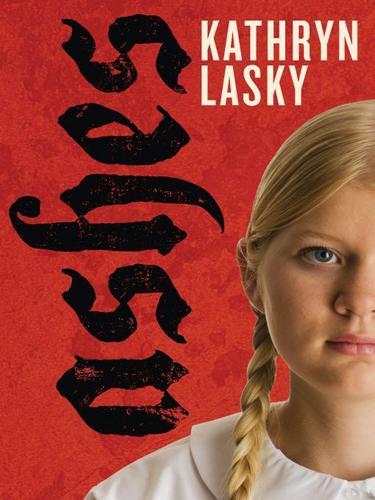
YA Review - Ashes by Kathryn Lasky
Some time periods in history are so widely written about that it hardly seems as if we need more books about it. World War II is arguably one of these. It's not that it isn't worth reading titles set during this timeframe, it's just that with so many quality options already on the shelves, are there still other viewpoints we haven't examined?
In Ashes, Kathryn Lasky manages to give us a different perspective - that of Gaby Schramm, an upper class German girl who gets an inside look at the formation of Hitler's Third Reich. Gaby's parents are close enough to the social elite that they know many powerful people in Germany's upper echelon. Professor Schramm is a colleague of Albert Einstein, and the two families vacation together during summers in Caputh. The Schramms watch with growing horror as Einstein and other prominent scientists are singled out for their "Jewish physics", as friends are banned from social events due to their ethnicity, and as those who make the wrong comment in a public setting suddenly disappear.
Gaby herself despises Hitler and all his government stands for; and yet, she finds herself going along with the required "Heil Hitler" salute when it becomes part of her school day. Though she refuses to join the Hitler Youth, it is not until one of the Reich's new policies touches close to home that Gaby finds the courage to really define her opposition, and to turn with her parents toward another life.
I picked Ashes up looking for something like The Book Thief; while I found Zusak's book more compelling, Ashes is still a strongly written title with a unique take on the events of Nazi Germany. As the heat gradually turns up around the Schramm family, Lasky shows us how the political events combine with Gaby's own internal struggles to give her an increasing awareness of the world at large. Forced to confront the effect that politics has on her own household, Gaby grows up very quickly - maybe too quickly, as she often has insights that seem beyond her own years. And yet, in times such as these, doesn't maturity come all too suddenly?
Though some libraries shelve this in the children's section, there are themes here that seem more suited to teens, particularly a plotline revolving around Gaby's sister Ulla and her boyfriend Karl. The overall message, too, is one that will speak to young adults in a more immediate way -- that of reconciling the world you've grown up with alongside that you've come to know, which in Gaby's case is one that conflicts in nearly every aspect with her pampered childhood. Lasky ties in connections to actual historical figures, weaving them into her cast of characters so seamlessly that the events of Nazi Germany come alive as we read.
Ashes is, above all, a subtle and unforgettable piece of historical fiction, and a worthy contribution to the canon of World War II literature.
Ashes by Kathryn Lasky, published by Viking
Ages 12 up
Source: Library
Sample: "I thought of that swirl of sugar on the kitchen floor from years before. How could Hitler cause so many problems? I put down the binoculars. The scrap of moon had slipped away, making the dark even darker and the stars even brighter. They scorched the blackness with their fire. Ninety-two elements to bake a universe and one madman to blow it up?"
Recommended
In Ashes, Kathryn Lasky manages to give us a different perspective - that of Gaby Schramm, an upper class German girl who gets an inside look at the formation of Hitler's Third Reich. Gaby's parents are close enough to the social elite that they know many powerful people in Germany's upper echelon. Professor Schramm is a colleague of Albert Einstein, and the two families vacation together during summers in Caputh. The Schramms watch with growing horror as Einstein and other prominent scientists are singled out for their "Jewish physics", as friends are banned from social events due to their ethnicity, and as those who make the wrong comment in a public setting suddenly disappear.
Gaby herself despises Hitler and all his government stands for; and yet, she finds herself going along with the required "Heil Hitler" salute when it becomes part of her school day. Though she refuses to join the Hitler Youth, it is not until one of the Reich's new policies touches close to home that Gaby finds the courage to really define her opposition, and to turn with her parents toward another life.
I picked Ashes up looking for something like The Book Thief; while I found Zusak's book more compelling, Ashes is still a strongly written title with a unique take on the events of Nazi Germany. As the heat gradually turns up around the Schramm family, Lasky shows us how the political events combine with Gaby's own internal struggles to give her an increasing awareness of the world at large. Forced to confront the effect that politics has on her own household, Gaby grows up very quickly - maybe too quickly, as she often has insights that seem beyond her own years. And yet, in times such as these, doesn't maturity come all too suddenly?
Though some libraries shelve this in the children's section, there are themes here that seem more suited to teens, particularly a plotline revolving around Gaby's sister Ulla and her boyfriend Karl. The overall message, too, is one that will speak to young adults in a more immediate way -- that of reconciling the world you've grown up with alongside that you've come to know, which in Gaby's case is one that conflicts in nearly every aspect with her pampered childhood. Lasky ties in connections to actual historical figures, weaving them into her cast of characters so seamlessly that the events of Nazi Germany come alive as we read.
Ashes is, above all, a subtle and unforgettable piece of historical fiction, and a worthy contribution to the canon of World War II literature.
Ashes by Kathryn Lasky, published by Viking
Ages 12 up
Source: Library
Sample: "I thought of that swirl of sugar on the kitchen floor from years before. How could Hitler cause so many problems? I put down the binoculars. The scrap of moon had slipped away, making the dark even darker and the stars even brighter. They scorched the blackness with their fire. Ninety-two elements to bake a universe and one madman to blow it up?"
Recommended
Labels:
Germany,
girls,
growing up,
historical fiction,
racism,
secrets,
YA
Thursday, February 2, 2012
Nonfiction Picture Book - Belle, the Last Mule at Gee's Bend by Calvin Alexander Ramsey and Bettye Stroud
So much of history is in the telling. When presented as a recitation of facts, dates, events, it can be pretty dry, as anyone who took World History 101 in college can probably confirm (the most exciting thing was waiting for the prof to nod off during the lecture). But when made personal, when fleshed out with actual people and details and colorful back stories, then it comes alive and suddenly seems relevant to your life.
Such is the case with the Civil Rights Movement. Arguably one of the most important periods in our country's history, and a time chock-full of passion, dedication, emotion and fevered anxiety on all sides -- and yet, for many kids, I suspect this too has been boiled down to a timeline of key events. Critical to know, of course, but not very real, not very personal.
Into that gap rides Belle, the Last Mule at Gee's Bend. Belle epitomizes the quality that exists in nonfiction picture books today; authors Calvin Alexander Ramsey and Bettye Stroud have done their homework, taken a story rooted in actual fact and brought it to life with the introduction of some wholly believable fictional characters. Coupled with the extraordinary artistic renderings of John Holyfield, the result is a knock-out piece of publishing that belongs on every library and classroom shelf.
The story centers around the people of Gee's Bend, Alabama, and the part they played in the struggle for civil rights for all citizens. "Benders", as these folks were known, didn't have much, but they had determination and belief in the cause. Stirred by a visit from Dr Martin Luther King Jr., the Benders pluck up the courage to take the ferry to Camden and register to vote. Upon arriving there, they are stopped by the white sheriff, who has shut the ferry down. But the Benders will not be swayed -- instead, they pack up their wagons and hitch up their mules, Belle included, and make the trip all the way around the river to register.
It's not a peaceful resolution. Life in Gee's Bend gets even harder in the wake of the backlash that results from their actions. But the Benders soldier on. And then in April 1968, Dr King is killed. The grief that sweeps through the nation is felt even more strongly in Gee's Bend. But some of that grief is eased when the Benders find out that it was Dr King's wish to have mules pull the wagon with his coffin. And so Belle and Ada, the mules of Gee's Bend, become part of history, a further manifestation of all the quiet determination of their owners and others who fought for civil rights.
Framing the story around young Alex, who has come to Gee's Bend with his mother and hears the story from Belle's owner, is a touch of genius on Ramsey and Stroud's part. They skillfully weave in the interaction between Alex and Miz Pettway, making Belle's tale an organic part of the conversation. And in so doing, they bring home the impact of history. Young readers will mirror Alex's dawning realization, as he comes to recognize that the people he's learned about in school were flesh and blood, just like himself and his family, not just characters in a book. Talk about bringing history to life -- Ramsey and Stroud do it in such a way that readers won't even think about this as a tale from "long ago". Vivid, emotional details in the illustrations emphasize the reality even further, from the gentle smiles of the Gee's Bend quilters to the placid dignity of Belle and Ada, pulling Dr King's coffin through the streets.
Read this one with your kids, with your students, or just for yourself. Read it and remember.
Belle, the Last Mule at Gee's Bend by Calvin Alexander Ramsey and Bettye Stroud, published by Candlewick Press
Ages 8-12
Source: Library
Sample: "But we must have scared the white folks in Camden, because the next thing we knew, they shut down the ferry. The white sheriff was a big bully who wanted to keep us in our place. He told reporters, 'We didn't close the ferry because they were black. We closed it because they forgot they were black.'"
Highly recommended
Bonus: interview with illustrator John Holyfield at The Brown Bookshelf
Such is the case with the Civil Rights Movement. Arguably one of the most important periods in our country's history, and a time chock-full of passion, dedication, emotion and fevered anxiety on all sides -- and yet, for many kids, I suspect this too has been boiled down to a timeline of key events. Critical to know, of course, but not very real, not very personal.
Into that gap rides Belle, the Last Mule at Gee's Bend. Belle epitomizes the quality that exists in nonfiction picture books today; authors Calvin Alexander Ramsey and Bettye Stroud have done their homework, taken a story rooted in actual fact and brought it to life with the introduction of some wholly believable fictional characters. Coupled with the extraordinary artistic renderings of John Holyfield, the result is a knock-out piece of publishing that belongs on every library and classroom shelf.
The story centers around the people of Gee's Bend, Alabama, and the part they played in the struggle for civil rights for all citizens. "Benders", as these folks were known, didn't have much, but they had determination and belief in the cause. Stirred by a visit from Dr Martin Luther King Jr., the Benders pluck up the courage to take the ferry to Camden and register to vote. Upon arriving there, they are stopped by the white sheriff, who has shut the ferry down. But the Benders will not be swayed -- instead, they pack up their wagons and hitch up their mules, Belle included, and make the trip all the way around the river to register.
It's not a peaceful resolution. Life in Gee's Bend gets even harder in the wake of the backlash that results from their actions. But the Benders soldier on. And then in April 1968, Dr King is killed. The grief that sweeps through the nation is felt even more strongly in Gee's Bend. But some of that grief is eased when the Benders find out that it was Dr King's wish to have mules pull the wagon with his coffin. And so Belle and Ada, the mules of Gee's Bend, become part of history, a further manifestation of all the quiet determination of their owners and others who fought for civil rights.
Framing the story around young Alex, who has come to Gee's Bend with his mother and hears the story from Belle's owner, is a touch of genius on Ramsey and Stroud's part. They skillfully weave in the interaction between Alex and Miz Pettway, making Belle's tale an organic part of the conversation. And in so doing, they bring home the impact of history. Young readers will mirror Alex's dawning realization, as he comes to recognize that the people he's learned about in school were flesh and blood, just like himself and his family, not just characters in a book. Talk about bringing history to life -- Ramsey and Stroud do it in such a way that readers won't even think about this as a tale from "long ago". Vivid, emotional details in the illustrations emphasize the reality even further, from the gentle smiles of the Gee's Bend quilters to the placid dignity of Belle and Ada, pulling Dr King's coffin through the streets.
Read this one with your kids, with your students, or just for yourself. Read it and remember.
Belle, the Last Mule at Gee's Bend by Calvin Alexander Ramsey and Bettye Stroud, published by Candlewick Press
Ages 8-12
Source: Library
Sample: "But we must have scared the white folks in Camden, because the next thing we knew, they shut down the ferry. The white sheriff was a big bully who wanted to keep us in our place. He told reporters, 'We didn't close the ferry because they were black. We closed it because they forgot they were black.'"
Highly recommended
Bonus: interview with illustrator John Holyfield at The Brown Bookshelf
Monday, November 28, 2011
Chapter Book Review - Sylvia & Aki by Winifred Conkling
Winifred Conkling's Sylvia and Aki is a deceptively slim little book, the kind kids are drawn to for book reports or school projects because it's so skinny. And yet, for all its brevity, Sylvia and Aki packs a punch.
The story is a fictionalized account of the lives of Sylvia Mendez and Aki Munemitsu, opening in 1941. Aki's family has been evacuated from their farm, sent to a Japanese internment camp in the furor that resulted from the bombing of Pearl Harbor. Aki's father is taken away first, with no notice -- she is terrified that she will never see him again, that their family will always be separated. Because of the restrictions about what the family could take with them, Aki has had to leave some of her most precious things behind, including her favorite doll, which she tucks onto the shelf in her closet, hoping she'll be back to reclaim her.
Each family struggles. Each girl feels lost, alone, uncertain. But as time passes the girls come into contact with one another, and a friendship slowly blossoms, borne of shared hardship and isolation. Life for the girls is not easy, but knowing that there is someone else, someone like them who feels on the outside of things, makes it all just a little easier to bear.
Conkling weaves the girls' stories together skillfully, showing how both Sylvia and Aki were outsiders because of something they had no control over, the color of their skin. Aki's time in the camp is particularly poignant, as we feel with her the pain of loss and the fear that her family will never be whole again. Like Aki, Sylvia is made to feel foreign, an outsider, as school district officials assume she is unclean or tell her to go back to Mexico (with the irony being that she is American). Conkling depicts the quiet heroism mirrored in each girls' individual heartbreak. Because the girls experience a similar day-to-day reality, as victims of prejudice and open racism, when they find friendship in one another, it is all the more sweet.
One of the readings in my multicultural kidlit class last week pointed out that children's books with a diverse cast almost always include white characters in the mix. This hadn't occurred to me, but flipping through some of Sprout's books I can see it's true. Sylvia and Aki is that rare thing, a book that examines racism from the inside without casting a white person in the role of savior. For these girls, breaking down barriers just meant living the lives they dreamed of. It's hard to think of a more inspiring tale, no matter what your skin color.
Sylvia and Aki by Winifred Conkling, published by Tricycle Press
Ages 8-12
Source: Library
Sample quote: "Then Aki said good-bye to the nurse, picked up her suitcase, and took her mother's hand. She missed her father. She missed her home. She missed the life she used to have. But when she felt her mother's hand in hers, she knew that she was ready to face Poston."
Recommended
The story is a fictionalized account of the lives of Sylvia Mendez and Aki Munemitsu, opening in 1941. Aki's family has been evacuated from their farm, sent to a Japanese internment camp in the furor that resulted from the bombing of Pearl Harbor. Aki's father is taken away first, with no notice -- she is terrified that she will never see him again, that their family will always be separated. Because of the restrictions about what the family could take with them, Aki has had to leave some of her most precious things behind, including her favorite doll, which she tucks onto the shelf in her closet, hoping she'll be back to reclaim her.
Sylvia finds Aki's doll, on a very bad day when she is in need of comfort. Sylvia and her family are renting the farm from the Munemitsus, and Sylvia's father is the boss, something the family is very proud of. But the day Sylvia's aunt takes the children to enroll in the closest school, they discover that Mexicans must attend the migrant school. Everything about the Hoover School is second-best, from the rundown buildings to the battered supplies. And Sylvia's father is determined to get his daughter into the Westminster School, which so far is white students only.
Conkling weaves the girls' stories together skillfully, showing how both Sylvia and Aki were outsiders because of something they had no control over, the color of their skin. Aki's time in the camp is particularly poignant, as we feel with her the pain of loss and the fear that her family will never be whole again. Like Aki, Sylvia is made to feel foreign, an outsider, as school district officials assume she is unclean or tell her to go back to Mexico (with the irony being that she is American). Conkling depicts the quiet heroism mirrored in each girls' individual heartbreak. Because the girls experience a similar day-to-day reality, as victims of prejudice and open racism, when they find friendship in one another, it is all the more sweet.
One of the readings in my multicultural kidlit class last week pointed out that children's books with a diverse cast almost always include white characters in the mix. This hadn't occurred to me, but flipping through some of Sprout's books I can see it's true. Sylvia and Aki is that rare thing, a book that examines racism from the inside without casting a white person in the role of savior. For these girls, breaking down barriers just meant living the lives they dreamed of. It's hard to think of a more inspiring tale, no matter what your skin color.
Sylvia and Aki by Winifred Conkling, published by Tricycle Press
Ages 8-12
Source: Library
Sample quote: "Then Aki said good-bye to the nurse, picked up her suitcase, and took her mother's hand. She missed her father. She missed her home. She missed the life she used to have. But when she felt her mother's hand in hers, she knew that she was ready to face Poston."
Recommended
Friday, September 30, 2011
Library Find - Ron's Big Mission by Rose Blue and Corinne J. Naden
One thing I especially appreciate about our local libraries is that the staff members take the time to incorporate diversity into their displays. Although I work for the library system, I don't work in a branch, so I don't know how much extra time this takes, but we're grateful. Every time we go into the library, Sprout can see characters on the covers of books who have skin and hair like his, or like his friends. This is such a huge step forward in making everyone feel welcome -- kudos to all librarians, pages, booksellers and other staffers who take the time to do this!
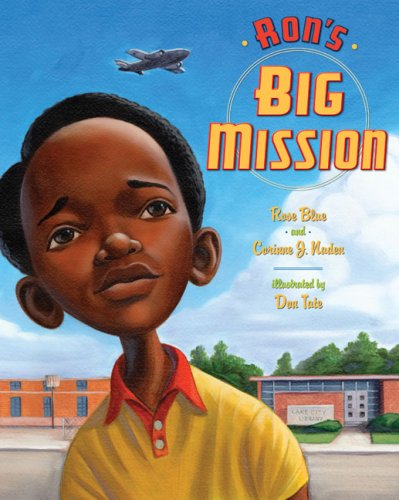
The other day Sprout ran right over to the shelf and pulled down Ron's Big Mission by Rose Blue and Corinne J. Naden. No surprise why -- the cover features a gorgeous African American boy with a plane overhead (win win for Sprout!). The illustration style looked familiar, with a rich color palate, careful use of shading and simple details that nevertheless add complexity. As soon as I flipped to the back I saw why, as illustrator Don Tate also did one of our favorite recent reads, Summer Sun Risin'.
The book relates an incident in the life of Ron McNair, a little boy from South Carolina who grew up to be an astronaut. As a boy, Ron loved the library, but as an African American child in the 1950's, he was not allowed to check out any books. Several of the white patrons would take out books on their cards for Ron. But one day Ron decided he had had enough, and he refused to leave the library until he was allowed to check out his books. The desk clerk refused to give him a card, and soon Ron's mother and even the police were called. But nothing could make Ron budge -- until, at last, the head librarian did the right thing and gave Ron his own library card.
Ron's Big Mission by Rose Blue and Corinne J. Naden, published by Dutton Children's Books
All ages
Source: Library
Sample quote: "At last Ron found some books on airplanes. He took the books and started to walk to the front desk. Ron felt nervous and his hands felt a little sweaty, but he knew what he wanted to do."
Highly recommended
The other day Sprout ran right over to the shelf and pulled down Ron's Big Mission by Rose Blue and Corinne J. Naden. No surprise why -- the cover features a gorgeous African American boy with a plane overhead (win win for Sprout!). The illustration style looked familiar, with a rich color palate, careful use of shading and simple details that nevertheless add complexity. As soon as I flipped to the back I saw why, as illustrator Don Tate also did one of our favorite recent reads, Summer Sun Risin'.
If I thought the story wouldn't hold Sprout's interest, I was wrong. He was riveted through the whole thing. This is the first book we've read where racism was openly discussed, but it won't be the last -- we know that our child will encounter hatred in his life, and we intend to prepare him the best we can for that, with tools like these. And I couldn't help comparing Ron's experience at the library with ours today, fifty years later, when Sprout can go into a library and see books that represent diversity in all its forms. No, we're not a perfect society yet, and we have a long way to go until equality is realized for all our citizens. But on this day, it warmed my heart to see my beautiful Ethiopian son carry Ron's Big Mission up to the counter, hand the librarian our library card, and walk away with a smile on his face.
Ron's Big Mission by Rose Blue and Corinne J. Naden, published by Dutton Children's Books
All ages
Source: Library
Sample quote: "At last Ron found some books on airplanes. He took the books and started to walk to the front desk. Ron felt nervous and his hands felt a little sweaty, but he knew what he wanted to do."
Highly recommended
Subscribe to:
Posts (Atom)