First off, let me say that I am not a big graphic novel fan. Nothing against them - in fact, comics and graphic novels are what brought my husband and I together - and there are a number that I've enjoyed. It's just that I am far more likely to choose something else when I have leisure reading time.
But whenever a graphic novel pops up on my radar as many times as tonight's pick has, I feel pretty sure it's something I better make time to read. And when I enjoy a book as much as I did Cece Bell's El Deafo, I start thinking that graphic novels should be added into my rotation a little more frequently. (It's been a banner month for the format for me - first Sisters by Raina Telgemeier, now El Deafo!)
So, to the review: Cece Bell is an accomplished illustrator but El Deafo is her graphic novel debut. You'd never guess it, though, as it's a fully realized work with no false moments or plot threads left dangling. Likely that's because El Deafo is largely autobiographical. I say largely because the main character in El Deafo is a bunny named Cece Bell - presumably the author is not in fact a rabbit, but I don't totally know that because I haven't met her (maybe someday).
El Deafo tells Bell's story of growing up with severe deafness as a result of contracting meningitis when she was four years old. Don't think that she's going to gloss over any parts of her illness just because the book is for young readers; Bell talks about being in pain, about not knowing why, and the scariness of first realizing that she could no longer hear. We follow her through getting hearing aids, then a more powerful hearing aid for school - thus becoming, in time, "El Deafo", a girl with supersonic hearing thanks to her Phonic Ear and the microphone her teachers have to wear. (One superpower? Being able to hear when the teacher is coming back to the room so everyone can scramble back to their seats. Niiiiice.)
Bell is candid here about the ups and downs of her childhood, which I think all readers can relate to, hearing or not. There's a good dose of humor, and she's not afraid to laugh at herself or others - I really love that she brings out how one friend goes WAAY overboard with accentuating in-di-vi-du-al sy-ll-a-bl-es. El Deafo is Cece's alter ego, a person who does all the things Cece herself isn't always brave enough to do, like calling out that same friend for her pronunciation exaggeration. And I like that the struggles Cece faces don't always have to do with her deafness, but are rather those that kids and former kids everywhere will get - like feeling awkward, being frustrated with your mom, having trouble finding and keeping friends. That's childhood, people, and we all know what those issues are about.
Readers who enjoyed Smile and Sisters are a natural fit for this one. But go a bit further too - to readers who like novels like Wonder or A View from Saturday. El Deafo is one of my favorite books of this year, or any year really. Share this one with your kids, for the bright wit and serious insights, and the sheer joy of a story brilliantly crafted.
El Deafo by Cece Bell, published by Amulet Books
Ages 9-12
Source: Library
Highly recommended
Showing posts with label growing up. Show all posts
Tuesday, October 21, 2014
Tuesday, February 4, 2014
You Were the First by Patricia MacLachlan
A couple of nights ago, feeling nostalgic, Hubs & I cracked out a few old photos and videos of Sprout when he first joined our family. It was fun for us, and for Sprout, to marvel over how small he was, how adorably squishy and cute, with his mop of curls and big eyes. We told Sprout story after story about his first days home: when he ate ice cream (and cried inconsolably at the cold); the way he used to stand in front of the oven and watch food cooking (Hubs called it "food tv"); the obsession with trains that meant we had track spread all over the living room. It seems like yesterday to us, of course, but to Sprout it's almost unthinkable that he was ever that small, and he loves to hear about himself at that age.
Tonight's title puts me in mind of that fascination that Sprout, like most kiddos I've known, has with hearing about himself as a baby. Patricia MacLachlan's You Were the First is a wonderful look back at a young child's early days, as told from the perspective of his doting parents. "You were the first to sleep in the basket with the yellow ribbon wound round," the book begins, opposite a picture of Mom and Dad (and puppy) gazing down at their newborn. On it goes, through early experiences like laughing at the dog, to milestones like learning to crawl, to reveling in the thrill of snow with Dad. On each page, there are tender family moments, and at the end, a reassurance: "One day there may be a second -- or a third -- to sleep in the basket with the yellow ribbon wound round. / But you will always be the first."
You Were the First is a beautiful book, gentle and sweet, written by a skilled author who knows what children enjoy. If you haven't read a Patricia MacLachlan title, you're missing out -- there are so many that we love, I'm hard-pressed to name them all . And this is a very worthy addition to her canon of modern classics, which is really what she writes, after all. While goofy and trendy titles capture attention, and are great for what they are, it is quiet books like this that parents can share with their children when it matters, when they need bolstering from the world around them. (And it could easily work for adoptive families, as there's no mention of pregnancy or birth, just an opening scene of the darling boy in his bassinet.)
MacLachlan's words are elegantly set off by Stephanie Graegin's illustrations. Graegin hasn't garnered as much attention as I feel she deserves, but she's one to seek out. Her finely articulated illustrations truly match the mood conjured by MacLachlan's prose. There are also lots of small touches that kiddos will enjoy - the presence of the baby's stuffed elephant, popping up here and there, the beaming puppy who is clearly besotted with his boy, and the cozy domesticity that's present in every image of the little family. Even the endpapers are adorable, small jewels of images that trace a baby's early months and days.
It's worth noting that this is a transracial family, Asian American and white, which for me is a huge bonus. It's always nice to find a title like this that reads so easily and soothingly -- and diversity too? Almost too good to be true. Jump at the chance to read You Were the First to your little ones, whether they are onlies like Sprout, or the first (or tenth) of several. Because it's the kind of inclusive, peerless book we need more of for our children, and for ourselves as well.
You Were the First by Patricia MacLachlan, published by Little, Brown
Ages 2-6
Source: Library
Highly recommended
Sunday, January 12, 2014
Princess Academy by Shannon Hale
Recently I received a comment about the presence of several girl-centered books on the blog. "Thought these books were for your boy," the commenter stated. "Does he like it when you read books about girls?"
Well, yes. Because, you see, we read them to him.
I think we do our kids a real disservice with our preconceived notions about what boys will like or what girls will be into. We're big believers in following our kiddo's lead, but also in giving him a diverse crop of things to read and do. So we include books that feature girls as often as boys, just like we read about an equal number of books featuring characters of various ethnicities. And I hope that as he grows older, this will make him open to the idea of cracking open a book with a female protagonist.
Having said that, I know it's probably an uphill battle to expect that most boys will want to read a book titled Princess Academy, no matter how awesome it is (and with Shannon Hale as the author, you know it's going to be a good one). Heck, I'll admit that even I had reservations about this because let's be honest, that title is kind of awful. Still, it's a Newbery Honor title, and I'm on a mission to read as many Newbery medalists as I can, so I overcame my feelings about the name of this book and dove right in.
Princess Academy tells the story of Miri Larendaughter, who lives with her father and sister in the village of Mount Eskel. The villagers have been quarriers for generations, extracting linder from the mountain and trading it to lowland traders, sustaining themselves through the harsh winter months. The people of Mount Eskel are used to the idea that the lowlanders look down on them, and keep to themselves as much as possible. But then comes the proclamation that the prince's bride is to be one of the girls of Mount Eskel, and that in preparation, all girls of the right age must enter the Princess Academy to be established on the mountainous slopes.
Miri's torn about whether or not she wants to be chosen, and this struggle forms much of the narrative drive of the book. But there are other factors as well -- competition among the girls, worries about home, the completely horrible tutor Olana, and Miri's feelings for her childhood friend Peder -- that make up the complexity that is Miri's life at the Academy. I love that through it all, Miri relies on her own cleverness and the help of her friends to solve her problems. When bandits take the girls hostage, for example, it is Miri's knowledge of the villagers' "quarry speech" that allows her to summon help and save everyone from a terrible situation.
I'm so glad I read this, and it's one I'm really looking forward to reading with Sprout when he's old enough. The story is paced very well -- there's plenty of suspense to keep readers turning pages, but enough heart and soul with the characters to make them easily relatable. Add in a touch of fantasy, and just a hint of fairy-tale essence, and you have the makings of a solidly classic title that will appeal to readers of all types. Plus you can't help but admire the mighty-girl message here. Miri's anything but a damsel in distress, and really none of the other girls are helpless maidens either. The idea of a fairy tale where the heroine saves the day isn't new, but it's beautifully done in this novel. Easy to see why the Newbery committee couldn't pass it by!
Grab this one for your middle-grade girl or boy -- because once they get past the titles, readers can't help but cheer for Miri and thrill at the adventures this fantasy has to offer.
Princess Academy by Shannon Hale, published by Bloomsbury Children's Books
Ages 9-12
Source: Library
First lines: "Miri woke to the sleepy bleating of a goat. The world was as dark as eyes closed, but perhaps the goats could smell dawn seeping through the cracks in the house's stone walls. Though still half-asleep, she was aware of the late autumn chill hovering just outside her blanket, and she wanted to curl up tighter and sleep like a bear through frost and night and day."
Recommended
Well, yes. Because, you see, we read them to him.
I think we do our kids a real disservice with our preconceived notions about what boys will like or what girls will be into. We're big believers in following our kiddo's lead, but also in giving him a diverse crop of things to read and do. So we include books that feature girls as often as boys, just like we read about an equal number of books featuring characters of various ethnicities. And I hope that as he grows older, this will make him open to the idea of cracking open a book with a female protagonist.
Having said that, I know it's probably an uphill battle to expect that most boys will want to read a book titled Princess Academy, no matter how awesome it is (and with Shannon Hale as the author, you know it's going to be a good one). Heck, I'll admit that even I had reservations about this because let's be honest, that title is kind of awful. Still, it's a Newbery Honor title, and I'm on a mission to read as many Newbery medalists as I can, so I overcame my feelings about the name of this book and dove right in.
Princess Academy tells the story of Miri Larendaughter, who lives with her father and sister in the village of Mount Eskel. The villagers have been quarriers for generations, extracting linder from the mountain and trading it to lowland traders, sustaining themselves through the harsh winter months. The people of Mount Eskel are used to the idea that the lowlanders look down on them, and keep to themselves as much as possible. But then comes the proclamation that the prince's bride is to be one of the girls of Mount Eskel, and that in preparation, all girls of the right age must enter the Princess Academy to be established on the mountainous slopes.
Miri's torn about whether or not she wants to be chosen, and this struggle forms much of the narrative drive of the book. But there are other factors as well -- competition among the girls, worries about home, the completely horrible tutor Olana, and Miri's feelings for her childhood friend Peder -- that make up the complexity that is Miri's life at the Academy. I love that through it all, Miri relies on her own cleverness and the help of her friends to solve her problems. When bandits take the girls hostage, for example, it is Miri's knowledge of the villagers' "quarry speech" that allows her to summon help and save everyone from a terrible situation.
I'm so glad I read this, and it's one I'm really looking forward to reading with Sprout when he's old enough. The story is paced very well -- there's plenty of suspense to keep readers turning pages, but enough heart and soul with the characters to make them easily relatable. Add in a touch of fantasy, and just a hint of fairy-tale essence, and you have the makings of a solidly classic title that will appeal to readers of all types. Plus you can't help but admire the mighty-girl message here. Miri's anything but a damsel in distress, and really none of the other girls are helpless maidens either. The idea of a fairy tale where the heroine saves the day isn't new, but it's beautifully done in this novel. Easy to see why the Newbery committee couldn't pass it by!
Grab this one for your middle-grade girl or boy -- because once they get past the titles, readers can't help but cheer for Miri and thrill at the adventures this fantasy has to offer.
Princess Academy by Shannon Hale, published by Bloomsbury Children's Books
Ages 9-12
Source: Library
First lines: "Miri woke to the sleepy bleating of a goat. The world was as dark as eyes closed, but perhaps the goats could smell dawn seeping through the cracks in the house's stone walls. Though still half-asleep, she was aware of the late autumn chill hovering just outside her blanket, and she wanted to curl up tighter and sleep like a bear through frost and night and day."
Recommended
Tuesday, July 23, 2013
Better Nate Than Ever by Tim Federle
Whew, lots going on around here at the moment! In addition to the Multicultural Kid Blogs Pinterest Scavenger Hunt we are participating in (are you pinning along?), I've recently been promoted to a librarian position at the regional library system where I work. That's a dream come true for me, frankly, and though it isn't a children's services position, I'll still be doing acquisitions for our children's department, so no shortage of new books any time soon. But while I've been adjusting to all of this, the blog has taken a back seat of sorts, and I do apologize for the lack of new content. Fear not, more is coming!
Of all the books I've recently read, though, one is so unique that I couldn't take it back to the library unblogged. In his debut novel for middle graders, Better Nate Than Ever, Tim Federle gives us a fast, funny and oh-so-relatable tale of a fish out of water who may just have finally found his true calling. Nate Foster hasn't always known he wanted to be on Broadway, but he has always felt he didn't quite fit in his hometown of Jankburg, Pennsylvania. With the help of best friend Libby, Nate's finally figuring out that he was born for the stage - and he may be getting his big break, when Libby helps him hatch a plot to sneak off to New York for a Broadway audition. It's for the stage version of Nate's favorite film -- E.T.: The Musical -- and Nate just feels in his bones that he's meant to play Elliott. So Nate screws up all his courage and takes the city by storm. But with every twist and turn, it seems it's not going to be an easy road to stardom. Should Nate give up and head for home, or keep on keeping on to make his big dreams a reality?
This one isn't going to strike a chord with every kid, but for those to whom it rings true, this one may just be a lifesaver. Federle's frank about Nate's struggles to figure out his place in the world; this is an especially good choice for young teens who are gay or questioning. There are lots of other weighty issues as well, including religion, happiness at home, sibling rivalry, bullying and the drama of not fitting in. But lest you think this is a heavy book, far from it. Parts of this warm and witty novel had me laughing out loud, and every single page had me rooting for Nate that he'd find his place in the world, now or later.
Federle's mined his own experiences for the story of Nate, and the truth of his writing shines through on every page. You can't help but smile at a kid who uses failed musicals as curse words, and who's almost single-minded about getting to eat at the Times Square Applebee's. There's the perfect pitch here between adulthood and childhood, between a kid who is dazzled by the white lights of Broadway and one who just wants to, once and for all, find the place he's meant to be. For all of us who've ever felt there was a version of life out there with kindred spirits, and who suffered through some years of being odd one out before finding it, Better Nate Than Ever says it all.
Better Nate Than Ever by Tim Federle, published by Simon and Schuster
Ages 9-13+
Source: Library
Sample: "And now I'm staring out the window at a familiar world zooming past, colors bleeding from grey (Pittsburgh) to bright red and blue (a car accident) to brown (somewhere thirty minutes out of town). Libby shared a really good technique that is thus far working beautifully: Crumple up a bunch of Kleenex and put them on the seat next to yours, and nobody will sit next to you on long bus trips. Try it sometime, guys."
Recommended
Of all the books I've recently read, though, one is so unique that I couldn't take it back to the library unblogged. In his debut novel for middle graders, Better Nate Than Ever, Tim Federle gives us a fast, funny and oh-so-relatable tale of a fish out of water who may just have finally found his true calling. Nate Foster hasn't always known he wanted to be on Broadway, but he has always felt he didn't quite fit in his hometown of Jankburg, Pennsylvania. With the help of best friend Libby, Nate's finally figuring out that he was born for the stage - and he may be getting his big break, when Libby helps him hatch a plot to sneak off to New York for a Broadway audition. It's for the stage version of Nate's favorite film -- E.T.: The Musical -- and Nate just feels in his bones that he's meant to play Elliott. So Nate screws up all his courage and takes the city by storm. But with every twist and turn, it seems it's not going to be an easy road to stardom. Should Nate give up and head for home, or keep on keeping on to make his big dreams a reality?
This one isn't going to strike a chord with every kid, but for those to whom it rings true, this one may just be a lifesaver. Federle's frank about Nate's struggles to figure out his place in the world; this is an especially good choice for young teens who are gay or questioning. There are lots of other weighty issues as well, including religion, happiness at home, sibling rivalry, bullying and the drama of not fitting in. But lest you think this is a heavy book, far from it. Parts of this warm and witty novel had me laughing out loud, and every single page had me rooting for Nate that he'd find his place in the world, now or later.
Federle's mined his own experiences for the story of Nate, and the truth of his writing shines through on every page. You can't help but smile at a kid who uses failed musicals as curse words, and who's almost single-minded about getting to eat at the Times Square Applebee's. There's the perfect pitch here between adulthood and childhood, between a kid who is dazzled by the white lights of Broadway and one who just wants to, once and for all, find the place he's meant to be. For all of us who've ever felt there was a version of life out there with kindred spirits, and who suffered through some years of being odd one out before finding it, Better Nate Than Ever says it all.
Better Nate Than Ever by Tim Federle, published by Simon and Schuster
Ages 9-13+
Source: Library
Sample: "And now I'm staring out the window at a familiar world zooming past, colors bleeding from grey (Pittsburgh) to bright red and blue (a car accident) to brown (somewhere thirty minutes out of town). Libby shared a really good technique that is thus far working beautifully: Crumple up a bunch of Kleenex and put them on the seat next to yours, and nobody will sit next to you on long bus trips. Try it sometime, guys."
Recommended
Labels:
boys,
city,
debut,
fitting in,
growing up,
identity,
LGBTQ,
novel,
teen,
YA
Sunday, February 24, 2013
Bigger Than Daddy by Harriet Ziefert {The Children's Bookshelf}
This has been kind of a bittersweet weekend for our family. The time had finally arrived for us to upgrade Sprout from his toddler bed to a regular "big boy" bed. Sprout, of course, was thrilled -- what's not to love about the excitement of a huge new bed coupled with the fun of getting to pick out a new bed set? (After much deliberation, he went with Toy Story bedding, in case you're wondering.)
But for Sprout's mama and daddy, it was a much harder milestone, and yet another guidepost on the road to growing up. Oh, we know it's inevitable. We see it every day, in all the little ways his independence is coming out. And we hear about it, too, as in "When I get big. . . " and "I'm almost big enough for. . . ". It's enough to drive a mama crazy.
Fortunately Sprout's not too big for bedtime reading, nor do I anticipate that he will be any time soon. And today's pick speaks directly to his wish to be grown up -- Harriet Ziefert's Bigger Than Daddy. I love this fun title, all about one special day in the life of Edward and his daddy. Like Sprout, Edward can't wait to be big, as big as Daddy, or better yet, bigger! There are so many things he wants to do, like ride a racing bike or run fast as a fire truck. And Edward's daddy assures him that one day, Edward will be big enough for all those things.
But that's not quite good enough, so when the pair get home from the park, Edward decides a little role-reversal is in order. And so a game is in order, where Daddy is the little kid and Edward the big grownup -- which works out just fine until Edward discovers he's hungry, and Daddy's still being a little boy who can't make dinner for the pair. Suddenly Edward realizes that being a little guy and having a daddy to look after him seems just right.
This is a terrific story about the importance of the roles we each play in our various family dynamic. Kids will of course relate to Edward's desire to be big, and the frustration of feeling like that will never happen. And parents will empathize with Daddy's wish to keep Edward from growing up too soon. The illustrations done by Elliott Kreloff are just right for Ziefert's light tone, done in a sketchy style that mimics a child's own drawings (reminiscent of David Shannon's David books). In Sprout's case, the pictures are what keeps him coming back to this one - that cover art, with the face of a gleeful Edward aloft on his daddy's shoulders, is just so darn hard to resist!
If your little one is growing up a smidge too fast, or if you hear "When I get big. . . " as many times a day as we do, Bigger Than Daddy is a great choice for your next library trip. Because as big as they want to be, they'll still love snuggling together to read this sweet story of a boy and his dad.
Bigger Than Daddy by Harriet Ziefert, published by Blue Apple Books
Ages 2-6
Source: Library
First lines: "Edward was small. He wanted to be big."
Recommended
----------------------------------------------------------------------------
This post is part of The Children’s Bookshelf, a weekly linky party with the goal of connecting parents with great books for their kids. Do you have a book review, literacy or book-related post that you think will be helpful for parents? If so, please add your link below.
NOTE: By linking up you are giving permission for any of the co-hosts to pin and/or feature a your photo on a future The Children’s Bookshelf post. Kindly link up to an individual post, not your blog’s homepage. The hosts reserve the right to delete any links to homepages, commercial links, repeat links or otherwise inappropriate links. Thank you for your understanding.
You can also follow The Children’s Bookshelf on Pinterest or visit TCB’s co-hosts: Sprout’s Bookshelf, What Do We Do All Day?, No Twiddle Twaddle, Smiling Like Sunshine, My Little Bookcase, The Picture Book Review, MemeTales and Mouse Grows, Mouse Learns. You can find more details here.
But for Sprout's mama and daddy, it was a much harder milestone, and yet another guidepost on the road to growing up. Oh, we know it's inevitable. We see it every day, in all the little ways his independence is coming out. And we hear about it, too, as in "When I get big. . . " and "I'm almost big enough for. . . ". It's enough to drive a mama crazy.
Fortunately Sprout's not too big for bedtime reading, nor do I anticipate that he will be any time soon. And today's pick speaks directly to his wish to be grown up -- Harriet Ziefert's Bigger Than Daddy. I love this fun title, all about one special day in the life of Edward and his daddy. Like Sprout, Edward can't wait to be big, as big as Daddy, or better yet, bigger! There are so many things he wants to do, like ride a racing bike or run fast as a fire truck. And Edward's daddy assures him that one day, Edward will be big enough for all those things.
But that's not quite good enough, so when the pair get home from the park, Edward decides a little role-reversal is in order. And so a game is in order, where Daddy is the little kid and Edward the big grownup -- which works out just fine until Edward discovers he's hungry, and Daddy's still being a little boy who can't make dinner for the pair. Suddenly Edward realizes that being a little guy and having a daddy to look after him seems just right.
This is a terrific story about the importance of the roles we each play in our various family dynamic. Kids will of course relate to Edward's desire to be big, and the frustration of feeling like that will never happen. And parents will empathize with Daddy's wish to keep Edward from growing up too soon. The illustrations done by Elliott Kreloff are just right for Ziefert's light tone, done in a sketchy style that mimics a child's own drawings (reminiscent of David Shannon's David books). In Sprout's case, the pictures are what keeps him coming back to this one - that cover art, with the face of a gleeful Edward aloft on his daddy's shoulders, is just so darn hard to resist!
If your little one is growing up a smidge too fast, or if you hear "When I get big. . . " as many times a day as we do, Bigger Than Daddy is a great choice for your next library trip. Because as big as they want to be, they'll still love snuggling together to read this sweet story of a boy and his dad.
Bigger Than Daddy by Harriet Ziefert, published by Blue Apple Books
Ages 2-6
Source: Library
First lines: "Edward was small. He wanted to be big."
Recommended
----------------------------------------------------------------------------
This post is part of The Children’s Bookshelf, a weekly linky party with the goal of connecting parents with great books for their kids. Do you have a book review, literacy or book-related post that you think will be helpful for parents? If so, please add your link below.
NOTE: By linking up you are giving permission for any of the co-hosts to pin and/or feature a your photo on a future The Children’s Bookshelf post. Kindly link up to an individual post, not your blog’s homepage. The hosts reserve the right to delete any links to homepages, commercial links, repeat links or otherwise inappropriate links. Thank you for your understanding.
You can also follow The Children’s Bookshelf on Pinterest or visit TCB’s co-hosts: Sprout’s Bookshelf, What Do We Do All Day?, No Twiddle Twaddle, Smiling Like Sunshine, My Little Bookcase, The Picture Book Review, MemeTales and Mouse Grows, Mouse Learns. You can find more details here.
Thursday, May 17, 2012
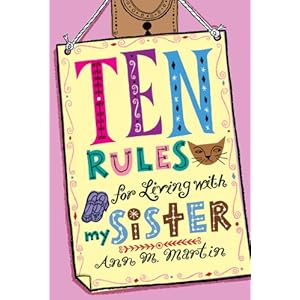
Chapter Book Review - Ten Rules for Living with My Sister by Ann M. Martin
Many readers recognize the name Ann M. Martin from her prolific Babysitters' Club series of novels. Oh, the thousands upon thousands of middle school girls who have pored over these books! I never read them myself -- being more of a Nancy Drew girl -- but many of my friends did, and they continued to be popular long through my career as a bookseller.
Lest you think that's all Martin's got up her sleeve, though, please note that she's also written a number of critically acclaimed stand-alone novels, including A Corner of the Universe, which received a Newbery Honor. (And which, oh my word, is a flat-out incredible novel - one of the few I've seriously considered rereading of late.) Seems to me there's something to be said for all those Babysitters books -- through them Martin honed her craft, especially where starring roles for middle-grade girls are concerned.
That's where Pearl Littlefield comes in. The star of Martin's latest novel, Ten Rules for Living with My Sister, Pearl has a unique voice and perspective all her own. Fourth-grader Pearl's stuck between two worlds, idolizing (and terrorizing) her older sister Lexie and mentoring her best friend, first-grader Justine. Pearl can't help noticing all the ways that she and Lexie are different, and Lexie just has no tolerance for Pearl and her antics, no matter how good they are. And believe me, they're good -- Pearl's not one to let that "No Pearl" sign on Lexie's door stand without a fight.
Just when things between the sisters are reaching a fever pitch, though, the game changes. Suddenly Pearl and Lexie's grandfather, Daddy Bo, is moving in with the family, and the girls become unwilling roommates. By everyone's estimation, this is a recipe for disaster. And Pearl figures she'd better start making herself some rules, if she's going to live through this experience. But as she soon finds out, not even the most carefully constructed list of rules can cover every eventuality that life has to offer. Expecting the unexpected is only the beginning.
With Pearl, Martin's given us a snapshot of a girl smack dab in the middle -- of her family and of her maturity. This is something a lot of kids can relate to, I think, that feeling of not quite belonging but desperately wanting to. To call Pearl spirited is an understatement (annoying her sister is something Pearl's brought to an art form) but when things in the Littlefield family dynamic shift, Pearl steps up in ways no one thought possible. What's really great about Ten Rules is the glimpse it gives us into some important relationships: between sisters, between friends, and between a grandparent and grandchild. There are some honest and compelling scenes in this novel, ones that make you laugh even as they make you think about the relationships in your own life.
Ten Rules shows us that sometimes the defining moments in our lives are the ones no rules can cover. For Pearl, and for many of us, real life is all about the gaps in between.
Ten Rules for Living with My Sister by Ann M. Martin, published by Feiwel and Friends
Ages 9-13
Source: ARC provided by the publisher for review purposes
Sample: "I am no stranger to the silent treatment. When Lexie is mad at me she shouts, 'I'm not speaking to you!'. Sometimes after that she whips her head away from me, or turns her back, or stomps into her room and slams the door. / And then sometimes one of my parents will mutter 'Teenagers.' (They only mean Lexie, not me, since you don't qualify as a teenager until you are thirteen.)"
Recommended
Lest you think that's all Martin's got up her sleeve, though, please note that she's also written a number of critically acclaimed stand-alone novels, including A Corner of the Universe, which received a Newbery Honor. (And which, oh my word, is a flat-out incredible novel - one of the few I've seriously considered rereading of late.) Seems to me there's something to be said for all those Babysitters books -- through them Martin honed her craft, especially where starring roles for middle-grade girls are concerned.
That's where Pearl Littlefield comes in. The star of Martin's latest novel, Ten Rules for Living with My Sister, Pearl has a unique voice and perspective all her own. Fourth-grader Pearl's stuck between two worlds, idolizing (and terrorizing) her older sister Lexie and mentoring her best friend, first-grader Justine. Pearl can't help noticing all the ways that she and Lexie are different, and Lexie just has no tolerance for Pearl and her antics, no matter how good they are. And believe me, they're good -- Pearl's not one to let that "No Pearl" sign on Lexie's door stand without a fight.
Just when things between the sisters are reaching a fever pitch, though, the game changes. Suddenly Pearl and Lexie's grandfather, Daddy Bo, is moving in with the family, and the girls become unwilling roommates. By everyone's estimation, this is a recipe for disaster. And Pearl figures she'd better start making herself some rules, if she's going to live through this experience. But as she soon finds out, not even the most carefully constructed list of rules can cover every eventuality that life has to offer. Expecting the unexpected is only the beginning.
With Pearl, Martin's given us a snapshot of a girl smack dab in the middle -- of her family and of her maturity. This is something a lot of kids can relate to, I think, that feeling of not quite belonging but desperately wanting to. To call Pearl spirited is an understatement (annoying her sister is something Pearl's brought to an art form) but when things in the Littlefield family dynamic shift, Pearl steps up in ways no one thought possible. What's really great about Ten Rules is the glimpse it gives us into some important relationships: between sisters, between friends, and between a grandparent and grandchild. There are some honest and compelling scenes in this novel, ones that make you laugh even as they make you think about the relationships in your own life.
Ten Rules shows us that sometimes the defining moments in our lives are the ones no rules can cover. For Pearl, and for many of us, real life is all about the gaps in between.
Ten Rules for Living with My Sister by Ann M. Martin, published by Feiwel and Friends
Ages 9-13
Source: ARC provided by the publisher for review purposes
Sample: "I am no stranger to the silent treatment. When Lexie is mad at me she shouts, 'I'm not speaking to you!'. Sometimes after that she whips her head away from me, or turns her back, or stomps into her room and slams the door. / And then sometimes one of my parents will mutter 'Teenagers.' (They only mean Lexie, not me, since you don't qualify as a teenager until you are thirteen.)"
Recommended
Sunday, April 15, 2012
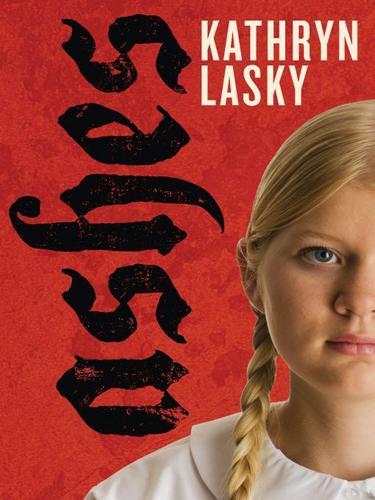
YA Review - Ashes by Kathryn Lasky
Some time periods in history are so widely written about that it hardly seems as if we need more books about it. World War II is arguably one of these. It's not that it isn't worth reading titles set during this timeframe, it's just that with so many quality options already on the shelves, are there still other viewpoints we haven't examined?
In Ashes, Kathryn Lasky manages to give us a different perspective - that of Gaby Schramm, an upper class German girl who gets an inside look at the formation of Hitler's Third Reich. Gaby's parents are close enough to the social elite that they know many powerful people in Germany's upper echelon. Professor Schramm is a colleague of Albert Einstein, and the two families vacation together during summers in Caputh. The Schramms watch with growing horror as Einstein and other prominent scientists are singled out for their "Jewish physics", as friends are banned from social events due to their ethnicity, and as those who make the wrong comment in a public setting suddenly disappear.
Gaby herself despises Hitler and all his government stands for; and yet, she finds herself going along with the required "Heil Hitler" salute when it becomes part of her school day. Though she refuses to join the Hitler Youth, it is not until one of the Reich's new policies touches close to home that Gaby finds the courage to really define her opposition, and to turn with her parents toward another life.
I picked Ashes up looking for something like The Book Thief; while I found Zusak's book more compelling, Ashes is still a strongly written title with a unique take on the events of Nazi Germany. As the heat gradually turns up around the Schramm family, Lasky shows us how the political events combine with Gaby's own internal struggles to give her an increasing awareness of the world at large. Forced to confront the effect that politics has on her own household, Gaby grows up very quickly - maybe too quickly, as she often has insights that seem beyond her own years. And yet, in times such as these, doesn't maturity come all too suddenly?
Though some libraries shelve this in the children's section, there are themes here that seem more suited to teens, particularly a plotline revolving around Gaby's sister Ulla and her boyfriend Karl. The overall message, too, is one that will speak to young adults in a more immediate way -- that of reconciling the world you've grown up with alongside that you've come to know, which in Gaby's case is one that conflicts in nearly every aspect with her pampered childhood. Lasky ties in connections to actual historical figures, weaving them into her cast of characters so seamlessly that the events of Nazi Germany come alive as we read.
Ashes is, above all, a subtle and unforgettable piece of historical fiction, and a worthy contribution to the canon of World War II literature.
Ashes by Kathryn Lasky, published by Viking
Ages 12 up
Source: Library
Sample: "I thought of that swirl of sugar on the kitchen floor from years before. How could Hitler cause so many problems? I put down the binoculars. The scrap of moon had slipped away, making the dark even darker and the stars even brighter. They scorched the blackness with their fire. Ninety-two elements to bake a universe and one madman to blow it up?"
Recommended
In Ashes, Kathryn Lasky manages to give us a different perspective - that of Gaby Schramm, an upper class German girl who gets an inside look at the formation of Hitler's Third Reich. Gaby's parents are close enough to the social elite that they know many powerful people in Germany's upper echelon. Professor Schramm is a colleague of Albert Einstein, and the two families vacation together during summers in Caputh. The Schramms watch with growing horror as Einstein and other prominent scientists are singled out for their "Jewish physics", as friends are banned from social events due to their ethnicity, and as those who make the wrong comment in a public setting suddenly disappear.
Gaby herself despises Hitler and all his government stands for; and yet, she finds herself going along with the required "Heil Hitler" salute when it becomes part of her school day. Though she refuses to join the Hitler Youth, it is not until one of the Reich's new policies touches close to home that Gaby finds the courage to really define her opposition, and to turn with her parents toward another life.
I picked Ashes up looking for something like The Book Thief; while I found Zusak's book more compelling, Ashes is still a strongly written title with a unique take on the events of Nazi Germany. As the heat gradually turns up around the Schramm family, Lasky shows us how the political events combine with Gaby's own internal struggles to give her an increasing awareness of the world at large. Forced to confront the effect that politics has on her own household, Gaby grows up very quickly - maybe too quickly, as she often has insights that seem beyond her own years. And yet, in times such as these, doesn't maturity come all too suddenly?
Though some libraries shelve this in the children's section, there are themes here that seem more suited to teens, particularly a plotline revolving around Gaby's sister Ulla and her boyfriend Karl. The overall message, too, is one that will speak to young adults in a more immediate way -- that of reconciling the world you've grown up with alongside that you've come to know, which in Gaby's case is one that conflicts in nearly every aspect with her pampered childhood. Lasky ties in connections to actual historical figures, weaving them into her cast of characters so seamlessly that the events of Nazi Germany come alive as we read.
Ashes is, above all, a subtle and unforgettable piece of historical fiction, and a worthy contribution to the canon of World War II literature.
Ashes by Kathryn Lasky, published by Viking
Ages 12 up
Source: Library
Sample: "I thought of that swirl of sugar on the kitchen floor from years before. How could Hitler cause so many problems? I put down the binoculars. The scrap of moon had slipped away, making the dark even darker and the stars even brighter. They scorched the blackness with their fire. Ninety-two elements to bake a universe and one madman to blow it up?"
Recommended
Labels:
Germany,
girls,
growing up,
historical fiction,
racism,
secrets,
YA
Wednesday, December 7, 2011
Chapter Book Review - Breadcrumbs by Anne Ursu
So wouldn't it be great if you could hand your child a thrilling, well-crafted, engrossing novel in which neither race nor adoption were the driving force behind the plot?
Thought so.
If you'd like to do just that, Anne Ursu's Breadcrumbs is a must-have. I was excited to read this one not only because the main character, Hazel, is part of a multiracial family formed by adoption, but also because I've read and loved Ursu's adult novels Spilling Clarence and The Disapparation of James. Both were favorite handsells back in my retail days, for the clever mixing of intriguing characters and fantastical turns of everyday reality.
And Ursu didn't disappoint me in Breadcrumbs, which I think is a strong contender for the Newbery this year (please please please). In the book, Hazel and Jack are two peas in a pod, sharing everything from a love of fantasy to a talent at superhero baseball (a game of their own invention). But one day Jack just -- goes away. Oh, he's there in body, all right, but he's no more Hazel's best friend than a stranger on the street. Jack just looks right through Hazel like he doesn't even see her. Hazel's crushed, and she can't accept what her mother tells her, that "these things happen". And when Jack disappears for real, Hazel doesn't believe for one second that he's with his elderly Aunt Bernice. No, Hazel's going to get to the bottom of this -- and for that, she must set off into the frigid Minnesota woods to rescue her very best friend.
Now, I could go on and on about all the things there are to love about Breadcrumbs, from the way Ursu interweaves fantasy into common events and how she turns fairytale conventions upside down, while never betraying their essence. Particularly well-done are the scenes once Hazel enters the woods, so evocative that I was amazed to look up from reading them and find myself at home tucked up in bed. But what many readers will take away from Breadcrumbs is the sense of holding fast to your sense of self and letting that be your compass. Hazel never wavers from the notion that Jack, the real Jack is still in there, and that he needs her now even more than he ever has. Quite a commentary on growing up but not away, this one.
Breadcrumbs is that rare thing, a novel that's not genre- (or gender) defined, neither wholly fictive nor entirely true. Honestly, I can't say enough about this smart, funny, surprising novel, which I found so compelling that I truly regretted turning the last page. For kids who feel on the outside, either because of something like adoption, or because they're finding their way across that looming chasm between childhood and growing up, Breadcrumbs will be a great gift. And if you feel that way as an adult? Guess what -- it'll speak to you too.
Breadcrumbs by Anne Ursu, published by HarperCollins
Ages 10-13
Source: Library
Sample Quote: "Hazel blinked. It occurred to her that Mikaela was being nice to her. She did not know how to react, for when your heart has been poisoned and someone picks a dandelion for you -- because it is bright and yellow and you seem like you could use something like that -- all you can do is contemplate the funny ways of weeds."
Highly recommended
Want to read more? Check out this guest post from Anne Ursu at The Book Smugglers blog, or visit her official author site.
Thought so.
If you'd like to do just that, Anne Ursu's Breadcrumbs is a must-have. I was excited to read this one not only because the main character, Hazel, is part of a multiracial family formed by adoption, but also because I've read and loved Ursu's adult novels Spilling Clarence and The Disapparation of James. Both were favorite handsells back in my retail days, for the clever mixing of intriguing characters and fantastical turns of everyday reality.
And Ursu didn't disappoint me in Breadcrumbs, which I think is a strong contender for the Newbery this year (please please please). In the book, Hazel and Jack are two peas in a pod, sharing everything from a love of fantasy to a talent at superhero baseball (a game of their own invention). But one day Jack just -- goes away. Oh, he's there in body, all right, but he's no more Hazel's best friend than a stranger on the street. Jack just looks right through Hazel like he doesn't even see her. Hazel's crushed, and she can't accept what her mother tells her, that "these things happen". And when Jack disappears for real, Hazel doesn't believe for one second that he's with his elderly Aunt Bernice. No, Hazel's going to get to the bottom of this -- and for that, she must set off into the frigid Minnesota woods to rescue her very best friend.
Now, I could go on and on about all the things there are to love about Breadcrumbs, from the way Ursu interweaves fantasy into common events and how she turns fairytale conventions upside down, while never betraying their essence. Particularly well-done are the scenes once Hazel enters the woods, so evocative that I was amazed to look up from reading them and find myself at home tucked up in bed. But what many readers will take away from Breadcrumbs is the sense of holding fast to your sense of self and letting that be your compass. Hazel never wavers from the notion that Jack, the real Jack is still in there, and that he needs her now even more than he ever has. Quite a commentary on growing up but not away, this one.
Breadcrumbs is that rare thing, a novel that's not genre- (or gender) defined, neither wholly fictive nor entirely true. Honestly, I can't say enough about this smart, funny, surprising novel, which I found so compelling that I truly regretted turning the last page. For kids who feel on the outside, either because of something like adoption, or because they're finding their way across that looming chasm between childhood and growing up, Breadcrumbs will be a great gift. And if you feel that way as an adult? Guess what -- it'll speak to you too.
Breadcrumbs by Anne Ursu, published by HarperCollins
Ages 10-13
Source: Library
Sample Quote: "Hazel blinked. It occurred to her that Mikaela was being nice to her. She did not know how to react, for when your heart has been poisoned and someone picks a dandelion for you -- because it is bright and yellow and you seem like you could use something like that -- all you can do is contemplate the funny ways of weeds."
Highly recommended
Want to read more? Check out this guest post from Anne Ursu at The Book Smugglers blog, or visit her official author site.
Labels:
adoption,
boys,
fantasy,
friendship,
girls,
growing up,
identity,
India,
middle grade,
Newbery hopeful,
novel
Friday, September 9, 2011
Chapter Book Review - As Simple As It Seems by Sarah Weeks
One reason I think I'm drawn especially to middle grade novels is that the characters are generally right in the throes of the struggle for identity. Novels for teens address similar issues, but the audience is closer to adulthood. In the middle grade years, we're all caught in that trap of beginning to leave childhood behind and grow up. This can make for a complex muddle of emotions and conflicts, when what we want and what we think we should do are often at opposite ends of the spectrum.
Such is the case for the heroine of Sarah Weeks' novel As Simple As It Seems, Verbena Colter, twelve years old and dealing with a whole lot of turmoil. Verbena has grown up thinking she knew her life story, only to find out that her reality isn't what she knew at all. Suddenly a huge family secret is revealed, leaving Verbena to piece together meaning and a new self-identity. Understandably this is a lot for Verbena, and so when she has the chance to be someone else with her new friend Pooch, she grabs it. But can she really be the friend Pooch needs if she can't tell him who she is? And who is that exactly?
I don't want to let out a huge spoiler for this novel, so I won't reveal Verbena's secret. But let's just say it's the kind of thing that would throw anyone for a loop, much less a girl who's already at a crossroads in her life just due to her age and development. Add to this Verbena's struggles with her own delays and her best friend Annie's sudden interest in makeup and boys, and you can see why Verbena might want to be someone else. At times it seemed as if Weeks had really piled a lot on Verbena, but when you think about it, isn't that the way life goes? It does for me, at least. And what's admirable is that Verbena handles it like a real kid would -- not always gracefully, not always wisely, and sometimes by lashing out at the people who love her most.
Verbena is the kind of character kids will relate to and empathize with. Even those who haven't faced the same challenges Verbena copes with can understand her, a girl who just wants life to go back the way it used to be. This is a solidly written, believable novel by an author who clearly relates to her audience.
As Simple As It Seems by Sarah Weeks, published by HarperCollins
Ages 9-12
Source: Library
Sample quote: "I could have told those boys to knock it off, or at least given them a dirty look -- especially Chris, whose guts I already hated for another reason. But instead of defending my mother, I closed my eyes and wished with all my might that I could be somebody else -- anybody besides me."
Recommended
I don't want to let out a huge spoiler for this novel, so I won't reveal Verbena's secret. But let's just say it's the kind of thing that would throw anyone for a loop, much less a girl who's already at a crossroads in her life just due to her age and development. Add to this Verbena's struggles with her own delays and her best friend Annie's sudden interest in makeup and boys, and you can see why Verbena might want to be someone else. At times it seemed as if Weeks had really piled a lot on Verbena, but when you think about it, isn't that the way life goes? It does for me, at least. And what's admirable is that Verbena handles it like a real kid would -- not always gracefully, not always wisely, and sometimes by lashing out at the people who love her most.
Verbena is the kind of character kids will relate to and empathize with. Even those who haven't faced the same challenges Verbena copes with can understand her, a girl who just wants life to go back the way it used to be. This is a solidly written, believable novel by an author who clearly relates to her audience.
As Simple As It Seems by Sarah Weeks, published by HarperCollins
Ages 9-12
Source: Library
Sample quote: "I could have told those boys to knock it off, or at least given them a dirty look -- especially Chris, whose guts I already hated for another reason. But instead of defending my mother, I closed my eyes and wished with all my might that I could be somebody else -- anybody besides me."
Recommended
Labels:
friendship,
girls,
growing up,
middle grade,
novel,
secrets
Monday, July 25, 2011
Mom's Bookshelf - The Reading Promise by Alice Ozma
As a parent, I stand pretty firmly on the notion that one of the greatest gifts I can give Sprout is a love of reading. Lots of reasons for that -- books open your mind to new worlds, give you possibilities you would never otherwise have dreamed of, allow endless opportunities for exploration, hone and refine literacy skills that will serve you in great stead, and provide huge amounts of enjoyment on a daily basis. What could be better? And I'm well aware that the best way to spark that love is through example, by filling our house with books and reading as much as we can, both individually and as a family.
I'd like to say that we've read to Sprout every day since he's been a part of our home. The percentage of days we have read to him certainly outweighs those we haven't. But I can't guarantee that we haven't missed a night here or there -- life goes awry sometimes, even with the best laid plans.
Impressed? Me too.
Alice Ozma writes about The Streak in her new book The Reading Promise: My Father and the Books We Shared. But the title is a bit misleading. Yes, Alice talks a bit about some of the books they read together, but the bulk of the book is about Alice's relationship with her dad, and the way that relationship influenced the rest of her life and the choices she made. From the opening anecdote, where Alice and Jim are reading together on a train and someone asks them why (who would do that, BTW? Wouldn't you just silently applaud??), it's pretty clear that the bond between this father and daughter runs amazingly deep. Though Alice's mother makes some brief appearances, her dad appears to have been the center point around which Alice's life turned. And the reading seems to have been the bond that kept the two connected, even through the aftermath of parental divorce and the tumult of the teenage years.
Parts of this memoir made me laugh right out loud: Jim's stubborn insistence on reading despite a wicked bout of laryngitis ("you are like some sort of voiceless alien" Alice tells him); Alice's sales pitches to drum up business for her dad's book fair ("Books are collectors' items, especially if you collect books"); Jim's efforts to eradicate Alice's irrational yet persistent fear that her room is haunted by the ghost of JFK ("Would I be talking to you so calmly if the body of an ex-president was lying on your bottom bunk?"). But other parts are incredibly moving, such as Alice's sister leaving home and the end of The Streak, which, though impossibly sad, is, of course, inevitable. At the end I was compelled to go back and read Jim's introduction, feeling, now that I knew their story, a thousand times more moved by a father's words.
Not many parents still read to their nine-year-olds, although if you asked them I'm pretty certain that most nine-year-olds would secretly love to be read to. But Jim Brozina did, and he kept reading long past the point where everyone else would have given up. And that, as they say, made all the difference.
If you already read to your kiddo, as we do, you probably don't need any encouragement to keep on doing so. But maybe you'd like a glimpse into the future, to see what could be, the outcome of the bond forged by sharing books together. Here's one such glimpse, and it couldn't be better.
The Reading Promise by Alice Ozma, published by Hachette
Adult
Source: Library
Sample quote: "We were already good at routines, but The Streak was anything but. Every night was different because every story was different. Even when a book started to drag, as some did late in the second half, there was still the thrill of getting closer to our goal to make things a little more interesting. But as my father told him, and as anyone who reads regularly might agree, the only thing that has to be similar from night to night is the act of turning pages."
Highly recommended
Friday, July 8, 2011
Chapter Book Review: Junonia by Kevin Henkes
Alice has been coming to Sanibel Island on vacation almost since she can remember, and she loves the rhythm and predictability of the island. Her parents always rent the same cabin, the same neighbors are usually there, and her birthday is always the highlight of the trip. But this year, it seems that nothing will go according to plan. Old friends can't make it and new friends don't live up to Alice's expectations. Especially vexing is six-year-old Mallory, who wants to do everything Alice does and whose tantrums seem to ruin everything that would otherwise be so perfect.
Henkes' novel is one of those quiet, gentle plots that unfolds just like the ebb and flow of the tides. The conflict within Alice provides the greatest tension, as she wrestles with the reality of her trip, and how things have turned out differently from her ideal version. I think there's a lot here that speaks to kids of a certain type, the kind of child who craves routine and precision and is somewhat undone when actual events don't match up to expectation. And isn't that all of us, at some time or another?
Or maybe it was just me, but I can see how watching Alice deal with the way things change in this pivotal year would offer a number of opportunities to talk with kids who are themselves undergo
And in any case, Junonia is a pitch-perfect choice for reading aloud, a book whose subtle rhythms would make for the perfect bedtime read, whether on vacation at the beach (I wish!) or snuggled up together at home.
Junonia by Kevin Henkes, published by Greenwillow
Ages 8 up
Source: Library
Sample quote: "After all, she was going to be ten. Finding a junonia would be the perfect gift. She picked up one of her new tulip shells and turned it in the light. It was covered with bluish gray and brown markings. Its inner surface was lustrous. . . . It was many things, but it wasn't a junonia." (pp 87-88)
Highly recommended
Subscribe to:
Posts (Atom)