Showing posts with label Japan. Show all posts

Saturday, September 6, 2014

Celebrating Grandparents - Our Multicultural Picks!


In the U.S., tomorrow is Grandparents' Day. This isn't as big a deal for Americans as Mother's Day or Father's Day, not by a long shot (you don't see ads like "buy Grandma a diamond necklace for Grandparents' Day", for instance). I'm not sure why this is, although it's an interesting commentary on our culture. The sociologist in me is fascinated by this kind of thing. But the mother in me is busy making sure we have a homemade card and a picture for Oma -- no diamond necklaces here, that's just how we roll.

A fun way to celebrate Grandparents' Day would definitely be an intergenerational storytime. I think this would be an awesome program for a library or bookstore to host, but you could certainly do an impromptu one at your own Grandparents' Day celebration or the next time an extended family get-together comes around. I've gathered up some terrific picks to share for such an event - none of which are specific to Grandparents' Day itself, making them the perfect titles to share for the holiday or any time you want to celebrate these important folks in your kiddo's life.


1. Can You Hear the Sea? by Judy Cumberbatch - this vibrant title, set in West Africa, catches readers right from the front cover (got you, didn't it?). The story is simple enough for the youngest listeners, but works on multiple levels to teach concepts and share relationships. I love the messages about trust and caring for one another.


2. All the Way to America by Dan Yaccarino - kids will recognize Yaccarino's whimsical style, and adults will appreciate his intergenerational theme of a family's immigrant heritage. Based on the author's family's journey to America from Italy, this story of perseverance and connections will get kids thinking about what pieces of their own family are being handed down for generations. A lovely title on all levels.


3. Hot, Hot Roti for Dada-ji by F. Zia - this was one of Sprout's favorites for a long time, for the fun illustrations and the playful text. This one's great because it really shows the relationship between Aneel and his grandfather, whom he idolizes. And the elements of tall tales that Zia weaves in make this a true joy to read aloud - over and over again!


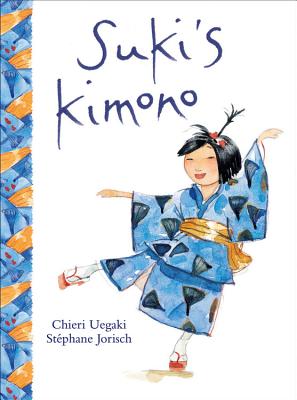
4. Suki's Kimono by Chieri Uegaki - a classic title that speaks very much to identity and being confident in your own skin. Suki decides to wear her kimono to school because it reminds her of a special time with her grandma - even though she knows that other kids might make fun of her. All is well in the end, though not unrealistically so. A good choice for older kids just starting to find their identity.


5. Rainbow Stew by Cathryn Falwell - Falwell's books are always a hit in our house and Rainbow Stew is no exception. This one not only has a grandpa taking care of all three of his grandkids, it also emphasizes the appeal of growing and preparing your own healthy food. Great for late fall storytimes about harvest and togetherness.


6. Lottie Paris Lives Here by Angela Johnson - it's hard to say how much I love Lottie Paris. She's pretty much everything I adore about kidlit today - a dynamic personality, full of flair and life, and just a little bit of naughtiness (which makes you love her even more). Lottie's just right for kids who like all things color and sparkle, and will add a burst of liveliness to storytime for sure.


7. My Granny Went to Market by Stella Blackstone - a rhyming book! What fun! This rollicking read features a grandma who's getting around - around the world, that is. Kids will enjoy counting along with granny's purchases even as they are introduced to the concepts of global citizenship. Full of small details that make this entertaining even after the story is done!

There are so many more titles that we could have included, but I hope this list gives you just a taste of all the wonderful intergenerational titles that populate the shelves at your library or bookstore. What are your favorite grandparent stories? Please share in the comments!


Sunday, May 5, 2013

Suki's Kimono by Chieri Uegaki {The Children's Bookshelf}

As Sprout grows and makes friends, we have begun to talk about certain topics more and more. Being kind to others is a biggie, as is sharing (is this not a perpetual talk parents have with preschoolers??). But one topic I didn't expect to talk about as much as we do is identity. You see my darling son, while relatively strong-willed, is also a pleaser, and he wants very much to be just like his friends -- who among us can't relate to that? And so we've seen in the last several months a slow denying of things he likes in favor of things his friends like, or a shift in what he wants to take for "share day" based on what he thinks others will bring.

In these instances, we let him make his own choices, but we also gently remind him that he needs to be true to himself. What Sprout wants is a theme we return to again and again -- as in, is this what Best Friend of the Moment likes, or what Sprout likes? Sometimes he clings to the choice he's made, but sometimes he does rethink and select something we know is more "him". It's an ongoing discussion, and we know it's by no means going to reduce, quite the opposite. But we feel it's important to reinforce that his own identity is pretty awesome.


Naturally books that we share together are a great way to stress this idea with Sprout. One in particular that we recently checked out, Suki's Kimono by Chieri Uegaki, presents a character who's very confident and comfortable in her own skin, even after she has some brief doubts. Suki's determined to wear her favorite outfit on the first day of school. The outfit just happens to be her kimono, which her grandmother gave her on a very special outing over the summer. The outfit brings back warm memories of a wonderful day with someone she loves. Her sisters caution Suki that other kids will tease her, but Suki's unconcerned, even when her friend Penny tells her she's dressed funny ("I'm not dressed funny," Suki replies). She even shares about her kimono in front of the class, and does a little dance like the festival dancers she saw with her grandmother. But then Suki feels a little awkward -- will the other kids laugh, like her sisters warned her?

Delicate illustrations by Stéphane Jorisch are the perfect accompaniment to this tale (we've loved his previous work, especially Betty Bunny Loves Chocolate Cake). The scenes where Suki and her grandmother attend the street festival draw young readers right into the moment, as you can just about hear the beat of the drums and smell the delicious treats too. Most of all, I love Suki's confidence throughout the story. Uegaki could easily have written Suki as embarrassed or slinking off to change her clothes at some point during the day. But she didn't. Instead Uegaki gave Suki the determination to share one of her favorite memories through the clothes she wears. Even when she is faced by a silent classroom after she dances for them, Suki's never willing to hide who she is -- and fortunately, the class all applauds her performance for the wonderful experience it was.

If we want our kids to be themselves, we need to surround them with examples of confidence and self-assurance to inspire them. Suki's Kimono is a terrific instance where a character believes in herself, even when others aren't so sure. And that's exactly who I want Sprout to be, no matter what comes his way.

Suki's Kimono by Chieri Uegaki, published by Kids Can Press
Ages 3-6
Source: Library
Sample: "But Suki shook her head. She didn't care for new. She didn't care for cool. She wanted to wear her favorite thing. And her favorite thing was her kimono."
Recommended

----------------------------------------------------------------------------

This post is part of The Children’s Bookshelf, a weekly linky party with the goal of connecting parents with great books for their kids. Do you have a book review, literacy or book-related post that you think will be helpful for parents? If so, please add your link below.

NOTE: By linking up you are giving permission for any of the co-hosts to pin and/or feature a your photo on a future The Children’s Bookshelf post. Kindly link up to an individual post, not your blog’s homepage. The hosts reserve the right to delete any links to homepages, commercial links, repeat links or otherwise inappropriate links. Thank you for your understanding.

You can also follow The Children’s Bookshelf on Pinterest or visit TCB’s co-hosts: Sprout’s Bookshelf, What Do We Do All Day?, No Twiddle Twaddle, Smiling Like Sunshine, My Little Bookcase, The Picture Book ReviewMemeTales and Mouse Grows, Mouse Learns. You can find more details here.


Monday, February 13, 2012

Happy Valentine's Day!

Who'd have thought finding a multicultural book for Valentine's Day would be such a tall order? I mean, I get that this is a holiday that's not exactly celebrated all around the globe -- and, in truth, it isn't one of my favorites. But this year Sprout's old enough to pick out valentines cards and small candies to share with his friends, and of course if we're going to recognize a holiday we need to read a book about it, too.

Oh boy, did I have my work cut out for me.

Sure, there are books about love and kisses and hugs that feature diverse casts of characters. But I wanted something that would relate the custom we follow here, of making or giving valentines to our special friends. And that presented more of a challenge.


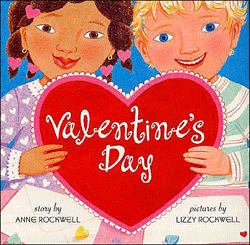
Thank goodness for libraries, though. They have the older titles that just don't crop up on most booksellers' radar any longer. And in this case the older title was Valentine's Day by Anne Rockwell. In this book, the members of Mrs Madoff's class are making some very special valentines to send to their friend Michiko, who has moved away to Japan. Each person in the class thinks of something fun that they remember about Michiko, and uses that as their inspiration in creating a valentine. For Kate, it's flying kites together; for Eveline, it's the wonderful gift Michiko gave her for her birthday; for Nicholas, it's the way Michiko always gave him his turn on the slide. In each spread, colorfully illustrated by Lizzy Rockwell, the special memory comes to life, appearing opposite the hand-crafted valentine that inspired it.

Reading this one with Sprout provided us with the opportunity to talk about friends, and how much they mean to us. We also got to talk about what it feels like when someone you love is far away. Though it's not something that he fully understands yet, when he gets older he may begin to experience loss at times when everyone else is celebrating, because people he is intimately connected with aren't part of his daily life any longer. When that happens, it's good for us to have books like Valentine's Day in our arsenal - to show him that time and distance don't diminish the love we feel in our hearts.

Valentine's Day by Anne Rockwell, published by HarperCollins
Ages 2-7
Source: Library
Sample: "Sarah's valentine is pink. Her valentine says, 'I miss you every single day, especially when it's snack time.'"
Recommended

Wednesday, December 21, 2011

12 Days of Christmas Picture Books - Tree of Cranes

A few years ago, there was a big furor about the "death of the picture book". I've blogged about it before, but the gist is that an article claimed that in the push to get kids reading younger and younger, picture books were no longer relevant. I think that's patently false -- for nearly all of us who love books, that love was born out of the experience of being read to, and as a parent, that's an experience I am determined to pass on to my son. Sure, chapter books are great read-alouds, but there's something about the magic of picture books that can't be replicated in any other form.

And artists like Allan Say prove that picture books are not just for the youngest members of the family. His photorealistic illustrations and detailed, nuanced text is perfect for sharing with school-age children, who will also appreciate the subtleties of his plots. We read Say's Grandfather's Journey in a class I took last semester, and there was more than enough there to keep a classful of grad students conversing for weeks!


In Tree of Cranes, Say gives us the story of a young Japanese boy who has been playing in the pond, which he's been told not to do. When he comes home wet and chilled, he thinks his mother is angry with him. All afternoon she's busy doing strange things -- making many paper cranes, digging up a tree from the garden and bringing it inside. Then the boy's mother explains to him that where she grew up, in California, the family celebrated Christmas, a wonderful holiday with presents, lights, and a "day of love and peace". The boy thinks that nowhere on earth could there have been a more beautiful sight than what his mother created, a tree of cranes.

When Sprout's old enough, I think we'll take time out to read Tree of Cranes and learn to make our own origami cranes to hang on the tree. Examining a holiday from the outside in can give us a unique perspective to share with our kids, one in which we look past the piles of gifts and holiday treats to the spirit that drives our celebration. This peaceful portrait is more than just a glimpse into another culture - it's also a reminder to be mindful of what the holiday really means, to us and those we love.

Monday, November 28, 2011

Chapter Book Review - Sylvia & Aki by Winifred Conkling

Winifred Conkling's Sylvia and Aki is a deceptively slim little book, the kind kids are drawn to for book reports or school projects because it's so skinny. And yet, for all its brevity, Sylvia and Aki packs a punch.

The story is a fictionalized account of the lives of Sylvia Mendez and Aki Munemitsu, opening in 1941. Aki's family has been evacuated from their farm, sent to a Japanese internment camp in the furor that resulted from the bombing of Pearl Harbor. Aki's father is taken away first, with no notice -- she is terrified that she will never see him again, that their family will always be separated. Because of the restrictions about what the family could take with them, Aki has had to leave some of her most precious things behind, including her favorite doll, which she tucks onto the shelf in her closet, hoping she'll be back to reclaim her.

Sylvia finds Aki's doll, on a very bad day when she is in need of comfort. Sylvia and her family are renting the farm from the Munemitsus, and Sylvia's father is the boss, something the family is very proud of. But the day Sylvia's aunt takes the children to enroll in the closest school, they discover that Mexicans must attend the migrant school. Everything about the Hoover School is second-best, from the rundown buildings to the battered supplies. And Sylvia's father is determined to get his daughter into the Westminster School, which so far is white students only.

Each family struggles. Each girl feels lost, alone, uncertain. But as time passes the girls come into contact with one another, and a friendship slowly blossoms, borne of shared hardship and isolation. Life for the girls is not easy, but knowing that there is someone else, someone like them who feels on the outside of things, makes it all just a little easier to bear.

Conkling weaves the girls' stories together skillfully, showing how both Sylvia and Aki were outsiders because of something they had no control over, the color of their skin. Aki's time in the camp is particularly poignant, as we feel with her the pain of loss and the fear that her family will never be whole again. Like Aki, Sylvia is made to feel foreign, an outsider, as school district officials assume she is unclean or tell her to go back to Mexico (with the irony being that she is American). Conkling depicts the quiet heroism mirrored in each girls' individual heartbreak. Because the girls experience a similar day-to-day reality, as victims of prejudice and open racism, when they find friendship in one another, it is all the more sweet.

One of the readings in my multicultural kidlit class last week pointed out that children's books with a diverse cast almost always include white characters in the mix. This hadn't occurred to me, but flipping through some of Sprout's books I can see it's true. Sylvia and Aki is that rare thing, a book that examines racism from the inside without casting a white person in the role of savior. For these girls, breaking down barriers just meant living the lives they dreamed of. It's hard to think of a more inspiring tale, no matter what your skin color.

Sylvia and Aki by Winifred Conkling, published by Tricycle Press
Ages 8-12
Source: Library
Sample quote: "Then Aki said good-bye to the nurse, picked up her suitcase, and took her mother's hand. She missed her father. She missed her home. She missed the life she used to have. But when she felt her mother's hand in hers, she knew that she was ready to face Poston."
Recommended