Sunday, May 13, 2012

Let Us Eat Cake!

May's a festive month around our household: two birthdays, Mother's Day, and the anniversary of the day we became a family. This year we're throwing a big shindig for Sprout's third birthday, and the excitement is really starting to build, with lots of talk about cake, presents, cake, decorations, cake and friends who are coming. Oh, and cake - did I say cake?


Sprout's kind of obsessed with the birthday cake this time around. I blame Betty Bunny. Just about every night the book of choice is Betty Bunny Loves Chocolate Cake by Michael Kaplan. I can completely understand why: it's funny and clever, populated by some fantastic characters (our favorites: wiseacre brother Bill and Betty Bunny herself, a real "handful") and full of the kind of real dilemmas kids face. Like, for instance, how you handle it when you want to eat chocolate cake for dinner and Mommy insists on healthy dinner first. (I'm pretty sure Betty Bunny's solution, throwing veggies at her siblings, is probably not the best.) Preschoolers will gobble this one up as surely as Betty Bunny makes short work of her chocolate cake, and the ending is guaranteed to get a laugh every time. Luscious!


If Betty Bunny can't get enough cake, Sugar's on the other end of the spectrum. In Emily Jenkins' Sugar Would Not Eat It, Leo's newly adopted cat Sugar gets hungry, so Leo offers her a piece of his leftover birthday cake. But Sugar refuses, and the more Leo cajoles, the less interested Sugar becomes. In desperation, Leo solicits advice from everyone in his neighborhood. But nothing he tries seems to work: not getting mad, not punishment, not limiting her to only four bites. At last the hungry kitty makes her own preferences clear, and Leo finally realizes that for cats, maybe birthday cake isn't the meal of choice. The illustrations by Giselle Potter add just the right amount of whimsy - we especially love Sugar's vibrant blue fur. A great message here for picky eaters and their parents!
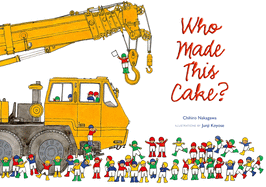


Who Made This Cake? by Chihiro Nakagawa was a hit for Sprout right from the cover - a huge crane and loads of little workmen getting ready for a big project. Turns out the tiny workmen are taking on a massive project: making a birthday cake for a full-size human boy. Think Gulliver and the Lilliputians. This is a resourceful bunch, and they've got plenty of heavy equipment to help with the job: diggers and backhoes, tractors and dump trucks, and an enormouse flatbed to transport the cake pan to the oven. Pumper trucks spread the icing, and a helicopter loads in the final touch, a giant sign reading "Happy Birthday". For little ones obsessed with trucks, trains and all things construction, here's an ingenious twist on the birthday theme. We love it!

Cake-themed reads are fun no matter what time of year your birthday falls. But be forewarned: these delicious titles might just drive you to crack out the baking pans!

Friday, May 11, 2012

Nonfiction Picture Book - All the Way to America by Dan Yaccarino

Books come into our lives in lots of ways. Some speak to us through their cover art or we notice them because we're familiar with their creators. Others are the result of personal recommendations or reviews we read. And some just keep pushing their way into our consciousness - an author interview here, a prepub notice there, a prominent placement at the library.

Dan Yaccarino's All the Way to America was one of those insistent titles that kept cropping up in my travels through the kidlitosphere. I read a couple of reviews about the book and saw a book trailer. Then I read an interview Yaccarino did with Publisher's Weekly. Some of my favorite book bloggers started buzzing about the book. And then it kind of dropped off my radar, until I started reading best of the year lists. Lo and behold, that little story of a family that I'd heard about was gently edging its way onto those lists.

And for good reason.


Yaccarino calls this "the story of a big Italian family and a little shovel", and promises that "some parts have been condensed a bit, but it's all true. And all Italian." The story opens with Dan's great-grandfather Michele Iaccarino, growing up in Sorrento, Italy. Michele has a little shovel that he uses to till the earth, and he brings the shovel with him when he travels to America. He uses it at his job as a baker, then as a pushcart peddler. The shovel passes through the generations of the Iaccarino (now Yaccarino) family - Dan's grandfather Aniello, who owns a market and then a restaurant; his father Mike, who opens a barbershop; and on to Dan, who uses it even now to garden with his own children.

The story may be a familiar one but that just means that it resonates all the more with readers. I appreciate the fact that Yaccarino ties the shovel in to the work that each member of the family does, emphasizing not only the diversity of opportunities that was available to each generation of the Yaccarinos, but also the thread of family that ties each member together. The illustrations are vivid and interesting, fleshing out the story of the family with small details like the ever-present bowl of spaghetti with Mama Iaccarino's tomato sauce. Each spread is inviting, with lots of action and depth to the backgrounds that tell a tale all their own.

This is the kind of tale that makes it easy for kids to draw parallels with their own family history and introduce curiosity about how their own families got to the United States. It will also make them think about their own lives, and what pieces of their heritage might have been passed on from previous generations. While not every family has a little shovel (too bad, I think - what a great detail!), there are other inheritances, like red hair and freckles, or an aptitude for music, or a long-held secret recipe.

All the Way to America  is one family's story, a variation on a theme that has occurred countless times in many places. And that, in a way, is its greatest strength - the quietly compelling thread of a narrative that makes one family unique. It's a journey you'll truly enjoy taking.

All the Way to America by Dan Yaccarino, published by Alfred A. Knopf
Ages 5-12
Source: Library
Sample; "Friends from home helped each other in this new country. Michael found work in a bakery owned by a man who had also come from Sorrento. Michael polished his little shovel till it shined and used it to measure out flour and sugar."
Recommended

Bonus: Dan Yaccarino's post on why picture books are important

Tuesday, May 8, 2012

Rest in Peace, Maurice Sendak

"And he sailed off through night and day
       
and in and out of weeks
and almost over a year

to where the wild things are"


Your words will live on forever.

Wednesday, May 2, 2012

Picture Book Review - Same, Same but Different by Jenny Sue Kostecki-Shaw

One thing I love about picture books these days is that they are an absolute bounty of visual delights. Seriously, some of the artwork that illustrators and author/illustrators are turning out lately just causes me to go all goggle-eyed with admiration. I have zero artistic talent, or maybe less than zero -- an elementary school memory of gobs of clay plus the instruction "make whatever you feel like inside" still causes me to break out in a cold sweat -- but I loves me some gorgeous illustrations.

And wow oh wow, does this book have them! Filled with collage and outstanding mixed-media imagery, this is just a delight to behold. And best of all, it's a multicultural title about two boys. Win win, right?


According to the jacket copy, Same, Same but Different was inspired by author/illustrator Jenny Sue Kostecki-Shaw's travels in India and Nepal. While there she picked up the saying "same, same but different" -- a way of expressing that things in other cultures might be done differently, but are ultimately still the same. That simple phrase sparked the idea for her picture book, which is, I tell you truly, simply rich with culture and nuance.

In the book an American boy named Elliot participates in an art exchange at school, painting a picture of the world that his teacher mails to India. A boy named Kailash responds, mailing Elliot a picture of the world as he sees it. And so begins the correspondence, in which each boy talks about the things he enjoys, or what life is like where he's from. As the book continues, we begin to see that though some aspects of their activities are different, they are also much the same. For example, Elliot lives with his family (mom, dad and baby sister) and Kailash lives with his family (23 relatives in all). Elliot rides a bus to school and so does Kailash (though his is a large pedal-cab). Elliot and his friends do a complicated handshake to say hello, while Kailash bows and tells his friends "Namaste". All in all -- same, same but different!

I love the way that the book posits each culture opposite one another, so we get a sense of each in its uniqueness even as we see that people around the world live much the same. I would have liked it if the comparison was a little more equal -- because Kailash lives in a village, we're comparing rural life with Elliot's city life, and that feels a bit disjointed -- but Kostecki-Shaw is careful never to overtly place one culture as more important or better than the other. And indeed we can see that each boy enjoys the same pursuits, just in different ways. In one of the final spreads Elliot is drawing a bird from his perch in his treehouse, while Kailash draws a bird from the shade of a big tree. While Elliot's picture displays more material goods (books, a globe, even a telescope), each boy looks just as content, just as satisfied with his leisure time.

If you're looking for a good introduction to other cultures, a title that will open up lots of possibilities for discussion and further exploration, Same, Same But Different is an excellent choice. And if you're just looking for a book that's outright wonderful to look at and to read together -- this one fills the bill.

Same, Same But Different by Jenny Sue Kostecki-Shaw, published by Henry Holt and Company
Ages 2-5
Source: Library
Sample: "A great river flows through my village. Peacocks dance under trees shaped like umbrellas. The sun is giant and especially hot here. / In my city, the sun hides behind buildings as tall as the sky. Taxis, buses, and cars fill the streets."
Recommended

Thursday, April 26, 2012

Chapter Book Review - The Book of Wonders by Jasmine Richards

Fantasy has, post-Harry Potter, become somewhat of the stock-in-trade of the middle grade section. Series reign supreme, and there are magical elements in even the most seemingly ordinary stories. In fact, it sometimes feels as though realistic contemporary fiction is in the minority. And sometimes it's hard for me to distinguish one fantasy series from another: orphans with special powers being pursued by ubiquitous baddies. If you've read one of those, well, you just might have read them all.


And here's where Jasmine Richards' novel The Book of Wonders breaks from the pack. Because from the very first sentences ("I heard the noise first. A howl, which sounded like all the djinnis in the world were crying out as one") you know you're in for something very different.

In Wonders, Richards takes the Sinbad legends and other elements of Middle Eastern tales and spins them around, adding in characters and sensibilities that harken to another world but still are very much relatable to modern readers. Our heroine Zardi is fascinated by lore of days gone by - days when magic existed in the kingdom of Arribitha, before Sultan Shahryar came to power and banned any mention of mystical occurrences. Zardi contents herself with peering through the window of fantasy here and there, until her sister Zubeyda is captured by the sultan and made to serve as his praisemaker, a position whose only end is death. Zardi must save her sister, and she and best friend Rhidan set off to do the impossible: bring magic back into Arribitha and with it defeat Shahryar once and for all.

Zardi and Rhidan's fates become inextricably intertwined with that of Captain Sinbad, a figure that will be familiar to many but whose role in this novel is unlike anything else I've ever read. Djinnis, medicine women, mysterious amulets and powers beyond compare -- Richards' originality comes through on every page, as she brings the legends of Sinbad to life in a whole new way. Sinbad isn't what he seems, as Zardi and Rhidan soon discover, a lesson that is to serve them in good stead as they journey toward magic and salvation for Zubeyda.

The plotting in Wonders is tight, the pace brisk and the characters as complex as they are believable. Richards makes us care about Zardi, Rhidan and the rest in a way that some fantasy writers, preoccupied perhaps with their magical realms, never quite do. But readers can identify with Rhidan's struggle for identity, with Zardi's drive to save her family, and that connection is what makes this novel truly shine.

And the setup for a sequel? You'd better believe I'll be back for more.

The Book of Wonders by Jasmine Richards, published by HarperCollins
Ages: 9-13
Source: Library
Sample quote: "She surveyed the columns ahead, each one sitting a bit higher than the last, huge rocky steps rising upward. All we need to do is reach the middle. She looked down at the river and the spiky clusters of rocks that stabbed out of the water within the shadow of the arch. And not fall off. . . "
Recommended

Bonus: Interview with Jasmine Richards from Doret at The Happy Nappy Bookseller blog