Saturday, September 29, 2012

Cinderella Around the World - Mufaro's Beautiful Daughters by John Steptoe

I'm thrilled to be participating in the "Cinderella Around the World" project dreamed up by Becky of Kid World Citizen. A ton of very talented bloggers, and yours truly, are posting their reviews of Cinderella tales from many different cultures. Once all the posts are up, I'll link to a complete list of all the reviews. Until then, here's my take on one such tale!

If there's one thing that unites us as people, all around the globe, it's story. Stories tell us not only where we've been, but where we're going and what we hold dear. When you study the storytelling traditions of a particular culture, you learn something about the unique perspective of its people, not to mention its history. For centuries stories were passed down in the oral tradition, and as that happened the tales themselves deepened and changed, becoming particular creations of the teller and inspiring others to put their individual spin on the tale. As cultural values changed, so stories changed with them, blossoming into what we today consider folklore.

Or, as the author Rafe Martin put it:
Folklore maps the territory, shows us the roads before us, and sets us free to walk the roads we choose-after allowing us to experience each road for ourselves. For, in stories, folk stories, all the characters are so universal as to be not individual characters as in fiction, but more generally recognizable aspects of our own psyches; characters common to all.
  
And with only a quick study of folklore, it becomes readily apparent how universal those characters and themes truly are. From fables to myths, from tall tales to epics, the same themes continue to emerge, across cultures and countries. Sure, the setting may be different from one place to the next, and the values may change, but it's remarkable how much of the essence of the story stays the same.


Take Cinderella, for instance. Most of us grew up with the cotton-candy Disney version, all taffeta and glass slippers. [Disney based their take on the Charles Perrault version, finding it a lot more palatable than the Grimm brothers tale, in which the stepsisters maim themselves in order to fit into the slipper (shudder).] And the moral of the Disney version, naturally, is that Cinderella is rewarded for her goodness by marriage and "happily ever after". Fine, of course, but hardly the end of the story.
 
What's interesting is that Cinderella stories are not solely a Western European construct, but rather pop up all around the globe, from China to Ireland, Indonesia to Appalachia. Name a culture and you can probably find a Cinderella version for it. And why is this theme so popular? Most likely because we all want to see good rewarded and evil punished. We all want to think that the honest, hardworking person will eventually get her due, and those who made her life miserable will get theirs in the end, too. It may seem simplistic in this modern age, but look at the way folktales are pervading our culture and you can see that there's still plenty of appeal in this familiar theme.


So, on to the title at hand: Mufaro's Beautiful Daughters, a gorgeously wrought Cinderella story by John Steptoe. This version is based on a Cinderella story from Zimbabwe and Steptoe populated his illustrations with scenes representative of the country. The pictures are lush and detailed, capturing perfectly the African nature of this story; ball gowns and pumpkin coaches are replaced with fine linen and festive drummers. In the book, the two sisters Manyara and Nyasha are as different as can be. Though both girls are beautiful, Manyara is concerned with power and position, while Nyasha is kind to all. When the Great King announces that he is seeking a wife, both girls prepare to travel to the city. On the way each encounters a number of individuals, and their responses couldn't be more different; while virtuous Nyasha shares her food with a beggar and gives gifts to an old woman, haughty Manyara rushes on. Once each girl reaches the city, they are surprised to find that the King does not appear in his human form - to Manyara, he is a vicious monster, while Nyasha finds only a small garden snake that she has already befriended, and which soon turns into the King himself.
 
Of course, the moral here is consistent with that of all Cinderella tales and justice is served: Nyasha, the good sister, triumphs, while Manyara is forced to become a servant in Nyasha's household. But the story stays true to its African roots, keeping the focus on community and the necessity of helping others. Because Manyara is selfish, she does not get the spotlight; instead her sister, who gives freely to others, is rewarded. Rather than the emphasis being on material comforts, Steptoe suggests that a life of worth is one that is lived in service to others. Food for thought, for those of us who grew up with castles and princes and glass slippers, after all.
 
Sprout's still a little young for Mufaro, though he did enjoy flipping through the pages and browsing the arresting pictures that complement Steptoe's words. I'm looking forward to exploring more folklore with him, including other Cinderella tales, in the years to come - there's so much to learn from these stories, lessons that truly span the globe.
 
Mufaro's Beautiful Daughters by John Steptoe, published by HarperCollins
Ages 5-9
Source: Library
Sample: "Mufaro knew nothing of how Manyara treated Nyasha. Nyasha was too considerate of her father's feelings to complain, and Manyara was always careful to behave herself when Mufaro was around."
Recommended
 

Thursday, September 27, 2012

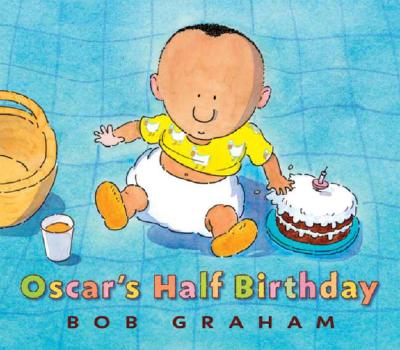
Picture Book Review - Oscar's Half Birthday by Bob Graham

I first encountered Bob Graham's work eons ago as a bookseller, when his title "Let's Get a Pup!" Said Kate was newly published. The book resonated with me for a lot of reasons - the nontraditional vibe about the family (tattoos! nose rings!), the really-real household environment (clutter and all), the fact that the family ends up with not one dog but two. It was one of those I bought and stuck away for my own kiddo, someday.

Fast forward to today when I actually do have my own wee one, and what do you know, Bob Graham's one of his favorite author/illustrators. We've read not only Kate, but also Graham's April and Esme, Tooth Fairies and most recently (and repeatedly) A Bus Called Heaven, which can and probably will be the subject of its own post. How this talented man hasn't received more awards and accolades I'll never know - just to pick up one of his titles is to be transported into a world where the prosaic and magical intersect in the form of angelic toddlers with messy hands and fairy godmother-esque grandmas bearing chocolate cakes. The books Graham creates are equal parts unique and comforting, the kinds of experiences you never knew you always wanted.

One of my personal picks from among Graham's excellent catalog of titles is 2005's Oscar's Half Birthday. It's fair to say that this one probably stands out because of its multiracial family - Mom's dark-skinned with braids, Dad's light-skinned with a soul patch, and the kiddos, Millie and Oscar, are a beautiful blend of both. We don't have enough of this in kidlit, and it's especially nice that the family just is, no mention of skin color necessary, thank you very much. I love how deftly Graham mixes in diversity with all of his titles, like a pinch of spice that livens up the whole concoction.


But beyond the broad color palette, Oscar's Half Birthday is just a solidly built piece of children's literature. Oscar's having a half-birthday party - mostly because no one can wait for his real birthday - and that forms the central plot of this cozy tale. Mom and Dad and Millie pack up picnic fixings and set out for a hilltop park, pushing Oscar in his stroller and led by Boris the dog. Along the way there are adventures, none too scary but just thrilling enough: squawking gulls overhead, a train rocketing down the tracks, a meandering path through the woods as Oscar slumbers. One really feels that the journey is most of the adventure. At last the family makes it to the hilltop and finds the perfect picnic place. Suddenly the family's circle has expanded to take in a whole crowd of bystanders, and all join in the chorus of "Happy Birthday" to Oscar.

Like so many of his other works, Oscar's Half Birthday celebrates not only family and camaraderie but also community and the place we all have in one another's lives. That all the characters are drawn to the birthday celebrations seems natural, simple and perfect. And the ending is pitch-perfect too. After the action on the hilltop, Graham brings his characters back to their comfy apartment home, for the tried-and-true ritual of bath and cuddles for Millie and Oscar, a little slow dancing for Mom and Dad.

Reading this together at bedtime is like slipping into a pair of favorite pjs, soft and familiar. There's something new to look at each time through, so much detail for Sprout to examine and exclaim over. It affords us plenty of chances to talk about our own day's activities, the perfect key-down to another busy day of fun and family.

Oscar's Half Birthday by Bob Graham, published by Candlewick Press
Ages 3-7
Source: Library
Sample: "Near the top, the path goes through woods. They listen to the wind in the trees and the drone of distant traffic. Boris chases rabbits. / Oscar frowns in the dim light -- six different expressions on his face in the time it takes a leaf to fall."
Highly recommended

Bonus: Author Suzy Becker on her visit to Bob Graham, from Publisher's Weekly (file this under "things about which I am profoundly jealous")

Monday, September 24, 2012

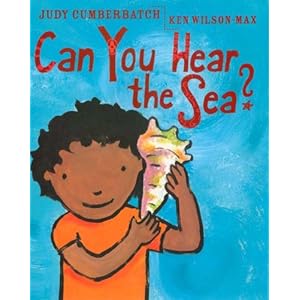
Library Find - Can You Hear the Sea?

The other day, I was headed back to my work area when something on a cart caught my eye. I should mention, in case you don't already know it, that I am privileged to work at the administrative center for a regional library system. The building I work in houses not only all the staff who support our system, but also shelves containing older titles and materials that are in transit to one of our library branches. Books are coming in and going out literally all day long. It is a bibliophile's dream and nightmare all at the same time. Small wonder my library card gets such a workout.

Anyway, right off I recognized the book in question as being illustrated by Ken Wilson-Max. Eons ago, before Sprout came into our family, our children's librarian recommended some titles she thought we might like (and she was spot on, by the way). Among them were Karen Baicker's I Can Do It Too! and You Can Do It Too!, both illustrated by Wilson-Max. Sprout loved both of these books from the first time we read them and they have been frequent revisits since. This new title, Can You Hear the Sea?, written by Judy Cumberbatch, appealed to me right off (don't let anyone tell you we don't judge books by the cover, we all do it). I was pretty sure Sprout would like it, and -- no surprise here -- he firmly declared it "really just good, Mama!"


The story is set in an unnamed country in West Africa but the author's bio notes that she grew up in Ghana so it's not too much of a leap to think it was set there. The narrative explores the relationship between Sarah and her beloved grandfather. On a Saturday before he leaves, Grandpa gives Sarah a beautiful seashell; he tells her to hold it to her ear and listen closely, for she will hear the sea. Though Sarah knows that Grandpa would never lie to her, she can't hear the sound, no matter how hard she tries. Instead, each day of the week, Sarah only hears the sounds of the everyday world around her - the drums in church on Sunday, the monkeys in the trees on Wednesday, the honking taxis on Friday. But then Grandpa returns and shows Sarah just how to listen. And suddenly there it is, the sound of the waves on the shore and the roaring, rushing power of the ocean.

What I love about this simple story is all the layers it incorporates. There are the building blocks of learning, like the progression of the week which teaches about sequences and the passing of time. There are the vivid colors and multilayered illustrations, which stimulate young readers' senses. And then there is the emotional component, in which Sarah knows she should trust her grandfather but then begins to doubt his word. In the end, Sarah's trust is restored as she learns to listen, just as her Grandpa has instructed her. This reaffirms the bond between the two, and provides a gently reassuring ending to this sweet story.

Though I wish there were a few more cultural details - a further development of the setting and the use of culturally correct names or language terms - this is a solidly written and gorgeously illustrated story that will engage any child. Use with other West African stories like Jane Kurtz's In the Small, Small Night or Penda Diakite's I Lost My Tooth in Africa to build a unit about this diverse region of Africa.

Can You Hear the Sea? by Judy Cumberbatch, published by Bloomsbury
Ages 2-6
Source: Library
Sample: "On Monday, Sarah listened to her shell by the river as she and Grandma did the washing. But what she heard was. . . water splashing, Grandma beating out the sheets, and the clothes flip-flapping in the wind."
Recommended

Friday, September 21, 2012

Chapter Book Review - The Year of the Book by Andrea Cheng

Sometimes I just desperately wish for time travel. Usually it's because I'd like to go back and shake my 20-something-year-old self into finishing my degree (since I always wonder how much further I'd be in my career if I'd done it then instead of now). Sometimes it's because I'd like to reassure my 30-something-year-old self that this adoption thing really is going to turn out great and totally be worth the risk. But most often, it's because I come across a book that I would love, dearly love, to go back in time and present to my grade-school self.


Most recently that desire was sparked by Andrea Cheng's The Year of the Book. This is the kind of book I would have lived for as a middle-grader, one that is bursting at the seams with character and heart and all kinds of fantastic novels to boot. Oh, and just about the most adorable drawings, courtesy of the delightful illustrator Abigail Halpin (whose pictures for Penny Dreadful made me love that fantastic book even more, if that's possible!).

Anna's the kind of girl I was at her age -- bookish, slightly lonely and yet fulfilled in herself. She was best friends with Laura, but now all of a sudden Laura's hanging out with a different crowd and they don't seem to have time for Anna. This bothers her, but she's got her own life: her friendship with crossing guard Ray, her creative pursuits in the realm of sewing, and of course, her books. In fact, a book is the place Anna'd most like to be, when she's feeling out of place in Chinese school for being ABC (American-born Chinese) or when she's embarrassed by her report on winter break, when she built paper airplanes with her brother most days. As each novel she reads unfolds, Anna not only learns more about her fictional friends, but also finds more confidence in who she is, and what she has to offer to a real-life friend.

Fans of Grace Lin's Pacey novels (The Year of the Dog, The Year of the Rat, and Dumpling Days) will find a lot to love about Anna Wang as well. For starters, Anna is also a girl with a foot in two worlds, both American and Chinese, and she doesn't always feel she fits in either one. Then, too, there is the search to find a friend, which both Pacey and Anna experience. I love that Cheng gives us a very realistic scenario for Anna to face, that of friends suddenly changing allegiances for no apparent reason. That's grade school for you, isn't it? And though Laura and Anna keep the thread of friendship, it isn't quite the same while Laura's hanging out with another crowd. There's also the fact that Anna isn't always sure how she feels about her parents. While she's proud of her mother for learning to drive and attempting to master English, Anna sometimes finds herself embarrassed by her mom's Chinese-ness. Kids of all backgrounds will identify with Anna's struggle to reconcile her feelings.

Though The Year of the Book is pretty short, and the story is comparatively quiet, there's a lot to think about here. It's great to see an Asian American heroine for this age, one who is totally relatable to the audience Cheng is writing for.The story is well-told, the characters finely drawn, and overall it's a real and true pleasure to read. And Halpin's illustrations add just the right note of whimsy - her renditions of familiar book covers are particularly charming, and kids just may find some new titles for their reading lists. What could be better than that?

The Year of the Book by Andrea Cheng, published by Houghton Mifflin Harcourt
Ages 8-12
Source: Library
Sample: "Writing that makes me think about Mom. I always wished I had a mom who spoke perfect English and who got her driver's license when she turned sixteen. But if Mom wasn't the way she is, she wouldn't be my mom and I wouldn't be me. Suddenly I just want to go home, but I have to finish my work first."
Recommended

Wednesday, September 19, 2012

Picture Book Review - What Happens on Wednesdays by Emily Jenkins

Ah, routine. It is the stuff of the young child's life. Why is it that kids so often crave the knowledge of what is happening next? I tend to think it's because so little in their world is within their control (hence the tantrums when you unwittingly grab the wrong red shirt for them to wear - but that's another post). Think about it: when you're the littlest one, most of the decisions in your life are made for you. And so if you can't control what happens, no matter how stormy the tantrum, the next best thing is at least being able to anticipate what's coming when.

Sprout is certainly a creature of habit. Although he does bounce back rather well from some changes in routine, we try to do everything we can to prepare him for those changes. As I blogged about here, we recently moved to a new preschool, and so we spent a lot of time reading books about preschool and what happens when. This bit of biblio-intervention was very helpful in transitioning him from daycare to a much more structured and rule-centered environment, where he is absolutely thriving.


One of the books we encountered in the search for preschool themes is Emily Jenkins' What Happens on Wednesdays, a picture book that follows a young girl through one entire day. I've always loved the idea of documenting a day top to bottom - I would love to do that with Sprout, taking pictures of all the moments big and small that happen throughout the course of a typical day in his life. And that's precisely what Jenkins has done with Wednesdays, as her heroine narrates exactly what transpires for her on the same day of each week. From early morning wake-up with Mommy, to breakfast with Daddy at the dog park, to preschool, to swimming at the pool and visiting the library, to being tucked into bed at night, it's all here, a child-centric snapshot of Wednesday.

Sprout adores this book, as much for the carefully articulated word choice as for the perfectly detailed recitation of the day's events. Jenkins captures the voice of a preschooler with amazing clarity, noting all the small elements that are important to a child ("We buy an orange juice that comes with a special little straw. . .") and glossing over the boring grownup stuff ("Mommy goes around straightening things. . . "). He drinks in every bit of this young girl's world, totally mesmerized by Lauren Castillo's realistic yet softened illustrations just as he is by the story. I love the neighborhood Jenkins and Castillo have rendered, brought to life through the alchemy of their talents. Jenkins points out the landmarks in the text and Castillo carefully depicts every element of this child's world in pictures that kids will thoroughly enjoy poring over.

While managing to keep the focus always on our narrator, Castillo still gives us a glimpse of the world outside the spotlight, with other tables of children eating lunch and other families going about their own daily routine. This is a book I've truly been thrilled to read over and over to Sprout, as each time I take away something new. What Happens on Wednesdays is a great jumping-off place for discussing your family's day-to-day activities, noting who goes where and what they do in the process. You may just decide to create your own "day-in-the-life" project, maybe in the form of a slide show or blog post, or maybe a picture book much like this one. (If you do, drop us a line - we'd love to share it!)

What happens on Wednesdays in your life is very likely much different from what occurs in Jenkins' charming picture book -- and really, that's the fun!

What Happens on Wednesdays by Emily Jenkins, published by Farrar, Straus and Giroux
Ages 2-6
Source: library
Sample: "I sit on the counter while Mommy makes coffee. Then she drinks her coffee and I drink my milk and maybe we have some strawberries while we read stories on the couch. When the clock says six, we wake up Daddy. Which can take a long time."
Recommended

Bonus: an interview with Emily Jenkins, a Favorite Writer of the blog Seven Impossible Things Before Breakfast