Friday, March 2, 2012

Nonfiction Review - The Great Big Book of Families by Mary Hoffman

Lately, Sprout's been kind of obsessed with the notion of family. He likes to talk about our family: who's in it ("Daddy, Mama, Maxie, me!"), our common traits, what we like to do, where we are going to go together. It's fun watching his understanding of family change. He knows that he has family he lives with, family he sees only sometimes, and family he doesn't get to see. And he's gradually learning that not every family looks like ours.


In The Great Big Book of Families, Mary Hoffman takes a good long look at what makes families different, and the same. Beginning with an acknowledgement that "in real life, families come in all sorts of shapes and sizes", Hoffman explores all the ways families can be unique. She starts by looking at who children might live with, and how those families may have come together. Small drawings along the edges of the page emphasize that everyone's family looks just a bit different from everyone else's.

She also looks at all the characteristics that set one family apart from another, beyond just who makes up the family. Homes, for instance: some people live in small houses, some in apartments, some in large houses. Some have no homes at all. Holidays are another point. Some families celebrate in big ways, some in small, and not everybody observes the same days. The list of categories goes on and on -- clothes, transportation, school,  even feelings -- and each category contains a wealth of rich detail in the illustrations by Ros Asquith.

It may take a bit of hunting to find The Great Big Book of Families in your local library. Ours is shelved in nonfiction, so you might try there, or with the picture books (it's kind of two things at once). Sprout and I read this together and he pored over each page; kids who like to study a lot of small illustrations, a la Richard Scarry, will find this worth a look. Best of all, for me, was the way that Hoffman and Asquith combine and recombine family structures, mixing skin colors, genders, ages, ability, and everything in between. The subtitle of this visually appealing book could well be "a joyful celebration of all kinds of families", because it surely is. We love it!

The Great Big Book of Families by Mary Hoffman, published by Dial Books for Young Readers
Ages 2-10
Source: Library
Sample: "Some people have lots of brothers and sisters. . . and uncles and aunties. . . and cousins. . . and grandmas and grandpas. And even great-grandmas and great-grandpas. But some people have really small families. You can be a family with just two people."
Recommended

Monday, February 27, 2012

Library Find - Beautiful Bananas by Elizabeth Laird

Story is so critical to us as human beings. Literally every culture has storytelling as a fundamental component of socialization and community. In many cultures oral history is passed on from generation to generation through stories, some of which seem mystical and fantastical to outsiders but which, upon further examination, speak volumes about the values that are central to that culture's way of life.

I love folk tales for this reason - you can really get a sense of what makes a particular population tick when you examine the elements that occur over and over again in their stories (it begs the question, doesn't it, what outsiders would think of a certain spate of vampire lit -- most especially sparkly ones!). In East Africa, like other regions, stories are related not only to connect with the past but to instill a sense of pride, of connection with the land and the people who came before. Animals are often central figures in these tales, because animals represent character traits and nature and the gifts the earth gives to us. Which makes them an ideal type of tale to share with young children, who still are in a sense of awe around animals of every sort.


Sprout's been going through a particular fascination lately with elephants. I wish I could say this was due to some great developmental teaching or experience, but really it's probably because there's a Thomas episode he likes where one of the trains encounters a tunnel that's blocked by an elephant (don't ask). So when he pulled the book Beautiful Bananas by Elizabeth Laird off the shelf at the library recently, he immediately screamed "Elephant, Mama, elephant!". (Thank goodness our librarians are indulgent about excitable child noise!)

Well, we had to stop and read the book right away, because not only does the cover feature the aforementioned elephant, but also bananas, a frog, and a little girl with brown skin. Perfection, no? And the perfection carries through the story, which is a circular tale that comes from East Africa. Our heroine, Beatrice, is headed off to visit her granddad with a bunch of bananas to give as a gift. Right off the bat she runs into a giraffe, whose "tufty tail" sweeps the bananas off Beatrice's head and into the river nearby. Beatrice is upset, but the giraffe offers her some flowers for Granddad instead -- which is a great solution, until a bunch of bees come along and the flowers get crushed (here Sprout always whispers "Bees!" and shivers with the delicious dangerousness of these stingy critters). But the bees make it right by giving Beatrice some honey, which is taken by monkeys.

And on and on it goes, each page featuring an African animal or insect that is more beguiling than the last. Really, those monkeys? You can see why Beatrice isn't too upset, because they're so darn cute. Illustrator Liz Pichon brings Laird's funny and fantastic story to life in just the right way. Beatrice is vivacious and bubbly, whether she's being frightened by a lion or sneezed on by an elephant. And the colorful spreads provide plenty of fun details, especially the last one that features each of the animals Beatrice encounters.

This is a simply delightful tale and a great way to introduce young children to folklore. Plus, for us, it was fun to point out to Sprout that he once lived in a home much like Beatrice's and may just have been told a similar story by his Ethiopian relatives. Love it when a great book helps make important connections!

Beautiful Bananas by Elizabeth Laird, published by Peachtree Publishers
Ages 2-6
Source: Library
Sample: "Some naughty monkeys see the honeycomb. 'We like honey!' they cry. They snatch it away from Beatrice. All the honey drips onto the ground."
Recommended

Bonus: more about author Elizabeth Laird

Thursday, February 23, 2012

Picture Book Review - Hot, Hot Roti for Dada-ji by F. Zia

Hitting the right balance with a culturally specific tale is no easy feat. You want the book to appeal to insiders, by being authentic and a true representation of their cultural experience. At the same time you need it to be something that cultural outsiders can appreciate, even if they have no knowledge of traditions or even language. Tough stuff indeed.

The same is true for intergenerational stories - the plot needs to be believable and realistic. Why is this young kid interested in what an oldster has to say, anyway? What's his/her motivation to listen? We've all read historical fiction in which the often-used trope of "come little child, let me tell you a tale" is trotted out, and most of the time it's thin at best. We just aren't given a good rationale for keeps the kiddies enthralled.


And so, since it is both culturally specific and intergenerational, you might think Hot, Hot Roti for Dada-ji has the deck stacked against it. But you'd be wrong, because this is a story that works on many levels: specific enough to speak to cultural insiders, broad enough to appeal to outsiders, and held together by the truly believable bond between grandfather and grandson.

The book begins with Aneel's grandparents coming from India. Aneel relishes his time with them, especially Dada-ji's wonderful stories. He loves to hear the tales of Dada-ji's amazing strength as a young lad - wrestling elephants and tying cobras in a knot. And what was the young boy's secret? Eating lots of his mother's fluffy-puffy roti, hot from the grill and topped with spicy mango pickle. Mmmmm! Dada-ji can almost taste the roti now! So Aneel asks everyone to make some, but all the members of the family are busy. It's up to Aneel, and he gets to work, making a huge stack of delicious roti for Dada-ji. When the last scrap of roti has been gobbled up, Dada-ji has his famous strength -- and the two go off to the yard to have some new adventures together.

It's interesting to note that this is the first picture book for both author F. Zia and illustrator Ken Min. The quality of this effort certainly speaks to a pair of artists who know how to craft a work that appeals to a broad audience. Sprinkling culturally specific elements throughout the text, Zia lets us in on what life was like for Dada-ji as a young boy. I especially appreciate that she doesn't interrupt the flow of the story to define the Hindi words, but rather includes a glossary in the back for those of us who may be unfamiliar with the terms. And Min's illustrations are spot-on: you can feel the power welling up in Dada-ji as he gulps down the huge stack of roti, and the shifting perspectives he uses (watching from inside the bowl as Aneel dumps the flour down) add a playful element that's just right. I love the energy that bursts from each of the characters, especially Aneel, who is excited to be doing something for his grandfather.

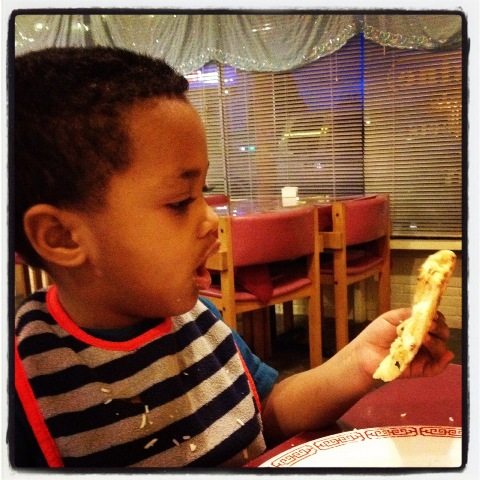
Sprout LOVED this book, which surprised me because it's a bit on the long side and more introspective than some of his favorites. But he asked for it over and over again, and was thrilled when my husband offered to take us all out for Indian food the other night. (Here he is, enjoying his own hot, hot roti - ok, naan bread, but it was hot and delicious too!)


Hot, Hot Roti for Dada-ji by F. Zia, published by Lee & Low
Ages 2-6
Source: Library
Sample: "What made the lad so strong? It was the hot, hot roti that sizzled and wizzled on Badi-ma's wood hearth. You see, baba, Badi-ma made the best roti around! Hungry villagers trampled tall fields and swam angry rivers to sniff the fluffy-puffy roti that bubbled and wobbled in ghee on the hot, hot tavva pan."
Recommended

Bonus: interview with F. Zia at The Happy Nappy Bookseller

Sunday, February 19, 2012

Mom's Bookshelf - How Eskimos Keep Their Babies Warm by Mei-Ling Hopgood

When it comes to parenting notions, most of us don't stray too far outside the realm of what we know to be true. We might do what our parents did, or actively try not to do what they did. We consult parenting books that receive high marks, check out websites, seek out the advice of other moms and dads for particularly thorny issues. But most of us don't look much beyond our cultural comfort zone when considering how to discipline our kiddos or what time we should be putting them to bed.

And then there's Mei-Ling Hopgood.

Hopgood and her husband were thrilled to add daughter Sofia to their family, while living abroad in Argentina. Pretty much everything the couple knew about kids they had learned through their own cornfed American upbringings. Essential gear? Strollers and pull-ups. Approved play? Mommy and me. Sleeping arrangements? Bedtime and crib for one.

But then Hopgood started noticing how Argentine parents treated bedtime - more of a suggestion than anything, with young kids present in restaurants and out and about far later than American children generally are. Digging deeper, Hopgood found the roots of this practice in the culture of her adopted homeland. What she found was less about sleep habits and more about what the Argentine approach to bedtime says about their attitude toward children as a whole. And far from negligent parenting (which is, let's be honest, what most of us might think here if we saw kids eating dinner at 10 p.m.), in Argentina it's considered an important part of family togetherness.


This led Mei-Ling Hopgood to begin exploring parenting practices around the globe, compiling her findings in the fascinating book How Eskimos Keep Their Babies Warm: And Other Adventures in Parenting. Hopgood's research is incredibly insightful, as she digs into why Mayan children participate (happily!) in household chores and how French moms and dads get their children (willingly!) eating veggies. In each case that Hopgood examines, we learn a little something about the particular cultural norms that are transmitted from parent to child, and how those norms support the larger values and beliefs of that cultural system.

As an undergrad sociology/anthropology major, this stuff is right up my alley, and it really made me think about why we hold the beliefs we do about proper nutrition, playtime, and yes, even bedtime. Much of what we do is in all honesty pretty arbitrary, when it all comes down to it. And in fact it could just be that the Japanese are on to something when they let kids work out their own petty squabbles with -- shock of shocks! -- little or no adult intervention. Can you imagine??!

Though I'm not giving up our stroller just yet, I'll admit that Hopgood makes some pretty intriguing points here. And if nothing else, I'll feel a lot less guilty next time we stay up a little past bedtime.

Wednesday, February 15, 2012

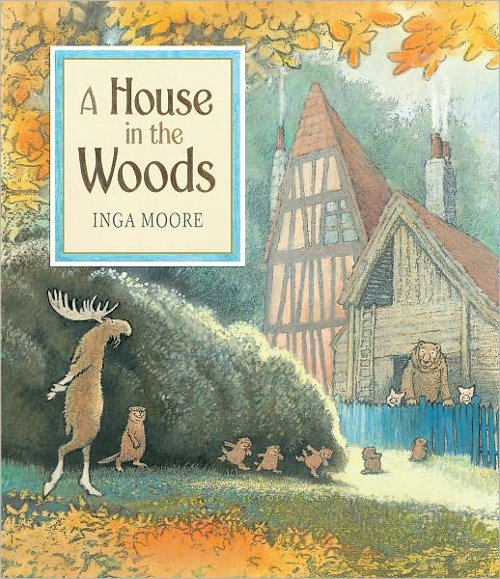
Picture Book Review - A House in the Woods by Inga Moore

Every night at bedtime, Sprout's allowed to pick out his own reading material. We usually get through 3-4 books while he's taking his bath, and then we do one more once he's all snuggled down in bed. I used to do the selections, trying to reserve a calmer title for that last one of the night, but lately he's all about doing it himself. And for the past several nights, Sprout has chosen only one book for that last selection: A House in the Woods by Inga Moore.

If you're not familiar with Inga Moore, you're in for a treat. She's probably best known for Six-Dinner Sid, about a greedy little black cat whose elaborate plot to get multiple dinners every night eventually trips him up (or does it?). She's also published a number of acclaimed illustrated volumes, most notably her iteration of Wind in the Willows by Kenneth Grahame -- cannot wait until Sprout's old enough for this one!

And in A House in the Woods Inga Moore gives us a book that is as charming and cozy as Wind in the Willows, albeit in a different vein. The plot is fairly simple: a couple of pigs have built themselves perfectly lovely homes in the woods, but when each pig gets an unexpected houseguest, their homes are ruined. Suddenly the two pigs, and Moose and Bear, find themselves without living quarters. What's the most logical solution? Build themselves a proper house, of course. So the unlikely group hires themselves a pack of beaver builders to do the job. Luckily for them, beavers work cheap. Soon enough the little group has a sturdy and suitable home, complete with all the comforts -- all of that for only the price of several plates of peanut butter sandwiches (told you those beavers were a bargain!).

It's just about impossible for me to convey in writing how delightfully lovely this book is. Really, it's the kind of book you read as a child and remember fondly as an adult. The characters all get along splendidly, working together to accomplish their goal. The reward for their hard work is satisfyingly handsome, and best of all they all get to curl up together at the end of the night and dream about their labors. And the illustrations -- oh my, how gorgeous they are! I'm not exaggerating when I say that each time we read it, one of us notices something new: from the crooked stick that one pig finds at the beginning, to the lovely squishy pillows the group brings home from the badger junkyard. Oh, and the friends themselves are pitch-perfect: gangly Moose, all knees and elbows, the busy little pigs, and bumbly Bear.

Sprout thinks a visit to the house in the woods is the perfect way to end the night, and I heartily agree. You'll want to pull yourself and your kiddo right inside this cozy picture book and never leave.

A House in the Woods by Inga Moore, published by Candlewick
All ages
Source: Library
Sample: "Which left the two Little Pigs with nowhere to live--not to mention Moose and Bear. This was a pickle. It really was."
Highly recommended