Friday, December 7, 2012

Chapter Book Review - A Long Walk to Water by Linda Sue Park

It's the holiday season, and at this time of year thoughts naturally turn to all we have to do. Gifts to make or buy (and wrap), rooms to clean, meals to prepare, cards to send -- it can get a little bit overwhelming and crazy. I myself am very far behind this year. Though we have our Christmas tree up, I've yet to even order cards and still have quite a bit to do on holiday gifts. And like most Americans, these are things that seem important to me.

Until I stop to consider the daily reality of most people around the globe. To them, priorities like trimming the Christmas tree or baking cookies aren't even on the radar. Instead, they're laboring every day for food, for shelter, for clean water and for safety for their children. And that thought humbles me, as it does every time I open my cupboards and find them full of food, or look through my closet and consider all I have to wear. It humbles me, and it makes me mindful of all I have that others do not.
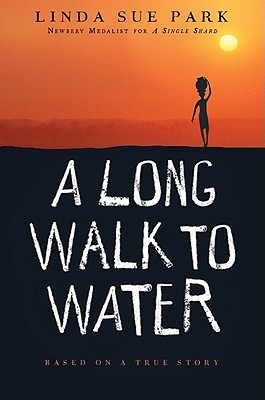


That thought was ever-present in my mind as I read Linda Sue Park's short but powerful novel A Long Walk to Water. Park based her book on the real-life experiences of Sudanese-born Salva Dut. The novel opens in 1985, when Salva is eleven, on a regular school day. Suddenly rebel forces open fire and the students are forced to flee into the bush, leaving their families behind. In the ensuing scuffle, Salva ends up being left behind by the group of survivors. Alone, he struggles to find safety, looking for news of his family and village as he walks to who-knows-where. Along the way he encounters many who are kind and helpful, some who mean him harm, and much tragedy. Even when Salva finds shelter in a refugee camp, the trouble isn't over, and it is many, many years before Salva will know what became of his loved ones on that terrible day.

Park intersperses Salva's story with that of modern-day Nya. Nya's tale is much shorter, but no less moving. We learn of the girl that much of her life revolves around water. The process of getting clean water for her family takes up an enormous amount of Nya's time, as she must travel many miles on foot each day, carrying a large plastic container on her head. Though at certain times Nya's family lives near a lake, the fighting between neighboring tribes means that it's only really possible to stay there during the dry season, when the warring factions are preoccupied with survival. The rest of the year, Nya must walk to water, and doing so is consuming her life and that of her friends as well.

The stories of Salva and Nya are different but parallel, and when Park draws the two disparate threads together it is with a satisfying sense of rightness. Though sparely written, A Long Walk to Water is emotionally charged, and readers will feel a connection to both main characters from the first page on. Park's voice throughout this novel is respectful but never patronizing. While we empathize with the situation, Park never makes either character an object of pity but instead helps readers to recognize the extraordinary dignity and strength that both Nya and Salva display. You cannot help but be moved by this story -- as I envison Nya walking miles each day to gather water that is very likely contaminated, my heart simply breaks.

In reading Salva's story, kids will be inspired to action, to find out how they can help provide clean water for those in Sudan and so many other nations around the world. Salva Dut's organization Water for South Sudan is doing amazing work providing safe drinking water and changing lives. This holiday season, as you make your gift list, consider adding the gift of clean water for someone you've never met -- I guarantee it will be a gift that is never forgotten.

A Long Walk to Water by Linda Sue Park, published by Clarion Books
Ages 8-12
Source: Library
Sample: "The water that filled the hole was filthy, more mud than liquid. It seeped in so slowly that it took a long time to collect even a few gourdsful. Nya would crouch by the hole, waiting. / Waiting for water. Here, for hours at a time. And every day for five long months, until the rains came and she and her family could return home."
Recommended

Bonus: Linda Sue Park and Salva Dut discuss the book and the mission of Water for South Sudan

Tuesday, December 4, 2012

Mom's Bookshelf -- Show Me a Story by Leonard S. Marcus

Now that our 30 Days of Picture Books series is over, you may have noticed it's been a bit quieter here on the Bookshelf. It's not that we've stopped reading -- far from it -- but more that I took a bit of a break over the weekend to focus on end-of-the-semester projects. I so enjoyed doing the 30 Days writing that I was tempted to keep on with one post a day until the end of the year, but sanity prevailed when I realized how much research and writing looms ahead for school. So while I might be posting a little more infrequently over the next couple of weeks, rest assured that I'm still here.

In the meantime, we have been busily working on some other projects. First are our Pinterest boards. If you haven't jumped on the Pinterest bandwagon I really commend you, but I've jumped in with both feet. I love this site for creating booklists -- so much more visual and interesting to look at than a list of linked titles! Our most recent additions include boards for Kwanzaa, Hanukkah, and Christmas, as well as a board of Kidlit for Global Citizens. It's been so much fun compiling these lists, and I encourage you to use them to build a library list or as gift ideas. And as always, we'd love to hear what your favorite holiday reads are, so we can pin those as well.

Last year I did a very popular project called 12 Days of Christmas Picture Books. Each day we shared a Christmas favorite, many of which were multicultural titles. The idea for that series came about when Sprout and I were (where else) at the library, and I overheard someone mention that "It's so hard to find Christmas stories from other countries." That of course got me to thinking about the need for diversity in holiday literature, so I began to dig deep and come up with some excellent books. We're planning to continue the tradition this year, and I've been keeping a list of candidate titles for the past 12 months. If your favorite multicultural Christmas title wasn't covered in last year's posts, please pass it on so we can work it in for this year's 12 Days.


And so, you may ask, have I been reading anything besides picture books for the past 30 days? Well as it happens, I have, and not just required reading for class either. Partway through the month I started reading Leonard S. Marcus's book Show Me A Story: Why Picture Books Matter, which is a title that's been on my TBR list since it came out in the spring. Folks, if you love kidlit, you HAVE to track this book down (if it's not in your library, suggest it as a purchase: your local librarians will love it too!). Sprout's a little miffed every time he picks it up because he thinks it's written by Mo Willems (reference the cover art) and then he says, quite disappointed, "This is just a grown-up book."

Marcus is well-known in kidlit circles as a researcher and writer, and he's penned some incredible books about the creation of children's books. In Show Me A Story, Marcus compiles his interviews with more than 20 of the world's best-loved children's illustrators. Many of our favorites are here: Ashley Bryan, Kevin Henkes, Jerry Pinkney, Robert McCloskey, Yumi Heo, and others too. After reading through so many picture books in a month, it was especially fun to read these revealing interviews about the art and craft of creating books for children. This is the kind of book you dip into from time to time, for inspiration or to connect with a favorite creator. I'm not an especially creative person myself, but I'm fascinated by the creative process, so this kind of voyeuristic read is right up my alley (really need to make sure Santa knows that!).

One of the best quotes I came across (and there are tons), is one from Kevin Henkes: "I love having something for the adult who is reading to the child. But I try to keep in mind at all times that the book is for the child. I don't want any of that extra layer to interfere with the main objective, which is to make an entertaining book for a kid." Beautifully said, Mr. Henkes! And I dare say it's why we love to read his books as well.

Show Me a Story by Leonard S. Marcus, published by Candlewick Press
Adult
Source: Library
Sample: From the Foreward by David Wiesner "And nowhere is visual humor explored more fully than in the picture book. Possibly only Charlie Chaplin or Buster Keaton could equally run the gamut from gentle kidding to sophisticated wit to pie-in-the-face slapstick to anarchic postmodernism."
Recommended

Friday, November 30, 2012

30 Days of Picture Books - In November by Cynthia Rylant

This is it -- Day 30 of Picture Book Month. Have you had as much fun as we have? It's been wonderful to share some of our favorite books with you, books old and new. Many of these titles are ones we return to again and again -- we hope you've found some books among our picks that will be the same for you and yours.

I hope you've been following along not only with our little project, but also with the great things happening at the Picture Book Month site. So many amazing posts about picture books, how their art and words and their very spirit can change the lives of kids and adults alike. I think author/illustrator Joyce Wan said it best, in her November 29 post on the importance of picture books: "Picture books empower the underprivileged and give hope to the voiceless. They have the power to capture your heart and transform your soul. They are the first interaction we have with books and that initial connection creates a ripple effect that lasts a lifetime and for generations to come."


Today's pick is Cynthia Rylant's In November. This is often read at Thanksgiving, and that fits because of course the Thanksgiving feast is mentioned prominently. But it's also so much about the wrapping up of the world for winter, the way the birds take flight and the animals become lazier, and how the bite to the air becomes sharper. This is a book to read by the firelight, snuggled down with a blanket and the comforts of home to keep you.

This is one that I've been saving all month long, because it seems to sum up not only the spirit of this month, but also because it represents so much of what is best about picture books today. Its storyline is spare and tight, words dropped like jewels into place so that phrase each shines with a unique beauty. Its illustrations, beautifully done by Jill Kastner, are evocative, snapshots of the way the world looks at this time of year, with the light sifting through the clouds and the closeness of dark coming ever near. Of all the books written about fall, this is the one that for me best symbolizes the transition from autumn to winter, and celebrates that time as perfect for all it is.

I hope that through this past 30 days, you've encountered some books that will crack open the whole wide world for your children. When you read picture books to your children, you give them so much: laughter and knowledge, closeness and exploration, silliness and introspectiveness, dreams and honesty. You teach them and you learn from them, watching their experience with the words on the page and the pictures they lose themselves in. I've never read books in the same way as I have now that I read them to Sprout, even when I read them to other children, because I see each title as I se the world - much differently through his eyes.

As for us? We'll still be right here, a stack of books by our side, and many more where these came from.

In November by Cynthia Rylant, published by Harcourt

Thursday, November 29, 2012

30 Days of Picture Books - A Bus Called Heaven by Bob Graham

It's Day 29 of Picture Book Month, and the theme of our choice for today is community. Books in general, and picture books in particular, are a major means of teaching cultural norms, which is a critical part of socialization. Young children learn how to work together, how to share, how to be part of society not only through the behaviors they see modeled, but also through more passive channels.

And so armed with that knowledge, I think it's vital to read books that show what we want our kiddos to become. For us, it's important that Sprout become the kind of kid who cares about others and is inspired to contribute as a citizen of the world as well as of his community. So we read books that build social consciousness, books about amazing people like Wangari Maathai and Pura Belpre, and then we read books about communities coming together.


The most amazing community-themed book I've read in recent months, and one that Sprout has asked for again and again, is Bob Graham's A Bus Called Heaven. I've written about Bob Graham's books before, but I must say again that I find his work so very incredible. He hits the nail right on the head when it comes to books that kids will love but which carry deeper messages - about love and acceptance, and in this case about working together. His illustrations are spot on for his target audience, with plenty of small details that kids love to pore over and realism and idealism melded together. Simply fantastic, every one.

In A Bus Called Heaven, Graham gives us another neighborhood story, this time of a group of people who turn an abandoned bus into a de facto community center. Nobody's sure where the bus, labelled with a sign that reads "Heaven", came from. But acting on an idea from shy little Stella, the neighbors rally and convert it into their own place. It's not just for the kids, but for everyone, with movie nights, foosball, a lending library, a gathering spot. Sooner or later, though, the bureaucrats get involved and the bus has to move -- unless quiet Stella's plan to save their bus can somehow be successful.

Here you have the most inclusive backgrounds I've seen in picture books, as Graham peoples his books with elderly and infants, tattooed biker types and glasses-wearing rabbis, moms and dads, multiracial families, and people of all colors and creeds. (Nothing annoys me more than books set in urban areas where there's zero diversity.) Graham gets it right in his message too: that some things are bigger than just one person, that we all need "third places" to connect and involved and be together. The last spread shows the whole point best - at the center of the gray city night is the bus called Heaven -- alive with color and light, festive and drawing together a community, with grass "danced flat".

The bus may be called Heaven - but this book, for us, is too.

A Bus Called Heaven by Bob Graham, published by Candlewick Press

Wednesday, November 28, 2012

30 Days of Picture Books - Roly Poly Pangolin by Anna Dewdney

It's Day 28 of Picture Book Month! Today I'm thinking about fears. This might seem like an odd topic when it relates to picture books, but some of the best picture books have really scary bits in them, and that's handled to various degrees by the kids who read them. Honestly, I find it's usually parents who have more issues with creepy parts of kids books, because they aren't sure how their little darling is going to handle it (and often kids are more okay with it than their parents are.)

But that's not really what I mean - in this instance I'm talking less about monsters and more about the kind of fear that's more intimidation, a fear of things or places that others are just fine with. Children's lit is full of examples where protagonists confronted something they were daunted by, and found a way to deal with it. While that might seem repetitious, it's important that kids see plenty of examples of friends, even fictional ones, who face their fears head on. That way we give them tools and strategies when they face their own trepidations, which they're bound to do.


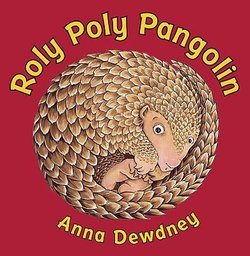
Today's pick is one Sprout chose, and I think he likes it because the character is scared of new things, which Sprout himself tends to be. You're probably familiar with Anna Dewdney from her Llama Llama books (we find them deeply adorable), and that's why we initially checked out Roly Poly Pangolin, which Dewdney wrote and illustrated. A pangolin, if you don't know it, is an oddball little critter found in Africa and parts of Asia. Pangolins are covered in scales, which they use as a defense when they are scared - they roll into a ball so whatever threatens them is faced by their armor. Between that and the fact that they eat bugs (they have no teeth), Sprout finds them "weird and cool".

Dewdney cleverly turns the pangolin's defense system into a plot point. Our little friend Roly Poly doesn't like new things. He doesn't want to eat yucky bugs, he doesn't want to play with a friendly monkey, and he definitely doesn't want to find out what's making that scary noise in the forest. In running away from the noise, Roly Poly trips and stumbles into a ball, where he's most comfortable. But then Roly Poly decides to open his eyes just a bit, and what he finds is someone who's just like him!

As always, Dewdney's text is readable and relatable for even the youngest listeners, who will identify with Roly Poly's reluctance to try new things. And her art makes these strange little guys seem so appealing. Now we want to meet one in person! I can see a report on the pangolin coming up somewhere in our academic future. . . but in the meantime, we're thrilled to see yet another strong literary example of a character confronting his fears and coming out much the better for it.

Roly Poly Pangolin by Anna Dewdney, published by Viking