Friday, January 11, 2013

Nonfiction Review - They Called Themselves the KKK by Susan Campbell Bartoletti

This past semester I was fortunate to take a class on teen literature. We read some amazing stuff over the course of the 16 weeks in the class, and my professor really made every attempt to introduce us to a diverse cross-section of books for teens. One unfortunate side effect, however, was that my already formidable TBR list grew by leaps and bounds (sadly, my available reading time did not grow with it, so who knows when I'll get to all these wonderful books, but that's another problem).

One of the titles we read that really blew me away was Susan Campbell Bartoletti's nonfiction selection  Hitler Youth: Growing Up in Hitler's Shadow. Not only was the subject matter fascinating -- the effect of Nazism on tweens and teens who became part of the movement -- but Bartoletti's writing is top-notch. While never sensationalizing events, she has the ability to pull you into the story and absolutely compel you to keep reading, to find out how life turned out for the young men and women Bartoletti focuses on. The book was recognized with a number of awards, including a Newbery Honor and a Sibert Honor, and for good reason, because it's simply incredible.


Reading Hitler Youth left me wanting more from this talented author, so I turned to her more recent book They Called Themselves the KKK, published in 2010. This is another fascinating historical account, this time centering on the formation of the Ku Klux Klan in the period of post-Civil War Reconstruction. I knew little to nothing about the KKK's history, so I went into this one entirely fresh, and was amazed at the depth of historical detail Bartoletti was able to uncover.

Her story takes up right after the Civil War concludes, when the Southern states were still reeling from their devastation and defeat at the hands of the Union soldiers. Tennessee was particularly hard hit, and the residents of Pulaski, TN worried about their future in a country that intended to see the South punished for their rebellion. Six Pulaski men took up meeting in the evenings to reminsce about "the good old days" before war ravaged their region; it was at one of these meetings that the Ku Klux Klan was formed, as a club for men who shared the six friends' ethos.

To say the Klan took off like wildfire is an understatement. Bartoletti traces the rapid spread of the KKK through the South and also the tactics that caused its membership to swell, even if many of the new recruits joined against their will. To oppose the Klan was to risk reprisal, and few young men were willing to risk it. And very soon the Klan began to take steps to protect its members and other white Southerners from what it felt were overly punitive and biased laws and mandates.

Of course, we all know of the violence and bloodshed that was left in the wake of the KKK, but it is here that Bartoletti's book becomes most moving. She traces first-hand accounts from former slaves and others who stood up to the Klan and were severely punished for their trouble. Stories like that of disabled preacher Elias Hill, whose sermons caused the Klan to target him for inciting black-on-white violence, provide an essentially personal element to this period of history. Throughout the book, reproductions of photographs, illustrations and historical documents add depth and bring out the poignant moments of human suffering described in Bartoletti's text. Much of it is horrifying, and yet critical to understand events that followed, most notably the Civil Rights Movement.

With excellent resources like this well-researched and riveting book, history truly comes alive for students, in a way no dry textbook can do. It's easy to condemn the actions that were carried out by the KKK -- far harder to analyze what events brought the Klan to power and how its effects lingered for years afterward, even to this day. I so admire the balance, sensitivity and accuracy Bartoletti employs in this account, which should be required reading for every student of American history.

They Called Themselves the KKK by Susan Campbell Bartoletti, published by Houghton Mifflin
Ages 13+
Source: Library
Sample: "Despite the Klan's terror tactics, freedmen turned out to vote in extraordinary numbers. In Spartanburgh County, South Carolina, for instance, freedmen swam rivers, waded streams, and walked miles to reach the polls. 'A man can kill me,' explained Henry Lipscomb, 'but he can't scare me.'"
Recommended

Bonus: Susan Campbell Bartoletti's visit to a KKK rally as background research

Wednesday, January 9, 2013

Nonfiction Picture Book - Who's in My Family? by Robie H. Harris

We're in a phase right now around our house that is simultaneously the most entertaining and the most annoying one ever -- the "why" phase. I thought we'd been through this once before, and we had, but this new incarnation seems to be a deeper and more questioning one. Now instead of "why is the car wet?" it's more "why does it rain?". Everything is more philosophical. And it's great, if a bit frustrating when the question is something like "why are pancakes made out of eggs and milk and flour and salt?" (an honest-to-goodness query from last night's dinner).


So a quick flip through today's pick, Who's In My Family? by Robie H. Harris, told me this one would be just the thing for Sprout's current quizzical turn. Harris's goal with this and her other titles, including books on bodies, birth and health, is to present information in a clear and age-appropriate manner. And clarity is certainly the watchword here: Harris examines all the facets of what makes up a family, as well as the various aspects that different family members may either share or that may differ from person to person.

There's a lot here to recommend it as an addition for home libraries and classrooms alike. The prose is concise and straightforward, easy for kids to understand, which parents and teachers will appreciate. While the dialogue between the two main characters, Nellie and Gus, is a little stilted, the general upbeat tone works well with the pictures. Nadine Bernard Westcott did the illustrations, and they are charming, lively and fun, with lots of small details that make the spreads visually appealing. A whole chunk of the book centers around a trip to the zoo, so there are even family groups among animals shown here, reinforcing the overall message of Harris's text.

A big plus for us is the diversity - transracial families are featured prominently, as are same-sex parents, extended family members, older parents, and characters with disabilities. Differences are discussed in an open manner, and I appreciate Harris's no-nonsense approach to matters like varying skin colors within a family unit. This is great not only for kids whose families don't "match", like ours, but even more critical for families who do match, so all children can see that the bonds that unite family members go far beyond similarities in hair or skin color.

When you're looking to tackle the big topics with your kiddo, books like Who's In My Family? are exactly what you want on hand. And maybe a few adults should read it too -- you know, to remind us that "Most of all, and most of the time, and no matter what -- children and grown-ups and their families really do love one another!".

Who's In My Family? by Robie H. Harris, published by Candlewick Press
Ages 3-9
Source: Library
Sample: "Parents, sisters, brothers, grandparents, cousins, aunts, and uncles can all be part of a child's family. Often, good friends or a pet can be part of a child's family too."
Highly recommended

Monday, January 7, 2013

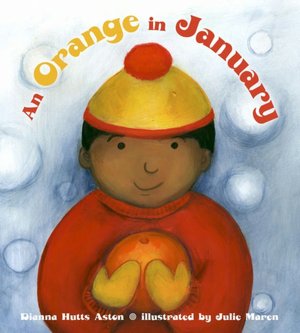
An Orange in January by Dianna Hutts Aston {The Children's Bookshelf}

Boy oh boy, does my kid love fruit. Really, I think it's his favorite thing to eat. He'd much rather have a slice of melon or an apple than a cookie any day. Every night we prepare his dinner plate plus a bowl of one of his favorites like grapes or pineapple on the side. And woe to us if we forget - to Sprout, a meal isn't a meal unless there's fruit involved.

Which is what made this particular library find all the sweeter, because not only does it focus on one of his all time most-preferred fruits, oranges, but also because it explains the cycle of how that orange comes to the table.


In An Orange in January, Dianna Hutts Aston starts by centering the story on one tiny blossom, glowing in the light of spring. From there, we follow the progress of the bees pollinating the blossom, to the orange itself beginning to manifest itself. Eventually the fruit is ripe, and it is picked by "a hand, brown with seasons of sun," then it is on its way to a grocery store. There it is selected by an adorable brown-skinned boy, who cradles his find carefully home, then takes it to school where he distributes pieces of the juicy treat to his friends. Yum!

Julie Maren illustrated this colorful title, and her pictures definitely add an air of realistic whimsy to the story Hutts Aston has to tell. In one fanciful spread, the boy pictures himself using his orange in various ways: as something to juggle, as a ball to pitch, as a globe to help him see the future. Sprout loves this part - he likes to laugh at the idea of doing anything with an orange but eating it, which he simply cannot imagine doing. He also likes the pictures at the end, when the hero has shared his orange with his friends on the playground. "They are sharing!" he says, delightedly. Another fantastic message to take away from this well-written book.

A big part of healthy eating is awareness, getting kids to understand the natural element in the food that they are consuming. With lyrical precision, Hutts Aston carries readers along for the journey of the food cycle. (That she made the main character a person of color is particularly wonderful - this is a message that all kids need to understand.) Helping to connect the dots between what's on our plates and where it came from, An Orange in January is a great way to make kids aware of agriculture and how food is sourced. No longer will they think of supermarket produce as springing only from boxes and bags - rather, they'll look at the trees and vines around them as a source of nutrition and deliciousness. And that's a treat that's everyone can appreciate!

An Orange in January by Dianna Hutts Aston, published by Dial Books for Young Readers
Ages 2-7
Source: library
Sample: "When morning came, the orange reached the end of its journey, bursting with the seasons inside it. / And two hands, pink with cold, shared its segments, so that everyone could taste the sweetness of an orange in January."
Recommended

----------------------------------------

This post is part of The Children’s Bookshelf, a weekly linky party with the goal of connecting parents with great books for their kids. Do you have a book review, literacy or book-related post that you think will be helpful for parents? If so, please add your link below.

NOTE: By linking up you are giving permission for any of the co-hosts to pin and/or feature a your photo on a future The Children’s Bookshelf post. Kindly link up to an individual post, not your blog’s homepage. The hosts reserve the right to delete any links to homepages, commercial links, repeat links or otherwise inappropriate links. Thank you for your understanding.

You can also follow The Children’s Bookshelf on Pinterest or visit TCB’s co-hosts: Sprout’s Bookshelf, What Do We Do All Day?, No Twiddle Twaddle, Smiling Like Sunshine, My Little Bookcase, The Picture Book ReviewMemeTales and Mouse Grows, Mouse Learns. You can find more details here.


Friday, January 4, 2013

Chapter Book Review - Keeping Safe the Stars by Sheila O'Connor

Last summer I participated in MotherReader's 48 Hour Book Challenge, which was an awesome experience (can't wait to do it again!). Though I didn't get to read as much as I'd hoped to, what I read was fantastic stuff, and probably my favorite title was Sheila O'Connor's Sparrow Road, her debut in children's literature. The book was not only beautifully written, it featured a host of interesting characters, the kind of people you just want to know more about.

So when I saw that O'Connor had a new title for children out this fall, I was, to say the least, pretty jazzed. Of course there's always that worry that the next book won't be as good, that it will feel like a repeat or fall flat in one sense or another. But that worry didn't prove out with O'Connor's latest title, Keeping Safe the Stars, a family story that's as tender as it is compelling.


The novel opens with thirteen-year-old Pride, the oldest of the three Star children, trying to decide just what she's going to do about the family's current situation. The kids -- Pride, her sister Nightingale and their brother Baby -- have had a hard road in life, losing their parents already and now living with their somewhat reclusive grandfather Old Finn on his remote patch of land. Old Finn is wonderful for the Stars, teaching them all sorts of things that most kids never get to know and always remaining sensitive to their uniqueness. (His reclusiveness comes from his criticism of the government, particularly President Nixon who at the time of the novel is on the verge of resigning.)But now Old Finn has been stricken with a brain infection, taken to the hospital in Duluth, and the three Stars are left alone on the land, with only the ancient Miss Addie for supervision -- though truthfully, Miss Addie needs more supervision herself.

Pride's got to keep the family going, she knows that. And most importantly, she's got to keep the Social Services people away. Otherwise she, Nightingale and Baby will end up with fosters, and there's no guarantee that those fosters will be the sorts of people Old Finn is, or that the Stars can stay together if they have to leave. Still, how's a young girl, barely thirteen, supposed to look after her siblings and a senior citizen, not to mention find the money to keep everyone fed, all while hiding Old Finn's absence from outsiders?

This novel reminded me of Cynthia Voigt's Homecoming, and Pride of Voigt's heroine Dicey Tillerman. Like Dicey, Pride is stubborn and driven, determined to keep her family together no matter the cost. And like Dicey, Pride results to any means necessary to provide for the Stars and protect them from the frightening graveness of their situation. But Pride is her own person, and the Stars wholly individual as well. Though the resolution to their situation could strain the realms of believability, in O'Connor's skilled hands it comes off as natural, inevitable. And though there are certain stereotypes reinforced here -- parent-like older sibling, smart but quirky middle sibling, reckless baby of the family -- the Stars never feel like cut-outs of some more well-worn cloth.

Though the historical setting may be a stretch for some, I think this would be a hit with readers who favor independent, resourceful narrators. Pride isn't perfect, and therein lies her charm; while she makes mistakes, and knows even as she does some things that she's gone off the past, ultimately she's motivated by her huge heart and love for her entire family. As she did in Sparrow Road, O'Connor has once again created a novel that's driven by careful plotting and intriguing characters, the sort you hope to return to, if only to see how they all turn out.

Keeping Safe the Stars by Sheila O'Connor, published by G.P. Putnam's Sons
Ages 9-12
Source: Library
Sample: "Mama used to say I came to earth a doer. Nightingale a dreamer. Baby came to earth a darer -- it's why he tried to fly and why he had twelve stitches in his chin. / Still, different as the Stars were, all of us were part of the same heart -- Mama's heart -- and even gone, her love kept us a family. No matter what, we hardly ever fought. I didn't want to fight with Nightingale now."
Recommended

Wednesday, January 2, 2013

Winter Wonderland - 5 Favorite Picture Books About Snow

Sprout's so disappointed - he was really hoping for a white Christmas, but it never materialized. I blame all these Christmas specials that show evergreens strung with lights against the snow, kids building magical snowmen, families skating on ice-covered ponds. What a bummer when you live here in the Pacific Northwest, where snow on Christmas is a once-in-every-so-many-years occurrence.


No matter though, because we're reading snowy books instead! First up was Denise Fleming's The First Day of Winter. We're fans of Fleming's unique illustration style, which combines dyed pulp and hand-cut stencils to create pictures with the flavor of collage and the depth of paintings. Beautiful! In this outing, Fleming uses the basis of the "Twelve Days of Christmas" carol to count down twelve days of winter, and all the things that a young boy gives to his snowman friend. By the end the snowman is bursting with life and has several woodland creatures to keep him company. Sprout enjoys keeping track of what's given each day and pointing it out in the pictures - great reinforcement for counting, too!


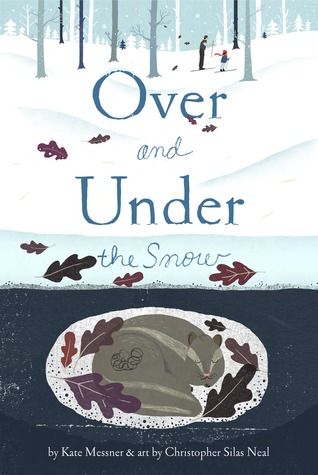
Kate Messner's fantastic Over and Under the Snow has been a favorite around here for several weeks, and we're sad to see it finally come due at the library. Beginning from the perspective of a family out for an afternoon cross-country skiing, Messner examines all the secret activity that goes on beneath the blanket of white that covers the landscape. Squirrels are nesting, bullfrogs brooding, tiny voles making their way through hidden tunnels. Sprout was captivated by the images of all this, done in cut-away fashion by Christopher Silas Neal. Having a sneak peek at the world of hibernating animals gave us plenty to talk about when the first hard freeze hit: "Mama, are the squirrels staying home in bed today?"


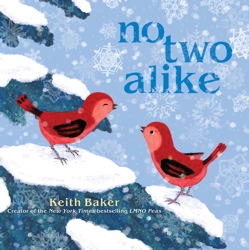
The next pick is one we first read last year, but enjoyed so much that we had to have it again this winter. Keith Baker's No Two Alike is just beautiful, a vivid look at the winter landscape that is set off by the presence of a pair of scarlet birds. As the friends venture through the wintry day, they examine all the things that appear at first glance to be the same -- snowflakes, branches, houses, roads -- but really are not. This is a gentle choice for storytime, as it captures the hushed feeling of a winter snowfall, and ends on just the right note. Fans of Baker's previous books will happily find the same stellar illustrations in this effort.


Phillis Gershator's When It Starts to Snow is another great title for looking at how winter weather affects animals and people differently. As a young boy excitedly roams in the building snow, he asks each animal he encounters "What do you do? Where do you go?". There's a different answer from everyone, but all are looking for a warm place to wait out the chilliness. From the rooster crowing in the barn rafters to the bear heading for his den, everyone has a plan for when the snow flies. And that includes our hero, who is so thrilled by the presence of the white stuff that he can't sleep! This one's for the kiddo in all of us, spellbound by the sight of the whiteness building and drifting just outside our windows.


For older kiddos, and their readers, Snowflake Bentley is a unique and delightful choice. Jacqueline Briggs Martin examines the life of Wilson Bentley, whose quest to capture photographs of snowflakes consumed him entirely. Bentley loved the snow, and he wished from a young age to share the beauty of it in a more permanent fashion than the temporary nature of snowflakes would permit. What I love most about this story is the way Bentley's family supports him absolutely, though they didn't understand his obsession -- that's a message every child should get, I think. Illustrator Mary Azarian created gorgeous Caldecott-winning illustrations for this title, which bring Bentley's thesis, the uniqueness of each snowflake among millions of its kind, to brilliant life.

Whether you're surrounded by snowbanks or camped out on a sandy beach, these wintry storytime additions are all full of icy delight!