Friday, March 30, 2012

Picture Book Review - Going Home by Eve Bunting

Picture books truly are a format that can work with any and all ages. For those who think they're only for the youngest child, I would counter that there are books that encompass the complexity and nuance of certain subjects every bit as well as chapter books or nonfiction. Of course, these selections need to be used with the right audience, but when chosen carefully, picture books shed new light on a topic or open up opportunities for critical thinking for children and adults alike.

A perfect example of this is the work by Eve Bunting and David Diaz. Never ones to shy away from a tough subject, Bunting and Diaz have produced some stunningly beautiful literary works. Their collaboration Smoky Night, written in response to the LA riots, won a Caldecott for its unique and dazzling illustrations, which underscore the tense, emotional plotline. One glimpse through this title and you'll see why it draws strong responses from its readers.


Going Home, their next book together, is a similar melding of thought-provoking text and complex, evocative illustrations. In the book, Carlos and his family are on their way home to Mexico for Christmas. The family hasn't been back since Mama and Papa left years before; though the parents are looking forward to going back, Carlos and his sisters really don't know what to expect. After all, California is home to them. It may not be perfect -- Papa and Mama must do backbreaking labor in the fields, and Carlos never seems to see the opportunities that immigration promised them -- but it's what the children know.

But now the world of their homeland begins to open up to the children. As they drive they see the land that their parents left behind, and it isn't what they expected. There is beauty here, lots of it: in the flowers and trees, in the buildings and little villages, in the faces of relatives and those who knew their parents, once upon a time. And most of all there is beauty in Mama and Papa, who come alive in this place in a way that Carlos and his sisters have never seen.

What Bunting and Diaz have created here is a masterful opening to any conversation about immigration and the experience of people who leave their home for another. We can approach this topic from a variety of ideologies, but one common root remains: the notion that finding oneself far from home is hard, no matter what the reasons are for leaving. For older children, pair this with a title like Return to Sender by Julia Alvarez; younger readers might be ready for Grandfather's Journey by Allan Say or La Mariposa by Francisco Jimenez, for a look at the immigrant experience.

Going Home by Eve Bunting and David Diaz, published by HarperCollins
Ages 6-10
Source: Library
Sample: "There is a wooden plow outside Grandfather's house. I remember when Mama and Papa saved the money for it. Later they also sent money for two oxen. I wonder where the oxen are and if we will be friends."
Recommended

Bonus: Video interview with Eve Bunting from Reading Rockets

Friday, March 16, 2012

Picture Book Review - Big Red Lollipop by Rukhsana Khan

Ah, birthday parties. Whether you lived through it yourself or via your own children (or both), most of us are familiar with the dynamic of birthday parties in elementary school. Who's coming and who's not, which of your friends are invited, what it feels like when you're included (elation!) and what it feels like when you're not (depression). For girls especially, this whole birthday party thing can take on a life of its own, and make or break you -- or so it seems.


In Big Red Lollipop, author Rukhsana Khan presents us with Rubina's dilemma: she's invited to her first-ever birthday party, but her mother insists she bring her little sister Sana along. Rubina protests, sure that her new friends won't understand, but Ami stands firm. Of course Rubina's friend says it's all right, but Sana doesn't know how to act at the party. Rubina's only consolation is the huge red lollipop that Sally's mom gives out as party favors. While Sana gobbles hers down right away, Rubina saves it for the next morning, dreaming all night about her sweet treat. But Sana manages to spoil that as well.

Rubina is so mad at Sana - about the lollipop, yes, but also for ruining Rubina's chances at being invited to more parties. Until Sana receives her own invitation to a party. . .

Lollipop is amazing on so many levels, and it is one of those rare titles that works for just about any child. In one sense, you have the sibling relationship: older sister plus pesky younger sister. The way Khan resolves the conflict is surprising, but completely perfect, and it speaks volumes about how we really should treat others. On another level, this is a story about fitting in: the cultural norms that Rubina's family is familiar with don't fit with the society they are living in. Rubina is caught between what the kids at school think is normal and what her mother wants her to do. And on yet another plane, this is a story about right and wrong - when doing what you want to do is not the best solution.

Wrap all that up in a multicultural package and you have a charming yet deep picture book. The illustrations by Sophie Blackall are beguiling in her signature fashion - colorful and energetic, simple and expressive, perfectly suited to Rukhsana Khan's story. I love the hidden depths that are hinted at in this one, something that the pictures really carry forth. There's a lot to think about here; this would be a perfect classroom pick as the possibilities for discussion are numerous.

Big Red Lollipop is the kind of book you need to read through more than once, for each time another aspect of the story reveals itself to you. Khan has given us a sensitive and thoughtful story that will make you laugh, and think, in equal measures. Don't miss this one!

Big Red Lollipop by Rukhsana Khan, illustrated by Sophie Blackall. Published by Viking
Ages 3-7
Source: Library
Sample: "I beg and plead, but Ami won't listen. I have no choice. I have to call. Sally says "All right." But it doesn't sound all right. I know she thinks I'm weird."

Bonus: check out this interview with Rukhsana Khan at Paper Tigers

Friday, March 2, 2012

Nonfiction Review - The Great Big Book of Families by Mary Hoffman

Lately, Sprout's been kind of obsessed with the notion of family. He likes to talk about our family: who's in it ("Daddy, Mama, Maxie, me!"), our common traits, what we like to do, where we are going to go together. It's fun watching his understanding of family change. He knows that he has family he lives with, family he sees only sometimes, and family he doesn't get to see. And he's gradually learning that not every family looks like ours.


In The Great Big Book of Families, Mary Hoffman takes a good long look at what makes families different, and the same. Beginning with an acknowledgement that "in real life, families come in all sorts of shapes and sizes", Hoffman explores all the ways families can be unique. She starts by looking at who children might live with, and how those families may have come together. Small drawings along the edges of the page emphasize that everyone's family looks just a bit different from everyone else's.

She also looks at all the characteristics that set one family apart from another, beyond just who makes up the family. Homes, for instance: some people live in small houses, some in apartments, some in large houses. Some have no homes at all. Holidays are another point. Some families celebrate in big ways, some in small, and not everybody observes the same days. The list of categories goes on and on -- clothes, transportation, school,  even feelings -- and each category contains a wealth of rich detail in the illustrations by Ros Asquith.

It may take a bit of hunting to find The Great Big Book of Families in your local library. Ours is shelved in nonfiction, so you might try there, or with the picture books (it's kind of two things at once). Sprout and I read this together and he pored over each page; kids who like to study a lot of small illustrations, a la Richard Scarry, will find this worth a look. Best of all, for me, was the way that Hoffman and Asquith combine and recombine family structures, mixing skin colors, genders, ages, ability, and everything in between. The subtitle of this visually appealing book could well be "a joyful celebration of all kinds of families", because it surely is. We love it!

The Great Big Book of Families by Mary Hoffman, published by Dial Books for Young Readers
Ages 2-10
Source: Library
Sample: "Some people have lots of brothers and sisters. . . and uncles and aunties. . . and cousins. . . and grandmas and grandpas. And even great-grandmas and great-grandpas. But some people have really small families. You can be a family with just two people."
Recommended

Monday, February 27, 2012

Library Find - Beautiful Bananas by Elizabeth Laird

Story is so critical to us as human beings. Literally every culture has storytelling as a fundamental component of socialization and community. In many cultures oral history is passed on from generation to generation through stories, some of which seem mystical and fantastical to outsiders but which, upon further examination, speak volumes about the values that are central to that culture's way of life.

I love folk tales for this reason - you can really get a sense of what makes a particular population tick when you examine the elements that occur over and over again in their stories (it begs the question, doesn't it, what outsiders would think of a certain spate of vampire lit -- most especially sparkly ones!). In East Africa, like other regions, stories are related not only to connect with the past but to instill a sense of pride, of connection with the land and the people who came before. Animals are often central figures in these tales, because animals represent character traits and nature and the gifts the earth gives to us. Which makes them an ideal type of tale to share with young children, who still are in a sense of awe around animals of every sort.


Sprout's been going through a particular fascination lately with elephants. I wish I could say this was due to some great developmental teaching or experience, but really it's probably because there's a Thomas episode he likes where one of the trains encounters a tunnel that's blocked by an elephant (don't ask). So when he pulled the book Beautiful Bananas by Elizabeth Laird off the shelf at the library recently, he immediately screamed "Elephant, Mama, elephant!". (Thank goodness our librarians are indulgent about excitable child noise!)

Well, we had to stop and read the book right away, because not only does the cover feature the aforementioned elephant, but also bananas, a frog, and a little girl with brown skin. Perfection, no? And the perfection carries through the story, which is a circular tale that comes from East Africa. Our heroine, Beatrice, is headed off to visit her granddad with a bunch of bananas to give as a gift. Right off the bat she runs into a giraffe, whose "tufty tail" sweeps the bananas off Beatrice's head and into the river nearby. Beatrice is upset, but the giraffe offers her some flowers for Granddad instead -- which is a great solution, until a bunch of bees come along and the flowers get crushed (here Sprout always whispers "Bees!" and shivers with the delicious dangerousness of these stingy critters). But the bees make it right by giving Beatrice some honey, which is taken by monkeys.

And on and on it goes, each page featuring an African animal or insect that is more beguiling than the last. Really, those monkeys? You can see why Beatrice isn't too upset, because they're so darn cute. Illustrator Liz Pichon brings Laird's funny and fantastic story to life in just the right way. Beatrice is vivacious and bubbly, whether she's being frightened by a lion or sneezed on by an elephant. And the colorful spreads provide plenty of fun details, especially the last one that features each of the animals Beatrice encounters.

This is a simply delightful tale and a great way to introduce young children to folklore. Plus, for us, it was fun to point out to Sprout that he once lived in a home much like Beatrice's and may just have been told a similar story by his Ethiopian relatives. Love it when a great book helps make important connections!

Beautiful Bananas by Elizabeth Laird, published by Peachtree Publishers
Ages 2-6
Source: Library
Sample: "Some naughty monkeys see the honeycomb. 'We like honey!' they cry. They snatch it away from Beatrice. All the honey drips onto the ground."
Recommended

Bonus: more about author Elizabeth Laird

Thursday, February 23, 2012

Picture Book Review - Hot, Hot Roti for Dada-ji by F. Zia

Hitting the right balance with a culturally specific tale is no easy feat. You want the book to appeal to insiders, by being authentic and a true representation of their cultural experience. At the same time you need it to be something that cultural outsiders can appreciate, even if they have no knowledge of traditions or even language. Tough stuff indeed.

The same is true for intergenerational stories - the plot needs to be believable and realistic. Why is this young kid interested in what an oldster has to say, anyway? What's his/her motivation to listen? We've all read historical fiction in which the often-used trope of "come little child, let me tell you a tale" is trotted out, and most of the time it's thin at best. We just aren't given a good rationale for keeps the kiddies enthralled.


And so, since it is both culturally specific and intergenerational, you might think Hot, Hot Roti for Dada-ji has the deck stacked against it. But you'd be wrong, because this is a story that works on many levels: specific enough to speak to cultural insiders, broad enough to appeal to outsiders, and held together by the truly believable bond between grandfather and grandson.

The book begins with Aneel's grandparents coming from India. Aneel relishes his time with them, especially Dada-ji's wonderful stories. He loves to hear the tales of Dada-ji's amazing strength as a young lad - wrestling elephants and tying cobras in a knot. And what was the young boy's secret? Eating lots of his mother's fluffy-puffy roti, hot from the grill and topped with spicy mango pickle. Mmmmm! Dada-ji can almost taste the roti now! So Aneel asks everyone to make some, but all the members of the family are busy. It's up to Aneel, and he gets to work, making a huge stack of delicious roti for Dada-ji. When the last scrap of roti has been gobbled up, Dada-ji has his famous strength -- and the two go off to the yard to have some new adventures together.

It's interesting to note that this is the first picture book for both author F. Zia and illustrator Ken Min. The quality of this effort certainly speaks to a pair of artists who know how to craft a work that appeals to a broad audience. Sprinkling culturally specific elements throughout the text, Zia lets us in on what life was like for Dada-ji as a young boy. I especially appreciate that she doesn't interrupt the flow of the story to define the Hindi words, but rather includes a glossary in the back for those of us who may be unfamiliar with the terms. And Min's illustrations are spot-on: you can feel the power welling up in Dada-ji as he gulps down the huge stack of roti, and the shifting perspectives he uses (watching from inside the bowl as Aneel dumps the flour down) add a playful element that's just right. I love the energy that bursts from each of the characters, especially Aneel, who is excited to be doing something for his grandfather.

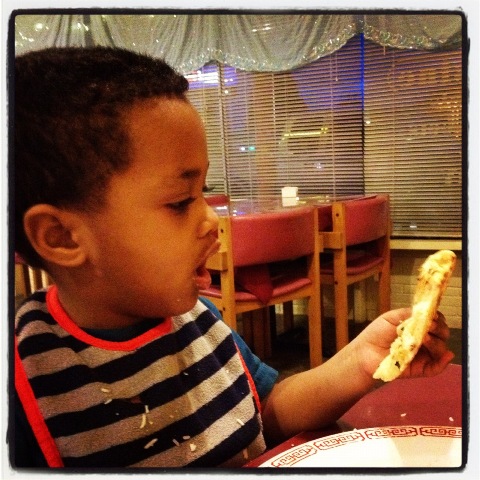
Sprout LOVED this book, which surprised me because it's a bit on the long side and more introspective than some of his favorites. But he asked for it over and over again, and was thrilled when my husband offered to take us all out for Indian food the other night. (Here he is, enjoying his own hot, hot roti - ok, naan bread, but it was hot and delicious too!)


Hot, Hot Roti for Dada-ji by F. Zia, published by Lee & Low
Ages 2-6
Source: Library
Sample: "What made the lad so strong? It was the hot, hot roti that sizzled and wizzled on Badi-ma's wood hearth. You see, baba, Badi-ma made the best roti around! Hungry villagers trampled tall fields and swam angry rivers to sniff the fluffy-puffy roti that bubbled and wobbled in ghee on the hot, hot tavva pan."
Recommended

Bonus: interview with F. Zia at The Happy Nappy Bookseller